(I want to thank Lane Hemaspaandra for bringing this to my attention.)
When I google:
google scholar William Gasarch
I get this
(I wonder if what you get depends on who you are- I describe below what I get.)
The first entry on it is
Methods of Mathematical Physics by Courant and Hilbert.
The first page page that Google brings up has all papers with Hilbert as a co-author except the book
Handbook of discrete and combinatorial mathematics edited by Rosen
I have a short article in that book.
The second page has the paper of Hilbert:
Uber die irreducible ganzer rationaler blah blah
which I have a connection to since Mark Villarino, Bill Gasarch, and Ken Regan have a paper explaining this paper in modern terms here. Could this have confused google scholar into thinking I am Hilbert? Seems unlikely.
In fact, the first two pages are all papers with Hilbert as an author. The third page has
Some connections between bounded query classes and non-uniform complexity by Amir, Beigel, Gasarch.
And after that the pages are a mix of Hilbert's papers and mine, though mostly his since he had so many more papers than I did.
This raises some questions
1) How did this happen? Did I hack google scholar? Many theorists at one time in their lives were excellent programmers- however, I am not one of them.
2) How common is it for google scholar to be this far wrong?
3) If I wanted to get this fixed who would I tell? In the past whenever I've tried to tell a company something FOR THEIR OWN GOOD I get the same run-around as when I am trying to get information not on their website, so I have STOPPED even trying. Same here?
4) Should I want to get it fixed? I am proud to be affiliated with Hilbert!
Tuesday, May 30, 2017


Thursday, May 25, 2017
Graduation from the Other Side

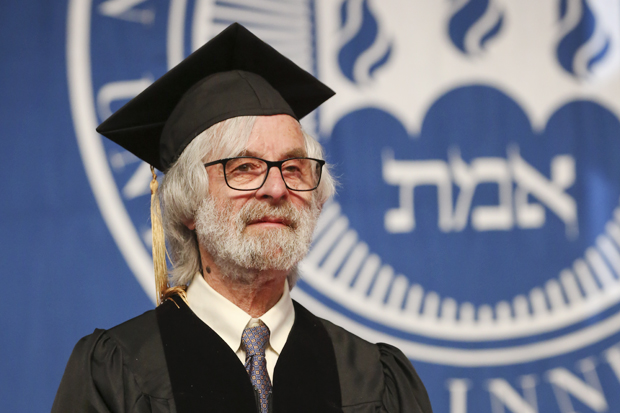
I've attended many graduations in my time, mostly as faculty, a couple of times as a student or a brother. This last weekend I attended my first university graduation as a parent as my daughter Annie graduated from Brandeis University in Waltham, Massachusetts. Brandeis has a big graduation ceremony with lots of speeches and then different departments or groups of departments have their own diploma ceremonies with their own speakers and where they give out the actual diplomas.
Brandeis gives out a number of honorary doctorates each year and for the first time gave one to a computer scientist, Turing Award Winner Leslie Lamport. Lamport received his PhD at Brandeis in math in 1972 before they had a CS deparment but now he has an (honorary) PhD in Computer Science. Lamport gave an eight-minute talk in the School of Science ceremony. But when you are a parent the weekend is about your child and my daughter didn't graduate from the school of science so I didn't see the Lamport talk.
In the main ceremony, Brandeis has not only an undergrad give a speech but also a grad student. Sounds like a crazy idea, but Vivekanand Vimal, Neuroscience PhD, gave what could be best described as a performance art. Since I can't find the video of Lamport and you probably don't want to see my videos of Annie, enjoy the new Dr. Vimal's ode to the craziness of the PhD and saving society.
Thursday, May 18, 2017
The Optimizers
In theoretical CS we often take NP-complete as a sign to stop searching for an efficient algorithm. Optimization people take NP-complete as a starting point, using powerful algorithmic ideas, clever heuristics and sheer computing power to solve or nearly optimize in many real-world cases.
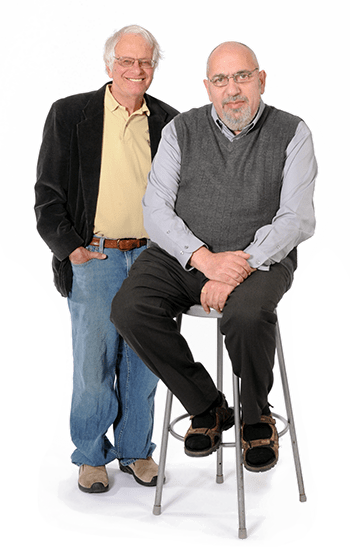
Bill Cook talked about his adventures with the traveling salesman problem. Check out his British pub crawl and his tour through the nearly 50,000 US historic sites.
Michael Trick talked about his side job, schedule MLB baseball games, a surprisingly challenging problem. Like TSP, you want to minimize total travel distance but under a wide variety of constraints. "There's something satisfying about being at a bar, seeing a game on the TV and knowing those two teams are playing because you scheduled them." Can't say I've had that kind of satisfaction in my computational complexity research.
Tuesday, May 16, 2017
If an ugrad asks `is field X worth studying' the answer is almost always yes
An undergraduate Freshman recently emailed me that he was very interested in Quantum Computing and wanted to know
1) Who on the fCS aculty works in QC (Answer: Andrew Childs though you should ask him about postdocs, grad students, and Physics faulty in the area.)
2) What are good books on QC for a bright ugrad. I said the following:
QC since Democritus by Aaronson
QC-A gentle introduction by Rieffel and Polak
QC for CS by Yanofsy and Mannucci
QC and QI by Nielsen and Chuang
Some of Scott's blog posts.
Ask Andrew Childs for more.
my webpage of book reviews for SIGACT NEWS here and search for Quantum to get some other books- read the reviews and pick one.
on Amazon type in quantum computing and see what reviews say- though they might not be reliable.
There are likely other good books but I do not know of them. (You can leave comments.)
3) Is QC a good topic to get into? I said YES of course. My reasoning is that they would of course LEARN something by studying it.
But this raises the question: When would I say `that field is not worth studying' ?
1) If they really want to do RESEARCH and the topic is either too dead or too hard and they want to actually do research (as opposed to learning the topic without wanting to to research).
2) If there was nobody around to help them in that topic. Might still be okay if they are both highly motivated and very smart.
3) If the topic was bogus AND they would learn NOTHING from studying it. Are there topics that are bogus but you still learn from studying them? Does studying astrology seriously teach you some astronomy? Some history? How about Alchemy and Chemistry? Fine if the students KNOWS that Astrology is bogus and Alchemy is not correct.
The points is that I really do not want to dampen someone's enthusiasm for a topic.
SO- aside from the reasons above, can you think of any other reason to discourage a student from a topic they are interested in? I ask, as always, non-rhetorically.
1) Who on the fCS aculty works in QC (Answer: Andrew Childs though you should ask him about postdocs, grad students, and Physics faulty in the area.)
2) What are good books on QC for a bright ugrad. I said the following:
QC since Democritus by Aaronson
QC-A gentle introduction by Rieffel and Polak
QC for CS by Yanofsy and Mannucci
QC and QI by Nielsen and Chuang
Some of Scott's blog posts.
Ask Andrew Childs for more.
my webpage of book reviews for SIGACT NEWS here and search for Quantum to get some other books- read the reviews and pick one.
on Amazon type in quantum computing and see what reviews say- though they might not be reliable.
There are likely other good books but I do not know of them. (You can leave comments.)
3) Is QC a good topic to get into? I said YES of course. My reasoning is that they would of course LEARN something by studying it.
But this raises the question: When would I say `that field is not worth studying' ?
1) If they really want to do RESEARCH and the topic is either too dead or too hard and they want to actually do research (as opposed to learning the topic without wanting to to research).
2) If there was nobody around to help them in that topic. Might still be okay if they are both highly motivated and very smart.
3) If the topic was bogus AND they would learn NOTHING from studying it. Are there topics that are bogus but you still learn from studying them? Does studying astrology seriously teach you some astronomy? Some history? How about Alchemy and Chemistry? Fine if the students KNOWS that Astrology is bogus and Alchemy is not correct.
The points is that I really do not want to dampen someone's enthusiasm for a topic.
SO- aside from the reasons above, can you think of any other reason to discourage a student from a topic they are interested in? I ask, as always, non-rhetorically.
Sunday, May 14, 2017
William Tutte (1917-2002)
 Today we celebrate our mothers of course, but also the 100th anniversary of the birth of Bill Tutte, best known for his role in decrypting the Lorenz cipher used by the Nazi high command. Tutte also made many important advances in graph theory and algorithms.
For this post, let's look at one very powerful concept, the Tutte Polynomial, with a rather technical looking definition. Fix a graph G with vertex set V and edge set E with n = |V|. For a subset A of E, let kA be the number of connected components of A and nA be the number of vertices of the vertices of G induced by A, and k=kE the number of connected components of G.
The Tutte polynomial T(x,y) is the sum over all subsets A of E of the quantity
(x-1)kA-k(y-1)KA+nA-n.
What makes this problem interesting? For some fixed values of x and y we get various properties of the graph.
T(2,1) is the number of forests of G.
T(1,2) number of spanning forests (or spanning trees if G is connected.
T(2,0) is the number of spanning subgraphs.
T(0,2) is the number of strongly connected orientations.
The value (-1)n-kqkT(1-q,0) counts the number of q-colorings of G.
Computing T can be difficult. Counting the number of 3-colorings is #P-complete, equivalent to counting the number of satisfying assignments of a Boolean formula. So even computing T(-2,0) for a given graph G is #P-complete. Leslie Goldberg and Mark Jerrum show that even computing the sign of a Tutte polynomial, just determining whether it is positive, zero or negative, on certain values is still #P-hard.
This is only a sampling of the many applications of the Tutte polynomial. Let's remember Tutte for creating a single function that captures so much information about a graph and helping to defeat the Nazis. Not a bad life. Must have had a good mother.
Computing T can be difficult. Counting the number of 3-colorings is #P-complete, equivalent to counting the number of satisfying assignments of a Boolean formula. So even computing T(-2,0) for a given graph G is #P-complete. Leslie Goldberg and Mark Jerrum show that even computing the sign of a Tutte polynomial, just determining whether it is positive, zero or negative, on certain values is still #P-hard.
This is only a sampling of the many applications of the Tutte polynomial. Let's remember Tutte for creating a single function that captures so much information about a graph and helping to defeat the Nazis. Not a bad life. Must have had a good mother.
Thursday, May 11, 2017
How to Solve It
Today a guest post from Periklis Papakonstantinou, coincidentally not unrelated to Bill's post earlier this week. I'll be back with a special post on Sunday.
I'm teaching in an undergrad program that is half computer science and half business at Rutgers, but the CS part taught there is the real thing (I assume for Business too). This term I taught a very theoretical course in cryptography and I realized that (1) the students enjoyed it and (2) that they were lacking basic reasoning skills. I ended up teaching for a few weeks how one can structure basic logic arguments. I am not sure if they appreciated things like the hybrid argument but I believe I convinced them that without rigorous thinking one cannot think clearly.
So, I decided to teach a much more fun class (hopefully next year) titled "How to solve it" -- à la Pólya. The goal is students to develop rigorous problem-solving skills. At the same time, I'd like to use this course as an excuse to introduce basic concepts in combinatorics, linear algebra, and theoretical stats. I'm not sure whether the original book by Polya is appropriate for this and that's why I thought of reaching out to my peers for suggestions. Any ideas and thoughts on possible texts, topics, or notes would be greatly appreciated.
I'm teaching in an undergrad program that is half computer science and half business at Rutgers, but the CS part taught there is the real thing (I assume for Business too). This term I taught a very theoretical course in cryptography and I realized that (1) the students enjoyed it and (2) that they were lacking basic reasoning skills. I ended up teaching for a few weeks how one can structure basic logic arguments. I am not sure if they appreciated things like the hybrid argument but I believe I convinced them that without rigorous thinking one cannot think clearly.
So, I decided to teach a much more fun class (hopefully next year) titled "How to solve it" -- à la Pólya. The goal is students to develop rigorous problem-solving skills. At the same time, I'd like to use this course as an excuse to introduce basic concepts in combinatorics, linear algebra, and theoretical stats. I'm not sure whether the original book by Polya is appropriate for this and that's why I thought of reaching out to my peers for suggestions. Any ideas and thoughts on possible texts, topics, or notes would be greatly appreciated.
Sunday, May 07, 2017
Students try to memorize rather than understand! Who knew! (everyone)
Discrete Math. Required for CS majors, taken mostly by Sophmores. Goal is to teach them how to think rigorously. Topics are logic, number theory (not much), induction, sets, functions, relations, combinatorics (includes Pigeon hole prin, henceoforth PNP), prob, countability, uncountability.
We taught the Pigeon Hole Principle and gave MANY examples and HW of the following type:
Let A be a subset of {1,...,50} of size 10. Show there are two subsets of A that have the same sum.
ANSWER: There are 2^{10} = 1024 possible subsets.
MAXSUM is 41+..+50 = (1+...+ 50 )-(1 +...+ 40) = 50*51/2 - 40*41/2 = 455
MINSUM is 0 (the empty set). So the NUMBER OF SUMS is 456
Since 1024 > 456 there are two subsets of A of the same size.
The EXAM covered PHP, combs, prob, and induction. Hence they should know n choose k
On the HW and in class we NEVER did a problem where we only cared about the subsets of a fixed size. Conceptually this is really the same problem but if you had MEMORIZED the proof template and tried to apply it you would get it wrong.
I asked the following on the exam: which was worth 20 points.
(20 points) Let A be a subset of {1,...,21} of size 8. Show that A has at least two subsets of size 3 which have the same sum.
ANSWER: There are (8 choose 3) = 56 subsets of A of size 3.
MAXSUM = 19+20+21 = 60, MINSUM = 1+2+ 3 = 6,
So the NUMBER OF SUMS is 60-5 = 55.
Since 56> 55 there are two subsets of A of size 3 that have the same size.
Grading rubric:
If they got (8 choose 3) thats 3 points.(Many said 2^8- I suspect incorrect memorization)
If they got the MAXSUM and the MINSUM both right (aritj errors- NO penalty) then 3 points
(Many had MINSUM=0- I suspect incorrect memorization).
If they knew to use these PHP then 3 points.
If they got all three right then 20 points
So they got 0,3,6, or 20.
Here is the final tally:
0 points: 85
3 points: 190
6 points: 71
20 points: 167
(For the entire exam: 39 100's, 55 90-99, 77 80-89, 77 70-79, 76 60-69, 70 50-59, 47 40-49, 24 30-39, 24 30-39, 17 20-29, 3 10-19, 3 1-9)
This all raises the much harder question- how can we get students to UNDERSTAND rather than MEMORIZE
Telling them: DO NOT MEMORIZE! TRY TO UNDERSTAND!- I did this. Oh well.
Allowing a cheat sheet (which I did) is both good and bad for this issue.
Giving them a much wider variety of problems of this type. Either they would understand OR they would memorize several different templates.
I WELCOME your thoughts on either my grading or on how to get them to try to UNDERSTAND rather than MEMORIZE.
Thursday, May 04, 2017
Summer Conferences
Ahh summer. No Classes. Baseball. Opera Festivals. Time to focus on research and starting a new book. But, of course, many computer scientists travel the world to various conferences. I went to too many last year and trying to cut down but many great options abound.
The STOC 2017 Theory Fest, June 19-23 in Montreal, five days of conference talks, tutorials, invited lectures and so much more. Sanjeev Arora has the details over at Windows on Theory.
The ACM celebrates 50 years of Turing Awards with a special conference June 23-24 in San Francisco. Tim Berners-Lee takes home this year's prize.
The Computational Complexity Conference, that meeting that shares its domain with this blog, holds its annual get together July 6-9 for the first time in Latvia. Latvia gave us Juris Hartmanis, one of the founders of the field. Travel grants available for students and "needy researchers", you don't have to be an author to apply.
Computability in Europe, June 12-16 in Turku, Finland. Economics and Computation, June 26-30 at MIT. Computational Geometry, July 4-7 in Brisbane. ICALP, July 10-14 in Warsaw. Random/Approx, August 16-18 in Berkeley.
If I missed your favorite events, well that's why we have comments.
The STOC 2017 Theory Fest, June 19-23 in Montreal, five days of conference talks, tutorials, invited lectures and so much more. Sanjeev Arora has the details over at Windows on Theory.
The ACM celebrates 50 years of Turing Awards with a special conference June 23-24 in San Francisco. Tim Berners-Lee takes home this year's prize.
The Computational Complexity Conference, that meeting that shares its domain with this blog, holds its annual get together July 6-9 for the first time in Latvia. Latvia gave us Juris Hartmanis, one of the founders of the field. Travel grants available for students and "needy researchers", you don't have to be an author to apply.
Computability in Europe, June 12-16 in Turku, Finland. Economics and Computation, June 26-30 at MIT. Computational Geometry, July 4-7 in Brisbane. ICALP, July 10-14 in Warsaw. Random/Approx, August 16-18 in Berkeley.
If I missed your favorite events, well that's why we have comments.
Monday, May 01, 2017
A Celebration of Computer Science at Harvard in Honor of Harry Lewis's 70th Bday
My adviser Harry Lewis turned 70 recently. I blogged about how things have changed since I got my Phd in this post. I now post on
A celebration of Computer Science at Harvard in Honor of Harry Lewis's 70th Birthday
(for video of all talks in order see: here)
The title was accurate: most of the speakers (1) were Harvard ugrads, (2) went on to do great things, and (3) Harry Lewis had inspired them. The talks were mostly non-technical and fun!
went on to do great things. Margo Seltzer, a prof at Harvard now (who I TAed many years ago in Aut Theory) orgnaized the event, though she gave lots of credit to her helpers.
0) Marty Chavez was one of Harry Lewis's teaching assistants for a CS programming course and recalled Harry's harsh (but fair) grading polices on code which he later saw the wisdom of.
1) Marty Chavez never thought he would use that HALT is undecidable (I think I might have been his TA for that course). But he found himself telling an egghead of economists who wanted to VERIFY all code to avoid future crashes that... Can't be done. Actually, while that is true, attempts to verify some of it might be a good idea.
2) James Gwertzman noted that:
in 1991 10% of all ugrads at Harvard had email, and there was no web
in 1995 100%of all ugrads at Harvard had email, and there was web (though primitive).
He then pointed out that a company can do very well by using LOTS of packages that are already out there to use. He named #slack, salesforce, trello, jeaking, mailchip, greenhouse, phabricator, pingdom (just deals with pings- really!), datadog, strips, statuspage, zendeski.
The future will be serverless and codeless.
4) Guy Steele gave the most technical talk and it was, as the kids say, awesome (do adults still say `as the kids say' ?) Here is a version of the talk:
A Logial Concern
Its about how papers at POPL and some other conference have been informally using a language to specify protocols and by now its all bent out of shape. There is also some nice history of math embedded in the talk of which I'll say one thing: one way to group terms together is by placing a bar over them. The most common use of this now is the squareroot sign which didn't always have that bar over the quantity.
Guy's talk even had some slides about his notebooks from Harvard, from a course Harry taughtback in 1974 (the first course Harry taught at Harvard). Part of the course was on the sequent calculus which relates to Guys work and the current paper. Guy's notebook had both material relevent to the current paper and doodles of things like a picture of a Church next to Church's thesis.
The paper was very labor intensive since you can't just use a search program to search for some of the notations he was talking about. For example overbar and underbar. So he had to go through ALL of the POPL proceedings (and a few others) by hand. In 2017. Will that ever be easier?
He also had a two quotes about proofs:
Its not enough to prove something. You must seduce people into believing it
One man's truth is another man's cold broccoli
I leave it to you to figure out who these quotes are credited to (different people).
5) Stuart Shieber's talk was WWHD (What Would Harry Do).
Care
Promote Character over knowledge (see Harry's book Excellence without a soul- How a great university forgot education)
Pursue the right over the popular
A late talk by Rebecca Nessin told of some things Harry did as Dean that were RIGHT but NOT POPULAR:
The housing at Harvard used to be you chose the house (dorm complex) you lived in. When I was there Dunster was KNOWN to be the Math-house, and others had other reputations that were somewhat accurate. Harry made housing RANDOMIZED (did he use a hardness result to derive a pseudo random generation?) His goal was to increase diversity- people should get to know other kinds of people that are not like themselves.
He made polices do curb underage drinking.
He raised standards for when students get WARNINGS about their performance in classes.
These were all unpopular BUT the right thing to do.
6) There was a panel discussion on teaching. I'll save this for a later blog post since my random thoughts on this may make this post longer than it should be. I WILL say it was excellent.
7) Rebecca Nessin is the head online course development at Harvard. The courses are (1) open enrollment (2) No faculty- all are borrowed from the usual faculty, (3) some courses are online. She developed a course where the students ARE avatars. Helps with shy students. And text based conversation allows students to get out coherent complete thoughts (CONTRAST- I find myself saying to my students questions ``that was a random sequence of math words'')
That was the first part of her talk.
THEN she began talking about her journey through Harvard and Harry's place in it. Unlike her fellow students she did not what she wanted to do. She took random courses (ancient greek! Multivar calc!) After graduating she still did not know what she wanted to do so she went to... Harvard Law School. While there she took a CS course (what! You can do that?) and soon after had Aut Theory with Harry. Her PhD was with Stuart Shieber with Harry on the committee and lots of Grammars in it.
Then she told a great story: There was a discussion of raising the min age that someone can get an ugrad degree at the Harvard extension school. Harry asked who this would affect. The answer was
A small number. Students who can't go to a residential full time school for some reason. This includes competitive athletes, performance artists, deployed military personal, youthful entrepreneurs, and people with disabilities.
to which Harry replied:
These are the oddballs. Are we trying to say there is no room for oddballs at Harvard?
Rebecca ended her talk by pointing out that with her crooked path to where she is now she is an oddball and
that all of the oddballs should celebrate that they will also have a place at at Harry Lewis's Harvard.
8) Cliff Young declared Moore's Law Dead (some disagree- see here) - and the solution is to go back to special purpose machines- which, contrary to popular belief, Do NOT just do one thing and
ARE programmable, He also talked about Amdahl's law which is about the limits of parallelism and about how parallelism research seems to fight the same battle over and over again (RISC vs CISC,
SIMD vs MIMD, and VLIW)
9) Danielle Feinberg from Pixar had the following quote about animation:
Long hair is an unsolved problem
But they did solve it (for the movie The Incredibles). She also pointed out that they can sometimes spend lots of time and energy and creativity on a scene that will take 3 second, or on something just in the background.
Much like Rebecca, Danielle also appreciated Harrys appreciating for oddballs.
10) Harry Lewis- He spoke some about his career but also about CS in general.
His career and where his now is sort-of an accident. He was originally going to get his PhD in Systems but Theorists got out faster.
Computer Science has changed a lot in the last X years- but the change he remarked on the most is that it CS is at
The twilight of the Amateur Era
I'll let you debate what that means.
11) Later at the reception Bill Gates and Mark Zuckerberg send their recorded greetings, though only Mark Z's is on the you tube video- towards the end. Its short so rather than summarize it- I urge to to view it yourself.
A celebration of Computer Science at Harvard in Honor of Harry Lewis's 70th Birthday
(for video of all talks in order see: here)
The title was accurate: most of the speakers (1) were Harvard ugrads, (2) went on to do great things, and (3) Harry Lewis had inspired them. The talks were mostly non-technical and fun!
went on to do great things. Margo Seltzer, a prof at Harvard now (who I TAed many years ago in Aut Theory) orgnaized the event, though she gave lots of credit to her helpers.
0) Marty Chavez was one of Harry Lewis's teaching assistants for a CS programming course and recalled Harry's harsh (but fair) grading polices on code which he later saw the wisdom of.
1) Marty Chavez never thought he would use that HALT is undecidable (I think I might have been his TA for that course). But he found himself telling an egghead of economists who wanted to VERIFY all code to avoid future crashes that... Can't be done. Actually, while that is true, attempts to verify some of it might be a good idea.
2) James Gwertzman noted that:
in 1991 10% of all ugrads at Harvard had email, and there was no web
in 1995 100%of all ugrads at Harvard had email, and there was web (though primitive).
He then pointed out that a company can do very well by using LOTS of packages that are already out there to use. He named #slack, salesforce, trello, jeaking, mailchip, greenhouse, phabricator, pingdom (just deals with pings- really!), datadog, strips, statuspage, zendeski.
The future will be serverless and codeless.
4) Guy Steele gave the most technical talk and it was, as the kids say, awesome (do adults still say `as the kids say' ?) Here is a version of the talk:
A Logial Concern
Its about how papers at POPL and some other conference have been informally using a language to specify protocols and by now its all bent out of shape. There is also some nice history of math embedded in the talk of which I'll say one thing: one way to group terms together is by placing a bar over them. The most common use of this now is the squareroot sign which didn't always have that bar over the quantity.
Guy's talk even had some slides about his notebooks from Harvard, from a course Harry taughtback in 1974 (the first course Harry taught at Harvard). Part of the course was on the sequent calculus which relates to Guys work and the current paper. Guy's notebook had both material relevent to the current paper and doodles of things like a picture of a Church next to Church's thesis.
The paper was very labor intensive since you can't just use a search program to search for some of the notations he was talking about. For example overbar and underbar. So he had to go through ALL of the POPL proceedings (and a few others) by hand. In 2017. Will that ever be easier?
He also had a two quotes about proofs:
Its not enough to prove something. You must seduce people into believing it
One man's truth is another man's cold broccoli
I leave it to you to figure out who these quotes are credited to (different people).
5) Stuart Shieber's talk was WWHD (What Would Harry Do).
Care
Promote Character over knowledge (see Harry's book Excellence without a soul- How a great university forgot education)
Pursue the right over the popular
A late talk by Rebecca Nessin told of some things Harry did as Dean that were RIGHT but NOT POPULAR:
The housing at Harvard used to be you chose the house (dorm complex) you lived in. When I was there Dunster was KNOWN to be the Math-house, and others had other reputations that were somewhat accurate. Harry made housing RANDOMIZED (did he use a hardness result to derive a pseudo random generation?) His goal was to increase diversity- people should get to know other kinds of people that are not like themselves.
He made polices do curb underage drinking.
He raised standards for when students get WARNINGS about their performance in classes.
These were all unpopular BUT the right thing to do.
6) There was a panel discussion on teaching. I'll save this for a later blog post since my random thoughts on this may make this post longer than it should be. I WILL say it was excellent.
7) Rebecca Nessin is the head online course development at Harvard. The courses are (1) open enrollment (2) No faculty- all are borrowed from the usual faculty, (3) some courses are online. She developed a course where the students ARE avatars. Helps with shy students. And text based conversation allows students to get out coherent complete thoughts (CONTRAST- I find myself saying to my students questions ``that was a random sequence of math words'')
That was the first part of her talk.
THEN she began talking about her journey through Harvard and Harry's place in it. Unlike her fellow students she did not what she wanted to do. She took random courses (ancient greek! Multivar calc!) After graduating she still did not know what she wanted to do so she went to... Harvard Law School. While there she took a CS course (what! You can do that?) and soon after had Aut Theory with Harry. Her PhD was with Stuart Shieber with Harry on the committee and lots of Grammars in it.
Then she told a great story: There was a discussion of raising the min age that someone can get an ugrad degree at the Harvard extension school. Harry asked who this would affect. The answer was
A small number. Students who can't go to a residential full time school for some reason. This includes competitive athletes, performance artists, deployed military personal, youthful entrepreneurs, and people with disabilities.
to which Harry replied:
These are the oddballs. Are we trying to say there is no room for oddballs at Harvard?
Rebecca ended her talk by pointing out that with her crooked path to where she is now she is an oddball and
that all of the oddballs should celebrate that they will also have a place at at Harry Lewis's Harvard.
8) Cliff Young declared Moore's Law Dead (some disagree- see here) - and the solution is to go back to special purpose machines- which, contrary to popular belief, Do NOT just do one thing and
ARE programmable, He also talked about Amdahl's law which is about the limits of parallelism and about how parallelism research seems to fight the same battle over and over again (RISC vs CISC,
SIMD vs MIMD, and VLIW)
9) Danielle Feinberg from Pixar had the following quote about animation:
Long hair is an unsolved problem
But they did solve it (for the movie The Incredibles). She also pointed out that they can sometimes spend lots of time and energy and creativity on a scene that will take 3 second, or on something just in the background.
Much like Rebecca, Danielle also appreciated Harrys appreciating for oddballs.
10) Harry Lewis- He spoke some about his career but also about CS in general.
His career and where his now is sort-of an accident. He was originally going to get his PhD in Systems but Theorists got out faster.
Computer Science has changed a lot in the last X years- but the change he remarked on the most is that it CS is at
The twilight of the Amateur Era
I'll let you debate what that means.
11) Later at the reception Bill Gates and Mark Zuckerberg send their recorded greetings, though only Mark Z's is on the you tube video- towards the end. Its short so rather than summarize it- I urge to to view it yourself.
Thursday, April 27, 2017
So Was I

Most of the marchers I saw did not come from the ranks of academia or professional scientists. Rather people from all walks of life who believe in the important role science and scientists have in shaping our future. Parents dragged their kids. Kids dragged their parents.
There have been some worry about politicizing science and whether the march would be a bad idea. The march won't have much effect on policy positively or negatively. But we mustn't forget that scientists need to deal with politics, as long as the government continues its missions of funding science and using proper science to help guide policies that require understanding of the world.
If there's one positive sign of a Trump presidency, as Molly explained to me, it's inspiring a generation. We would not have had a March for Science if Trump wasn't president, but what an wonderful movement and we should march every year around Earth Day no matter who sits in the oval office.
Monday, April 24, 2017
I was at the March for Science on Saturday
(Will blog on Harry Lewis's 70th Bday next week-- Today's post is more time sensitive.)
I was on the March for Science on April 22. Here are some Kolmogorov random comments
1) Why should I go to it? One less person there would not have matters. AH- but if they all think that then nobody goes. The Classic Voting Paradox- why vote if the chance that your vote matters is so small (even less so in my state- Maryland is one of the Bluest States). In the case of the March For Science there is another factor- since I live in Maryland I really CAN go at minimal effort. Most of the readers of this blog cannot (Though there were some other marches in other cities. Scott was at a March in Austin Texas.)
2) One of the speakers said something like `and the fact that you are all here in the rain shows how much you believe in our cause!' While the rain might have made our being there more impressive, I wish it had been better weather.
3) Here are some of the Signs I saw:
What do we Want!
Empirical Based Science!
When do we Want it!
After Peer Review!
Trump- where's your PhD? Trump University?
(This one is not fair- most presidents have not been scientists and have funded science. Trump himself not have a PhD is not relevant here.)
A sign had in a circle: pi, sqrt(2) and Trump and said: These are all irrational.
A 6-year old had a sign: Light travels faster than sound which is why Trump looks bright until he talks (I think her mother, who was there, made it for her).
Science is the Solution (with a picture of a chemical Flask)
If you are not part of the solution you are part of the precipitate
Truth is sometimes inconvenient.
So severe even the nerds are here
I can't believe I'm marching for facts!
There is no planet B (this refers to if Global Warming kills the planet we can't go elsewhere- a play off of `Plan B')
I'm with her (pointing to the earth) (The person with this sign told me she used the same sign for the Women's March- so recycling!)
Science has no borders
Science doesn't care what you think.
Its not Rocket Science- well, some of it is.
4) The March For Science was the same day as Earth Day and many of the talks mentioned global warming and pollution. Many of the talks mentioned the contributions of women and minorities. One of the speakers was transgender .Hence the March had a liberal slant. BUT- if believing in Global Warming and wanting to open science up to all people (e.g., women and minorities) are Liberal positions, this speaks very badly of conservatives. First ACCEPT that Global Warming is TRUE- then one can debate what to do about it--and that debate could be a constructive political debate. One talk was about Indigenous Science-- I can't tell if its a healthy alternative view or ... not.
A more telling point about the march having a liberal slant is the OMISSION of the following topics:
Technology has
(a) helped Oil people extract more oil, and fracking to be cost effective
(b) GMO's have helped feed the world and have had no ill effects (I think anti-GMO in America is a fringe view-- I don't know of any elected democrat who is anti-GMO, though I could be wrong. I think its a more mainstream view in Europe.)
(c) make the weapons that keep us safe (that's a positive spin on it)
(d) DNA used to prove people GUILTY (they did mention DNA used to prove people INNOCENT).
So the March LOOKED like it was a bunch of Liberal Scientists. Does this make it less effective and easy for Trump and others to dismiss? Or are we so far past any hope of intelligent conversation that it doesn't matter?
5) Many of the machers, including Darling and me, had lunch at the Ronald Reagan Center. Is this an IRONY?
NO: Reagan funded the NSF as well as other presidents, see this blog post of Lance's from 2004. That post is interesting for other reasons: at the time Dems and Reps seemed to both RESPECT science. Trump may be the first one not to- though its early in his term so we'll see how it all pans out. Second, Lance has been blogging for a LONG time! (since 2003, and me since 2007).
YES: See these quotes by the Gipper (ask your grandparents why Reagan is called that):here
6) Will it have any effect? Short term I doubt it, Long term probably yes. An article about the impact of the the Women's March: here
7) There have been Women's Marches, The Million Man March, Civil Rights Marchs, pro-life, pro-choice, anti-war, pro-gay, anti-gay marches before. Has there ever been a March for Science before? Has there ever been a need before? I don't think so but I am asking non-rhetorically.
Cutting EPA because you don't believe in Global warming is appalling, (see here) but I understand politically where that comes from.
Not allowing funding of gun violence because you are pro-gun is appalling, (see here) but I understand politically where that comes from.
IF they cut funding on the study of evolution (Have republican presidents done that?) then that would be appalling but I would understand politically where it came from.
But cutting the NIH (see here) or the NSF (has he done that yet or is he just thinking of doing that?) I really DON"T understand- It does not even fit into the Republican Philosophy.
There should NOT be a NEED for a MARCH FOR SCIENCE, Or, to quote one of the signs
I can't believe I"m marching for facts!
I was on the March for Science on April 22. Here are some Kolmogorov random comments
1) Why should I go to it? One less person there would not have matters. AH- but if they all think that then nobody goes. The Classic Voting Paradox- why vote if the chance that your vote matters is so small (even less so in my state- Maryland is one of the Bluest States). In the case of the March For Science there is another factor- since I live in Maryland I really CAN go at minimal effort. Most of the readers of this blog cannot (Though there were some other marches in other cities. Scott was at a March in Austin Texas.)
2) One of the speakers said something like `and the fact that you are all here in the rain shows how much you believe in our cause!' While the rain might have made our being there more impressive, I wish it had been better weather.
3) Here are some of the Signs I saw:
What do we Want!
Empirical Based Science!
When do we Want it!
After Peer Review!
Trump- where's your PhD? Trump University?
(This one is not fair- most presidents have not been scientists and have funded science. Trump himself not have a PhD is not relevant here.)
A sign had in a circle: pi, sqrt(2) and Trump and said: These are all irrational.
A 6-year old had a sign: Light travels faster than sound which is why Trump looks bright until he talks (I think her mother, who was there, made it for her).
Science is the Solution (with a picture of a chemical Flask)
If you are not part of the solution you are part of the precipitate
Truth is sometimes inconvenient.
So severe even the nerds are here
I can't believe I'm marching for facts!
There is no planet B (this refers to if Global Warming kills the planet we can't go elsewhere- a play off of `Plan B')
I'm with her (pointing to the earth) (The person with this sign told me she used the same sign for the Women's March- so recycling!)
Science has no borders
Science doesn't care what you think.
Its not Rocket Science- well, some of it is.
4) The March For Science was the same day as Earth Day and many of the talks mentioned global warming and pollution. Many of the talks mentioned the contributions of women and minorities. One of the speakers was transgender .Hence the March had a liberal slant. BUT- if believing in Global Warming and wanting to open science up to all people (e.g., women and minorities) are Liberal positions, this speaks very badly of conservatives. First ACCEPT that Global Warming is TRUE- then one can debate what to do about it--and that debate could be a constructive political debate. One talk was about Indigenous Science-- I can't tell if its a healthy alternative view or ... not.
A more telling point about the march having a liberal slant is the OMISSION of the following topics:
Technology has
(a) helped Oil people extract more oil, and fracking to be cost effective
(b) GMO's have helped feed the world and have had no ill effects (I think anti-GMO in America is a fringe view-- I don't know of any elected democrat who is anti-GMO, though I could be wrong. I think its a more mainstream view in Europe.)
(c) make the weapons that keep us safe (that's a positive spin on it)
(d) DNA used to prove people GUILTY (they did mention DNA used to prove people INNOCENT).
So the March LOOKED like it was a bunch of Liberal Scientists. Does this make it less effective and easy for Trump and others to dismiss? Or are we so far past any hope of intelligent conversation that it doesn't matter?
5) Many of the machers, including Darling and me, had lunch at the Ronald Reagan Center. Is this an IRONY?
NO: Reagan funded the NSF as well as other presidents, see this blog post of Lance's from 2004. That post is interesting for other reasons: at the time Dems and Reps seemed to both RESPECT science. Trump may be the first one not to- though its early in his term so we'll see how it all pans out. Second, Lance has been blogging for a LONG time! (since 2003, and me since 2007).
YES: See these quotes by the Gipper (ask your grandparents why Reagan is called that):here
6) Will it have any effect? Short term I doubt it, Long term probably yes. An article about the impact of the the Women's March: here
7) There have been Women's Marches, The Million Man March, Civil Rights Marchs, pro-life, pro-choice, anti-war, pro-gay, anti-gay marches before. Has there ever been a March for Science before? Has there ever been a need before? I don't think so but I am asking non-rhetorically.
Cutting EPA because you don't believe in Global warming is appalling, (see here) but I understand politically where that comes from.
Not allowing funding of gun violence because you are pro-gun is appalling, (see here) but I understand politically where that comes from.
IF they cut funding on the study of evolution (Have republican presidents done that?) then that would be appalling but I would understand politically where it came from.
But cutting the NIH (see here) or the NSF (has he done that yet or is he just thinking of doing that?) I really DON"T understand- It does not even fit into the Republican Philosophy.
There should NOT be a NEED for a MARCH FOR SCIENCE, Or, to quote one of the signs
I can't believe I"m marching for facts!
Thursday, April 20, 2017
Will talk about Harry Lewis 70th bday conference later but for now- that was then/this is now
On Wed April 19 I was at the Harry Lewis 70th birthday celebration!
I will blog on that later.
Harry Lewis was my thesis adviser. Odd to use the past tense- I DID finish my thesis with him
and so he IS my adviser? Anyway, I will do a blog about the celebration next week.
This week I ponder- what was different then and now (I got my PhD in 1985).
False predictions that I made in 1985:
1) CS depts all have different views of what a CS major should know. By the year 2017 they will have figured out EVERY CS MAJOR SHOULD KNOW XXX and I will still write questions for the CS GRE. DID NOT HAPPEN. And a MINOR source of income for me has been cut off.
2) CS will be about 45% or more female. After all, the old guard is dying, its a new field without a tradition of sexism (this may have been false even then). Actually Women in CS has DECLINED since 1985. I'm still surprised since people in computing tend to be progressive. One could do several blog posts on this, but lacking the expertise I won't. (Gee bill- since when has lacking expertise stopped you before :-)
3) There will be some progress on P vs NP. Maybe an n^2 lower bound on SAT. Saying we've made NO progress is perhaps pessimistic, but we haven't made much.
4) in 2017 when Jet Blue emails me `CLICK HERE TO PRINT YOUR BOARDING PASS' the previous night then it will always work, and if it doesn't then I can call them and after 9 minutes on hold (not too bad) be able to fix the problem. They were not able to, though at the airport they fixed it and got me onto the plane fast as compensation.
OTHER CHANGES
1) Theory was more centralized. STOC and FOCS were the only prestige conferences, and everyone went to them.
2) A grad student could get a PhD and only have 2 papers published and get a Tenure Track Job.
3) One could learn all that was known in complexity theory in about two years.
4) You didn't have to do ugrad research to get into grad school (I don't think you HAVE TO now either, but many more do it so I PREDICT in the future you'll have to. Though my other predictions were not correct so .... there's that)
5) Complexity was more based in Logic then Combinatorics.
6) Complexity theory was easier! Gee, when did it get so hard and use so much hard math!
7) It seemed feasible that P vs NP would be solved within twenty years. I've heard it said that the Graph Minor Theorem was when P lost its innocence- there were now problems in P that used VERY HARD math--- techniques that were hard to pin down and hence hard to show would not work.
8) The number of complexity classes was reasonable. (I don't count Sigma_i as an infinite number of classes)
9) Grad students were just beginning to NOT learn the Blum Speed Up Theorem. It would take a while before they began to NOT learn finite injury priority arguments in recursion theory. OH- speaking of which...
10) Computability theory was called recursion theory.
11) Some schools had this odd idea that in FRESHMAN programming one should teach proofs of program correctness.
12) Some schools (SUNY Stonybrook and Harvard were among them) did not have a discrete math course. Hence the course in automata theory spend some of its time teaching how to prove things. (Both schools now have such a course. For Maryland I don't recall- either it didn't have one and I invented it OR it did have one and I revamped it.)
13) No Web. You had to go to a library to copy papers on a copier (Ask your grandparents what a copier is)
14) Copying cost far less than printing.
15) Someone who looked good on paper for MATH but had no real CS background could get into Harvard Applied science department for grad school and get a degree in ... speaking of which
16) In 1980 Harvard did not have a CS dept. So my Masters degree is formally in Applied Math, though I don't recall solving partial diff equations or other things that one associates with applied math. Sometime when I was there CS became officially something so I got my PhD in CS. (My students are surprised to hear this-- they think I got my PhD in Math.)
17) Harry Lewis had a moustache and smoked a pipe. He has shaved off one and gave up the other.
SO, what to make of this list? ONE THING- I DO NOT `yearn for the good old days' That was then, this is now. I am GLAD about everything on the list EXCEPT two area where NOT ENOUGH change has happened- (a) I wish there was more diversity in CS, and (b) I wish Jet Blue had better software for boarding passes.
I will blog on that later.
Harry Lewis was my thesis adviser. Odd to use the past tense- I DID finish my thesis with him
and so he IS my adviser? Anyway, I will do a blog about the celebration next week.
This week I ponder- what was different then and now (I got my PhD in 1985).
False predictions that I made in 1985:
1) CS depts all have different views of what a CS major should know. By the year 2017 they will have figured out EVERY CS MAJOR SHOULD KNOW XXX and I will still write questions for the CS GRE. DID NOT HAPPEN. And a MINOR source of income for me has been cut off.
2) CS will be about 45% or more female. After all, the old guard is dying, its a new field without a tradition of sexism (this may have been false even then). Actually Women in CS has DECLINED since 1985. I'm still surprised since people in computing tend to be progressive. One could do several blog posts on this, but lacking the expertise I won't. (Gee bill- since when has lacking expertise stopped you before :-)
3) There will be some progress on P vs NP. Maybe an n^2 lower bound on SAT. Saying we've made NO progress is perhaps pessimistic, but we haven't made much.
4) in 2017 when Jet Blue emails me `CLICK HERE TO PRINT YOUR BOARDING PASS' the previous night then it will always work, and if it doesn't then I can call them and after 9 minutes on hold (not too bad) be able to fix the problem. They were not able to, though at the airport they fixed it and got me onto the plane fast as compensation.
OTHER CHANGES
1) Theory was more centralized. STOC and FOCS were the only prestige conferences, and everyone went to them.
2) A grad student could get a PhD and only have 2 papers published and get a Tenure Track Job.
3) One could learn all that was known in complexity theory in about two years.
4) You didn't have to do ugrad research to get into grad school (I don't think you HAVE TO now either, but many more do it so I PREDICT in the future you'll have to. Though my other predictions were not correct so .... there's that)
5) Complexity was more based in Logic then Combinatorics.
6) Complexity theory was easier! Gee, when did it get so hard and use so much hard math!
7) It seemed feasible that P vs NP would be solved within twenty years. I've heard it said that the Graph Minor Theorem was when P lost its innocence- there were now problems in P that used VERY HARD math--- techniques that were hard to pin down and hence hard to show would not work.
8) The number of complexity classes was reasonable. (I don't count Sigma_i as an infinite number of classes)
9) Grad students were just beginning to NOT learn the Blum Speed Up Theorem. It would take a while before they began to NOT learn finite injury priority arguments in recursion theory. OH- speaking of which...
10) Computability theory was called recursion theory.
11) Some schools had this odd idea that in FRESHMAN programming one should teach proofs of program correctness.
12) Some schools (SUNY Stonybrook and Harvard were among them) did not have a discrete math course. Hence the course in automata theory spend some of its time teaching how to prove things. (Both schools now have such a course. For Maryland I don't recall- either it didn't have one and I invented it OR it did have one and I revamped it.)
13) No Web. You had to go to a library to copy papers on a copier (Ask your grandparents what a copier is)
14) Copying cost far less than printing.
15) Someone who looked good on paper for MATH but had no real CS background could get into Harvard Applied science department for grad school and get a degree in ... speaking of which
16) In 1980 Harvard did not have a CS dept. So my Masters degree is formally in Applied Math, though I don't recall solving partial diff equations or other things that one associates with applied math. Sometime when I was there CS became officially something so I got my PhD in CS. (My students are surprised to hear this-- they think I got my PhD in Math.)
17) Harry Lewis had a moustache and smoked a pipe. He has shaved off one and gave up the other.
SO, what to make of this list? ONE THING- I DO NOT `yearn for the good old days' That was then, this is now. I am GLAD about everything on the list EXCEPT two area where NOT ENOUGH change has happened- (a) I wish there was more diversity in CS, and (b) I wish Jet Blue had better software for boarding passes.
Monday, April 17, 2017
Understanding Machine Learning
Today Georgia Tech had the launch event for our new Machine Learning Center. A panel discussion talked about different challenges in machine learning across the whole university but one common theme emerged: Many machine learning algorithms seem to work very well but we don't know why. If you look at a neural net (basically a weighted circuit of threshold gates) trained for say voice recognition, it's very hard to understand why it makes the choices it makes. Obfuscation at its finest.
Why should we care? A few reasons:
Why should we care? A few reasons:
- Trust: How do we know that the neural net is acting correctly? Beyond checking input/output pairs we can't do any other analysis. Different applications have a different level of trust. It's okay if Netflix makes a bad movie recommendation, but if a self-driving car makes a mistake...
- Fairness: Many examples abound of algorithms trained on data will learn intended or unintended biases in that data. If you don't understand the program how do figure out the biases?
- Security: If you use machine learning to monitor systems for security, you won't know what exploits still might exist, especially if your adversary is being adaptive. If you can understand the code you could spot and fix security leaks. Of course if the adversary had the code, they might find exploits.
- Cause and Effect: Right now at best you can check that a machine learning algorithm only correlates with the kind of output you desire. Understanding the code might help us understan the causality in the data, leading to better science and medicine.
What if P = NP? Would that help. Actually it would makes things worse. If you had a quick algorithm for NP-complete problems, you could use it to find the smallest possible circuit for say matching or traveling salesman but you would have no clue why that circuit works.
Sometimes I feel we put to much pressure on the machines. When we deal with humans, for example when we hire people, we have to trust them, assume they are fair, play by the rules without at all understanding their internal thinking mechanisms. And we're a long way from figuring out cause and effect in people.
Thursday, April 13, 2017
Alice and Bob and Pat and Vanna

"The only useful thing computer science has given us is Alice and Bob" - A physicist at a 1999 quantum computing workshopAlice and Bob, great holders of secrets, seemed to pop into every cryptography talk and now you see them referenced anytime you have two parties who have something to share. Someone at Dagstuhl a few weeks back asked who first used Alice and Bob. What a great idea for a blog post, and I decided to do some binary searching through research papers to find that elusive first Alice and Bob paper. Turns out Wikipedia beat me to it, giving credit to Rivest, Shamir and Adleman in their paper A method for obtaining digital signatures and public-key cryptosystems, the paper that won them the Turing Award.
In grad school attending a square dance convention we ran into a married couple Alice and Bob and they couldn't figure out why we were laughing. Yes, I square danced in grad school, get over it.
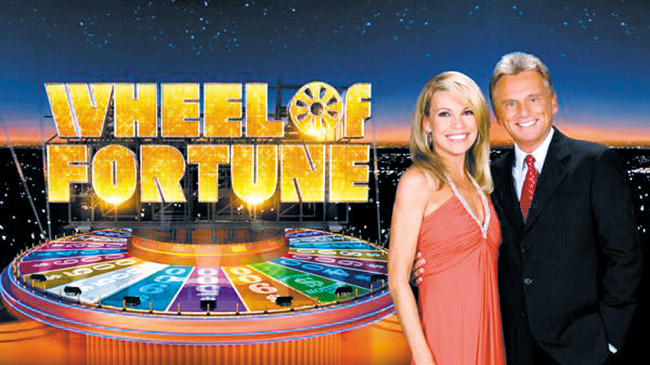
The Wikipedia page lists a number of other common names used in protocols including perennial third wheel Charlie and nosy eavesdropper Eve. I can claim credit for two of those names, Pat and Vanna. In my first conference talk in 1987 I had to explain interactive proofs and for the prover and verifier I picked Pat and Vanna after the hosts, Pat Sajak and Vanna White, of the popular game show Wheel of Fortune. Vanna didn't trust Pat and spun the wheel to get random questions to challenge him. Half of the audience laughed hysterically, the other half had no clue what I was talking about. I heard the FOCS PC took a break by watching an episode of Wheel of Fortune to understand the joke.
Howard Karloff insisted we use Pat and Vanna in the LFKN paper. Pat and Vanna have since retired from interactive proving but thirty years later they still host Wheel of Fortune.
Monday, April 10, 2017
What is William Rowan Hamilton know for- for us? for everyone else?
I found the song William Rowan Hamilton that I used in my April fools day post because I was working on a song about Hamiltonian Circuits to the tune of Alexander Hamilton
Circuit Hamiltonian
I want a Circuit Hamiltonian
And I'm run-ing a pro-GRAM for it
So I wait, so I wait
(Darling said: Don't quit your day job.)
I noticed that William Rowan Hamilton had the same cadence as Alexander Hamilton so I assumed that someone must have used that for a parody, and I was right
But
Listen to the son. They mention the following::
Kinetics, Quaternions (This is mentioned the most), An optimization view of light, Minimal action,
`your energy function generates the flow of time' ,Operators that Lie Commute with the symbol that bears your name, His versors(?) formed hyperspheres - see if you can plot 'em- invented vectors and scalars for when you dot 'em (Did he really invent vectors? Wikipedia says that in a sense he invented cross and dot products.) And Schrodinger sings that he adapted Hamilton's work for Quantum (I didn't know Schrodinger could sing!).
What do they NOT mention: Hamiltonian paths or circuits. His Wikipedia page does mention Hamiltonian circuits, but not much and you would have no idea they were important.
When a computer science theorists hears `Hamiltonian' she prob thinks `path' or `circuit' and not `an optimization view of light' or anything else in physics' She might think of Quaternions and if she does Quantum Computing she may very well think of some of the items above. But these are exception. She would likely think of the graph problems.
The rest of the world would think of the list above (or would think William Rowan Hamilton died in a dual over Quaternions and later had the best Hamilton Satire written about him- the second of course being the one about Batman,)
In his own time he was best know for Physics. Maybe also quaternions. I think Hamilton himself would be surprised that this problem became important. So here is my question:
When did the problem become important? Before NP-Completness or after?
Is he still better known for his physics and quats- I think yes.
When I say `Hamilton' what comes to YOUR mind?
Circuit Hamiltonian
I want a Circuit Hamiltonian
And I'm run-ing a pro-GRAM for it
So I wait, so I wait
(Darling said: Don't quit your day job.)
I noticed that William Rowan Hamilton had the same cadence as Alexander Hamilton so I assumed that someone must have used that for a parody, and I was right
But
Listen to the son. They mention the following::
Kinetics, Quaternions (This is mentioned the most), An optimization view of light, Minimal action,
`your energy function generates the flow of time' ,Operators that Lie Commute with the symbol that bears your name, His versors(?) formed hyperspheres - see if you can plot 'em- invented vectors and scalars for when you dot 'em (Did he really invent vectors? Wikipedia says that in a sense he invented cross and dot products.) And Schrodinger sings that he adapted Hamilton's work for Quantum (I didn't know Schrodinger could sing!).
What do they NOT mention: Hamiltonian paths or circuits. His Wikipedia page does mention Hamiltonian circuits, but not much and you would have no idea they were important.
When a computer science theorists hears `Hamiltonian' she prob thinks `path' or `circuit' and not `an optimization view of light' or anything else in physics' She might think of Quaternions and if she does Quantum Computing she may very well think of some of the items above. But these are exception. She would likely think of the graph problems.
The rest of the world would think of the list above (or would think William Rowan Hamilton died in a dual over Quaternions and later had the best Hamilton Satire written about him- the second of course being the one about Batman,)
In his own time he was best know for Physics. Maybe also quaternions. I think Hamilton himself would be surprised that this problem became important. So here is my question:
When did the problem become important? Before NP-Completness or after?
Is he still better known for his physics and quats- I think yes.
When I say `Hamilton' what comes to YOUR mind?
Thursday, April 06, 2017
A Bridge Too Far

In Atlanta last week a fire destroyed a major highway bridge right on my, and so many other's, commutes. I've been playing with different strategies, like coming in later or even working at home when I can, not so easy when a department chair. I expect at Georgia Tech, just South of the damaged highway, we'll see less people around for the next ten weeks or so.
Even before the bridge collapse faculty don't all come in every day. In the Chronicle last month Deborah Fitzgerald laments the empty hallways she sees in her department. Hallways became a victim of technology, particularly the Internet. We mostly communicate electronically, can access our files and academic papers on our laptops and iPads just as easily in a coffeehouse as in our office. If you use your mobile phone as your primary number the person calling you won't even know if you are in the office. The only reason to come into the office is to teach or to meet other people.
Of course meeting other people is a very good reason. Not only scheduled meeting with students but the random meeting with another colleague that turns into a research project. The times I've walked into a student's office with a crazy idea, or needed a combinatorial theorem from one of the local experts. As we even move our meetings to video conferences, we really start to lose those spontaneous connections that come from random conversations. Soon the technology may get so good that our online meetings and courses will become a better experience than meeting in person. What will happen to the universities then?
Tuesday, April 04, 2017
Proving Langs not Regular using Comm Complexity
(My notes on this are at my course website: here They are notes for my ugrad students so they may be longer and more detailed than you want.)
Using that { (x,y) : x=y, both of length n} has Communication Complexity \ge n+1 one can easily prove:
a) The Language \{ xx : x\in \Sigma^*} is NOT regular
b) For all n the language \{ xx : x \in \Sigma^n }, which is regular, requires a DFA on 2^{n+1} states.
I also used Comm Complexity to show that
{ w : the number of a's in w is a square} is not regular, from which one can get
{ a^{n^2} : n\in N} is not regular.
More generally, if A is any set such that there are arb large gaps in A, the set
{ w : the number of a's in w is in A} and {a^n : n \in A} are not regular.
This approach HAS TO BE KNOWN and in fact it IS- Ian Glaister and Jeffrey Shallit had a paper in 1996 that gave lower bounds on the size of NFA's using ideas from Comm Complexity (see here). They present their technique as a way to get lower bounds on the size of NFA's; however, their techniques can easily be adapted to get all of the results I have, with similar proofs to what I have.
(Jeffrey Shallit, in the comments, pointed me to an article that predates him that had similar ideas:here.)
(Added later- another early referene on applying comm comp to proving langs not regular is Communication Complexity. Advances in Computers Vol 44 Pages 331-360 (1997),
section 3.1, by Eyal Kushlevitz. (See here)
(Jeffrey Shallit, in the comments, pointed me to an article that predates him that had similar ideas:here.)
(Added later- another early referene on applying comm comp to proving langs not regular is Communication Complexity. Advances in Computers Vol 44 Pages 331-360 (1997),
section 3.1, by Eyal Kushlevitz. (See here)
Next time you teach Automata theory you may want to teach showing langs are NOT regular using Comm Complexity. Its a nice technique that also leads to lower bounds on the number of states for DFA's and NFA's.
Saturday, April 01, 2017
William Rowan Hamilton- The Musical!
With the success of Hamilton,the musical on broadway (for all of the songs and the lyrics to them see here- I wonder who would buy the CD since its here for free) Lin-Manuel Miranda looked around for other famous figures he could make a musical about. Per chance I know Lin's college roommates father and I suggested to him, more as a joke, that Lin-Manuel could make a musical about
William Rowan Hamilton
Well, Lin-Manuel heard about this and noticed that
William Rowan Hamilton
has the exact same number of syllabus as
Alexander Hamilton.
Hence some of the songs would be able to have the same cadence. He has gone ahead with the project! He has asked that I beta test the first song by posting it, so I will:
William Rowan Hamilton
Lin-Manuel will be reading the comments to this blog- so please leave constructive comments about the song and the idea.
Tuesday, March 28, 2017
Parity Games in Quasipolynomial Time
In one of the hallway discussions of last week's Dagstuhl I learned about an upcoming STOC paper Deciding Parity Games in Quasipolynomial Time by Cristian Calude, Sanjay Jain, Bakhadyr Khoussainov, Wei Li and Frank Stephan. Hugo Gimbert and Rasmus Ibsen-Jensen offer a simplified proof of the correctness of the algorithm.
A Parity Game works as follows: An instance is a finite directed graph where every vertex has at least one outgoing edge, integer weights on the vertices and a designated starting vertex. Alice and Bob take turns choosing the next vertex by following an edge from the current vertex. They play this game infinitely long and Alice wins if the the largest weight seen infinitely often is even. Not trivial to show but the game is determined and memoryless, no matter the graph some player has a winning strategy, and that strategy depends only the current vertex and not the history so far. That puts the problem into NP∩co-NP and unlikely to be NP-complete.
Like graph isomorphism, whether there exists a polynomial-time algorithm to determine the winner of a parity game remains open. Also like graph isomorphism we now have a quasipolynomial-time (exponential in logk) algorithm, an exponential improvement. Parity games have some applications to verification and model checking and some at Dagstuhl claim the problem is more important than graph isomorphism.
One difference: If you had to guess who would make the big breakthrough in graph isomorphism, László Babai would be at the top of your list. But many of the authors of this new parity games paper, like Frank Stephan and Sanjay Jain, focus mostly on computability and rarely worry about time bounds. Their algorithm does have the flavor of a priority argument often found in computability theory results. A nice crossover paper.
A Parity Game works as follows: An instance is a finite directed graph where every vertex has at least one outgoing edge, integer weights on the vertices and a designated starting vertex. Alice and Bob take turns choosing the next vertex by following an edge from the current vertex. They play this game infinitely long and Alice wins if the the largest weight seen infinitely often is even. Not trivial to show but the game is determined and memoryless, no matter the graph some player has a winning strategy, and that strategy depends only the current vertex and not the history so far. That puts the problem into NP∩co-NP and unlikely to be NP-complete.
Like graph isomorphism, whether there exists a polynomial-time algorithm to determine the winner of a parity game remains open. Also like graph isomorphism we now have a quasipolynomial-time (exponential in logk) algorithm, an exponential improvement. Parity games have some applications to verification and model checking and some at Dagstuhl claim the problem is more important than graph isomorphism.
One difference: If you had to guess who would make the big breakthrough in graph isomorphism, László Babai would be at the top of your list. But many of the authors of this new parity games paper, like Frank Stephan and Sanjay Jain, focus mostly on computability and rarely worry about time bounds. Their algorithm does have the flavor of a priority argument often found in computability theory results. A nice crossover paper.
Thursday, March 23, 2017
The Dagstuhl Family

We had a different ice breaker, where each person wrote topics they think about which ended up looking look like an interesting bipartite graph.

Molly has a few thoughts on Dagstuhl:
The coolest thing about the study of computer science is this place.
Okay, I know my dad would disagree with me (he probably thinks the coolest thing about computer science is the computer science itself). But for me, someone quite removed from the math and science and thinking, this place is by far the coolest thing about the computer science community. The point of it is isolation, as well simultaneous connection. The isolation comes in the form of a meeting center in rural Germany, separated from the world, devices which can (and do) block wifi in rooms like lecture rooms and the dining hall, resulting in a week without much interaction with the outside world. The connection stems from this very isolation -- in this highly isolated place, people are forced to connect with each other face-to-face, and to get to know each other, as well as the ideas and problems people are working on. The isolation creates a heightened sense of community, both in social and intellectual senses of the word. Forced to be so close and so interconnected, it’s no wonder so many problems get solved here.
I’m glad I got to come see why my father has been coming here for a quarter century. He is very old.
Sunday, March 19, 2017
If you want to help your bad students DO NOT give an easy exam
1) When I was a grad student TAing Formal Lang Theory we had a final ready to give out but noticed that one problem was too hard. So we changed it. But we made it too easy. Whoops. My thought at the time was this will help the bad students. I was wrong. Roughly speaking the students who got 70-80 on the midterm now got 90-100 on the final whereas the students who got 30-40 on the midterm got 35-45 on the final. So the bad students improved, but the better students improved more.
2) When I teach Discrete Math to LOTS of students we have a policy about midterm regrade requests. Rather than have them argue in person they have to:
In writing make a clear concise argument as to why it was mis-graded
If your argument displays that you really don't know the material, even when you can reflect on it, you can lose points. (True Story: We ask for an example of a Boolean Function with two satisfying assignments. They gave us a formula with only one, so they got -5. In the regrade request they try to still argue that it has two satisfying assignments. They lost 2 more points.)
In reality the policy is more preventative and we rarely remove points. However even this policy benefits the better students more than the poor ones who have a hard time even articulating why what they wrote is actually right (likely it is not).
3) Just this winter teaching a 3-week 1-credit course we were grading a problem and giving lots of 15/25 since the students were all making the same mistake. Half way through I got suspicious that maybe WE were incorrect. Looking at the exact wording of the question I realized WE were wrong, and, given the wording and what they would quite reasonably think we wanted, they were right. So we went back and upgraded many students from 15 to 25. And again, this lifted students in the 70's to 90's, but did NOTHING for the students below 50 since none of them had anything like a correct answer to any way to view the question.
Okay, so what does all of this mean? It means that an easy exam or a generous grading policy is devastating for the bad students.
However, that's just my experience- what are your experiences with this?
Thursday, March 16, 2017
NP in ZPP implies PH in ZPP
If NP is in ZPP is the entire polynomial-time hierarchy in ZPP? I saw this result used in an old TCS Stackexchange post but I couldn't find a proof (comment if you know a reference). The proof that NP in BPP implies PH in BPP is harder than it looks and NP in BQP implies PH is in BQP is still open as far as I know.
I found a simple proof that NP in ZPP implies PH in ZPP and then an even simpler one.
Assume NP in ZPP. This implies NP in BPP so PH is also in BPP. So we need only show BPP in ZPP.
BPP is in ZPPNP follows directly by Lautemann's proof that BPP is in Σ2P or by the fact that BPP is in MA is in S2P is in ZPPNP. By assumption, BPP in ZPPNP implies BPP in ZPPZPP = ZPP.
And this is even simpler.
ZPP = RP∩co-RP in NP∩co-NP. Σ2P = NPNP in NPZPP (by assumption) in NPNP∩co-NP = NP in ZPP. You can get the higher levels of the hierarchy by an easy induction.
I found a simple proof that NP in ZPP implies PH in ZPP and then an even simpler one.
Assume NP in ZPP. This implies NP in BPP so PH is also in BPP. So we need only show BPP in ZPP.
BPP is in ZPPNP follows directly by Lautemann's proof that BPP is in Σ2P or by the fact that BPP is in MA is in S2P is in ZPPNP. By assumption, BPP in ZPPNP implies BPP in ZPPZPP = ZPP.
And this is even simpler.
ZPP = RP∩co-RP in NP∩co-NP. Σ2P = NPNP in NPZPP (by assumption) in NPNP∩co-NP = NP in ZPP. You can get the higher levels of the hierarchy by an easy induction.
Monday, March 13, 2017
Other fields of math don't prove barrier results- why do we?
Before FLT was solved did some people prove theorems like:
FLT cannot be proven using techniques BLAH. This is important since all current proofs use BLAH.
I do not believe so.
Replace FLT with Goldbach's conjectures or others and I do not believe there were ever such papers.
I have sometimes seen a passing reference like `the techniques of this paper cannot get past BLAH but it was not dwelled on. The most striking example of this (and what got me to right this post) was the
Erdos Distance Problem (see here)--- when the result Omega( n^{ (48-14e)/(55-16e) - epsilon}) was shown I heard it said that this was as far as current techniques could push it. And then 11 years later the result Omega(n/log n) was proven. I asked around and YES the new paper DID use new techniques. But there was not the same kind of excitement I here when someone in TCS uses new techniques (e.g., IP=PSPACE used techniques that did not relativize!!!!!!!!)
With P vs NP and other results we in TCS DO prove theorems and have papers like that. I am NOT being critical-- I am curious WHY we do this and other fields don't. Some options
1) Bill is WRONG- other fields DO do this- see BLAH. Actually proof theory, and both the recursive math program and the reverse math program DID look into `does this theorem require this technique' but this was done for theorems that were already proven.
2) Bill is WRONG- we are not that obsessed with barrier results.
3) P vs NP is SO HARD that we are forced into considering why its hard. By contrast there has been progress on FLT and Goldbach over time. Rather than ponder that they NEED new techniques they went out and FOUND new techniques. Our inability to do that with P vs NP might be because it's a harder problem- though we'll know more about that once its solved (in the year 3000).
4) P vs NP is closer to logic so the notion of seeing techniques as an object worth studying is more natural to them.
What do you think?
FLT cannot be proven using techniques BLAH. This is important since all current proofs use BLAH.
I do not believe so.
Replace FLT with Goldbach's conjectures or others and I do not believe there were ever such papers.
I have sometimes seen a passing reference like `the techniques of this paper cannot get past BLAH but it was not dwelled on. The most striking example of this (and what got me to right this post) was the
Erdos Distance Problem (see here)--- when the result Omega( n^{ (48-14e)/(55-16e) - epsilon}) was shown I heard it said that this was as far as current techniques could push it. And then 11 years later the result Omega(n/log n) was proven. I asked around and YES the new paper DID use new techniques. But there was not the same kind of excitement I here when someone in TCS uses new techniques (e.g., IP=PSPACE used techniques that did not relativize!!!!!!!!)
With P vs NP and other results we in TCS DO prove theorems and have papers like that. I am NOT being critical-- I am curious WHY we do this and other fields don't. Some options
1) Bill is WRONG- other fields DO do this- see BLAH. Actually proof theory, and both the recursive math program and the reverse math program DID look into `does this theorem require this technique' but this was done for theorems that were already proven.
2) Bill is WRONG- we are not that obsessed with barrier results.
3) P vs NP is SO HARD that we are forced into considering why its hard. By contrast there has been progress on FLT and Goldbach over time. Rather than ponder that they NEED new techniques they went out and FOUND new techniques. Our inability to do that with P vs NP might be because it's a harder problem- though we'll know more about that once its solved (in the year 3000).
4) P vs NP is closer to logic so the notion of seeing techniques as an object worth studying is more natural to them.
What do you think?
Thursday, March 09, 2017
The Beauty of Computation
Lisa Randall wrote a New York Times book review of Carlo Rovelli's Reality Is Not What It Seems with some interesting responses. I want to focus on a single sentence from Randall's review.
Likewise the P versus NP question remains the same under any reasonable computational model. Russell Impagliazzo goes further in his description of his world Algorithmica.
That's why I am not a huge fan of results that are so specific to a single model, like finding the fewest number of states for a universal Turing machine. I had an email discussion recently about the busy beaver function which I think of in general terms: a mapping from some notion of program size to program output as opposed to some precise definition. I find the concept incredibly interesting and important, no one should care about the exact values of the function.
We need the formal definitions to prove theorems but we really care about the conceptual meaning.
Maybe that's what separates us from the physicists. They want precise definitions to capture their conceptual ideas. We want conceptual ideas that transcend formal definitions.
The beauty of physics lies in its precise statements, and that is what is essential to convey.I can't speak for physics but I couldn't disagree more when it comes to computation. It's nice we have formal models, like the Turing machine, for that gives computation a firm mathematical foundation. But computation, particularly a computable function, transcend the model and remain the same no matter what reasonable model of computation or programming language you wish to use. This is the Church-Turing thesis, exciting exactly because it doesn't have a formality that we can prove or disprove.
Likewise the P versus NP question remains the same under any reasonable computational model. Russell Impagliazzo goes further in his description of his world Algorithmica.
Algorithmica is the world in which P = NP or some moral equivalent, e.g. NP in BPP [probabilistic polynomial time].In other words the notion of easily finding checkable solutions transcends even a specifically stated mathematical question.
That's why I am not a huge fan of results that are so specific to a single model, like finding the fewest number of states for a universal Turing machine. I had an email discussion recently about the busy beaver function which I think of in general terms: a mapping from some notion of program size to program output as opposed to some precise definition. I find the concept incredibly interesting and important, no one should care about the exact values of the function.
We need the formal definitions to prove theorems but we really care about the conceptual meaning.
Maybe that's what separates us from the physicists. They want precise definitions to capture their conceptual ideas. We want conceptual ideas that transcend formal definitions.
Monday, March 06, 2017
why are regular expressions defined the way they are
BILL: The best way to prove closure properties of regular languages is to first prove the equiv of DFA's, NDFA's and Reg Expressions. Then, if you want to prove a closure property, choose the definition of regular that makes it easiest. For example, to prove Reg Langs closed under intersection I would use DFA's, NOT Reg Expressions.
STUDENT: I thought reg expressions were
a) finite sets
b) if alpha and beta are reg exp then so are alpha UNION beta, alpha INTERSECT beta, alpha CONCAT beta and alpha*
BILL: No. Regular expressions are defined just using UNION, CONCAT, and *.
STUDENT: Why? Had the defined it my way then closure under INTERSECTION would be easier. For that matter toss in COMPLIMENTATION and you're get that easily also.
BILL: First off, thats not quite right. You compliment a DFA by saying how lovely its states are. I think you mean complement. Second off, GOOD question!- Why are Reg Expressions defined the way they are. I"ll try to look that up and if I can't find anything I'll blog about it.
STUDENT: When will you blog about it?
BILL: I just did. Now, let me ask the question more directly:
The definition of Reg Exp is essentially closure under UNION, CONCAT, STAR. Why not other things? There are very broadly three possibilities:
a) Historical Accident.
b) Some good math or CS reason for it.
c) Something else I haven't thought of.
I hope its (b). Moreover, I hope one of my readers knows and can enlighten me and the other readers.
Thursday, March 02, 2017
International Science
I did some counting and the 35 academic faculty members in the Georgia Tech School of Computer Science come from 14 different countries. My co-authors come from at least 20 different nations. My 10 successful PhD students hail from 7 different countries. I have benefited immensely from global collaborations thanks to relatively open borders and communication during most of my academic career and I am hardly the only academic who has done so.
I'm old enough to remember the days of the cold war where travel between East and West was quite difficult. We had considerable duplication of effort--many important theorems were proven independently on both sides of the iron curtain but even worse ideas took a long time to permeate from one side to the other. We could not easily build on each other's work. Science progressed slower as a result. Pushing back the boundaries of science is not a zero-sum game, quite the opposite--we can only grow knowledge. We grow that knowledge much faster working together.
As the United States and other countries take on a more nationalistic point of view, we'll see fewer people travel, fewer people willing or even able to spend significant parts of their career in other countries. We will (hopefully) continue to have an open Internet so information will still flow but nothing can replace the focus of face-to-face collaboration to share ideas and create new ones.
The real loss for America will be an invisible one: the students who won't be coming here to study and later become our professors, scientists and colleagues, to make our universities, industries and society stronger. Sad.
I'm old enough to remember the days of the cold war where travel between East and West was quite difficult. We had considerable duplication of effort--many important theorems were proven independently on both sides of the iron curtain but even worse ideas took a long time to permeate from one side to the other. We could not easily build on each other's work. Science progressed slower as a result. Pushing back the boundaries of science is not a zero-sum game, quite the opposite--we can only grow knowledge. We grow that knowledge much faster working together.
As the United States and other countries take on a more nationalistic point of view, we'll see fewer people travel, fewer people willing or even able to spend significant parts of their career in other countries. We will (hopefully) continue to have an open Internet so information will still flow but nothing can replace the focus of face-to-face collaboration to share ideas and create new ones.
The real loss for America will be an invisible one: the students who won't be coming here to study and later become our professors, scientists and colleagues, to make our universities, industries and society stronger. Sad.
Sunday, February 26, 2017
Should we learn from the Masters or the Pupils (Sequel)
A while back I had a blog entry Should we learn from the Masters of the Pupils? The Masters may have more insights but he Pupils may have a better view aided by a modern viewpoint.
Sometimes the Masters are in a different language or not in the modern style but you still want to know what they did and why. As I blogged about earlier (See here) Villarino/Gasarch/Regan have a paper which explains Hilbert's Proof of Hilbert's Irreducibility Theorem (see) Tao has a paper on Szemeredi's Proof of Szemeredi's Theorem (on Tao's webpage: here). Villarino has a paper on Merten's Proof of Merten's Theorem (here).
Mark Villarino read that blog entry (good to know someone did!) and then presented me with MANY examples where the MASTER is worth reading, which I present to you. For all of them reading a well written exposition of what the Master did would also be good (as good? better?) if such exists.
Here is his letter with a few of my comments.
I would suggest the following examples where the original teaches and illuminates more than the modern slick version:
1. Euclid's proof of the Pythagorean Theorem (and its converse). Indeed, once you understand the diagram, the proof is immediate and beautiful. See here.
2. Gauss' first proof (by induction) of quadratic reciprocity. If you REALLY read it, you see how Gauss was led to the proof by numerous specific examples and it is quite natural. It is a marvelous example of how numerical examples inspired the structure of the induction proof. (BILL COMMENT: Here is a Masters Thesis in Math that has the proof and lots of context and other proofs of QR: here)
3. Gauss' first proof of the fundamental theorem of algebra. The real and imaginary parts of the polynomial must vanish simultaneously. However the graph of each is a curve in the plane, and so the two curves must intersect at some point. Gauss explicitly finds a circle which contains the parts of the two curves which intersect in the roots of the polynomial. The proof of the existence of a point of intersection is quite clever and natural, although moderns might quibble. In an appendix he gives a numerical example (BILL COMMENT- Sketch of the first proof of FTOA that I ever saw: First show that the complex numbers C and the punctured plane C- {(0,0)} have different fundamental groups (The fund group of C is trivial, the fund group of C-{(0,0)} is Z,the integers.) Hence there can't be an X-morphism from C to C-{(0,0)} (I forget which X it is). If there is a poly p in C[x] with no roots in C then the map x --> 1/p(x) is an X-morphism. Contradiction. Slick but not clear what it has to to with polynomials. A far cry from the motivated proof by Gauss.)
4. Abel's proof, in Crelle's Journal, of the impossibility of solving a quintic equation by radicals. Abel explores the properties that a "formula" for the root any algebraic equation must have, for example that if you replace any of its radicals by a conjugate radical, the new formula must also identically satisfy the equation, in order to deduce that the formula cannot exist Yes, it has a few correctable errors, but the idea is quite natural. (BILL's COMMENT- proof- sounds easier than what I learned, and more natural. There is an exposition in English here. I have to read this since I became a math major just to find out why there is no quintic equation.)
5. Jordan's proof of the Jordan curve theorem. His idea is to go from the theorem for polygons to then approximate the curve by a polygon and carry the proof over to the curve by a suitable limiting process. See here for a paper on Jordan's proof of the Jordan Curve theorem.
6. Godel's 1948 paper on his rotating universe solution to the Einstein Field Equations. Although his universe doesn't allow the red-shift, it DOES allow time travel! The paper is elegant, easy to read, and should be read (in my opinion) by any mathematics student. (Added later- for the paper see here)
7. Einstein's two papers on special/general relativity. There are english translations. They are both elegantly written and are much better than the later "simplifications" by text-book writers. I was amazed at how natural his ideas are and how clearly and simply they are presented in the papers. English Translation here
8. Lagrange's Analytical Mechanics. There is now an english translation. What can I say? It is beautiful. Available in English here.
9. I add "Merten's proof of Merten's theorem" to the list of natural instructive original proofs. His strategy is quite natural and the details are analytical fireworks. (BILL COMMENT- as mentioned above there is an exposition in English of Merten's proof.)
I could go on, but these are some standouts.
BILL COMMENT: So, readers, feel free to ad to this list!
BILL COMMENT: So, readers, feel free to ad to this list!
Thursday, February 23, 2017
Ken Arrow and Oscars Voting
Kenneth Arrow, the Nobel Prize winning economist known for his work on social choice and general equilibrium, passed away Tuesday at the age of 95.
I can't cover Arrow's broad influential work in this blog post even if I were an economist but I would like to talk about Ken Arrow's perhaps best known work, his impossibility theorem for voting schemes. If you have at least three candidates, there is no perfect voting method.
Suppose a group of voters give their full rankings of three candidates, say "La La Land", "Moonlight" and "Manchester by the Sea" and you have some mechanism that aggregates these votes and chooses a winner.
Now suppose we want a mechanism to have two fairness properties (for every pair of movies):
Arrow shows these are the only mechanisms that fulfill the properties: There is no non-dictatorial voting system that has the fairness properties above.
Most proofs of Arrow's theorem are combinatorial in nature. In 2002 Gil Kalai gave a clever proof based on Boolean Fourier analysis. Noam Nisan goes over this proof in a 2009 blog post.
Arrow's theorem that no system is perfect doesn't mean that some systems aren't better than others. The Oscars use a reasonably good system known as Single Transferable Voting. Here is a short version updated from a 2016 article.
Maybe the Oscars should just let Emma Watson choose the winner.
I can't cover Arrow's broad influential work in this blog post even if I were an economist but I would like to talk about Ken Arrow's perhaps best known work, his impossibility theorem for voting schemes. If you have at least three candidates, there is no perfect voting method.
Suppose a group of voters give their full rankings of three candidates, say "La La Land", "Moonlight" and "Manchester by the Sea" and you have some mechanism that aggregates these votes and chooses a winner.
Now suppose we want a mechanism to have two fairness properties (for every pair of movies):
- If every voter prefers "Moonlight" to "La La Land" then the winner should not be "La La Land".
- If the winner is "Moonlight" and some voters change their ordering between "La La Land" and "Manchester by the Sea" then "Moonlight" is still the winner (independence of irrelevant alternatives).
Arrow shows these are the only mechanisms that fulfill the properties: There is no non-dictatorial voting system that has the fairness properties above.
Most proofs of Arrow's theorem are combinatorial in nature. In 2002 Gil Kalai gave a clever proof based on Boolean Fourier analysis. Noam Nisan goes over this proof in a 2009 blog post.
Arrow's theorem that no system is perfect doesn't mean that some systems aren't better than others. The Oscars use a reasonably good system known as Single Transferable Voting. Here is a short version updated from a 2016 article.
For the past 83 years, the accounting firm PricewaterhouseCoopers has been responsible for tallying the votes, and again this year partners Martha Ruiz and Brian Cullinan head up the operation. The process of counting votes for Best Picture isn't as simple as one might think. According to Cullinan, each voter is asked to rank the nine nominated films 1-9, one being their top choice. After determining which film garnered the least number of votes, PWC employees take that title out of contention and look to see which movie each of those voters selected as their second favorite. That redistribution process continues until there are only two films remaining. The one with the biggest pile wins. "It doesn’t necessarily mean that who has the most number one votes from the beginning is ensured they win," he added. "It’s not necessarily the case, because going through this process of preferential voting, it could be that the one who started in the lead, doesn’t finish in the lead."Another article explicitly asks about strategic voting.
So if you’re a big fan of “Moonlight” but you’re scared that “La La Land” could win, you can help your cause by ranking “Moonlight” first and “La La Land” ninth, right?
Wrong. That won’t do a damn thing to help your cause. Once you rank “Moonlight” first, your vote will go in the “Moonlight” stack and stay there unless “Moonlight” is eliminated from contention. Nothing else on your ballot matters as long as your film still has a chance to win. There is absolutely no strategic reason to rank your film’s biggest rival last, unless you honestly think it’s the worst of the nominees.Arrow's theorem says there must be a scenario where you can act strategically. It might make sense for this fan to put "Fences" as their first choice to potentially knock out "La La Land" in an early round. A similar situation knocked out Chicago from hosting the 2016 Olympics.
Maybe the Oscars should just let Emma Watson choose the winner.
Sunday, February 19, 2017
The benefits of Recreational Mathematics
Why study Recreational Mathematics?
Why do recreational Mathematics?
1) The line between recreational and serious mathematics is thin. Some of the problems in so-called recreational math are harder than they look.
2) Inspiring. Both Lance and I were inspired by books by Martin Gardner, Ray Smullyan, Brian Hayes, and others.
3) Pedagogical: Understanding Godel's Inc. theorem via the Liar's paradox (Ray S has popularized that approach) is a nice way to teach the theorem to the layperson (and even to non-laypeople).
4) Rec math can be the starting point for so-called serious math. The Konigsberg bridge problem was the starting point for graph theory, The fault diagnosis problem is a generalization of the Truth Tellers and Normals Problem. See here for a nice paper by Blecher on the ``recreational'' problem of given N people of which over half are truth tellers and the rest are normals, asking questions of the type ``is that guy a normal'' to determine whose who. See here for my writeup of the algorithm for a slightly more general problem. See William Hurwoods Thesis: here for a review of the Fault Diagnosis Literature which includes Blecher's paper.
I am sure there are many other examples and I invite the readers to write of them in the comments.
5) Rec math can be used to inspire HS students who don't quite have enough background to do so-called serious mathematics.
This post is a bit odd since I cannot imagine a serious counter-argument; however, if you disagree, leave an intelligent thoughtful comment with a contrary point of view.
Why do recreational Mathematics?
1) The line between recreational and serious mathematics is thin. Some of the problems in so-called recreational math are harder than they look.
2) Inspiring. Both Lance and I were inspired by books by Martin Gardner, Ray Smullyan, Brian Hayes, and others.
3) Pedagogical: Understanding Godel's Inc. theorem via the Liar's paradox (Ray S has popularized that approach) is a nice way to teach the theorem to the layperson (and even to non-laypeople).
4) Rec math can be the starting point for so-called serious math. The Konigsberg bridge problem was the starting point for graph theory, The fault diagnosis problem is a generalization of the Truth Tellers and Normals Problem. See here for a nice paper by Blecher on the ``recreational'' problem of given N people of which over half are truth tellers and the rest are normals, asking questions of the type ``is that guy a normal'' to determine whose who. See here for my writeup of the algorithm for a slightly more general problem. See William Hurwoods Thesis: here for a review of the Fault Diagnosis Literature which includes Blecher's paper.
I am sure there are many other examples and I invite the readers to write of them in the comments.
5) Rec math can be used to inspire HS students who don't quite have enough background to do so-called serious mathematics.
This post is a bit odd since I cannot imagine a serious counter-argument; however, if you disagree, leave an intelligent thoughtful comment with a contrary point of view.
Thursday, February 16, 2017
Liberatus Wins at Poker
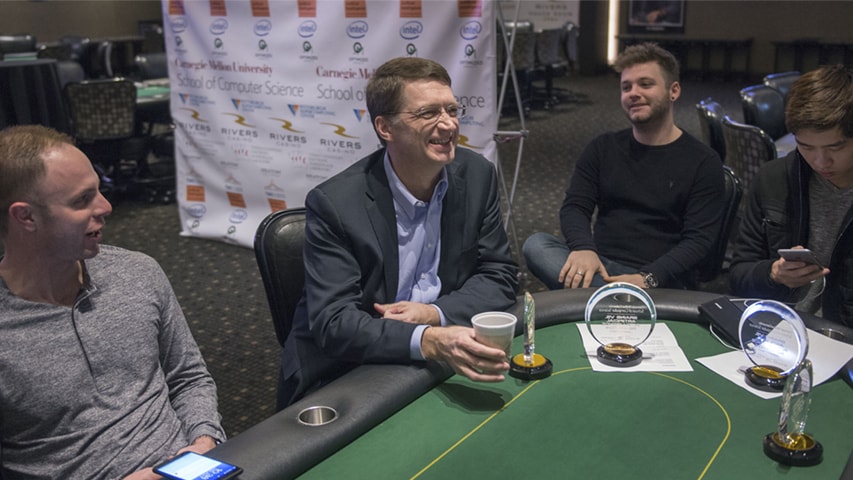 |
| Tuomas Sandholm (center) and Ph.D. student Noam Brown (via CMU) |
For those unfamiliar with Texas hold 'em
Two cards, known as the hole cards or hold cards, are dealt face down to each player, and then five community cards are dealt face up in three stages. The stages consist of a series of three cards ("the flop"), later an additional single card ("the turn") and a final card ("the river"). Each player seeks the best five card poker hand from the combination of the community cards and their own hole cards. Players have betting options to check, call, raise or fold. Rounds of betting take place before the flop is dealt, and after each subsequent deal.Unlike the computers that defeated the best humans in chess, Jeopardy and go, Liberatus comes directly from academia, from Tuomas Sandholm and his student Noam Brown at Carnegie-Mellon.
Unlike chess and go, poker is a game of incomplete information in many forms.
- Information both players have: the community cards already played.
- Information only one player has: the hole card
- Information neither player has: the community cards yet to be played.
Betting in poker plays the primary role of raising the stakes but betting can also signal what hole cards you have. Players can bluff (betting large amounts without a corresponding strong hand), trying to cause other players to misread the signal. There is no perfect play in poker, just a mixed equilibrium though we still don't know how to compute the equilibrium and even if we could we might deviate from the equilibrium to gain an advantage. Deviating also make you vulnerable.
All of this makes poker a far more complicated game for computers to tackle. But through persistence and new tools in machine learning, Sandholm and Brown have found success.
If history holds up, it won't be long before we have champion-caliber poker apps on our phones. Will we see cheating like has been happening in chess? Will online poker sites just disappear?
What is the next great game to fall to computers? I'm guessing NASCAR.
Monday, February 13, 2017
Raymond Smullyan: Logician, Recreational math writer, Philosopher, passed away
Raymond Smullyan was born on May 25 1919 and passed away recently at the age of 97. He was a logician (PhD from Princeton under Alonzo Church in 1959) who did serious, recreational, and philosophical work. I doubt he invented the truth-teller/liar/normals and knight/knave/Knormal problems, but he popularized them and (I suspect) pushed them further than anyone before him.
He was active all of his life:
His last book on Logic Puzzles, The Magic Garden of George B and other Logic Puzzles was published in 2015. Wikipedia lists 14 books on logical puzzles, from 1978 untl 2015.
His last book classified (on Wikipedia) as Philosophy/Memoir, A Mixed Bag: Jokes, Riddles, Puzzles, and Memorabilia was published in 2016. Wikipedia lists 8 books in this category, from 1977 until 2016.
His last Academica book, A beginners further guide to mathematical logic was published in 2016. (It was a sequel to his 2014 A beginners guide to mathematical logic.) Wikipedia lists 8 books in this category, from 1961 to 2016.
Recreational Work:
His recreational work was of the Knights/Knaves/Knormals/Sane/Insane/ variety.a
Knights always tell the truth.
Knaves always lie,
Knormals may tell the truth or lie.
Insane people only believe false things,
Sane people only believe true things.
He also added a complication: a species that says ALPHA and BETA for YES and NO but
you don't know which of ALPHA, BETA means YES and which one means NO.
Note that a truth teller Insane Knight will answer YES to 1+1=3.
He invented (discovered?) the so called hardest logic puzzle ever. He wrote many books on recreational math. We mention four of them that show the line between recreational and serious mathematics is thin.
He was active all of his life:
His last book on Logic Puzzles, The Magic Garden of George B and other Logic Puzzles was published in 2015. Wikipedia lists 14 books on logical puzzles, from 1978 untl 2015.
His last book classified (on Wikipedia) as Philosophy/Memoir, A Mixed Bag: Jokes, Riddles, Puzzles, and Memorabilia was published in 2016. Wikipedia lists 8 books in this category, from 1977 until 2016.
His last Academica book, A beginners further guide to mathematical logic was published in 2016. (It was a sequel to his 2014 A beginners guide to mathematical logic.) Wikipedia lists 8 books in this category, from 1961 to 2016.
Recreational Work:
His recreational work was of the Knights/Knaves/Knormals/Sane/Insane/ variety.a
Knights always tell the truth.
Knaves always lie,
Knormals may tell the truth or lie.
Insane people only believe false things,
Sane people only believe true things.
He also added a complication: a species that says ALPHA and BETA for YES and NO but
you don't know which of ALPHA, BETA means YES and which one means NO.
Note that a truth teller Insane Knight will answer YES to 1+1=3.
He invented (discovered?) the so called hardest logic puzzle ever. He wrote many books on recreational math. We mention four of them that show the line between recreational and serious mathematics is thin.
To Mock a Mockingbird. This book has logic puzzles based on combinatory logic. Is that really recreational?
Forever Undecided. This book introduces the layperson to Godel's theorem.
Logical Labyrinths. This is a textbook for a serious logic course that uses puzzles to teach somewhat serious logic. It was published in 2009 when he was only 89 years old.
A Personal Note: I read the following, from his
The Lady or the Tiger, when I was in high school, and I still don't know the answer!:
My brother told me he would fool me on April Fools Day. I lay awake that night wondering how he would fool me. All day I was worried how he would fool me. At midnight I asked him Hey, you said you would fool me but you didn't He replied April Fools!. To this day I don't know if I was fooled or not.
Serious Math Work. His serious work included the Double Recursion Theorem. (you can write two programs that know both their indices and each others indices) and other theorem in logic. (ADDED LATER: Lipton and Regan have a blog post with lots of great information about Ray S's serious math work here.)
Philosophy. I'm not qualified to comment on this; however, it looks like he did incorporate his knowledge of logic.
Looking over his books and these points it seems odd to classify his books as the recreational books had some serious logic in them, and the academic books had some math that a layperson could understand
I think its rarer now to do both recreational and serious mathematics, though I welcome intelligent debate on this point.
Before he died, was he the oldest living mathematician? No- Richard Guy is 100 years old. wikipedia claims that Guy is still an active math Guy. Is he the oldest living mathematican? The oldest living active mathematician? It was hard to find out on the web so I ask you.
I think its rarer now to do both recreational and serious mathematics, though I welcome intelligent debate on this point.
Before he died, was he the oldest living mathematician? No- Richard Guy is 100 years old. wikipedia claims that Guy is still an active math Guy. Is he the oldest living mathematican? The oldest living active mathematician? It was hard to find out on the web so I ask you.
Thursday, February 09, 2017
The Dichotomy Conjecture
Note (8/19/17): The authors have retracted their claim following the discovery of a counterexample by Ross Willard. However, there has been other progress on the dichotomy conjecture as explained in Process Algebra Diary.
Original Post:
Arash Rafiey, Jeff Kinne and Tomás Feder settle the Feder-Vardi dichotomy conjecture in their paper Dichotomy for Digraph Homomorphism Problems. Jeff Kinne is my academic grandchild--how quickly they grow up.
Keep in mind the usual caveat that this work has not yet been fully refereed and vetted by the community, though there is no reason to think it won't be (though some skepticism in the comments).
A homomorphism from a graph G = (V,E) to H=(V',E') is a function f:V→V' such that if (u,v) is in E then (f(u),f(v)) is in E'. For a fixed graph H, define L(H) as the set of graphs G such that there is a homomorphism from G to H.
If H is just a single edge then L(H) is the set of bipartite graphs. If H is a triangle then L(H) is the set of 3-colorable graphs. If H has a self-loop then L(H) is the set of all graphs.
L(H) is always in NP by guessing the homomorphism. In 1990 Pavol Hell and Jaroslav Nešetřil showed the following dichotomy result: If H is bipartite or has a self-loop then L(H) is computable in polynomial-time, otherwise L(H) is NP-complete. There are no undirected graphs H such that L(H) is not in P or NP-complete.
In 1998 Tomás Feder and Moshe Vardi conjectured that even for all directed graphs H, L(H) is either in P or NP-complete. Rafiey, Kinney and Feder settle the conjecture by showing a polynomial-time algorithm for a certain class of digraphs H.
Details in the paper.
Original Post:
Arash Rafiey, Jeff Kinne and Tomás Feder settle the Feder-Vardi dichotomy conjecture in their paper Dichotomy for Digraph Homomorphism Problems. Jeff Kinne is my academic grandchild--how quickly they grow up.
Keep in mind the usual caveat that this work has not yet been fully refereed and vetted by the community, though there is no reason to think it won't be (though some skepticism in the comments).
A homomorphism from a graph G = (V,E) to H=(V',E') is a function f:V→V' such that if (u,v) is in E then (f(u),f(v)) is in E'. For a fixed graph H, define L(H) as the set of graphs G such that there is a homomorphism from G to H.
If H is just a single edge then L(H) is the set of bipartite graphs. If H is a triangle then L(H) is the set of 3-colorable graphs. If H has a self-loop then L(H) is the set of all graphs.
L(H) is always in NP by guessing the homomorphism. In 1990 Pavol Hell and Jaroslav Nešetřil showed the following dichotomy result: If H is bipartite or has a self-loop then L(H) is computable in polynomial-time, otherwise L(H) is NP-complete. There are no undirected graphs H such that L(H) is not in P or NP-complete.
In 1998 Tomás Feder and Moshe Vardi conjectured that even for all directed graphs H, L(H) is either in P or NP-complete. Rafiey, Kinney and Feder settle the conjecture by showing a polynomial-time algorithm for a certain class of digraphs H.
Details in the paper.
Sunday, February 05, 2017
The Hardness of Reals Hierarchy
In my last post (here) I defined the following hierarchy (which I am sure is not original- if someone has a source please leave a comment on it)
Z_d[x] is the set of polys of degree d over Z (the integers)
ALG_d is the set of roots of these polys.
ALG_1 = Q (The rationals)
Given a real alpha I think of its complexity as being the least d such that alpha is in ALG_d. This is perhaps a hierarchy of hardness of reals (though there are an uncountable number of reals that are NOT in any ALG_d.)
I then said something like
Clearly
ALG_1 PROPER SUBSET ALG_2 PROPER SUBSET ALG_3 etc.
But is that obvious?
``Clearly'' 2^{1/d} is not in ALG_{d-1}. And this is not a trick- YES 2^{1/d} is NOT in ALG_{d-1} But how would you prove that. My first thought was `I'll just use Galois theory' And I am sure I could dust off my Galois theory notes (I had the course in 1978 so the notes are VERY dusty) and prove it. But is there an elementary proof. A proof a High School Student could understand.
How to find out? Ask a bright high school student to prove it! Actually I asked a Freshman Math Major who is very good, Erik Metz. I thought he would find a proof, I would post about it asking if it was known, and I would get comments telling me that OF COURSE its known but not give me a reference (have I become cynical from years of blogging. Yes.)
But that's not what happened. Erik had a book Problems from the Book by Dospinescu and Andreescu that has in it a lovely elementary proof (it uses Linear Algebra) that 2^{1/d} is NOT in ALG_{d-1}.
Hence the hardness of reals hierarchy is proper. For a write up of just the proof that
7^{1/3} is not in ALG_2 (which has most of the ideas) see this writeup
Z_d[x] is the set of polys of degree d over Z (the integers)
ALG_d is the set of roots of these polys.
ALG_1 = Q (The rationals)
Given a real alpha I think of its complexity as being the least d such that alpha is in ALG_d. This is perhaps a hierarchy of hardness of reals (though there are an uncountable number of reals that are NOT in any ALG_d.)
I then said something like
Clearly
ALG_1 PROPER SUBSET ALG_2 PROPER SUBSET ALG_3 etc.
But is that obvious?
``Clearly'' 2^{1/d} is not in ALG_{d-1}. And this is not a trick- YES 2^{1/d} is NOT in ALG_{d-1} But how would you prove that. My first thought was `I'll just use Galois theory' And I am sure I could dust off my Galois theory notes (I had the course in 1978 so the notes are VERY dusty) and prove it. But is there an elementary proof. A proof a High School Student could understand.
How to find out? Ask a bright high school student to prove it! Actually I asked a Freshman Math Major who is very good, Erik Metz. I thought he would find a proof, I would post about it asking if it was known, and I would get comments telling me that OF COURSE its known but not give me a reference (have I become cynical from years of blogging. Yes.)
But that's not what happened. Erik had a book Problems from the Book by Dospinescu and Andreescu that has in it a lovely elementary proof (it uses Linear Algebra) that 2^{1/d} is NOT in ALG_{d-1}.
Hence the hardness of reals hierarchy is proper. For a write up of just the proof that
7^{1/3} is not in ALG_2 (which has most of the ideas) see this writeup
Thursday, February 02, 2017
We Are All Iranians
 |
| A solidarity rally held at Georgia Tech today |
We have nine Iranian Ph.D. students. It was already difficult for them to leave the US and return and with the new executive order essentially impossible, even for family emergencies. One expressed disappointment “Why did we even bother to come to the United States to study?”
We also have a young Iranian professor, a very successful computer architect and my first hire as chair, in the final stage before getting his green card now on hold. If things don’t change he and his wife may be forced to leave the country they now call home. That would be a huge loss for Georgia Tech and the United States.
This is not the America I believe in.
Subscribe to:
Posts (Atom)