Complexity Theorem of the year goes to Ryan Williams for his exciting separation of NEXP from ACC0. The runner up is Arora, Barak and Steurer for their algorithm for unique games. Also some great progress on some of Bill's favorite questions including Arithmetic Progressions and the Erdos Distance Problem.
None of these papers got mentioned in the New York Times so the most notable paper of the year goes to Deolalikar's P ≠ NP. Many of you got upset that I didn't give this paper the respect it didn't deserve. I did appreciate the publicity the paper generated for our great open problem but the status of the P versus NP question remains: still open.
Last year we highlighted several new blogs. This year the trend is reversing as several theory bloggers have slowed down or stopped blogging. A few of our commentors got very ugly on our blog this year and finally we have given in to comment moderation, though we rarely block.
But social networking in the theory community continues on in other ways highlighted by the Theoretical Computer Science Q&A site. The SIGACT Facebook and Twitter pages have well over a hundred followers each.
The jury is still out on how a near complete change of NSF personnel and the fall elections will affect funding for theoretical computer science. We can always hope.
In this year I started a discussion on remaking STOC. The most popular thing I ever wrote is now this tweet. And don't forget my daughter Molly and her friend Danielle as NP and P.
Gone but not forgotten: Martin Gardner, Joseph Kruskal, Avner Magen, Benoît Mandelbrot, Robin Milner, Partha Niyogi, Sam Roweis and Numb3rs.
Thanks much to our guest posters: Daniel Apon, Paul Beame, Rance Cleveland, Ben Fulton, Josh Grochow, M.T. Hajiaghayi, Bernhard Haeupler, Nicole Immorlica, Subrahmanyam Kalyanasundaram, Clyde Kruskal, Michael Mitzenmacher, Rahul Santhanam, Aaron Sterling, Richard Taylor and Vijay Vazirani. We also thank guest photographer Evan Golub.
Looking forward to 2011 with the big FCRC meeting, learning the location for the Simons Institute for the Theory of Computing and just maybe I'll finish writing my P versus NP book (a bit more than half finished).
Wednesday, December 29, 2010


Wednesday, December 22, 2010
America's Most Important Algorithm
Yesterday the Census Bureau announced the new apportionment of the 435 representatives to states based on the 2010 census. Illinois lost one representative. Texas gains four. Not only do these affect the makeup of the House of Representatives but also the Electoral College that chooses the president.
Since 1940 the apportionment is not done by a specific formula but by an algorithm.
Since 1940 the apportionment is not done by a specific formula but by an algorithm.
- Input: Pop, a population array for the 50 states.
- Output: Rep, a representatives array for the 50 states.
- Let Rep[i] = 1 for each state i.
- For j = 51 to 435
- Let i = arg max Pop[i]/sqrt(Rep[i]*(Rep[i]+1))
- Rep[i] = Rep[i]+1
Check out the Census Bureau video The Amazing Apportionment Machine.
Implemented naively the running time is O(rn) for n the number of states and r the number of representatives. I'll leave it to you readers to find better implementations. Can I compute how many representatives New Jersey gets from Pop in o(n) space?
Of course with n=50 and r=435 the numbers don't get big enough to cause any problem at all for today's computers. I wonder how long it took in 1940?
Of course with n=50 and r=435 the numbers don't get big enough to cause any problem at all for today's computers. I wonder how long it took in 1940?
Monday, December 20, 2010
BREAKTHROUGH in algorithms: Improved algorithm for Metric TSP!!!!!!!!
BREAKTHROUGH in Algorithms: Improved Algorithm for Metric TSP,
(Guest Blog by Mohammad Hajiaghayi)
We all recently heard about the breakthrough complexity result by Ryan Williams on non-uniform circuit lower bounds. Here is a breakthrough from algorithms side.
All of us may heard about the Christofides' algorithm from 1976 for metric Traveling Salesman Problem (TSP), in which, given an undirected graph G with nonnegative edge weights on the edges satisfying the triangle inequality, the goal is find a shortest possible tour that visits each city once. The algorithm and its analysis is very simple. Create the minimum spanning tree (MST) T of G, find a minimum weight perfect matching M (T-join) in the complete graph over the vertices with odd degree in T, combine the edges of M and T to form an Eulerian circuit and shortcut the circuit by skipping visited nodes. This simple algorithm is a 3/2-approximation algorithm for metric TSP since both the weight of T and twice the weight of M are lowerbounds for the optimum. You can write a natural LP known as Held-Karp relaxation for the problem, for which one can show an integrality gap of at most 3/2 essentially via Christofides' algorithm. For lowerbounds, we know that the integrality gap is at least 4/3 for this LP. (ADDED BY BILL: According to Wikipedia it is known that you can never get an approx better than 220/219=1.00456... times opt, unless P = NP. ADDED LATER: Here is the link to the Wikipedia post and here is the paper by Papadrimtriou and Vempala that contains the result. The post lead me to find it. )
Though Christofides' algorithm seems very simple and easy to improve, so far there has been no progress in this regard despite consistent efforts from 1976. Today I'm happy to announce a breakthrough for this problem by Shayan Oveis-Gharan, Amin Saberi and Mohit Singh.
They obtain a (3/2-c)-approximation algorithm, for some positive constant c, for the graphical TSP where the metric is the shortest path distance in an unweighted graph (a very natural case considered by many so far). Their approach is natural also, they find the tour by sampling a random spanning tree from a maximum entropy distribution defined by the linear programming relaxation of the problem (similar to the approach of Asadpour, Goemans, Madry, Oveis-Gharan, and Saberi from SODA'10 on improved algorithms for asymmetric TSP). Since again the cost of this tree is upper bounded by the optimum solution, it suffices to show that the cost of its Eulerian augmentation (or T-join) is strictly less than half of the optimum. Of course the analysis is not simple at all. According to the authors:
``The first ingredient of the proof is a deeper study of random spanning trees and their corresponding generating functions. We build on a recent and very interesting study of real-stable polynomials and their applications in discrete probability. In particular, we use these techniques to bound the probability of events defined on the parity of the number of edges chosen from a certain subset to be in the random spanning tree. This is crucial for bounding the cost of the T-join.
The other essential ingredient of our proof is a more detailed analysis of the near-minimum cuts of the LP solution. We study the cross graph of (1+d)-near minimum cuts for some d < 1/100 and observe several interesting properties. In particular, we show that the cross graph corresponding to these cuts has a structure very similar to cactuses. Our analysis generalizes to all graphs and it could be of independent interest.''
Amin told me that they should post the paper in arxiv by the end of this month.
(Guest Blog by Mohammad Hajiaghayi)
We all recently heard about the breakthrough complexity result by Ryan Williams on non-uniform circuit lower bounds. Here is a breakthrough from algorithms side.
All of us may heard about the Christofides' algorithm from 1976 for metric Traveling Salesman Problem (TSP), in which, given an undirected graph G with nonnegative edge weights on the edges satisfying the triangle inequality, the goal is find a shortest possible tour that visits each city once. The algorithm and its analysis is very simple. Create the minimum spanning tree (MST) T of G, find a minimum weight perfect matching M (T-join) in the complete graph over the vertices with odd degree in T, combine the edges of M and T to form an Eulerian circuit and shortcut the circuit by skipping visited nodes. This simple algorithm is a 3/2-approximation algorithm for metric TSP since both the weight of T and twice the weight of M are lowerbounds for the optimum. You can write a natural LP known as Held-Karp relaxation for the problem, for which one can show an integrality gap of at most 3/2 essentially via Christofides' algorithm. For lowerbounds, we know that the integrality gap is at least 4/3 for this LP. (ADDED BY BILL: According to Wikipedia it is known that you can never get an approx better than 220/219=1.00456... times opt, unless P = NP. ADDED LATER: Here is the link to the Wikipedia post and here is the paper by Papadrimtriou and Vempala that contains the result. The post lead me to find it. )
Though Christofides' algorithm seems very simple and easy to improve, so far there has been no progress in this regard despite consistent efforts from 1976. Today I'm happy to announce a breakthrough for this problem by Shayan Oveis-Gharan, Amin Saberi and Mohit Singh.
They obtain a (3/2-c)-approximation algorithm, for some positive constant c, for the graphical TSP where the metric is the shortest path distance in an unweighted graph (a very natural case considered by many so far). Their approach is natural also, they find the tour by sampling a random spanning tree from a maximum entropy distribution defined by the linear programming relaxation of the problem (similar to the approach of Asadpour, Goemans, Madry, Oveis-Gharan, and Saberi from SODA'10 on improved algorithms for asymmetric TSP). Since again the cost of this tree is upper bounded by the optimum solution, it suffices to show that the cost of its Eulerian augmentation (or T-join) is strictly less than half of the optimum. Of course the analysis is not simple at all. According to the authors:
``The first ingredient of the proof is a deeper study of random spanning trees and their corresponding generating functions. We build on a recent and very interesting study of real-stable polynomials and their applications in discrete probability. In particular, we use these techniques to bound the probability of events defined on the parity of the number of edges chosen from a certain subset to be in the random spanning tree. This is crucial for bounding the cost of the T-join.
The other essential ingredient of our proof is a more detailed analysis of the near-minimum cuts of the LP solution. We study the cross graph of (1+d)-near minimum cuts for some d < 1/100 and observe several interesting properties. In particular, we show that the cross graph corresponding to these cuts has a structure very similar to cactuses. Our analysis generalizes to all graphs and it could be of independent interest.''
Amin told me that they should post the paper in arxiv by the end of this month.
Thursday, December 16, 2010
Low, Superlow, supersuperlow sets, and Paywalls
Recall the following:
Since they all thought it was a good question, and because papers that contain the needed results are behind paywalls or unpublished, and hence lost to humanity forever, I did an exposition, which you can get free online here where I present the following:
-
If A is a set then A' (pronounced 'A jump') is
the halting set relative to A. Formally it is:
{ e | MeA(e) converges }
- A set A is low if A' &leT HALT.
- A set A is superlow if A' &lett HALT.
A set A is supersuperlow if A' &lebtt HALT.I wondered if there exists an undecidable supersuperlow set. I asked four prominent computability theorists (spellcheck wanted me to write computable theorists). They all (1) thought it was a good question, (2) thought the answer was NO and KNOWN, and (3) didn't have a proof or reference. I then asked Carl Jockusch and he (1) thought it was a good question, (2) knew the answer was NO and KNOWN, and (3) had both a proof and a reference.
Since they all thought it was a good question, and because papers that contain the needed results are behind paywalls or unpublished, and hence lost to humanity forever, I did an exposition, which you can get free online here where I present the following:
- The classic proof that there exists an undecidable c.e. low set.
- Comments on this classic proof that show how it really resulted in an undecidable c.e. superlow set.
- A complete unpublished proof that if A is supersuperlow then A is decidable.
- PRO: The referees comments may help improve it.
- PRO: If the journal is free online then it will be better archived.
- PRO: I will get to learn all of this material.
- PRO: A paper on my resume.
- CON: Referees can be a pain in the neck.
- CON: Math arXiv is just as good, perhaps better, than a journal for archiving (I will certainly polish it a bit and submit it to math arXiv at some point)
- CON: I will have to learn all this stuff. Do I care beyond what I have already found out? I stopped doing recursion theory back when it was still called recursion theory. Now I'd rather spend my time and energy on Ramsey Theory and other things. (I could, of course, do a survey of Computable Ramsey Theory. Sample theorems by Carl Jockusch: (1) If COL is a COMPUTABLE 2-coloring of the edges of the complete graph on N then there exists a &Pi2 homogeneous set. (2) There exists a COMPUTABLE 2-coloring of the edges of the complete graph on N such that no homogeneous set is &Sigma2. There is one problem with that: I already did! Its part of my survey of recursive combinatorics.
- CAVEAT: Is having a survey on my resume that valuable? I ask this non-rhetorically which is why this is a CAVEAT rather than a CON.
Monday, December 13, 2010
Math- Old School
In the last month we have reported on NEW RESULTS by
Williams,
Katz and Guth,
Sanders,
and
Pinkerton and Setra.
For a change of pace lets look at some really OLD math from
a really OLD book- the Bible.
(NOTE- this has nothing to do with whether the Bible is true,
just that its old.)
In Genesis 18 God wants to destroy Sodom and Gomorrah. Abraham wants to argue against this. Here is a paraphrase using modern terms.
GOD: If there are 50 righteous people in Sodom then I will spare the city.
ABRAHAM: What if there are 45? 45 is pretty close to 50.
GOD: Okay. If there are 45 righteous people then I will spare the city.
ABRAHAM: What if there are 40? 40 is pretty close to 45.
GOD: Okay. If there are 40 righteous people then I will spare the city.
ABRAHAM: You know, uh, 30 is pretty close to 40.
GOD: Okay. If there are 30 righteous people then I will spare the city.
ABRAHAM: 20 is only 10 less than 30 so how about....
GOD: Okay. If there are 20 righteous people then I will spare the city.
ABRAHAM: 10 is only 10 less than 20 so how about....
GOD: Okay. If there are 10 righteous people then I will spare the city.
ABRAHAM: Good. (He stops bargaining. Perhaps he shouldn't have--- They couldn't find 10 and the city was destroyed.)
I think Abraham should have used smaller increments as he went down since going from 20 to 10 is cutting it in half which sounds like a lot. But who am I to argue--- he got God down to 10 which is impressive even though it didn't work.
This reminds me of two paradoxes:
In Genesis 18 God wants to destroy Sodom and Gomorrah. Abraham wants to argue against this. Here is a paraphrase using modern terms.
GOD: If there are 50 righteous people in Sodom then I will spare the city.
ABRAHAM: What if there are 45? 45 is pretty close to 50.
GOD: Okay. If there are 45 righteous people then I will spare the city.
ABRAHAM: What if there are 40? 40 is pretty close to 45.
GOD: Okay. If there are 40 righteous people then I will spare the city.
ABRAHAM: You know, uh, 30 is pretty close to 40.
GOD: Okay. If there are 30 righteous people then I will spare the city.
ABRAHAM: 20 is only 10 less than 30 so how about....
GOD: Okay. If there are 20 righteous people then I will spare the city.
ABRAHAM: 10 is only 10 less than 20 so how about....
GOD: Okay. If there are 10 righteous people then I will spare the city.
ABRAHAM: Good. (He stops bargaining. Perhaps he shouldn't have--- They couldn't find 10 and the city was destroyed.)
I think Abraham should have used smaller increments as he went down since going from 20 to 10 is cutting it in half which sounds like a lot. But who am I to argue--- he got God down to 10 which is impressive even though it didn't work.
This reminds me of two paradoxes:
- The Small Number Paradox. All numbers are small. Proof by induction. Clearly 0 is small. If n is small then adding 1 can't make it much bigger, so n+1 is small. Hence all numbers are small.
- The Sorties Paradox also called The Heap Paradox. 1,000,000 grains of sand makes a heap. If n grains of sand make a heap then so do n-1 grains of sand. Hence 0 grains of sand make a heap.
Thursday, December 09, 2010
46 free lunches!
(CONGRADS to all the new
ACM fellows.
Among them are theorists Jennifer Chayes, Anne Condon, Phil Klein, S. Muthu, and Dan Spielman.)
In my post about mentoring High School Students I noted that for every $1000 my HS mentees win in math and science research competitions I get a free lunch. Two of my students, James Pinkerton and Rafael Setra entered the Team Siemens Competition and won $23,000 each! (The article says $20,000 but James and Rafael tell me it's $23,000.) Looks like I will be eating well for a while. If you visit UMCP and they are free for lunch with us then you can have a free lunch from them.
In my post about mentoring High School Students I noted that for every $1000 my HS mentees win in math and science research competitions I get a free lunch. Two of my students, James Pinkerton and Rafael Setra entered the Team Siemens Competition and won $23,000 each! (The article says $20,000 but James and Rafael tell me it's $23,000.) Looks like I will be eating well for a while. If you visit UMCP and they are free for lunch with us then you can have a free lunch from them.
- Here is the announcement of the winners. They came in third place in the team category.
- Their project was on DUPLICATOR SPOILER games. (Like most games defined in math papers this game is not fun.) Recall that these games provide a way to prove certain properties are not expressible in certain languages (e.g., well-foundness for linear orderings is not first-order expressible). These games go for a FINITE number of moves that is specified before the game begins. They looked at these games when the number of moves can be an ordinal. Here is how it works: (1) at the beginning of the game there is a counter that has in the ordinal &alpha, and (2) after SPOILER makes his move he decrments the counter to some ordinal &beta < &alpha of his choice. Here is one result: for any ordinal &alpha there exists two linear orderings L1 and L2 such that if the game is played with these two orderings and both DUPLICATOR and SPOILER play perfectly then SPOILER wins the game in exactly &alpha moves. This is not just an existence proof- they actually say what the orderings are. They are natural in that they were not constructed just for the purpose of having this property.
- Here is their paper.
- The money actually goes towards tuition and other college-related expenses.
-
What is the secret of mine or their success?
There are two things that are needed here (this applies to ugrad projects, Masters Thesis,
PhD thesis, and, if properly generalized, to life):
- Student that are hard working, intelligent, and care about the material. (James actually thinks Dup-SPOILER games are fun!)
- A project that is doable.
- Note that if a project doesn't go very far it might be that the PROJECT wasn't good or that the STUDENTS weren't good. This happens quite a bit, though ALWAYS something can be salvaged for a high school project.
- I usually get to re-use projects since some students don't do a good job or give up. This was the FIRST TIME I had done the DUP-SPOILER GAMES WITH ORDINAL NUMBER OF MOVES project. Now, alas, I can't use it again.
Monday, December 06, 2010
Do Uniform Lower Bounds Matter?
From Ryan Willams' paper:
Karp and Lipton showed that if NP is in P/poly then the polynomial-time hierarchy collapses so we generally don't believe that NP is in P/poly. Suppose though we lived in a world where NP is in P/poly but still P ≠ NP.
In one argument, even though we study complexity in asymptotics we generally live at one input length, the size of the problems we want to solve. Once we find the program that works at this length then P = NP for us, even though P ≠ NP in general.
But the only constant over time is time itself. An hour now is the same as an hour in 1971, but the amount we can compute in that hour has grown dramatically. We don't care about fixed problem sizes, rather we care about the largest problem we can solve in a given amount of time. As our technology gets better, those input sizes also grow. For problems in P, like linear programming, the algorithms we have for smaller inputs also work on larger inputs by just increasing the computation time. However, if NP is in P/poly the code for NP-complete problems that worked a few years ago may fail miserably now as we may have to find completely different code for the larger inputs we care about now. If P ≠ NP we can't have an efficient process to find that code even though we know it exists.
The class P contains a language L where have a single fixed program that efficiently solves L for all inputs at all lengths. L is in P/poly if for every length n there is a program of size polynomial in n that efficiently solves L for all inputs of length n. The programs for two different lengths may have no relation to each other.Non-uniform lower bounds establish impossibility results for computation in the physical world: it could be that P ≠ NP, yet NP-complete problems can still be efficiently solved using a “bloated” program with sufficiently many lines of code. Non-uniform circuit size lower bounds for NP would rule out this possibility.
Karp and Lipton showed that if NP is in P/poly then the polynomial-time hierarchy collapses so we generally don't believe that NP is in P/poly. Suppose though we lived in a world where NP is in P/poly but still P ≠ NP.
In one argument, even though we study complexity in asymptotics we generally live at one input length, the size of the problems we want to solve. Once we find the program that works at this length then P = NP for us, even though P ≠ NP in general.
But the only constant over time is time itself. An hour now is the same as an hour in 1971, but the amount we can compute in that hour has grown dramatically. We don't care about fixed problem sizes, rather we care about the largest problem we can solve in a given amount of time. As our technology gets better, those input sizes also grow. For problems in P, like linear programming, the algorithms we have for smaller inputs also work on larger inputs by just increasing the computation time. However, if NP is in P/poly the code for NP-complete problems that worked a few years ago may fail miserably now as we may have to find completely different code for the larger inputs we care about now. If P ≠ NP we can't have an efficient process to find that code even though we know it exists.
Thursday, December 02, 2010
A BREAKTHROUGH result on density and 3-AP's
We use the following
terminology: [n] means the set {1,...,n}. k-AP means an arithmetic progression of length k.
A 3-free set is one with no 3-AP.s in it.
We use the following conventions: (1)all inequalities have a big-O or big-&Omega which
we do not include, and (2) we have the pointers to the papers be at the authors name when possible.
The following result was posted Oct 30, 2010 by Sanders.
Let f be a function such that for large enough n, for all A &sube [n], |A| &ge f(n), A has a 3-AP. Assume [n] is c-colored. Some color must appear n/c times. If n/c &ge f(n) then there is a 3-AP. Hence we need n/f(n) &ge c. So if n/f(n) &ge c then W(3,c) &le n.
The theorems above are of the form: If A is big enough then A has a 3-AP. What about the other side of the ledger: How large can 3-free sets be? There has been an empirical study for small n by Gasarch et al., an unpolished (not yet submitted) survey by Gasarch et al.. (ADDED LATER- SOMEONE POSTED A WEBSITE WHERE YOU CAN FIND ACTUAL LARGE 3-FREE SETS. here it is.) Behrend had the largest 3-free sets for about 50 years before Elkin obtained an improvement. A shorter proof of Elkin's result was given by by Green and Wolf. The current state of affairs on this was summarized in a nice blog entry by Gil Kalai.
Do these result help find lower bounds on W(3,c)? YES! Chandra-Furst-Lipton in their paper on multiparty protocols (of all things!) showed that if A &sube [n] and A is k-free then there is a coloring of [n] with nlog n/|A| colors without any k-AP's. Its an easy prob argument.
SO- how far are we from showing ER2 in the case of k=3? If Sanders NEW result could be improved to |A| &ge n/(log n)1+&delta or even |A| &ge n/log n (log log n)1+&delta or any function such that if you divide by n2 the series converges then ER2 for k=3 would be proven. How far away is this result? A few weeks ago I would have told you that getting NEXP not in ACC0 was not in likely for at least 20 years. Ryan Williams proved me WRONG! Two different knowledgeable sources told me personally that the Erdos Distance Problem had reached an impasse at n0.864. Guth and Katz proved them WRONG and me WRONG for believing them. Hence, for this one, I do not venture a guess.
What about k-AP's and k-free sets?
This post has 35 distinct links (UPDATE- now its 37) and mentioned four Field medalists: Roth (1958), Bourgain (1994), Gowers (1998), and Tao (2006). These are probably both complexityblog records.
For more information on this NEW result see also a nice blog posting by Gil Kalai.
The following result was posted Oct 30, 2010 by Sanders.
For large n, for all A &sube [n], |A| &ge n(log log n)5/log n then A has a 3-AP.I give the history and some misc information about the result.
-
In 1927 van der Waerden published the following theorem which is now known
as van der Waerden's theorem:
For all k, for all c, there exists W=W(k,c) such that for all c-colorings of [W] there exists a monochromatic k-AP.
Online sources: (1) Wikipedia, (2)blog by Gilish Varma, and (3) preprint of a book by Gasarch et al .The upper bounds on W(k,c) from the original proof and the links (which are essentially the same) are BIG. In particular they are not primitive recursive. (NOTE- if you know of an online source for van der warden's original article and/or a translation into English, let me know.) -
Erdos and Turan(you'll need to scroll down some)
wanted an alternative proof of this theorem with smaller bounds.
To this end they made the following conjectures:
- (ER1) For all k, for all &epsilon for large enough n, for all A &sube {1,...,n} such that |A| &ge &epsilon n, A has a k-AP.
- (ER2) Let A be a set of natural numbers. If &Sigmax ∈ A 1/x diverges then A has arbitrarily long arithmetic sequences.
- Roth showed ER1 for k=3. In fact, he showed the following: for large enough n, for all A &sube {1,...,n} such that |A| &ge n/log log n, A has a 3-AP. The proof used non-combinatorial methods. For an online proofs see either Terry Tao's blog or Alex Iosevich's notes.
- Szemeredi proved ER1 for k=4 and then for general k. The proof for general k used VDW's theorem and hence did not provide better bounds for W(k,c). Szmeredi's Regularity Lemma which he developed to prove it, has found many many applications. His proof for k=4 was purely combinatorial. A scaled down version of it for k=3 was presented in Graham-Rothchild-Spencer in about 2 pages. For an online exposition of this see pages 121-130 of Gasarch et al. For an online exposition of the proof for the general case see this exposition by Tao.
- Furstenberg obtained a different proof of ER1 using ergodic theory. This proof was nonconstructive and hence yielded no bounds on the VDW numbers. His technique was later used by Bergelson and Leibman to prove the poly VDW theorem and Poly HJ Theorem. Later Walters found a combinatorial proofs for both. See also the exposition by Gasarch et al.
- Shelah obtained primitive recursive bounds on the VDW numbers. His proof was purely combinatorial.
- Gowers proved ER1 in a way that lead to much better bounds on the VDW numbers.
- A purely combinatorial proof of the Density Hales-Jewitt theorem was done by the polymath group. This is likely the easiest proof of ER1.
- Green and Tao showed that the set of primes have arb large arithmetic progressions. Aside from this, there seems to have been little progress on ER2. Some people think ER2 should replace Poincare's conjectures on the list of Millennium Prizes.
- Szemeredi and Heath-Brown obtained the following result independently: There exists a constant d such that, for large enough n, for all A &sube [n], |A| &ge n/(log n)d, A has a 3-AP. There is a nice exposition by Green (NOTE- if you know of an online source for the original papers let me know.)
- Bourgain obtained the following result: for large enough n, for all A &sube [n], |A| &ge n((log log n)/log n)0.5 A has a 3-AP.
- Bourgain improved his result to: |A| &ge n/(log n)2/3-o(1)
- Sanders improved Bourgain's result to |A| &ge n/(log n)3/4-o(1).
- Sanders NEW result is that we only need |A| &ge n(log log n)5/log n.
Let f be a function such that for large enough n, for all A &sube [n], |A| &ge f(n), A has a 3-AP. Assume [n] is c-colored. Some color must appear n/c times. If n/c &ge f(n) then there is a 3-AP. Hence we need n/f(n) &ge c. So if n/f(n) &ge c then W(3,c) &le n.
- Roth's result yields that W(3,c) &le 22O(c). ( Graham and Solymosi obtained this result purely combinatorially.)
- Szemeredi's and Heath-Brown result yields W(3,c) &le 2cO(1).
- Bourgain's first result yields W(3,c) &le 2c2log c.
- Bourgain's second result improves the exponent of c from 2 to 3/2-o(1)
- Sanders's result results improve the exponent of c from 3/2-o(1) to 4/3-o(1).
- Sanders NEW RESULT yields W(3,c) &le 2c(log c)5.
The theorems above are of the form: If A is big enough then A has a 3-AP. What about the other side of the ledger: How large can 3-free sets be? There has been an empirical study for small n by Gasarch et al., an unpolished (not yet submitted) survey by Gasarch et al.. (ADDED LATER- SOMEONE POSTED A WEBSITE WHERE YOU CAN FIND ACTUAL LARGE 3-FREE SETS. here it is.) Behrend had the largest 3-free sets for about 50 years before Elkin obtained an improvement. A shorter proof of Elkin's result was given by by Green and Wolf. The current state of affairs on this was summarized in a nice blog entry by Gil Kalai.
Do these result help find lower bounds on W(3,c)? YES! Chandra-Furst-Lipton in their paper on multiparty protocols (of all things!) showed that if A &sube [n] and A is k-free then there is a coloring of [n] with nlog n/|A| colors without any k-AP's. Its an easy prob argument.
SO- how far are we from showing ER2 in the case of k=3? If Sanders NEW result could be improved to |A| &ge n/(log n)1+&delta or even |A| &ge n/log n (log log n)1+&delta or any function such that if you divide by n2 the series converges then ER2 for k=3 would be proven. How far away is this result? A few weeks ago I would have told you that getting NEXP not in ACC0 was not in likely for at least 20 years. Ryan Williams proved me WRONG! Two different knowledgeable sources told me personally that the Erdos Distance Problem had reached an impasse at n0.864. Guth and Katz proved them WRONG and me WRONG for believing them. Hence, for this one, I do not venture a guess.
What about k-AP's and k-free sets?
- Gowers has shown that there is a constant c such that if |A| &ge n/(log log n)c then A has a 4-AP. Gowers also proved that a function c(k) such that if |A| &ge n/(log log n)c(k) then A has a k-AP. In the paper cited he takes c(k) to be 2-2k+9; however, I have heard this has been improved.
- Green and Tao. have shown that there is a constant c such that if |A| &ge n/(log n)c then A has a 4-AP. Tao's website also indicates they have improved this and a paper is in preparation.
- Laba and Lacey have a construction of k-free sets which it turns out was already known.
This post has 35 distinct links (UPDATE- now its 37) and mentioned four Field medalists: Roth (1958), Bourgain (1994), Gowers (1998), and Tao (2006). These are probably both complexityblog records.
For more information on this NEW result see also a nice blog posting by Gil Kalai.
Monday, November 29, 2010
Complexity as Friction
What advantages can we get from computational hardness? Cryptography and pseudo-random number generators come to mind. But perhaps the universe made computation difficult for a reason, not unlike friction.
In the physical world friction usually costs us energy to overcome but on the other hand we can't walk without it. In the computational world, complexity can often slow progress but if it didn't exist we could have many other problems.
In the physical world friction usually costs us energy to overcome but on the other hand we can't walk without it. In the computational world, complexity can often slow progress but if it didn't exist we could have many other problems.
We've seen a taste of this as computers got faster, information more accessible and better algorithmic tools particularly in learning and search.
- Privacy: We can now store more information about each person and even the old information is much easier to access. Perhaps as important we can now learn more from less with much better algorithms. We're almost at the point where computers know more about us than we know about ourselves.
- Markets: Two words: Flash Crash
- Airlines: We can easily find the cheapest airline flights and so airlines have put considerable effort into competing on this single dimension of price at the expense of the whole flying experience. This has also reduced competition where now airlines have cut capacity so they can keep prices higher.
- Politics: Politicians act as a proxy for the people in a democracy and we entrusted them to make difficult decisions because we didn't have the tools to help in these processes ourselves. But now we have much more access giving less flexibility to politicians, making them focus more on the short term instead of the longer picture and polarizing our politics.
Wednesday, November 24, 2010
Game Theory, Terrorism, Hardness and SAT Solving
Last week I attended the Army Research Office sponsored Workshop on Reasoning in Adversarial and Noncooperative Environments related to Topic #22 of the 2011 MURI. Most of the attendees were AI types many of whom look at games with incomplete information against opponents you can't trust. A group at USC talked about their work using game theory to deploy federal air marshals on planes and road-side checking at LAX. Game theory that might save lives.
I talked in a panel on the complexity of computing equilibrium on why we should turn the question around and use computational complexity to redefine equilibrium. Bart Selman, also on the panel, talked about his limited success in using SAT solving heuristics for QBF. During the Q&A we got into an interesting debate on the importance of computational complexity in real-world scenarios. The word "irrelevant" came up to note that NP-completeness is too blunt a tool to capture hardness in practice. Bart didn't think average-case was quite the right approach either, some other structural property of problems was needed.
Though we both care deeply about satisfiability, Bart and I don't hang out much in the same circles and this workshop was the first time we really had to a chance to chat. Despite the panel, Bart later showed quite an interest in computational complexity. I found myself explaining Ryan's new result to him, which get complexity results from betters circuit SAT algorithms.
The PCP theorem says it is as hard to approximate max-SAT as it is to solve it exactly. In practice, according to Bart, this separation makes SAT easier to solve heuristically. So Bart suggested one might use the PCP theorem as a method to preprocess a formula to improve current heuristics. The PCP theorem still has large constants in the size of the reduction making a direct application impractical. But perhaps parts of the theorem, for example using good error-correcting codes, can help. That would take the PCP theorem, normally used for showing problems hard, to help make SAT easier. Cool if it could be made to work.
I talked in a panel on the complexity of computing equilibrium on why we should turn the question around and use computational complexity to redefine equilibrium. Bart Selman, also on the panel, talked about his limited success in using SAT solving heuristics for QBF. During the Q&A we got into an interesting debate on the importance of computational complexity in real-world scenarios. The word "irrelevant" came up to note that NP-completeness is too blunt a tool to capture hardness in practice. Bart didn't think average-case was quite the right approach either, some other structural property of problems was needed.
Though we both care deeply about satisfiability, Bart and I don't hang out much in the same circles and this workshop was the first time we really had to a chance to chat. Despite the panel, Bart later showed quite an interest in computational complexity. I found myself explaining Ryan's new result to him, which get complexity results from betters circuit SAT algorithms.
The PCP theorem says it is as hard to approximate max-SAT as it is to solve it exactly. In practice, according to Bart, this separation makes SAT easier to solve heuristically. So Bart suggested one might use the PCP theorem as a method to preprocess a formula to improve current heuristics. The PCP theorem still has large constants in the size of the reduction making a direct application impractical. But perhaps parts of the theorem, for example using good error-correcting codes, can help. That would take the PCP theorem, normally used for showing problems hard, to help make SAT easier. Cool if it could be made to work.
Monday, November 22, 2010
Erdos Distance Problem SOLVED!
(All papers referred to in this post can be accessed from my
website on the Erdos Distance Problem.).
In 1946 Erdos raised the following question: Given n points in the plane how many distinct distances between points are you guaranteed? Let g(n) denote the number. How does g(n) grow? This problem is now called The Erdos distance Problem.
A while back I created a website of all(?) of the papers on this problem. Today I happily added one more paper to it which comes close to just about settling it. See also Tao's Blog on the recent result.
Julia Garibaldi, Alex Iosevich, and Steven Senger have a book due out in Jan 2011 entitled The Erdos Distance Problem. I proofread it for them so, without giving away the ending, I'll just say it is AWESOME.
I have seen it written that Erdos conjectured either g(n) &ge n/sqrt(log n) or g(n) &ge n1-&epsilon. These paper reference Erdos's 1946 paper. No such conjecture is there. I suspect Erdos did state the conjecture in talks.
I give a brief history:
In 1946 Erdos raised the following question: Given n points in the plane how many distinct distances between points are you guaranteed? Let g(n) denote the number. How does g(n) grow? This problem is now called The Erdos distance Problem.
A while back I created a website of all(?) of the papers on this problem. Today I happily added one more paper to it which comes close to just about settling it. See also Tao's Blog on the recent result.
Julia Garibaldi, Alex Iosevich, and Steven Senger have a book due out in Jan 2011 entitled The Erdos Distance Problem. I proofread it for them so, without giving away the ending, I'll just say it is AWESOME.
I have seen it written that Erdos conjectured either g(n) &ge n/sqrt(log n) or g(n) &ge n1-&epsilon. These paper reference Erdos's 1946 paper. No such conjecture is there. I suspect Erdos did state the conjecture in talks.
I give a brief history:
- Erdos (1946) showed O(n/\sqrt(log n)) &ge g(n) &ge &Omega(n0.5). These proofs are easy by today's standards.
- Leo Moser (1952) showed g(n) &ge &Omega(n0.66...). (Actually n2/3.)
- Chung (1984) showed g(n) &ge &Omega(n0.7143...). (Actually n5/7.)
- Chung, Szemeredi, Trotter (1992) showed g(n) &ge &Omega(n 0.8/log n).
- Szekely (1993) showed g(n) &ge &Omega(n0.8).
- Solymosi and Toth (2004) showed g(n) &ge &Omega(n0.8571). (Actually n6/7.)
- On page 116 of Combinatorial Geometry and its Algorithmic Applications by Pach and Sharir there is a prediction about how far these techniques might go: A close inspection of the general Solymosi-Toth approach shows that, without any additional geometric idea, it can never lead to a lower bound greater than &Omega(n8/9). The exponent is 0.888... .
- Gabor Tardos (2003) showed g(n) &ge &Omega(n0.8634...). (Actually n(4e/(5e-1)) - &epsilon.)
- Nets Hawk Katz and Gabor Tardos (2004) showed g(n) &ge &Omega(n0.864...). Actually n((48-14e)/(55-16e)) - &epsilon).
- (ADDED LATER) Elekes and Sharir (2010) have a paper that sets up a framework which Guth and Katz used to get their result.
- (THE NEW RESULT) Guth and Katz (2010) showed g(n) &ge &Omega(n/log n).
- There is a big gap between 1954 and 1984. I'd be curious why this is.
- I have seen it written that Erdos conjectured either g(n) &ge n/sqrt(log n) or g(n) &ge n1-&epsilon. These paper reference Erdos's 1946 paper. No such conjecture is there. I am sure that Erdos made the conjecture in talks.
- The paper by Szekely is a very good read and is elementary. Solymosi and Toth is still elementary but is getting harder. It is not clear when these papers cross the line from Could be presented to a bright high school student to Could not be.
- While there is a casual statement about needing new techniques this field did not go in the barriers-direction of formally proving certain techniques could not work.
- Did the new result use additional geometric ideas? Not sure yet- though I have emailed some people to ask.
- The first result by Erdos really is sqrt(n)-O(1), not \Omega(\sqrt(n)). The rest are asymptotic.
- If there are 289 points in the plane then there are at least 17 distinct distances. Are there more? I would be curious what happens for actual numbers like this. Exact results are likely very hard; however, some improvement may be possible.
- Gabor Tardos is Eva Tardos's brother. Nets Hawk Katz is not related to Jon Katz (Cryptographer and Blogger). (Nets Hawk Katz is a great stage name!) I do not know if Leo Moser and Robin Moser are related.
Thursday, November 18, 2010
Eleven Tweets from GASARCH
I don't do tweets-I don't think I have enough interesting 140-char notes to tell people
(though that doesn't stop Lance).
However, several tweet-worthy notes did come up recently so I'll post them here.
Hope they are of interest. Some are more than than 140 characters. Oh well.
- Godel Prize nominations due soon.
- Knuth Prize nominations due soon.
- Would you rather win a Godel Prize or a Knuth Prize?
- Howard Karloff (no relation to Boris), Phil Gibbons, and Sergei Vassilvitskii are organizing a DIMACS workshop on Parallelism: A 2020 Vision on March 14-16, 2011. They will try to predict the future!
- This looks like its from THE ONION, but it is real.
- This looks like it is real, but its from THE ONION.
- NO progress on my 17x17 problem BUT someone was inspired by it to make a game out of grid colorings. See Brian Hayes's Post about it.
- UPDATE: 17x17 was solved. See Feb 8, 2012 post. Also see my paper on grid coloring on arXiv.
- My colleague Hal Daume has a Blog on NLP (Nat Lang Processing). One of his recent entries is of interest to all academics so I link to it here.
- Lance is impressed with Ryan William's result, as am I. However, Lance also has some Family Pride in seeing his Uncle Ryan get the result. (I'll let you figure out what that means.)
- My brush with fame: I know this guy. He is Phil Resnick (1) he does NLP in the Linguistics Dept at UMCP, and (2) I graded his papers in Automata Theory when he was an ugrad and I was a grad student (at Harvard).
- Private Information Retrieval: A Dilbert Strip and a Wikipedia Entry.
Monday, November 15, 2010
Is Ryan's Theorem Only Interesting to Complexity Theorists?
Last week, the complexity theory bloggers Dick, Scott, Luca and myself all heaped praise on Ryan Williams' new circuit lower bound, NEXP not in ACC0. Outside the computational complexity community the reaction has been something like "Wow, those complexity theorists are excited by Ryan's paper." So let me try to explain why we are excited by the result and perhaps why you should be too.
In the 1980's complexity theorists started looking at circuit complexity. Circuits are ANDs, ORs and NOT gates that feed into each other (no cycles) with input bits on the bottom and an output bit at the top. Every function mapping n bits to one bit can be expressed as a circuit but may require an exponential (2O(n)) number of gates. Every polynomial-time computable function can be expressed by circuit with a polynomial number of gates. If one could show some problem in NP cannot be computed by polynomial-size circuits then you would have proven P ≠ NP.
Furst, Saxe and Sipser made the first breakthrough in 1981. They showed a simple function (parity) cannot be computed by circuits with polynomial-size and constant depth where depth is the length of the longest chain of gates from the input bits to the output. Yao and Hastad would soon show that you need an exponential number of gates for a constant-depth circuit to compute parity.
I started graduate school in 1985 with Mike Sipser as my advisor. During that first year we saw Hastad's paper and then a new result by a Russian, Alexander Razborov. Razborov showed that no polynomial-size monotone circuit (just AND and OR gates, no NOTs) can compute the clique function. At this point Sipser was sure a proof of P ≠ NP using circuit complexity was just around the corner.
In 1987, Razborov and Smolesky has a nice extension on the constant-depth bounds. They showed that one cannot compute the parity function with constant-depth polynomial-size circuits even if we augment them with mod3 gates. A mod3 gates outputs 1 if the number of inputs is not a multiple of 3. More generally they showed that for any primes p ≠ q, one cannot compute the modp function with ANDs, ORs, NOTs and modq gates. Their proof broke down if q is not a power of a prime.
That's six major circuit results in six years. We had every expectation that the results would keep coming. But nothing in 1988. Nothing in 1989. Nothing in the 90's. Nothing in the first decade of the 2000's.
Nothing is a bit strong, there were several nice lower bounds for uniform and restrictive models. Some new characterizations of circuit classes. We also saw arguments that further progress would be difficult, Razborov showed that his techniques for his clique result break down completely with NOT gates and, of course, natural proofs.
But for 23 years we had no progress on general circuits beyond Razborov-Smolensky. Forget NP, we couldn't even show there were problems in NEXP (problems verifiable in exponential time) that didn't have polynomial-size constant depth circuits with only Mod6 gates. (Nothing special about 6, same holds for any number that is a multiple of at least two distinct primes).
That is until last week when Ryan showed that NEXP cannot have polynomial-size constant-depth circuits with AND, OR, NOT and Modm gates for any m, prime or not.
And that's why we are so excited about this paper.
In the 1980's complexity theorists started looking at circuit complexity. Circuits are ANDs, ORs and NOT gates that feed into each other (no cycles) with input bits on the bottom and an output bit at the top. Every function mapping n bits to one bit can be expressed as a circuit but may require an exponential (2O(n)) number of gates. Every polynomial-time computable function can be expressed by circuit with a polynomial number of gates. If one could show some problem in NP cannot be computed by polynomial-size circuits then you would have proven P ≠ NP.
Furst, Saxe and Sipser made the first breakthrough in 1981. They showed a simple function (parity) cannot be computed by circuits with polynomial-size and constant depth where depth is the length of the longest chain of gates from the input bits to the output. Yao and Hastad would soon show that you need an exponential number of gates for a constant-depth circuit to compute parity.
I started graduate school in 1985 with Mike Sipser as my advisor. During that first year we saw Hastad's paper and then a new result by a Russian, Alexander Razborov. Razborov showed that no polynomial-size monotone circuit (just AND and OR gates, no NOTs) can compute the clique function. At this point Sipser was sure a proof of P ≠ NP using circuit complexity was just around the corner.
In 1987, Razborov and Smolesky has a nice extension on the constant-depth bounds. They showed that one cannot compute the parity function with constant-depth polynomial-size circuits even if we augment them with mod3 gates. A mod3 gates outputs 1 if the number of inputs is not a multiple of 3. More generally they showed that for any primes p ≠ q, one cannot compute the modp function with ANDs, ORs, NOTs and modq gates. Their proof broke down if q is not a power of a prime.
That's six major circuit results in six years. We had every expectation that the results would keep coming. But nothing in 1988. Nothing in 1989. Nothing in the 90's. Nothing in the first decade of the 2000's.
Nothing is a bit strong, there were several nice lower bounds for uniform and restrictive models. Some new characterizations of circuit classes. We also saw arguments that further progress would be difficult, Razborov showed that his techniques for his clique result break down completely with NOT gates and, of course, natural proofs.
But for 23 years we had no progress on general circuits beyond Razborov-Smolensky. Forget NP, we couldn't even show there were problems in NEXP (problems verifiable in exponential time) that didn't have polynomial-size constant depth circuits with only Mod6 gates. (Nothing special about 6, same holds for any number that is a multiple of at least two distinct primes).
That is until last week when Ryan showed that NEXP cannot have polynomial-size constant-depth circuits with AND, OR, NOT and Modm gates for any m, prime or not.
And that's why we are so excited about this paper.
Thursday, November 11, 2010
A Problem with Wikipedia and the Next Best Thing to Winning a Godel Prize
(There are TWO theory day events in NY this semsester:
Nov 11, 2010
and
Nov 12, 2010.
The first one has likely already started as you read this.)
I searched for myself on Wikipedia and I found out something scary. Not about me. About Wikipedia.
The above points to both the strength and weakness of Wikipedia. On the one hand, some of these links are fragile and there are likely better ones out there. On the other hand, for some of them they found a link that worked and went with it. If they had waited around for a better or less fragile link then the entry would not have been made.
One lesson: If you find something online that you want an ecopy of, download it! It may not be there next time. (I made the same point here.)
I searched for myself on Wikipedia and I found out something scary. Not about me. About Wikipedia.
- One of the hits was to the page Godel Prize Winners. Since I don't recall winning a Godel prize this surprised me. The links to the Godel-prize winning papers Proof Verification and the Hardness of Approximation Problems by Arora, Lund, Motwani, Sudan, Szegedy and Probabilistic checking of proofs: a new characterization of NP by Arora and Safra both point to the copies of these papers on MY PCP website. This is truly frightening. I plan to keep the link up (I suppose now I have to); however, Wikipedia has such a problem with Link Rot that they even have an entry on it! For now. Why did they use my link for those papers? Was it the only copy of the paper that was free online? Doubtful- the authors surely have a copy on their websites. My PCP website is NOT well known: I whipped it up for a seminar. I never intended it to be stable or referenced by anyone else. (NOTE to Ryan Williams- I'll be runing a seminar on circuit lower bounds next semester. Please put your recent AWESOME paper someplace free and easy to find so that they point to your copy, not mine, when you win a Godel Prize.)
-
One of the hits was on the page
Recursively inseparable sets.
Two sets A and B are rec. insep. if they are disjoint and
there is no decidable set C that contains A and is disjoint from B.
Here is a quote from the entry:
Let φ be the standard indexing of the partial computable functions. Then the sets {e | φe(0) converges and equals 0} and {e | φe(0) converges and equals 1} are recursively inseparable (Gasarch 1998, p. 1047).
This is NOT my result- I think it's folklore. They reference my Survey of Recursive Combinatorics which states the result without proof or reference (my bad). They don't even point to the (free online) paper-they point to the math review of it. (If you know who proved that result then let me know. I plan on changing this entry by correcting the mis-attribution, giving a correct attribution if I have one (else attribute folklore), and including a proof. If you don't know who proved it then you can always look it up on Wikipedia. Oh. Don't!) - One of the hits was on the page The Coppersmith-Winograd algorithm for matrix multiplication in O(n2.376) time. The link to their paper points to my applications of Ramsey Theory website (the algorithm uses 3-free sets which is a concept from Ramsey Theory). This pointer makes some sense since my applications-of-Ramsey website is well known and it seems to be the only free online copy. Even so, seems fragile.
- One of the hits was on the page Graham's Number. The link to the paper Ramsey's Theorem for n-Parameter Sets by Graham and Rothchild points to my van der Warden's Theorem website (not to be confused with my applications of Ramsey Theory website). This is very odd since (1) there is a well known website of Ronald Graham's papers and (2) my vdw website is NOT well known.
The above points to both the strength and weakness of Wikipedia. On the one hand, some of these links are fragile and there are likely better ones out there. On the other hand, for some of them they found a link that worked and went with it. If they had waited around for a better or less fragile link then the entry would not have been made.
One lesson: If you find something online that you want an ecopy of, download it! It may not be there next time. (I made the same point here.)
Wednesday, November 10, 2010
Dr. Scott Goes to Washington
Fellow blogger Scott Aaronson was chosen as one of 19 NSF PECASE awardees and wins a trip to the White House. Congrats to Scott! He received the award "for pushing the frontiers of quantum complexity theory, and for making the insights of theoretical computer science accessible to the general public."
For all those of you who wonder how having a blog could affect your academic career, Scott won the PECASE not despite his having a blog but because of it.
For all those of you who wonder how having a blog could affect your academic career, Scott won the PECASE not despite his having a blog but because of it.
Tuesday, November 09, 2010
A Breakthrough Circuit Lower Bound
On October 8th, when in my graduate complexity course as we discussed the 1987 Razborov-Smolensky result that one can't compute the Modp by constant-depth polynomial-size circuits with AND, OR, NOT and Modq gates for primes p≠q, I noted the limits of our knowledge,
It's not so much the result itself, in class I'll now just say "We don't even know how to prove that NEXP isn't in TC0 (poly-size constant-depth circuits with majority gates)" but an outright example that the proof techniques described in Ryan's STOC paper can be used to get new lower bounds, really opening the door to the first fresh approach to circuits in a long time. This approach converts weak algorithms for solving circuit satisfiability questions into circuit lower bounds. Ryan's proof doesn't use deep mathematical techniques but rather puts together a series of known tools in amazingly clever ways.
Ryan breaks through the natural proofs barrier in an interesting way. We didn't know if one can have one-way functions described by ACC0 circuits so it wasn't clear if natural proofs applied to lower bounds for ACC0. Ryan's paper doesn't break these one-way functions, rather he avoids the issue by using diagonalization and so his proof does not fulfill the constructivity requirement of natural proofs. Modifying his proof to make it "natural" would imply showing there aren't ACC0 one-way functions but that's still open. So there is no inherent reason Ryan's techniques couldn't work on TC0 or larger classes without violating natural proofs.
We're still a long long long way from showing NP does not have arbitrary polynomial-size circuits and P ≠ NP but Ryan has taken the first real baby step in decades.
We can't even prove that NEXP (the exponential time version of NP) can't be solved by constant-depth polynomial-size circuits with just Mod6 gates, even without AND and ORs.Now we can. And by "we" I mean Ryan Williams who just yesterday posted his proof that NEXP cannot be solved in the class ACC0, the class of constant-depth poly-size circuits with AND, OR, NOT and Modm gates for any fixed m. For the larger class EXPNP, Ryan gets exponential lower bounds. Dick, Scott and Luca already heaped their praise on these new results. No doubt, this is perhaps the most interesting computational complexity result since Reingold and the best progress in circuit lower bounds in nearly a quarter century.
It's not so much the result itself, in class I'll now just say "We don't even know how to prove that NEXP isn't in TC0 (poly-size constant-depth circuits with majority gates)" but an outright example that the proof techniques described in Ryan's STOC paper can be used to get new lower bounds, really opening the door to the first fresh approach to circuits in a long time. This approach converts weak algorithms for solving circuit satisfiability questions into circuit lower bounds. Ryan's proof doesn't use deep mathematical techniques but rather puts together a series of known tools in amazingly clever ways.
Ryan breaks through the natural proofs barrier in an interesting way. We didn't know if one can have one-way functions described by ACC0 circuits so it wasn't clear if natural proofs applied to lower bounds for ACC0. Ryan's paper doesn't break these one-way functions, rather he avoids the issue by using diagonalization and so his proof does not fulfill the constructivity requirement of natural proofs. Modifying his proof to make it "natural" would imply showing there aren't ACC0 one-way functions but that's still open. So there is no inherent reason Ryan's techniques couldn't work on TC0 or larger classes without violating natural proofs.
We're still a long long long way from showing NP does not have arbitrary polynomial-size circuits and P ≠ NP but Ryan has taken the first real baby step in decades.
Monday, November 08, 2010
The FOCS Experience
You can now watch videos of the recent FOCS talks online. Glencora, who I had the pleasure of meeting at the conference, has her favorites. If you watch any, check out the talk of Dan Spielman for no reason other than to see how a talk should be given.
I don't have other recommendations for I go to very few talks at STOC and FOCS. Why should I when the talks are online?
I expect most of you, whether or not you attended the meeting, will watch few to none of the videos. If you do it will be on in the background while you check email or are busy with other things. You would feel guilty spending a day just watching videos. If you went to the conference you might feel guilty not going to the talks. Though some people spend the time during the talks checking email or being busy with other things.
The transportation revolution before I was born makes it possible for everyone to meet up in multiple conference every year. The communication revolution since I was born has brought us to the point where there is no more reason to go. We can replicate the activities of a conference from our desktops, a point Bill brought up last week. Many of you go just because you are supposed to give a talk, but you could just record the talk back home.
Going to a conference is an excuse to attend the conference, a justification for missing meetings and office hours and getting others to cover your classes. We pay many dollars for hotel, registration, airfare not because it allows us to attend the conference but because it doesn't allow us not to.
Thursday, November 04, 2010
A non rigorous proof technique
As a grad student (1980's) I found a book in the library
that claimed to solve Fermat's Last Theorem using elementary methods.
(This was before Wiles had shown it true using advanced methods.)
The book claimed that their proof was likely what Fermat
had in mind. I KNEW that it was wrong. Why?
Because
(All of the math that I refer to below is done rigorously in my writeup here.) As a Grad student I noticed the following:
If FLT had really been solved then I would know that. (Note- I am not bragging about how much math I knew; I am bragging about how much math I knew of.)Is that a rigorous proof technique? No, but it is useful and often correct.
(All of the math that I refer to below is done rigorously in my writeup here.) As a Grad student I noticed the following:
- Let C(x) be the length of the shortest description of x (the usual Kolmogorov complexity).
- It is easy to show that C ≤T HALT.
- The only proof I had seen that C was not computable was by contradiction: assume C is computable and then use that to create a string x that had no short description along with a short description of x. This proof did not use HALT at all! It was the only proof I knew of that a set was undecidable that did not use HALT (are there others?)
- Hence, from what I knew, it was possible that C was of intermediary Turing degree- neither decidable nor Turing-complete. This would be a natural intermediary Turing degree!! (As opposed to sets that are constructed for the sole purpose of being of intermediary Turing degree.)
If there was a natural intermediary Turing degree then I would know that. (Note- I am not bragging about how much computability theory I knew; I am bragging about how much computability theory I knew of.)Was my intuition correct? Unfortunately yes- one can show that HALT ≤T C. Too bad- I would have preferred to be wrong and have seen a natural intermediary Turing degree. (The writeup I pointed to above has the classic proof that C is undecidable, the proof that C ≤T HALT and the proof that HALT ≤T C. The proof of the latter I got from Peter Gacs.) (NOTE- I had it as Gac but a commenter pointed out that it is Gacs.)
Tuesday, November 02, 2010
The revolution will be DVRed
(There are TWO theory day events in NY this semester:
Thu Nov 11.
and
Fri Nov 12.)
BILL: Will you be going to the RALLY TO RESTORE SANITY AND/OR FEAR? (See also here.) It will be the event that defines this generation!!!! Just look at all of these pictures that will be taken there! Here are some pictures by Evan Golub who went, took pictures, then went home early to actually watch some of it. And here is a picture that is more suited to the readers of this blog.
DONNA: I'll DVR it.
Is this the wave of the future?
Will technology make it easier and easier to stay home? I think yes. When that happens you may have some surprises- some Rally has far less people than anticipated because people worry it will be too crowded, but then for the next Rally people think it won't be that crowded so it gets more people than anticipated. Rather than count how many people were actually there you might calculate some weighted sum of how many were there, downloaded it, DVRed it, sign up on the Facebook page for it, etc.
BILL: Will you be going to the RALLY TO RESTORE SANITY AND/OR FEAR? (See also here.) It will be the event that defines this generation!!!! Just look at all of these pictures that will be taken there! Here are some pictures by Evan Golub who went, took pictures, then went home early to actually watch some of it. And here is a picture that is more suited to the readers of this blog.
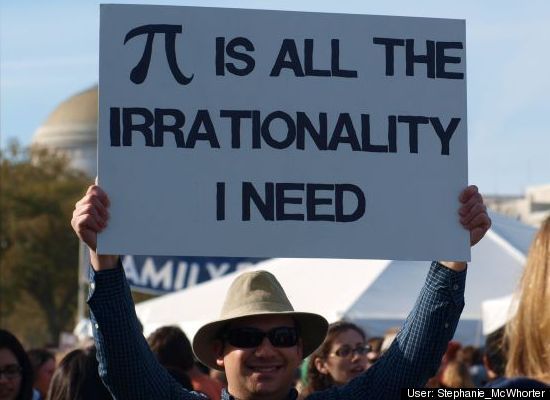
DONNA: I'll DVR it.
Is this the wave of the future?
- Even though watching a sports event on TV gives a better view and reasonably priced food (as opposed to the stadium which gives a terrible view and has overpriced food-like substances) most people say that being AT the game has a certain je ne sais quoi. At least people who think they know French say that. Will technology get SO good that being at home is preferred? Give the viewer the ability to pick what parts of the field he wants to see? Give him the ability to rewind in real time (already can via DVR)? 3-D? (not for a while). They might pay us to go to the game since an empty stadium looks bad for TV.
- Museums: Why go to the Louvre when you can do a virtual reality tour of it which saves you the cost of a trip to France? I think this is possible with today's technology. If not, then certainly soon. There already is a partial virtual tour.
- The rally was really crowded and I couldn't see much. Even so, being there had a certain I know not what which made it worth going. However, I'm glad I DVRed it so I can see what really happened. When I tell my great nieces that I was there at the dawn of a new age it will be partially fiction since I'll tell her of what I saw on DVR. Or I'll just show her the recording. You can also currently see it here.
- Movie Theaters are facing a problem with people waiting for the DVD to come out rather than go to the theater. For families the economics are insane: buying the movie on DVD (and thus OWNING it) costs less than taking the family to see it once. COUNTERPOINTS: (1) Some people want to get out of the house. (2) Lance told me that I really should see AVATAR in a theater.
- With conference talks online will people still go to conferences? (This was already discussed here but it fits today's theme also.)
Will technology make it easier and easier to stay home? I think yes. When that happens you may have some surprises- some Rally has far less people than anticipated because people worry it will be too crowded, but then for the next Rally people think it won't be that crowded so it gets more people than anticipated. Rather than count how many people were actually there you might calculate some weighted sum of how many were there, downloaded it, DVRed it, sign up on the Facebook page for it, etc.
Monday, November 01, 2010
By Any Other Name Would Be Just As Hard
In 1973 Donald Knuth searched for a name for the hardest problems in NP. Steve Cook didn't give a name in his paper and Karp called them P-complete. Knuth suggested three names "Herculean", "Formidable" and "Arduous". He sent out a ballot to people in the theory community and also allowed write-in votes.
The results he put in a SIGACT News Article, a fascinating and hilarious read. Of course Knuth's suggestions didn't fly and he got many quite inventive counter-proposals. My favorite: Hard-Ass Problems (Hard As satisfiability).
The winning solution came from a group at Bell Labs (likely including one of their new hires David Johnson), which you readers should all know as NP-hard and NP-complete. These names did have the advantage that it could generalize to other notions of hardness (like PSPACE-complete).
Knuth muses at the end
The results he put in a SIGACT News Article, a fascinating and hilarious read. Of course Knuth's suggestions didn't fly and he got many quite inventive counter-proposals. My favorite: Hard-Ass Problems (Hard As satisfiability).
The winning solution came from a group at Bell Labs (likely including one of their new hires David Johnson), which you readers should all know as NP-hard and NP-complete. These names did have the advantage that it could generalize to other notions of hardness (like PSPACE-complete).
Knuth muses at the end
NP-hard problems hits lots of people, and that's why I began searching for a special term. In other words, I don't consider it a major goal to invent descriptive terminology for every conceivably interesting question of the type considered here; the major goal is to have a good term to use for the masses, in the one case which experience shows is almost omnipresent. To say NP-hard actually smacks of being a little too technical for a mass audience, but it's not so bad as to be unusable.The importance of the P versus NP problems has reached well beyond the theory community despite its name but I wish Knuth had been more successful in finding a descriptive term. P, NP, NP-hard and NP-complete are technical names that tend to isolate us and confuse others.
Subscribe to:
Posts (Atom)