In one of the hallway discussions of last week's Dagstuhl I learned about an upcoming STOC paper Deciding Parity Games in Quasipolynomial Time by Cristian Calude, Sanjay Jain, Bakhadyr Khoussainov, Wei Li and Frank Stephan. Hugo Gimbert and Rasmus Ibsen-Jensen offer a simplified proof of the correctness of the algorithm.
A Parity Game works as follows: An instance is a finite directed graph where every vertex has at least one outgoing edge, integer weights on the vertices and a designated starting vertex. Alice and Bob take turns choosing the next vertex by following an edge from the current vertex. They play this game infinitely long and Alice wins if the the largest weight seen infinitely often is even. Not trivial to show but the game is determined and memoryless, no matter the graph some player has a winning strategy, and that strategy depends only the current vertex and not the history so far. That puts the problem into NP∩co-NP and unlikely to be NP-complete.
Like graph isomorphism, whether there exists a polynomial-time algorithm to determine the winner of a parity game remains open. Also like graph isomorphism we now have a quasipolynomial-time (exponential in logk) algorithm, an exponential improvement. Parity games have some applications to verification and model checking and some at Dagstuhl claim the problem is more important than graph isomorphism.
One difference: If you had to guess who would make the big breakthrough in graph isomorphism, László Babai would be at the top of your list. But many of the authors of this new parity games paper, like Frank Stephan and Sanjay Jain, focus mostly on computability and rarely worry about time bounds. Their algorithm does have the flavor of a priority argument often found in computability theory results. A nice crossover paper.
Tuesday, March 28, 2017


Thursday, March 23, 2017
The Dagstuhl Family

We had a different ice breaker, where each person wrote topics they think about which ended up looking look like an interesting bipartite graph.

Molly has a few thoughts on Dagstuhl:
The coolest thing about the study of computer science is this place.
Okay, I know my dad would disagree with me (he probably thinks the coolest thing about computer science is the computer science itself). But for me, someone quite removed from the math and science and thinking, this place is by far the coolest thing about the computer science community. The point of it is isolation, as well simultaneous connection. The isolation comes in the form of a meeting center in rural Germany, separated from the world, devices which can (and do) block wifi in rooms like lecture rooms and the dining hall, resulting in a week without much interaction with the outside world. The connection stems from this very isolation -- in this highly isolated place, people are forced to connect with each other face-to-face, and to get to know each other, as well as the ideas and problems people are working on. The isolation creates a heightened sense of community, both in social and intellectual senses of the word. Forced to be so close and so interconnected, it’s no wonder so many problems get solved here.
I’m glad I got to come see why my father has been coming here for a quarter century. He is very old.
Sunday, March 19, 2017
If you want to help your bad students DO NOT give an easy exam
1) When I was a grad student TAing Formal Lang Theory we had a final ready to give out but noticed that one problem was too hard. So we changed it. But we made it too easy. Whoops. My thought at the time was this will help the bad students. I was wrong. Roughly speaking the students who got 70-80 on the midterm now got 90-100 on the final whereas the students who got 30-40 on the midterm got 35-45 on the final. So the bad students improved, but the better students improved more.
2) When I teach Discrete Math to LOTS of students we have a policy about midterm regrade requests. Rather than have them argue in person they have to:
In writing make a clear concise argument as to why it was mis-graded
If your argument displays that you really don't know the material, even when you can reflect on it, you can lose points. (True Story: We ask for an example of a Boolean Function with two satisfying assignments. They gave us a formula with only one, so they got -5. In the regrade request they try to still argue that it has two satisfying assignments. They lost 2 more points.)
In reality the policy is more preventative and we rarely remove points. However even this policy benefits the better students more than the poor ones who have a hard time even articulating why what they wrote is actually right (likely it is not).
3) Just this winter teaching a 3-week 1-credit course we were grading a problem and giving lots of 15/25 since the students were all making the same mistake. Half way through I got suspicious that maybe WE were incorrect. Looking at the exact wording of the question I realized WE were wrong, and, given the wording and what they would quite reasonably think we wanted, they were right. So we went back and upgraded many students from 15 to 25. And again, this lifted students in the 70's to 90's, but did NOTHING for the students below 50 since none of them had anything like a correct answer to any way to view the question.
Okay, so what does all of this mean? It means that an easy exam or a generous grading policy is devastating for the bad students.
However, that's just my experience- what are your experiences with this?
Thursday, March 16, 2017
NP in ZPP implies PH in ZPP
If NP is in ZPP is the entire polynomial-time hierarchy in ZPP? I saw this result used in an old TCS Stackexchange post but I couldn't find a proof (comment if you know a reference). The proof that NP in BPP implies PH in BPP is harder than it looks and NP in BQP implies PH is in BQP is still open as far as I know.
I found a simple proof that NP in ZPP implies PH in ZPP and then an even simpler one.
Assume NP in ZPP. This implies NP in BPP so PH is also in BPP. So we need only show BPP in ZPP.
BPP is in ZPPNP follows directly by Lautemann's proof that BPP is in Σ2P or by the fact that BPP is in MA is in S2P is in ZPPNP. By assumption, BPP in ZPPNP implies BPP in ZPPZPP = ZPP.
And this is even simpler.
ZPP = RP∩co-RP in NP∩co-NP. Σ2P = NPNP in NPZPP (by assumption) in NPNP∩co-NP = NP in ZPP. You can get the higher levels of the hierarchy by an easy induction.
I found a simple proof that NP in ZPP implies PH in ZPP and then an even simpler one.
Assume NP in ZPP. This implies NP in BPP so PH is also in BPP. So we need only show BPP in ZPP.
BPP is in ZPPNP follows directly by Lautemann's proof that BPP is in Σ2P or by the fact that BPP is in MA is in S2P is in ZPPNP. By assumption, BPP in ZPPNP implies BPP in ZPPZPP = ZPP.
And this is even simpler.
ZPP = RP∩co-RP in NP∩co-NP. Σ2P = NPNP in NPZPP (by assumption) in NPNP∩co-NP = NP in ZPP. You can get the higher levels of the hierarchy by an easy induction.
Monday, March 13, 2017
Other fields of math don't prove barrier results- why do we?
Before FLT was solved did some people prove theorems like:
FLT cannot be proven using techniques BLAH. This is important since all current proofs use BLAH.
I do not believe so.
Replace FLT with Goldbach's conjectures or others and I do not believe there were ever such papers.
I have sometimes seen a passing reference like `the techniques of this paper cannot get past BLAH but it was not dwelled on. The most striking example of this (and what got me to right this post) was the
Erdos Distance Problem (see here)--- when the result Omega( n^{ (48-14e)/(55-16e) - epsilon}) was shown I heard it said that this was as far as current techniques could push it. And then 11 years later the result Omega(n/log n) was proven. I asked around and YES the new paper DID use new techniques. But there was not the same kind of excitement I here when someone in TCS uses new techniques (e.g., IP=PSPACE used techniques that did not relativize!!!!!!!!)
With P vs NP and other results we in TCS DO prove theorems and have papers like that. I am NOT being critical-- I am curious WHY we do this and other fields don't. Some options
1) Bill is WRONG- other fields DO do this- see BLAH. Actually proof theory, and both the recursive math program and the reverse math program DID look into `does this theorem require this technique' but this was done for theorems that were already proven.
2) Bill is WRONG- we are not that obsessed with barrier results.
3) P vs NP is SO HARD that we are forced into considering why its hard. By contrast there has been progress on FLT and Goldbach over time. Rather than ponder that they NEED new techniques they went out and FOUND new techniques. Our inability to do that with P vs NP might be because it's a harder problem- though we'll know more about that once its solved (in the year 3000).
4) P vs NP is closer to logic so the notion of seeing techniques as an object worth studying is more natural to them.
What do you think?
FLT cannot be proven using techniques BLAH. This is important since all current proofs use BLAH.
I do not believe so.
Replace FLT with Goldbach's conjectures or others and I do not believe there were ever such papers.
I have sometimes seen a passing reference like `the techniques of this paper cannot get past BLAH but it was not dwelled on. The most striking example of this (and what got me to right this post) was the
Erdos Distance Problem (see here)--- when the result Omega( n^{ (48-14e)/(55-16e) - epsilon}) was shown I heard it said that this was as far as current techniques could push it. And then 11 years later the result Omega(n/log n) was proven. I asked around and YES the new paper DID use new techniques. But there was not the same kind of excitement I here when someone in TCS uses new techniques (e.g., IP=PSPACE used techniques that did not relativize!!!!!!!!)
With P vs NP and other results we in TCS DO prove theorems and have papers like that. I am NOT being critical-- I am curious WHY we do this and other fields don't. Some options
1) Bill is WRONG- other fields DO do this- see BLAH. Actually proof theory, and both the recursive math program and the reverse math program DID look into `does this theorem require this technique' but this was done for theorems that were already proven.
2) Bill is WRONG- we are not that obsessed with barrier results.
3) P vs NP is SO HARD that we are forced into considering why its hard. By contrast there has been progress on FLT and Goldbach over time. Rather than ponder that they NEED new techniques they went out and FOUND new techniques. Our inability to do that with P vs NP might be because it's a harder problem- though we'll know more about that once its solved (in the year 3000).
4) P vs NP is closer to logic so the notion of seeing techniques as an object worth studying is more natural to them.
What do you think?
Thursday, March 09, 2017
The Beauty of Computation
Lisa Randall wrote a New York Times book review of Carlo Rovelli's Reality Is Not What It Seems with some interesting responses. I want to focus on a single sentence from Randall's review.
Likewise the P versus NP question remains the same under any reasonable computational model. Russell Impagliazzo goes further in his description of his world Algorithmica.
That's why I am not a huge fan of results that are so specific to a single model, like finding the fewest number of states for a universal Turing machine. I had an email discussion recently about the busy beaver function which I think of in general terms: a mapping from some notion of program size to program output as opposed to some precise definition. I find the concept incredibly interesting and important, no one should care about the exact values of the function.
We need the formal definitions to prove theorems but we really care about the conceptual meaning.
Maybe that's what separates us from the physicists. They want precise definitions to capture their conceptual ideas. We want conceptual ideas that transcend formal definitions.
The beauty of physics lies in its precise statements, and that is what is essential to convey.I can't speak for physics but I couldn't disagree more when it comes to computation. It's nice we have formal models, like the Turing machine, for that gives computation a firm mathematical foundation. But computation, particularly a computable function, transcend the model and remain the same no matter what reasonable model of computation or programming language you wish to use. This is the Church-Turing thesis, exciting exactly because it doesn't have a formality that we can prove or disprove.
Likewise the P versus NP question remains the same under any reasonable computational model. Russell Impagliazzo goes further in his description of his world Algorithmica.
Algorithmica is the world in which P = NP or some moral equivalent, e.g. NP in BPP [probabilistic polynomial time].In other words the notion of easily finding checkable solutions transcends even a specifically stated mathematical question.
That's why I am not a huge fan of results that are so specific to a single model, like finding the fewest number of states for a universal Turing machine. I had an email discussion recently about the busy beaver function which I think of in general terms: a mapping from some notion of program size to program output as opposed to some precise definition. I find the concept incredibly interesting and important, no one should care about the exact values of the function.
We need the formal definitions to prove theorems but we really care about the conceptual meaning.
Maybe that's what separates us from the physicists. They want precise definitions to capture their conceptual ideas. We want conceptual ideas that transcend formal definitions.
Monday, March 06, 2017
why are regular expressions defined the way they are
BILL: The best way to prove closure properties of regular languages is to first prove the equiv of DFA's, NDFA's and Reg Expressions. Then, if you want to prove a closure property, choose the definition of regular that makes it easiest. For example, to prove Reg Langs closed under intersection I would use DFA's, NOT Reg Expressions.
STUDENT: I thought reg expressions were
a) finite sets
b) if alpha and beta are reg exp then so are alpha UNION beta, alpha INTERSECT beta, alpha CONCAT beta and alpha*
BILL: No. Regular expressions are defined just using UNION, CONCAT, and *.
STUDENT: Why? Had the defined it my way then closure under INTERSECTION would be easier. For that matter toss in COMPLIMENTATION and you're get that easily also.
BILL: First off, thats not quite right. You compliment a DFA by saying how lovely its states are. I think you mean complement. Second off, GOOD question!- Why are Reg Expressions defined the way they are. I"ll try to look that up and if I can't find anything I'll blog about it.
STUDENT: When will you blog about it?
BILL: I just did. Now, let me ask the question more directly:
The definition of Reg Exp is essentially closure under UNION, CONCAT, STAR. Why not other things? There are very broadly three possibilities:
a) Historical Accident.
b) Some good math or CS reason for it.
c) Something else I haven't thought of.
I hope its (b). Moreover, I hope one of my readers knows and can enlighten me and the other readers.
Thursday, March 02, 2017
International Science
I did some counting and the 35 academic faculty members in the Georgia Tech School of Computer Science come from 14 different countries. My co-authors come from at least 20 different nations. My 10 successful PhD students hail from 7 different countries. I have benefited immensely from global collaborations thanks to relatively open borders and communication during most of my academic career and I am hardly the only academic who has done so.
I'm old enough to remember the days of the cold war where travel between East and West was quite difficult. We had considerable duplication of effort--many important theorems were proven independently on both sides of the iron curtain but even worse ideas took a long time to permeate from one side to the other. We could not easily build on each other's work. Science progressed slower as a result. Pushing back the boundaries of science is not a zero-sum game, quite the opposite--we can only grow knowledge. We grow that knowledge much faster working together.
As the United States and other countries take on a more nationalistic point of view, we'll see fewer people travel, fewer people willing or even able to spend significant parts of their career in other countries. We will (hopefully) continue to have an open Internet so information will still flow but nothing can replace the focus of face-to-face collaboration to share ideas and create new ones.
The real loss for America will be an invisible one: the students who won't be coming here to study and later become our professors, scientists and colleagues, to make our universities, industries and society stronger. Sad.
I'm old enough to remember the days of the cold war where travel between East and West was quite difficult. We had considerable duplication of effort--many important theorems were proven independently on both sides of the iron curtain but even worse ideas took a long time to permeate from one side to the other. We could not easily build on each other's work. Science progressed slower as a result. Pushing back the boundaries of science is not a zero-sum game, quite the opposite--we can only grow knowledge. We grow that knowledge much faster working together.
As the United States and other countries take on a more nationalistic point of view, we'll see fewer people travel, fewer people willing or even able to spend significant parts of their career in other countries. We will (hopefully) continue to have an open Internet so information will still flow but nothing can replace the focus of face-to-face collaboration to share ideas and create new ones.
The real loss for America will be an invisible one: the students who won't be coming here to study and later become our professors, scientists and colleagues, to make our universities, industries and society stronger. Sad.
Sunday, February 26, 2017
Should we learn from the Masters or the Pupils (Sequel)
A while back I had a blog entry Should we learn from the Masters of the Pupils? The Masters may have more insights but he Pupils may have a better view aided by a modern viewpoint.
Sometimes the Masters are in a different language or not in the modern style but you still want to know what they did and why. As I blogged about earlier (See here) Villarino/Gasarch/Regan have a paper which explains Hilbert's Proof of Hilbert's Irreducibility Theorem (see) Tao has a paper on Szemeredi's Proof of Szemeredi's Theorem (on Tao's webpage: here). Villarino has a paper on Merten's Proof of Merten's Theorem (here).
Mark Villarino read that blog entry (good to know someone did!) and then presented me with MANY examples where the MASTER is worth reading, which I present to you. For all of them reading a well written exposition of what the Master did would also be good (as good? better?) if such exists.
Here is his letter with a few of my comments.
I would suggest the following examples where the original teaches and illuminates more than the modern slick version:
1. Euclid's proof of the Pythagorean Theorem (and its converse). Indeed, once you understand the diagram, the proof is immediate and beautiful. See here.
2. Gauss' first proof (by induction) of quadratic reciprocity. If you REALLY read it, you see how Gauss was led to the proof by numerous specific examples and it is quite natural. It is a marvelous example of how numerical examples inspired the structure of the induction proof. (BILL COMMENT: Here is a Masters Thesis in Math that has the proof and lots of context and other proofs of QR: here)
3. Gauss' first proof of the fundamental theorem of algebra. The real and imaginary parts of the polynomial must vanish simultaneously. However the graph of each is a curve in the plane, and so the two curves must intersect at some point. Gauss explicitly finds a circle which contains the parts of the two curves which intersect in the roots of the polynomial. The proof of the existence of a point of intersection is quite clever and natural, although moderns might quibble. In an appendix he gives a numerical example (BILL COMMENT- Sketch of the first proof of FTOA that I ever saw: First show that the complex numbers C and the punctured plane C- {(0,0)} have different fundamental groups (The fund group of C is trivial, the fund group of C-{(0,0)} is Z,the integers.) Hence there can't be an X-morphism from C to C-{(0,0)} (I forget which X it is). If there is a poly p in C[x] with no roots in C then the map x --> 1/p(x) is an X-morphism. Contradiction. Slick but not clear what it has to to with polynomials. A far cry from the motivated proof by Gauss.)
4. Abel's proof, in Crelle's Journal, of the impossibility of solving a quintic equation by radicals. Abel explores the properties that a "formula" for the root any algebraic equation must have, for example that if you replace any of its radicals by a conjugate radical, the new formula must also identically satisfy the equation, in order to deduce that the formula cannot exist Yes, it has a few correctable errors, but the idea is quite natural. (BILL's COMMENT- proof- sounds easier than what I learned, and more natural. There is an exposition in English here. I have to read this since I became a math major just to find out why there is no quintic equation.)
5. Jordan's proof of the Jordan curve theorem. His idea is to go from the theorem for polygons to then approximate the curve by a polygon and carry the proof over to the curve by a suitable limiting process. See here for a paper on Jordan's proof of the Jordan Curve theorem.
6. Godel's 1948 paper on his rotating universe solution to the Einstein Field Equations. Although his universe doesn't allow the red-shift, it DOES allow time travel! The paper is elegant, easy to read, and should be read (in my opinion) by any mathematics student. (Added later- for the paper see here)
7. Einstein's two papers on special/general relativity. There are english translations. They are both elegantly written and are much better than the later "simplifications" by text-book writers. I was amazed at how natural his ideas are and how clearly and simply they are presented in the papers. English Translation here
8. Lagrange's Analytical Mechanics. There is now an english translation. What can I say? It is beautiful. Available in English here.
9. I add "Merten's proof of Merten's theorem" to the list of natural instructive original proofs. His strategy is quite natural and the details are analytical fireworks. (BILL COMMENT- as mentioned above there is an exposition in English of Merten's proof.)
I could go on, but these are some standouts.
BILL COMMENT: So, readers, feel free to ad to this list!
BILL COMMENT: So, readers, feel free to ad to this list!
Thursday, February 23, 2017
Ken Arrow and Oscars Voting
Kenneth Arrow, the Nobel Prize winning economist known for his work on social choice and general equilibrium, passed away Tuesday at the age of 95.
I can't cover Arrow's broad influential work in this blog post even if I were an economist but I would like to talk about Ken Arrow's perhaps best known work, his impossibility theorem for voting schemes. If you have at least three candidates, there is no perfect voting method.
Suppose a group of voters give their full rankings of three candidates, say "La La Land", "Moonlight" and "Manchester by the Sea" and you have some mechanism that aggregates these votes and chooses a winner.
Now suppose we want a mechanism to have two fairness properties (for every pair of movies):
Arrow shows these are the only mechanisms that fulfill the properties: There is no non-dictatorial voting system that has the fairness properties above.
Most proofs of Arrow's theorem are combinatorial in nature. In 2002 Gil Kalai gave a clever proof based on Boolean Fourier analysis. Noam Nisan goes over this proof in a 2009 blog post.
Arrow's theorem that no system is perfect doesn't mean that some systems aren't better than others. The Oscars use a reasonably good system known as Single Transferable Voting. Here is a short version updated from a 2016 article.
Maybe the Oscars should just let Emma Watson choose the winner.
I can't cover Arrow's broad influential work in this blog post even if I were an economist but I would like to talk about Ken Arrow's perhaps best known work, his impossibility theorem for voting schemes. If you have at least three candidates, there is no perfect voting method.
Suppose a group of voters give their full rankings of three candidates, say "La La Land", "Moonlight" and "Manchester by the Sea" and you have some mechanism that aggregates these votes and chooses a winner.
Now suppose we want a mechanism to have two fairness properties (for every pair of movies):
- If every voter prefers "Moonlight" to "La La Land" then the winner should not be "La La Land".
- If the winner is "Moonlight" and some voters change their ordering between "La La Land" and "Manchester by the Sea" then "Moonlight" is still the winner (independence of irrelevant alternatives).
Arrow shows these are the only mechanisms that fulfill the properties: There is no non-dictatorial voting system that has the fairness properties above.
Most proofs of Arrow's theorem are combinatorial in nature. In 2002 Gil Kalai gave a clever proof based on Boolean Fourier analysis. Noam Nisan goes over this proof in a 2009 blog post.
Arrow's theorem that no system is perfect doesn't mean that some systems aren't better than others. The Oscars use a reasonably good system known as Single Transferable Voting. Here is a short version updated from a 2016 article.
For the past 83 years, the accounting firm PricewaterhouseCoopers has been responsible for tallying the votes, and again this year partners Martha Ruiz and Brian Cullinan head up the operation. The process of counting votes for Best Picture isn't as simple as one might think. According to Cullinan, each voter is asked to rank the nine nominated films 1-9, one being their top choice. After determining which film garnered the least number of votes, PWC employees take that title out of contention and look to see which movie each of those voters selected as their second favorite. That redistribution process continues until there are only two films remaining. The one with the biggest pile wins. "It doesn’t necessarily mean that who has the most number one votes from the beginning is ensured they win," he added. "It’s not necessarily the case, because going through this process of preferential voting, it could be that the one who started in the lead, doesn’t finish in the lead."Another article explicitly asks about strategic voting.
So if you’re a big fan of “Moonlight” but you’re scared that “La La Land” could win, you can help your cause by ranking “Moonlight” first and “La La Land” ninth, right?
Wrong. That won’t do a damn thing to help your cause. Once you rank “Moonlight” first, your vote will go in the “Moonlight” stack and stay there unless “Moonlight” is eliminated from contention. Nothing else on your ballot matters as long as your film still has a chance to win. There is absolutely no strategic reason to rank your film’s biggest rival last, unless you honestly think it’s the worst of the nominees.Arrow's theorem says there must be a scenario where you can act strategically. It might make sense for this fan to put "Fences" as their first choice to potentially knock out "La La Land" in an early round. A similar situation knocked out Chicago from hosting the 2016 Olympics.
Maybe the Oscars should just let Emma Watson choose the winner.
Sunday, February 19, 2017
The benefits of Recreational Mathematics
Why study Recreational Mathematics?
Why do recreational Mathematics?
1) The line between recreational and serious mathematics is thin. Some of the problems in so-called recreational math are harder than they look.
2) Inspiring. Both Lance and I were inspired by books by Martin Gardner, Ray Smullyan, Brian Hayes, and others.
3) Pedagogical: Understanding Godel's Inc. theorem via the Liar's paradox (Ray S has popularized that approach) is a nice way to teach the theorem to the layperson (and even to non-laypeople).
4) Rec math can be the starting point for so-called serious math. The Konigsberg bridge problem was the starting point for graph theory, The fault diagnosis problem is a generalization of the Truth Tellers and Normals Problem. See here for a nice paper by Blecher on the ``recreational'' problem of given N people of which over half are truth tellers and the rest are normals, asking questions of the type ``is that guy a normal'' to determine whose who. See here for my writeup of the algorithm for a slightly more general problem. See William Hurwoods Thesis: here for a review of the Fault Diagnosis Literature which includes Blecher's paper.
I am sure there are many other examples and I invite the readers to write of them in the comments.
5) Rec math can be used to inspire HS students who don't quite have enough background to do so-called serious mathematics.
This post is a bit odd since I cannot imagine a serious counter-argument; however, if you disagree, leave an intelligent thoughtful comment with a contrary point of view.
Why do recreational Mathematics?
1) The line between recreational and serious mathematics is thin. Some of the problems in so-called recreational math are harder than they look.
2) Inspiring. Both Lance and I were inspired by books by Martin Gardner, Ray Smullyan, Brian Hayes, and others.
3) Pedagogical: Understanding Godel's Inc. theorem via the Liar's paradox (Ray S has popularized that approach) is a nice way to teach the theorem to the layperson (and even to non-laypeople).
4) Rec math can be the starting point for so-called serious math. The Konigsberg bridge problem was the starting point for graph theory, The fault diagnosis problem is a generalization of the Truth Tellers and Normals Problem. See here for a nice paper by Blecher on the ``recreational'' problem of given N people of which over half are truth tellers and the rest are normals, asking questions of the type ``is that guy a normal'' to determine whose who. See here for my writeup of the algorithm for a slightly more general problem. See William Hurwoods Thesis: here for a review of the Fault Diagnosis Literature which includes Blecher's paper.
I am sure there are many other examples and I invite the readers to write of them in the comments.
5) Rec math can be used to inspire HS students who don't quite have enough background to do so-called serious mathematics.
This post is a bit odd since I cannot imagine a serious counter-argument; however, if you disagree, leave an intelligent thoughtful comment with a contrary point of view.
Thursday, February 16, 2017
Liberatus Wins at Poker
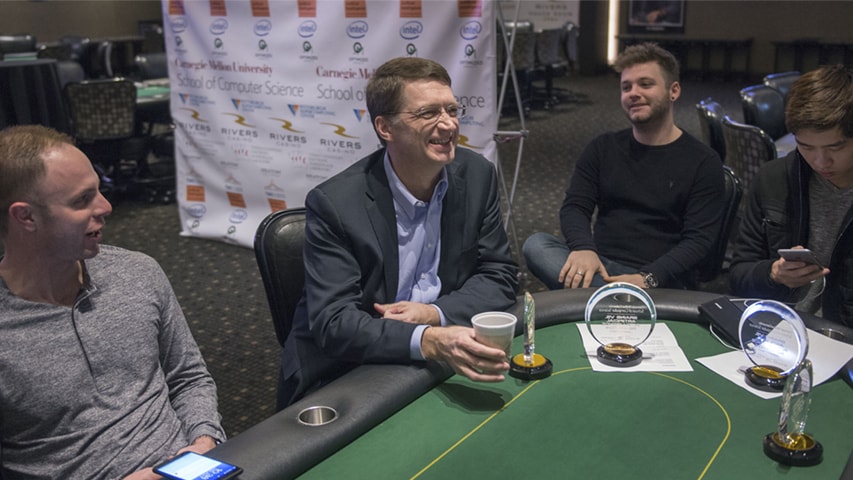 |
| Tuomas Sandholm (center) and Ph.D. student Noam Brown (via CMU) |
For those unfamiliar with Texas hold 'em
Two cards, known as the hole cards or hold cards, are dealt face down to each player, and then five community cards are dealt face up in three stages. The stages consist of a series of three cards ("the flop"), later an additional single card ("the turn") and a final card ("the river"). Each player seeks the best five card poker hand from the combination of the community cards and their own hole cards. Players have betting options to check, call, raise or fold. Rounds of betting take place before the flop is dealt, and after each subsequent deal.Unlike the computers that defeated the best humans in chess, Jeopardy and go, Liberatus comes directly from academia, from Tuomas Sandholm and his student Noam Brown at Carnegie-Mellon.
Unlike chess and go, poker is a game of incomplete information in many forms.
- Information both players have: the community cards already played.
- Information only one player has: the hole card
- Information neither player has: the community cards yet to be played.
Betting in poker plays the primary role of raising the stakes but betting can also signal what hole cards you have. Players can bluff (betting large amounts without a corresponding strong hand), trying to cause other players to misread the signal. There is no perfect play in poker, just a mixed equilibrium though we still don't know how to compute the equilibrium and even if we could we might deviate from the equilibrium to gain an advantage. Deviating also make you vulnerable.
All of this makes poker a far more complicated game for computers to tackle. But through persistence and new tools in machine learning, Sandholm and Brown have found success.
If history holds up, it won't be long before we have champion-caliber poker apps on our phones. Will we see cheating like has been happening in chess? Will online poker sites just disappear?
What is the next great game to fall to computers? I'm guessing NASCAR.
Monday, February 13, 2017
Raymond Smullyan: Logician, Recreational math writer, Philosopher, passed away
Raymond Smullyan was born on May 25 1919 and passed away recently at the age of 97. He was a logician (PhD from Princeton under Alonzo Church in 1959) who did serious, recreational, and philosophical work. I doubt he invented the truth-teller/liar/normals and knight/knave/Knormal problems, but he popularized them and (I suspect) pushed them further than anyone before him.
He was active all of his life:
His last book on Logic Puzzles, The Magic Garden of George B and other Logic Puzzles was published in 2015. Wikipedia lists 14 books on logical puzzles, from 1978 untl 2015.
His last book classified (on Wikipedia) as Philosophy/Memoir, A Mixed Bag: Jokes, Riddles, Puzzles, and Memorabilia was published in 2016. Wikipedia lists 8 books in this category, from 1977 until 2016.
His last Academica book, A beginners further guide to mathematical logic was published in 2016. (It was a sequel to his 2014 A beginners guide to mathematical logic.) Wikipedia lists 8 books in this category, from 1961 to 2016.
Recreational Work:
His recreational work was of the Knights/Knaves/Knormals/Sane/Insane/ variety.a
Knights always tell the truth.
Knaves always lie,
Knormals may tell the truth or lie.
Insane people only believe false things,
Sane people only believe true things.
He also added a complication: a species that says ALPHA and BETA for YES and NO but
you don't know which of ALPHA, BETA means YES and which one means NO.
Note that a truth teller Insane Knight will answer YES to 1+1=3.
He invented (discovered?) the so called hardest logic puzzle ever. He wrote many books on recreational math. We mention four of them that show the line between recreational and serious mathematics is thin.
He was active all of his life:
His last book on Logic Puzzles, The Magic Garden of George B and other Logic Puzzles was published in 2015. Wikipedia lists 14 books on logical puzzles, from 1978 untl 2015.
His last book classified (on Wikipedia) as Philosophy/Memoir, A Mixed Bag: Jokes, Riddles, Puzzles, and Memorabilia was published in 2016. Wikipedia lists 8 books in this category, from 1977 until 2016.
His last Academica book, A beginners further guide to mathematical logic was published in 2016. (It was a sequel to his 2014 A beginners guide to mathematical logic.) Wikipedia lists 8 books in this category, from 1961 to 2016.
Recreational Work:
His recreational work was of the Knights/Knaves/Knormals/Sane/Insane/ variety.a
Knights always tell the truth.
Knaves always lie,
Knormals may tell the truth or lie.
Insane people only believe false things,
Sane people only believe true things.
He also added a complication: a species that says ALPHA and BETA for YES and NO but
you don't know which of ALPHA, BETA means YES and which one means NO.
Note that a truth teller Insane Knight will answer YES to 1+1=3.
He invented (discovered?) the so called hardest logic puzzle ever. He wrote many books on recreational math. We mention four of them that show the line between recreational and serious mathematics is thin.
To Mock a Mockingbird. This book has logic puzzles based on combinatory logic. Is that really recreational?
Forever Undecided. This book introduces the layperson to Godel's theorem.
Logical Labyrinths. This is a textbook for a serious logic course that uses puzzles to teach somewhat serious logic. It was published in 2009 when he was only 89 years old.
A Personal Note: I read the following, from his
The Lady or the Tiger, when I was in high school, and I still don't know the answer!:
My brother told me he would fool me on April Fools Day. I lay awake that night wondering how he would fool me. All day I was worried how he would fool me. At midnight I asked him Hey, you said you would fool me but you didn't He replied April Fools!. To this day I don't know if I was fooled or not.
Serious Math Work. His serious work included the Double Recursion Theorem. (you can write two programs that know both their indices and each others indices) and other theorem in logic. (ADDED LATER: Lipton and Regan have a blog post with lots of great information about Ray S's serious math work here.)
Philosophy. I'm not qualified to comment on this; however, it looks like he did incorporate his knowledge of logic.
Looking over his books and these points it seems odd to classify his books as the recreational books had some serious logic in them, and the academic books had some math that a layperson could understand
I think its rarer now to do both recreational and serious mathematics, though I welcome intelligent debate on this point.
Before he died, was he the oldest living mathematician? No- Richard Guy is 100 years old. wikipedia claims that Guy is still an active math Guy. Is he the oldest living mathematican? The oldest living active mathematician? It was hard to find out on the web so I ask you.
I think its rarer now to do both recreational and serious mathematics, though I welcome intelligent debate on this point.
Before he died, was he the oldest living mathematician? No- Richard Guy is 100 years old. wikipedia claims that Guy is still an active math Guy. Is he the oldest living mathematican? The oldest living active mathematician? It was hard to find out on the web so I ask you.
Thursday, February 09, 2017
The Dichotomy Conjecture
Note (8/19/17): The authors have retracted their claim following the discovery of a counterexample by Ross Willard. However, there has been other progress on the dichotomy conjecture as explained in Process Algebra Diary.
Original Post:
Arash Rafiey, Jeff Kinne and Tomás Feder settle the Feder-Vardi dichotomy conjecture in their paper Dichotomy for Digraph Homomorphism Problems. Jeff Kinne is my academic grandchild--how quickly they grow up.
Keep in mind the usual caveat that this work has not yet been fully refereed and vetted by the community, though there is no reason to think it won't be (though some skepticism in the comments).
A homomorphism from a graph G = (V,E) to H=(V',E') is a function f:V→V' such that if (u,v) is in E then (f(u),f(v)) is in E'. For a fixed graph H, define L(H) as the set of graphs G such that there is a homomorphism from G to H.
If H is just a single edge then L(H) is the set of bipartite graphs. If H is a triangle then L(H) is the set of 3-colorable graphs. If H has a self-loop then L(H) is the set of all graphs.
L(H) is always in NP by guessing the homomorphism. In 1990 Pavol Hell and Jaroslav Nešetřil showed the following dichotomy result: If H is bipartite or has a self-loop then L(H) is computable in polynomial-time, otherwise L(H) is NP-complete. There are no undirected graphs H such that L(H) is not in P or NP-complete.
In 1998 Tomás Feder and Moshe Vardi conjectured that even for all directed graphs H, L(H) is either in P or NP-complete. Rafiey, Kinney and Feder settle the conjecture by showing a polynomial-time algorithm for a certain class of digraphs H.
Details in the paper.
Original Post:
Arash Rafiey, Jeff Kinne and Tomás Feder settle the Feder-Vardi dichotomy conjecture in their paper Dichotomy for Digraph Homomorphism Problems. Jeff Kinne is my academic grandchild--how quickly they grow up.
Keep in mind the usual caveat that this work has not yet been fully refereed and vetted by the community, though there is no reason to think it won't be (though some skepticism in the comments).
A homomorphism from a graph G = (V,E) to H=(V',E') is a function f:V→V' such that if (u,v) is in E then (f(u),f(v)) is in E'. For a fixed graph H, define L(H) as the set of graphs G such that there is a homomorphism from G to H.
If H is just a single edge then L(H) is the set of bipartite graphs. If H is a triangle then L(H) is the set of 3-colorable graphs. If H has a self-loop then L(H) is the set of all graphs.
L(H) is always in NP by guessing the homomorphism. In 1990 Pavol Hell and Jaroslav Nešetřil showed the following dichotomy result: If H is bipartite or has a self-loop then L(H) is computable in polynomial-time, otherwise L(H) is NP-complete. There are no undirected graphs H such that L(H) is not in P or NP-complete.
In 1998 Tomás Feder and Moshe Vardi conjectured that even for all directed graphs H, L(H) is either in P or NP-complete. Rafiey, Kinney and Feder settle the conjecture by showing a polynomial-time algorithm for a certain class of digraphs H.
Details in the paper.
Sunday, February 05, 2017
The Hardness of Reals Hierarchy
In my last post (here) I defined the following hierarchy (which I am sure is not original- if someone has a source please leave a comment on it)
Z_d[x] is the set of polys of degree d over Z (the integers)
ALG_d is the set of roots of these polys.
ALG_1 = Q (The rationals)
Given a real alpha I think of its complexity as being the least d such that alpha is in ALG_d. This is perhaps a hierarchy of hardness of reals (though there are an uncountable number of reals that are NOT in any ALG_d.)
I then said something like
Clearly
ALG_1 PROPER SUBSET ALG_2 PROPER SUBSET ALG_3 etc.
But is that obvious?
``Clearly'' 2^{1/d} is not in ALG_{d-1}. And this is not a trick- YES 2^{1/d} is NOT in ALG_{d-1} But how would you prove that. My first thought was `I'll just use Galois theory' And I am sure I could dust off my Galois theory notes (I had the course in 1978 so the notes are VERY dusty) and prove it. But is there an elementary proof. A proof a High School Student could understand.
How to find out? Ask a bright high school student to prove it! Actually I asked a Freshman Math Major who is very good, Erik Metz. I thought he would find a proof, I would post about it asking if it was known, and I would get comments telling me that OF COURSE its known but not give me a reference (have I become cynical from years of blogging. Yes.)
But that's not what happened. Erik had a book Problems from the Book by Dospinescu and Andreescu that has in it a lovely elementary proof (it uses Linear Algebra) that 2^{1/d} is NOT in ALG_{d-1}.
Hence the hardness of reals hierarchy is proper. For a write up of just the proof that
7^{1/3} is not in ALG_2 (which has most of the ideas) see this writeup
Z_d[x] is the set of polys of degree d over Z (the integers)
ALG_d is the set of roots of these polys.
ALG_1 = Q (The rationals)
Given a real alpha I think of its complexity as being the least d such that alpha is in ALG_d. This is perhaps a hierarchy of hardness of reals (though there are an uncountable number of reals that are NOT in any ALG_d.)
I then said something like
Clearly
ALG_1 PROPER SUBSET ALG_2 PROPER SUBSET ALG_3 etc.
But is that obvious?
``Clearly'' 2^{1/d} is not in ALG_{d-1}. And this is not a trick- YES 2^{1/d} is NOT in ALG_{d-1} But how would you prove that. My first thought was `I'll just use Galois theory' And I am sure I could dust off my Galois theory notes (I had the course in 1978 so the notes are VERY dusty) and prove it. But is there an elementary proof. A proof a High School Student could understand.
How to find out? Ask a bright high school student to prove it! Actually I asked a Freshman Math Major who is very good, Erik Metz. I thought he would find a proof, I would post about it asking if it was known, and I would get comments telling me that OF COURSE its known but not give me a reference (have I become cynical from years of blogging. Yes.)
But that's not what happened. Erik had a book Problems from the Book by Dospinescu and Andreescu that has in it a lovely elementary proof (it uses Linear Algebra) that 2^{1/d} is NOT in ALG_{d-1}.
Hence the hardness of reals hierarchy is proper. For a write up of just the proof that
7^{1/3} is not in ALG_2 (which has most of the ideas) see this writeup
Thursday, February 02, 2017
We Are All Iranians
 |
| A solidarity rally held at Georgia Tech today |
We have nine Iranian Ph.D. students. It was already difficult for them to leave the US and return and with the new executive order essentially impossible, even for family emergencies. One expressed disappointment “Why did we even bother to come to the United States to study?”
We also have a young Iranian professor, a very successful computer architect and my first hire as chair, in the final stage before getting his green card now on hold. If things don’t change he and his wife may be forced to leave the country they now call home. That would be a huge loss for Georgia Tech and the United States.
This is not the America I believe in.
Sunday, January 29, 2017
What was the first result in complexity theory?
Let Z_d[x] be the set of polynomials of degree d over the integers.
Let ALG_d be the set of roots of polys in Z_d.
One can easily show that
ALG_1 is a proper subset ALG_2is a proper subset ...
and that there are numbers not in any of the ALG_i (by a countability argument).
I began my ugrad automata theory course with this theorem (also a good review of countability- I found out, NOT to my surprise, that they never really understood it as freshman taking Discrete Math, even the good students.)
I presented this as the first theorem in complexity.
But is it? I suspect that the question What was the first result in complexity?
has no real answer, but there are thoughts:
Complexity theory is about proving that you can't do BLAH with resource bound BLAHBLAH.. We will distinguish it from Computability theory by insisting that the things we want to compute are computable; however, if someone else wants to argue that (say) HALT is undecidable is the first result in complexity, I would not agree but I would not argue against it.
Here are other candidates:
1) sqrt(2) is irrational. This could be considered a result in descriptive complexity theory.
2) The number of primes is infinite. If you view `finite' as a complexity class then this takes PRIMES out of that class.
3) You cannot, with ruler and compass, trisect an angle, square a circle, or double a cube. This seems very close to the mark--- one can view ruler-and-compass as a well defined model of computation and these are lower bounds in that model.
4) There is no quintic equation. Also close to the mark as this is a well defined lower bound.
5) In the early 60s the definition of P (Cobram) and of DTIME, etc (Hartmanis-Stearns). The result I would point to is the time hiearchy theorem. While these results are much later than those above, they are also far closer to our current notion of complexity.
6) I'm not sure which paper to point to, but Knuth's observation that one can analyse algorithms without running them. This is more algorithms than complexity, but at this level the distinction may be minor.
7) Cook-Levin Theorem. Probably not the first theorem in Complexity, but certainly a big turning point.
I urge you to comment with other candidates!
Let ALG_d be the set of roots of polys in Z_d.
One can easily show that
ALG_1 is a proper subset ALG_2is a proper subset ...
and that there are numbers not in any of the ALG_i (by a countability argument).
I began my ugrad automata theory course with this theorem (also a good review of countability- I found out, NOT to my surprise, that they never really understood it as freshman taking Discrete Math, even the good students.)
I presented this as the first theorem in complexity.
But is it? I suspect that the question What was the first result in complexity?
has no real answer, but there are thoughts:
Complexity theory is about proving that you can't do BLAH with resource bound BLAHBLAH.. We will distinguish it from Computability theory by insisting that the things we want to compute are computable; however, if someone else wants to argue that (say) HALT is undecidable is the first result in complexity, I would not agree but I would not argue against it.
Here are other candidates:
1) sqrt(2) is irrational. This could be considered a result in descriptive complexity theory.
2) The number of primes is infinite. If you view `finite' as a complexity class then this takes PRIMES out of that class.
3) You cannot, with ruler and compass, trisect an angle, square a circle, or double a cube. This seems very close to the mark--- one can view ruler-and-compass as a well defined model of computation and these are lower bounds in that model.
4) There is no quintic equation. Also close to the mark as this is a well defined lower bound.
5) In the early 60s the definition of P (Cobram) and of DTIME, etc (Hartmanis-Stearns). The result I would point to is the time hiearchy theorem. While these results are much later than those above, they are also far closer to our current notion of complexity.
6) I'm not sure which paper to point to, but Knuth's observation that one can analyse algorithms without running them. This is more algorithms than complexity, but at this level the distinction may be minor.
7) Cook-Levin Theorem. Probably not the first theorem in Complexity, but certainly a big turning point.
I urge you to comment with other candidates!
Thursday, January 26, 2017
60 years of Eric and Mike

 As I checked in at the Holiday Inn in New Brunswick Wednesday night, they asked me if I had stayed there before. I said it has been a while and they looked in their computer: October 2007. I was last at DIMACS for the Workshop on the Boundary between Economic Theory and Computer Science, the closing workshop of the Special Focus on Computation and the Socio-Economic Sciences which Rakesh Vohra and I had organized. DIMACS, the Center for Discrete Math and Computer Science at Rutgers, started as an NSF center and I went often, even serving on the executive committee when I worked at NEC in the early 2000's. So an odd feeling to be back after ten years.
But back for a good reason, the DIMACS Workshop on E+M=C2, the joint 60th birthday celebration for Rutgers Professors Eric Allender and Michael Saks. A great turnout of Eric and Mike's former colleagues and students. I've known both Eric and Mike for many years but it is Eric I've had the closest connections to. Eric and I share many research interests, especially in Kolmogorov complexity. I took over from Eric as chair of the Computational Complexity conference and Eric took over from me as editor-in-chief of ACM Transactions on Computation Theory. Combined we've attended 61 of the 31 complexity conferences so far (I missed 2012 in Porto) and many Dagstuhl workshops and other meetings together on four continents. But we've oddly enough never co-authored.
Congrats to Eric and Mike and their careers worth savoring.
Sunday, January 22, 2017
My once-every-four-years Presidential Quiz/how should quizes work in the e-era?
Every four years I post a PRESIDENTIAL QUIZ which I must update based on new information since we have a new prez and veep. The questions are here:here.
I will post a link to the answers next week. The answers will also contain more information if interest beyond the question, so the answers are worth reading whether or not you get it right.
The quiz is 43 questions (hmmm- that is long for a quiz)
Start with 14 points, and the questions are 2 points each. No penalty for wrong answers.
Why take a quiz when you can find most (maybe all) answers on the web?
Well- there are two ways to view this:
1) Take the quiz without the aid of the web and give yourself 3 hours. You are on your scouts honor. Doesn't matter much since you truly are just testing yourself.
2) USE the web. This is NOT cheating. But TIME how long it takes you. Stop when you want but your score is (120 times the number you got right)/(number of minutes it took you) + 14. So if using the web you get them all right in an hour, you get a 100. There may be other ways to do this.
REQUEST: Do not post answers to quiz questions since that may deprive others the joy.
You CAN (and I would like this) post how well you did using either criteria (1) or (2).
Is this the future of trivia contests? Rather than ban the use of the web embrace it!
bill g.
I will post a link to the answers next week. The answers will also contain more information if interest beyond the question, so the answers are worth reading whether or not you get it right.
The quiz is 43 questions (hmmm- that is long for a quiz)
Start with 14 points, and the questions are 2 points each. No penalty for wrong answers.
Why take a quiz when you can find most (maybe all) answers on the web?
Well- there are two ways to view this:
1) Take the quiz without the aid of the web and give yourself 3 hours. You are on your scouts honor. Doesn't matter much since you truly are just testing yourself.
2) USE the web. This is NOT cheating. But TIME how long it takes you. Stop when you want but your score is (120 times the number you got right)/(number of minutes it took you) + 14. So if using the web you get them all right in an hour, you get a 100. There may be other ways to do this.
REQUEST: Do not post answers to quiz questions since that may deprive others the joy.
You CAN (and I would like this) post how well you did using either criteria (1) or (2).
Is this the future of trivia contests? Rather than ban the use of the web embrace it!
bill g.
Thursday, January 19, 2017
Infinite Series and Markov Chains
There's a wonderful new series of math videos PBS Infinite Series hosted by Cornell Math Phd student Kelsey Houston-Edwards. Check out this latest video on Markov Chains.
She gives an amazingly clear description of why, on a random walk on an undirected graphs, the stationary distribution puts probability on each node proportional to its degree.
Houston-Edwards also relies without proof on the following fact: The expected time to start and return to a vertex v is 1/p where p is the probability given to v in the stationary distribution. Why should that be true?
Didn't seem so obvious to me, so I looked it up. Here is an informal proof:
Let V1 be the random variable that is the expected length of time to get from v back to v. Let's take that walk again and let V2 be the expected length of time to get from v back to v the second time, and so on. Let An=V1+V2+..+Vn, the random variable representing the number of transitions taken to return to v n times. In a Markov chain each Vi is distributed the same so E(An) = n E(V1).
As n gets large the Markov chain approaches the stationary distribution and will be in state v about a p fraction of the time. After E(An) transitions we should return to v about p E(An) times, where we actually return n times. So we have p E(An) approaches n, or p n E(V1) approaches n and the only way this could happen is if E(V1)=1/p.
Subscribe to:
Posts (Atom)