Computational Complexity and other fun stuff in math and computer science from Lance Fortnow and Bill Gasarch
Thursday, June 06, 2024
The Godzilla Moment
Monday, June 03, 2024
FOCS 2024 Test of Time Award. Call for nominations and my opinion
The call for nominations for the Test of Time Award at FOCS 2024 has been posted here.
Eligibility and past winners are here.
Points
1) It is good to have an award that waits until the dust settles and we can see what was really important.
2) The winners are all excellent papers that really have passed the test of time.
3) And of course it is really important that they appeared in FOCS. NO IT ISN"T! See next point
4) I would prefer a test-of-time award that is independent of WHERE the paper first appeared. Tying it to FOCS or STOCS or FOCS-or-STOC seems bad. I would opt for appearing in ANY journal or conference. Appearing in a journal of low quality is not a problem since this award should be for papers that are judged on their merit and influence, and not on their pedigree.
5) My proposal to allow any journal or conference may be impractical because some organization has to give it out, and if that organization is IEEE or ACM they will restrict to their own publications.
6) STOC also has a test of time award, see here 76) I tried to find out of the SODA conference has a test of time award but mostly got hits about the Baking Soda Test for determining if a pregnant women is going to have a boy or girl. It actually worlds 50% of the time! See here
7) I was not able to find any other test-of-time award for Comp Sci THEORY.
8) I DID find test of time awards for
SIGCSE- Comp Sci Education, here. Must be for a paper published in a conference co-sponsored by SIGCSE or in an ACM journal. So an excellent paper published elsewhere wouldn't count.
SC2- High Performanc Computing, see here. Paper must have been published in the SC conference.
ACM CCS - Security, Audit(?) and Control, see here I think these must appear in the CCS conference.
Wednesday, May 29, 2024
Double Digit Delights
It started with a post from Fermat's Library.
132 is the sum of all the 2-digit numbers made from its digits. It is the smallest such number. pic.twitter.com/hrByAXbr51
— Fermat's Library (@fermatslibrary) May 26, 2024
My immediate reaction was why not list them all? Giving the smallest such number suggests there are an infinite number of them. But the value of a d-digit number grows exponentially in d, while the 2-digit sum grows quadratically so there must only be a finite number.
Let's be a little more formal. Let's restrict ourselves to positive integers with no leading zeros. The 2-digit sum of x is the sum of all 2-digit numbers formed by concatenating the ith digit of x and the jth digit of x for all i,j with i\(\neq\)j. The 2-digit sum of 132 is 13+12+31+32+21+23 = 132. The 2-digit sum of 121 is 12+11+21+21+11+12 = 88. A number x if 2-idempotent if the 2-digit sum of x is x.
Let's look at the possible lengths of 2-idempotent numbers.
For 1-digit numbers the 2-digit sum is zero.
For 2-digit numbers the 2-digit sum is that number plus another positive number so never equal.
For 5-digit numbers, the 2-digit sum is bounded by 20*99 = 1980 < 10000. So there are no 2-idempotent numbers with 5-digits. More than 5 digits can be discarded similarly.
For 4-digit numbers, the two digit sum is at most 12*99 = 1188. So a 2-idempotent number must begin with a one. Which now bounds it by 19*3+91*3+99*6=924. So there are no 2-idempotent numbers of 4 digits.
So every 2-idempotent must have 3 digits. I wrote up a quick Python program and the only three 2-idempotents are 132, 264 and 396. Note that 264 is 2*132 and 396 is 3*132. That makes sense, if you double every digit and don't generate carries, every two-digit part of the sum also doubles.
Biscuit asks if there is some mathematical argument that avoids a computer or manual search. You can cut down the search space. Every length 3 2-idempotent is bounded by 6*99=594 and must be even since every digit appears in the one's position twice. But I don't know how to avoid the search completely.
Two more Python searches: 35964 is the only 3-idempotent number. If you allow leading zeros then 0594 is 2-idempotent. There may (or may not) be infinitely many such numbers.
Sunday, May 26, 2024
National BBQ day vs World Quantum Day
After my post on different holiDAYS, here, such as Talk like a Pirate Day, and Raegan Revor day, two other Days were brought to my attention
1) Lance emailed me about National BBQ day, which is May 16. See here
2) While at a Quantum Computing Prelim I saw a poster for World Quantum Day, which is April 14. See here.
The obvious question: Which of these days is better known? I Googled them again but this time note the number of hits.
I found out that Google seems to have removed that feature!
When using Google on both Firefox and Chrome, I did not get number of hits.
Some points about this
1) Is there a way to turn the number-of-hits feature on?
2) Bing DOES give number of hits.
World Quantum Day: 899,000 hits
National BBQ Day: 418,000 hits
To get a baseline I binged Pi Day. This did not reveal the number of hits. An unscientific set of Bing searches seems to indicate that if the number of hits is large then they are not shown.
Is hits-on-Bing a good measure of popularity? I do not know.
3) Duck Duck Go does not give number of hits. This might be part of their privacy policy.
4) I also noticed a while back that You Tube no longer allows DISLIKES, just likes. That may explain why my Muffin Math song on You Tube (see here), with Lance on the Piano, has 0 dislikes. It does not explain why it got 19 likes.
5) Google said that the number-of-hits is really an approximation and one should not take it too seriously.
YouTube said that (not in these words) the haters caused dislikes to be far more than they should be.
On the one hand, I want to know those numbers. On the other hand I think Google and YouTube are right about about the numbers not being that accurate. And more so for Bing which is used less so (I assume) has less data to work from.
6) Back to my question: What is better known National BBQ day or World Quantum Day? The nation and the world may never know.
7) All of the above is speculation.
Wednesday, May 22, 2024
Peer Review
Daniel Lemire wrote a blog post Peer Review is Not the Gold Standard in Science. I wonder who was claiming it was. There is whole section of an online Responsible Conduct in Research we are required to take on peer review which discussing its challenges: "honesty, objectivity, quality control, confidentiality and security, fairness, bias, conflicts of interest, editorial independence, and professionalism". With apologies to Winston Churchill, Peer Review is the worst form of measuring academic quality, except for all of the others.
Peer review requires answering two questions.
- Has the research been done properly?
- What is the value of the research?
Sunday, May 19, 2024
I don't do that well when the Jeopardy category is Math
BILL: Not clear.
Wednesday, May 15, 2024
Jim Simons (1938-2024)
While his academic research focused on manifolds, Simons and his foundation had theoretical computer science as one of its priorities and helped fund and promote our field on several fronts.
Foremost of course is the Simons Institute, a center for collaborative research in theoretical computer science. Announced as a competition in 2010 (I was on team Chicago) with the foundation eventually landing on UC Berkeley's campus. At the time, I wrote "this will be a game changer for CS theory" if anything proven to be an understatement over the last dozen years.
Beyond the institute, the Simons Foundation has funded a number of theorists through their investigator and other programs.
Let's not forget Quanta Magazine, an online science publication funded by the foundation without subscriptions or paywalls while science journalism has been seeing cuts elsewhere. Quanta has been particularly friendly to the computational complexity community such as this recent article on Russell and his worlds.
The Simons Foundation will continue strong even without its founder. But as we see challenges in government funding, how much can or should we count on wealthy patrons to support our field?
Read more on Jim Simons from Scott, Dick, the foundation and the institute.
Saturday, May 11, 2024
What is Closed Form? The Horse Numbers are an illustration
In the book Those Fascinating Numbers by Jean-Marie De Konick they find interesting (or `interesting') things to say about many numbers. I reviewed the book in a SIGACT News book review column here. The entry for 13 is odd: 13 is the third Horse Number. The nth Horse number is the number of ways n horses can finish a race. You might think: OH, that's just n!. AH- horses can tie. So it's the number of ways to order n objects allowing ties.
Is there a closed form for H(n)? We will come back to that later.
0) The Wikipedia Entry on horse races that ended in a dead heat is here. They list 78 dead heats (two horses tie for first place) and 10 triple dead heats (three horses tie for first place). For the horse numbers we care if (say) two horses tie for 4th place. In reality nobody cares about that.
1) I have found nowhere else where these numbers are called The Horse Numbers.
2) They are called the Ordered Bell Numbers. The Wikipedia entry here has some applications.
3) They are also called the Fubini Numbers according to the Ordered Bell Number Wikipedia page.
4) I had not thought about the Horse Numbers for a long time when they came up while I was making slides for the proof that (Q,<) is decidable (the slides are here).
5) There is an OEIS page for the Horse Numbers, though they are called the Ordered Bell Numbers and the Fubini Numbers. It is here. That page says H(n) is asymptotically \(\frac{1}{2}n!(\log_2(e))^{n+1}\) which is approx \(\frac{1}{2}n!(1.44)^{n+1}\).
6) There is a recurrence for the Horse Numbers:
H(0)=1
H(1)=1
H(2)=3
For all \(n\ge 3\) we split H(n) into what happens if i horses are tied for last place (choose i out of n) and if the rest are ordered H(n-i) ways. Hence
\( H(n) = \binom{n}{1}H(n-1) + \binom{n}{2}H(n-2) + \cdots + \binom{n}{n}H(0) \)
Using \(\binom{n}{i} = \binom{n}{n-i}\) we get
\( H(n) = \binom{n}{0}H(0) + \binom{n}{1}H(1) + \cdots + \binom{n}{n-1}H(n-1) \)
STUDENT: Is there a closed form for H(n)?
BILL: Yes. Its H(n).
STUDENT: That's not closed form.
BILL: Is there a closed form for the number of ways to choose i items out of n?
STUDENT: Yes, \(\binom{n}{i}\) or \( \frac{n!}{i!(n-i)!}\)
BILL: Does that let you compute it easily? No. The way you compute \(\binom{n}{i}\) is with a recurrence. The way you compute H(n) is with a recurrence. Just having a nice notation for something does not mean you have a closed form for it.
STUDENT: I disagree! We know what n! is!
BILL: Do not be seduced by the familiarity of the notation.
Wednesday, May 08, 2024
Favorite Theorems: Dichotomy
A constraint satisfaction problem has a group of constraints applied to a set of variables and we want to know if there is a setting of the variables that make all the constraints true. In CNF-Satisfiability the variables are Boolean and the constraints are ORs of variables and their negations. In graph coloring, the variables are the colors of the nodes and the constraints, corresponding to edges, are two variables must be different. These problems lie in NP, just guess the values of the variables and check the constraints. They are often NP-complete. They are sometimes in P, like 2-coloring graphs. But they are never in between--all such problems are either in P or NP-complete.
Sunday, May 05, 2024
May the fourth be with you. Too many -days?
(This post was inspired by Rachel F, a prior REU-CAAR student, emailing me wishing me a happy Star Wars Day.)
I am writing this on May 4 which is Star Wars day. Off the top of my head I know of the following special days (I exclude official holidays, though the term official has no official meaning.)
Jan 25: Opposite Day Wikipedia Link
Feb 2: Groundhog Day Wikipedia Link
Feb 12: Darwin Day Wikipedia Link
March 14: Pi Day Wikipedia link
May 4: Star Wars Day Wikipedia Link
April 22: Earth Day Wikipedia link
April 25: Take your Child to Work Day Wikipedia Link
Sep 21: National Cleanup Day Wikipedia Link
Sept 22: Hobbit Day Wikipedia Link
Oct 1: International Coffee Day Wikipedia Link
Oct 8: Ada Lovelace Day Wikipedia Link
Oct 16: Boss's Day Wikipedia Link
Oct 23: Mole Day Wikipedia Link
Nov 13: Sadie Hawkins Day Wikipedia Link
Sept 19: Talk like a Pirate Day Wikipedia Link
A few notes
1a) Oct 23 is also Weird Al's birthday.
1b) May 4 is also Edward Nelson's birthday (he invented the problem of finding the chromatic number of the plan). See my post (actually a guest post by Alexander Soifer) on the problem here for more information on that.
1c) I left off St. Patrick's Day (March 17) and International LGBT + Pride day (June 28) and many others. Those left off are so well known that they are official where as I was looking for unofficial holidays. But see next point.
2) The Wikipedia entry for Talk Like a Pirate Day says it's a parodic holiday. The entries on the others holidays use terms like unofficial. I prefer unofficial since ALL holidays are made up, so the only real question is which ones are recognized. But even that is problematic since one can ask recognized by who? Also, despite collecting parody music and videos for the last 50 years, I have never heard the term parodic. Therefore it is not a word. Spellcheck agrees!
3) Darwin Day should be Darwin-Lincoln day since they were both born on Feb 12. In fact,they were both born in 1809. Most famous same-birthday-and-year pair ever. Second place is Lenny Bruce and Margaret Thatcher (Oct 13, 1925).
4) The page on Pi Day mentions Tau Day, but Tau day has no page of its own. Tau is \(2\pi\) which some say comes up more often then \(\pi\) and hence should be THE constant. Some say that \(2\pi i\) comes up so often that it should be THE constant. However, there can't really be a day to celebrate it.(I blogged about is-tau-better-than-pi here.)
5) In the future every day will be some kind of day. The Future Is NOW: Website of Fun Holidays
Are the holidays on the list real? Depends what you mean by real. Because of the web anyone can post a list of anything and its just one person's opinion. I do not know who controls that website but even if I did, it would be hard to say YES THOSE ARE REAL or NO THOSE ARE NOT.
One could say that to be a real DAY, it has to be on Wikipedia. But there are two problems with this:
a) Goodhart's law. When a measure becomes a target it stops being a measure. If I want Jan 15 to be Bagel and Lox Day, I'll make a page for it.
b) I'm still waiting for Raegan Revord, who has played Missy on Young Sheldon for 7 years, to get a Wikipedia Page. So what hope does Polar Bear Plunge day (Jan 1) have for getting a Wikipedia Page? UPDATE: At long last Raegan Revord has a Wikpedia entry here.
Wednesday, May 01, 2024
Our Obsession with Proofs
Bullinger's post on this blog last week focused on Vijay Vazirani's public obsession of finding a proof for the 1980 Micali-Vazirani matching algorithm. But why does Vijay, and theoretical computer science in general, obsess over proofs?
You can't submit a paper to a theory conference without a claimed complete proof, often contained in an appendix dozens of pages long. Often we judge papers more on the complexity of the proof than the statement of the theorem itself, even though for a given theorem a simpler proof is always better.
A proof does not make a theorem true; it was always true. The Micali-Vazirani algorithm is no faster with the new proof. Would we have been better off if the algorithm didn't get published before there was a full proof?
We're theoretical computer scientists--doesn't that mean we need proofs? Theoretical economists and physicists don't put such an emphasis on proofs, they focus on models and theorems to justify them.
Once a senior CS theorist told economists that his group had given the first full proof of a famous economics theorem and wondered why the economists didn't care. The economists said they already knew the theorem was true, so the proof added little to their knowledge base.
More than one journalist has asked me about the importance of a proof that P \(\ne\) NP. A proof that P = NP would be both surprising and hopefully give an algorithm. While a proof that P \(\ne\) NP would be incredibly interesting and solve a major mathematical challenge, it wouldn't do much more than confirm what we already believe.
I'm not anti-proof, it is useful to be absolutely sure that a theorem is true. But does focusing on the proofs hold our field back from giving intuitively correct algorithms and theorems? Is working out the gory details of a lengthy proof, which no one will ever read, the best use of anyone's time?
As computing enters a phase of machine learning and optimization where we have little formal proof of why these models and algorithms work as well as they do, does our continued focus on proofs make our field even less relevant to the computing world today?
Sunday, April 28, 2024
Math Thoughts Inspired by the TV show Succession
I watched Succession one-episode-a-day on treadmill for 39 days. I'm glad I did this in 2023 since Season 2 aired its last show on Oct 19, 2019, and Season 3 had its first show on Oct 17, 2021, so I would have been in suspense (or at least as much suspense as corporate board meetings can generate) for about 2 years.
The show inspired the following mathematical thoughts.
1) There was a scene which I paraphrase as follows:
Alice: I'll give you two billion dollars for your shares in the company.
Bob: Don't insult me. It's worth at least 2.5 billion.
My thought: I would take the two billion.
My Math Thought: Let's say the shares really were worth 2.5 billion. Is it worth haggling? I think not, since I can't imagine I will ever spend that much money in my life. (See the blog post here on the St. Petersburg paradox which is about how much money is enough.) To be fair, if I wanted to buy Tesla (note that I mean buying the company, not buying the car) or buy the Comedy Cable Station (I would run it so that it only airs funny commercials) then I might need the extra half a billion to even begin trying (Tesla is worth around 740 billion). SO the question of is it worth the haggling depends on your situation.
So let's assume you don't need the money for some large purchase. Would you haggle? One reason to haggle is that you don't want the person who is ripping you off by only offering 2 billion to get away with it and/or think you are a chump. Whether one cares about this might depend on the relationship you have with that person. Even so, I would just take the 2 billion. Perhaps that's why I am in academia instead of business.
MATH QUESTION: Can we quantify what amount of money its not worth haggling over?
2) Alice wants to buy Bob's company. After months of negotiations they agree to x dollars (and there are many side issues as well). The next day
Alice thinks: OH, if he was willing to sell for x, he would be willing to sell for x-1.
Bob thinks:OH, if she was willing to buy for x, he would be willing to buy for x+1.
(In the show this scenario happened many times, but usually with only one party wanting to re-negotiate and its not just +1 and -1, its things like seats-on-the-board, who-will-be-CEO.)
MATH QUESTION: If Alice and Bob behave as above is there any mechanism to make them actually come to an agreement? Might involve assuming they can't factor fast or can't solve NPC problems fast.
Wednesday, April 24, 2024
Is Persistence an Anachronism?
Guest post by Martin Bullinger
Very recently, Vijay Vazirani's paper A Theory of Alternating Paths and Blossoms, from the Perspective of Minimum Length got accepted to Mathematics of Operations Research. For the first time, it gives a complete and correct proof that the Micali-Vazirani algorithm finds a maximum cardinality matching in time \(\mathcal O\left(m\sqrt{n}\right)\). I would like to give an account of the extraordinary story of this proof and how Vazirani's contribution inspires persistence.My fascination for matching already started during my undergrad when I gave a talk on Edmonds' blossom algorithm. It was at this time that I first heard about the Micali-Vazirani (MV) algorithm. Naturally, I was quite excited when I got to know Vazirani personally years later. When I talked to him about the MV algorithm I was, however, shocked: Vazirani admitted that even to that day, there did not exist a complete proof of its correctness. How can a theoretical result be accepted to FOCS without a proof?
Now, 44 years after publication of the algorithm, a proof exists and has been peer-reviewed in great depth. But why did it take so long? Apparently, some results just need time. Sometimes a lot of time. Think of Fermat's Last Theorem, whose proof took 358 years! So what is the story behind the MV algorithm? It can without a doubt be seen as a lifework. Together with his fellow PhD student Silvio Micali, Vazirani discovered it in the first year of his PhD in 1979-80. Without even attempting a proof, it was published in the proceedings of FOCS 1980. The first proof attempt by Vazirani was published in 1994 in Combinatorica. Unfortunately, this proof turned out to be flawed. It took another 30 years until his current paper.
What kept Vazirani going for so long? In the acknowledgements of his paper, he thanks matching theory for its gloriously elegant structure. Vazirani was driven by his passion for the subject matter---but passion by itself can only go so far. Even more important was his belief in the correctness of the algorithm and the theory, which he had broadly outlined in his 1994 paper. Similar to Andrew Wiles' story, his perseverance led him to the idea which clinched the proof. In Vazirani's case, this was to use the new algorithmic idea of double depth-first search, which forms the core of the MV algorithm, and now, its proof as well. But Vazirani's result is also the story of an excellent research environment. Finding deep results requires colleagues or friends to discuss ideas with. Vazirani had these in the form of strong postdocs and PhD students. About ten years ago, he had been discussing ideas towards his proof with his former postdoc Ruta Mehta, and in the last three years, he discussed the final touches of his proof with his current PhD student Rohith Gangam. Needless to say, both of them gained a lot from these discussions.
So why should we care for the MV algorithm? I have several reasons. First, without doubt, it is a historic result within combinatorial optimization. Matching is one of the most fundamental objects in discrete mathematics and we keep finding new applications for it, for example, in health, labor markets, and modern day matching markets on the Internet, basically in every part of our lives. But there is more. Once again, one can look at Vazirani's paper where he describes the impact of matching to the development of the theory of algorithms: Matching theory has led to foundational concepts like the definition of the complexity classes \(\mathcal P\) (Edmonds, 1965a) and \(\# \mathcal P\) (Valiant, 1979), the primal-dual paradigm (Kuhn, 1955), and polyhedral combinatorics (Edmonds, 1965b). The impact of matching on complexity theory was an earlier topic of this blog.
Despite being around for decades, the MV algorithm is still the fastest known algorithm for computing a maximum cardinality matching. This is surprising, to put it mildly. Similar to many other fundamental problems in combinatorial optimization, I would have expected the discovery of better algorithms in the last four decades. Why has this not happened? Vazirani appears to have gotten to the essence of the problem: a profound theory that interleaves algorithmic invariants and graph-theoretic concepts. It seems to be the kind of theory which would play an active role in the field of combinatorial optimization.
However, Vazirani's result proves something else, possibly even more important: the massive gains to be made by single-minded persistence. In a world in which departments and promotion procedures focus on publishing large numbers of papers, it seems impossible to work on one result for more than a year, let alone for decades. Vazirani managed to achieve both: pursue his passion and get the unfinished job done, but not let it come in the way of the rest of his otherwise-active research career. As a young researcher, this inspires me! In the end, it is through such persistence that science will take big steps forward.
This blog post evolved from many enjoyable discussions, which I had with Vijay Vazirani during a research stay at UC Irvine in spring 2024. I am grateful to Ruta Mehta for feedback on the initial version of this post. Vazirani recently presented his paper in a mini series of two talks available online.
Sunday, April 21, 2024
Intelligent Comments on Bill's G.H. Hardy/Avi W post that we did not post.
Moreover, Hardy’s dismissal of applied mathematics overlooks the dynamic interplay between various disciplines. Even in his era, the boundaries between pure and applied math, along with physics and computer science, were permeable and productive. Avi Wigderson’s work, though not strictly applied math, beautifully illustrates how applied considerations can drive significant theoretical advancements.
In this light, the recognition of Wigderson’s contributions is not just a celebration of his individual genius but also a testament to the evolving and interconnected landscape of mathematics, which continues to defy the narrow confines set by earlier academic opinions.
Furthermore, Hardy's critique of applied mathematics as being dull must be understood in the philosophical context of his personal commitment to pure mathematics. While we may not agree with his perspective, dismissing it entirely fails to appreciate the depth of passion that fueled his work and the work of many pure mathematicians. The interplay between disciplines enriches mathematics, indeed, but Hardy’s emphasis on the beauty of pure theory has inspired generations and continues to hold significant value in the mathematical community.
Thursday, April 18, 2024
Favorite Theorems: Quantum Provers
For our next favorite theorem, we look at the surprising power of provers who share entangled bits. If you can prove something to an arbitrarily computable verifier, then two entangled provers can convince a polynomial-time verifier.
MIP* = RE
Zhengfeng Ji, Anand Natarajan, Thomas Vidick, John Wright and Henry Yuen
A quick tour:
- A powerful prover convincing a skeptical computable deterministic verifier is another way of capturing computably enumerable (traditionally called recursively enumerable or RE). You can convince a verifier that a program halts by giving the halting time, and the verifier can simulate the machine for that many steps.
- A powerful prover convincing a skeptical polytime deterministic verifier is another way of capturing the class NP, like giving a 3-coloring of a graph that can be easily checked.
- If you allow the verifier to ask random questions, you can convince the verifier with high confidence that a graph is not colorable, or more generally any PSPACE problem.
- If you add two separated provers that a skeptical probabilistic verifier can play off each other, the provers can convince the verifier that any problem in NEXP, non-deterministic exponential time.
- The provers to coordinate their answers better and so they wouldn't convince the verifier for all the languages in NEXP
- The verifier could ask more complex questions to the provers which they could answer using the entanglement, allowing the provers to convince the verifier for even more complex languages.
Monday, April 15, 2024
Avi Wigderson is a counterexample to TWO stupid thoughts of G.H. Hardy
Recently
1) Avi Wigderson won the Turing Award (See blog posts by Fortnow-here, Scott-here, Lipton-Regan here, and the ACM announcement here). The last time I could find when Fortnow-Gasarch, Scott, Lipton-Regan all blogged on the same topic was when Goldwasser-Micali won the Turing Award- see the blog entries (here, here,here). We rarely coordinate. For that matter, even Fortnow and Gasarch rarely coordinate.
2) My joint book review of G.H. Hardy's A Mathematician's Apology (1940) and L.N. Trefethen's An Applied Mathematician's Apology appeared in SIGACT News.
These two events would seem unrelated. However, I criticize two points in Hardy's book; and those two points relate to Avi. The book review is here.
POINT ONE: Hardy says that Mathematics is a young man's game and that if you are over 40 then you are over the hill. He gives some fair example (Gauss, Newton) and some unfair ones (Galois, Ramanujan who died before they were 40.) Rather than STATE this fact he should have made it a CONJECTURE to be studied. I would make it two conjectures:
Was it true for math that Hardy would know about? Since most people died younger in those days, there might be to small a sample size. Euler and Leibniz might be counterexamples.
Is it true now? AVI is clearly a counterexample. Other modern counterexamples: Michael Rabin, Leslie Valiant, Roger Apery (proved zeta(3) irrational at the age of 62), Yitang Zhang (bounded gaps between primes at age 58, which, alas, is not a prime-- would have been really cool if it was a twin prime), Louis de Branges (proof of the Bieberbach conjecture at 51), Andre Weil, Jean-Pierre Serre. Is that enough people to disprove Hardy's conjecture?
Despite the counterexamples I provided, we have all seen some mathematicians stop producing after a time. I offer two reasons for this
a) (Andrew Gleason told me this one) A mathematician works in a field, and the field dries up. Changing fields is hard since math has so much prereq knowledge. CS has less of that problem. One can see if in the counterexamples above, and in other counterexamples, the fields they were in didn't dry up.
b) The Peter Principle: Abosla is a great research so lets make her department chair!
My conjecture: The notion that math is a young mans game is false.
POINT TWO: Applied Math is dull. Trefethan's book makes a good counter argument to this. I will say something else.
Even in Hardy's time he would have seen (if his head was not so far up his ass) that math, applied math, physics, compute science and perhaps other areas interact with each other. It is common to say that things done in pure math get applied. However, there are also cases where pure math uses a theorem from applied math. Or where Physics MOTIVATES a topic in pure or applied math. The boundaries are rather thin and none of these areas has the intellectual or moral high ground. There is the matter of personal taste, and if G.H. Hardy prefers pure math, that's fine for him. But he should not mistake his tastes for anything global. And is well known, he thought pure math like number theory would never apply to the real world. He was wrong about that of course. But also notice that Cryptography motivated work in number theory. I am not sure if I would call AVI's work applied math,but it was certainty motivated by applied considerations.
Wednesday, April 10, 2024
Avi wins the Turing Award
Avi is my first co-author to win the Turing award. Our paper was just one link in a chain of papers, from Nisan-Wigderson to Impagliazzo-Wigderson showing how circuit bounds yield derandomization. Philosophically these results tell us randomness is just computation we cannot predict.
But Avi did so much more. NP has zero-knowledge proofs. Zig-Zag expanders that led to Reingold's SL = L. Monotone circuit lower-bounds using communication complexity. Upper and lower bound for matching. Optimal Extractors. And that's just the tip of the iceberg.
Notably none of these papers are solely authored or even have much overlap in their author lists. Avi shared his wisdom with many, nearly 200 distinct co-authors according to DBLP.
Beyond his research, Avi has been a great advocate for our field, advocating to the NSF as a founding member of the SIGACT Committee for the Advancement for Theoretical Computer Science, and on the Simons Foundation scientific board which led to Simons Fellows and the Simons Institute. Avi wrote a book placing computational complexity as a great mathematical discipline that just also happens to have great applications in so many different fields.
Congrats to Avi and this capstone to an incredible career and individual.
Tuesday, April 09, 2024
Rance Cleaveland passed away on March 27, 2024. He will be missed
My friend and colleague Rance Cleaveland passed away on March 27, 2024 at the age of 62. He was a professor at The University of Maryland at College Park in the Computer Science Department. He worked in Software Engineering. He did program verification and model checking. He had his own company, so he did both theoretical and practical work.
He joined UMCP in 2005. I had known him and some of his work before then so we got together for lunch about once a month to talk about the department(he was new to the dept. so I filled him in on things) and about computer science.He would probably be considered a theorist in Europe, though he was considered a Software Engineer in America.
The department's announcement is here
Below is
1) A note from Rance's Grad student Peter Fontana, who got his PhD in 2014.
2) An email that Jeroen Keiren sent to the concurrency mailinglist.
3) A picture of Peter, Jeroen, and Rance in that order left to right.
-------------------------------------------
Peter Fontana's Note:
PERSONAL:
I’m truly shocked and saddened to hear that Rance Cleaveland passed away. Rance advised me (as a Ph.D. student of his at UMCP) in model checking (also called formal verification).
Rance was an extremely kind advisor and extremely skilled in leadership and communication. He also had all of the swiftness, communication, and people understanding of a skilled manager. He always encouraged us to find the simplest example possible to illustrate a nuanced corner-case of a property we wanted to prove or disprove. The simplicity made complicated things clearer. He was also an extremely clear communicator and extremely skilled with people. Rance was always patient and kind, eager to guide rather than to chastise. I will truly miss him.
COMPUTER SCIENCE
Model checking involves the following:
(1) abstracting a programs as a state machine (automaton) with labels,
(2) writing a desirable property (such as “bad event X will never happen”) as a formula in a logic,
(3) using a computer to automatically show (over all possible cases) that the specified property is true or false. This is model checking.
Theorists will note that this process of model checking is asking if state q of a machine satisfy a property phi, which is the model checking problem. If you are in the world of boolean formulas and propositions, the NP-complete satisfiability problem (SAT) asks: does there exists a boolean assignment q that s satisfy formula \phi? The analogous model checking problem is: given boolean assignment q (each proposition is either T or F), does q satisfy \phi? For boolean assignments, the model-checking problem is in P.
While Rance worked in a variety of areas related to formal verification that spanned process algebras, different logics, different automata types, and cyber-physical systems, with me we improved the art of timed automata model checking using a timed modal-mu calculus (timed logic). Timed automata and timed logics extend state machines by introducing a finite number of clocks. These clocks all advance (like time advancing) and can reset, and timed logics now have timing constraints (“within T time” is the most common constraint). We worked on extending the state of the art of what we could model-check on timed automata, both with theoretical proofs and by implementing a model checker (in C++) to model-check these richer timed properties. It turns out that this model checking work is decidable (model checking the simplest formulas in timed automata was previously shown to be PSPACE HARD). I inherited work started by others, enhanced it, and passed it on; that work is currently being enhanced by others today. Our approach was novel in that we used a proof system of predicates and were able to model check more expressive formulas on timed automata with this enhanced system (See this paper). For details see my PhD thesis here.
----------------------------------------------------------------------------------------------
Jeroen Keiren's message to the concurrency mailinglist
Dear colleagues,
It is with great sadness that I share the news of the sudden and unexpected passing of
our colleague Rance Cleaveland on 27 March 2024.
My thoughts are with his family, friends and loved ones during this sad time.
I am convinced that those of us that interacted with Rance throughout his career will remember him as a friendly person. He was always happy to discuss research, but also dwell on more personal topics or give his honest, yet in my experience always constructive, advice.
Rance obtained his PhD at Cornell, and held academic positions at Sussex, NC State and Stony Brook, before accepting his current position at the University of Maryland, College Park in 2005. UMD shared an obituary for Rance here.
Rance was not only interested in the theoretical foundations of our field, witnessed by over 150 scientific publications. He also had a strong focus on building the tools (for instance the Concurrency Workbench), and commercializing it (through his company Reactis).
Rance was also an active member of our community. He was one of the co-founders of TACAS, for which he was still serving on the steering committee, as well as one of the co-founders of the Springer journal Software Tools for Technology Transfer.
In the words of his wife “For Rance, the concurrency community was truly his intellectual home and he appreciated working with colleagues in Europe and the US - and around the world.”
I’m sorry to bring this news.
With kind regards,
Jeroen Keiren
Assistant professor, Formal System Analysis group
Eindhoven University of Technology, The Netherlands
------------------------------------
A Picture of Peter, Jeroen, and Rance, left to right:
Wednesday, April 03, 2024
Answer to Question. MetaQuestion remains unsolved
In a prior post I asked the following question:
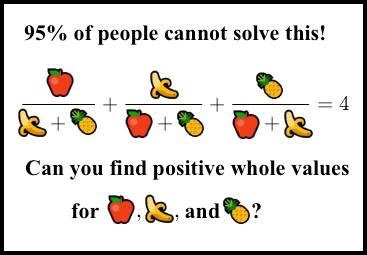
find x,y,z positive natural numbers such that the following is true:
$$ \frac{x}{y+z} + \frac{y}{x+z} + \frac{z}{x+y} = 4. $$
I first saw the question in a more fun way:
I did not put the answer in the post (should I have? That was the meta question.)
The question has an infinite number of (x,y,z) that work, so I'll just give the least one:
x= 154476802108746166441951315019919837485664325669565431700026634898253202035277999
y = 36875131794129999827197811565225474825492979968971970996283137471637224634055579
z = 4373612677928697257861252602371390152816537558161613618621437993378423467772036
1) For details on how you could have found the answer see here. Or watch a YouTube video on it here.
2) Did I really expect my readers to get this one? Note that I posted it on April Fools Day, though it is a legit problem with a legit answer.
3) The image that says that 95% of all people couldn't solve it---I wonder what their sample size was and where it was drawn from. I suspect that among mathematicians 99% or more can't solve it.
4) Comments on the comments I got:
a) Austin Buchanan says that Wolfram Alpha says NO SOLUTION. I wonder if Wolfram Alpha cannot handle numbers of this size.
b) Anonymous right after Austin had a comment that I MISREAD as saying that they found it using a python program. I asked that person to email me, and it turns out that NO-- they recalled where to look (on the web I assume).
c) Several commenters solved it by looking at the web. Math Overflow and Quora had solutions. So did other places. This may make the meta question should a blogger post the solution a moot point for a well known problem. If you get a problem off the web its quite likely its well known, or at least well enough known, to have the answer also on the web. If you make up a problem yourself then its harder to tell.
5) I think its a very hard problem to solve unless you have the prior KNOWLEDGE to solve it, so it would not be a good math competition problem.
6) The cute pictures of fruit in the presentation of the problem makes it LOOK like its a cute problem. It not.
7) Only one comment on the meta question about should a blogger post the solution at the same time as the problem (There were more comments about the unimportant question of whether 0 is a natural number.) The one comment says that a blogger SHOULD NOT - let the reader enjoy/agonize for a while. I agree.
8) Determining if a given math problem is interesting is a hard problem; however, that will be a topic for another blog. (Tip for young bloggers, if there are any (blogs are so 2010): If you do ONE idea per blog then your blog can last longer.)
Monday, April 01, 2024
A Math Question and a Meta Question
1) Question: find x,y,z natural numbers such that the following is true:
$$ \frac{x}{y+z} + \frac{y}{x+z} + \frac{z}{x+y} = 4. $$
I was first presented the problem a more fun way:
(NOTE- a commenter pointed out that ``Natural Numbers'' and `Positive Whole Values' are different since some people (and I AM one of them) include 0 as a natural. SO- to clarify, I want x and y and z to be naturals that are \(\ge 1\). )
2) Meta Question: When a blogger poses a question like that should they also post the answer? Have a pointer to the answer? Not have an answer? Pros and Cons:
a) If you do not list the answer at all (or post it in a few days) then people will not be tempted to look at the answer. They have to really work on it. (Maybe they can find the answer on the web).
b) There are people whose curiosity far exceeds their ego. So they want to work on in for (say) 5 minutes and then LOOK AT THE ANSWER! I am one of those people.
c) When you first look at a problem and work on it you are curious. If you have to wait a few days to get the answer then you may lose interest.
I invite you to work on both the question and the meta question. I will not be blocking people who post the answer in the comments, so if you want to work on it you might not want to look at the answers.
I will post the answer in a few days.


_Cropped.jpg)