I went to an AMS conference with my High School Student Naveen (who presented this paper) and an ugrad from my REU program Nichole (who presented this paper). Note that this is a math conference- low prestige, mostly unrefereed, parallel sessions, but still a good place to pick up some new problems to work on and learn some things, and meet people.
Both Naveen and Nichole later got email from a journal urging them to submit their work! They were also invited to be on the Editorial Board! I can understand inviting a HS student who is a SENIOR to be on an editorial board, but Naveen is a SOPHMORE!
Naveen and Nichole both emailed me asking what this was about and I looked around and found, not to my surprise, that the journal is an author-pays journal of no standards. On the other hand, it was open access, on the other other hand, they had an article claiming that R(4,6)=36 (might be true, but if this was known, I would know it, see this blog post for more on that proof technique).
The pay-to-publish model is not necc. bad, and is standard in some fields, but is unusual for math. Of perhaps more importance is that the journal had no standards. And they prey on the young and naive.
Or do they?
Consider the following scenario: Naveen publishes in this journal and this publication is on his college application, hence he gets into a good college with scholarship. He knows exactly what he is buying. Or Nicole does this to help her Grad school Application. Or I do this for my resume and get a salary increase. Or an untenured prof does this to get tenure ( Deans can count but they can't read). And it gets worse--- the school gives the prof tenure, knowing the papers are bogus, but now they can say they have a prof who publishes X papers a year! At some point I don't know who is scamming who.
This blog post (not mine) gives several criteria for when a journal is bogus. I'll add one: When they ask a 15 years old to be on their editorial board.
Showing posts sorted by relevance for query Naveen. Sort by date Show all posts
Showing posts sorted by relevance for query Naveen. Sort by date Show all posts
Sunday, November 29, 2015


Friday, June 22, 2018
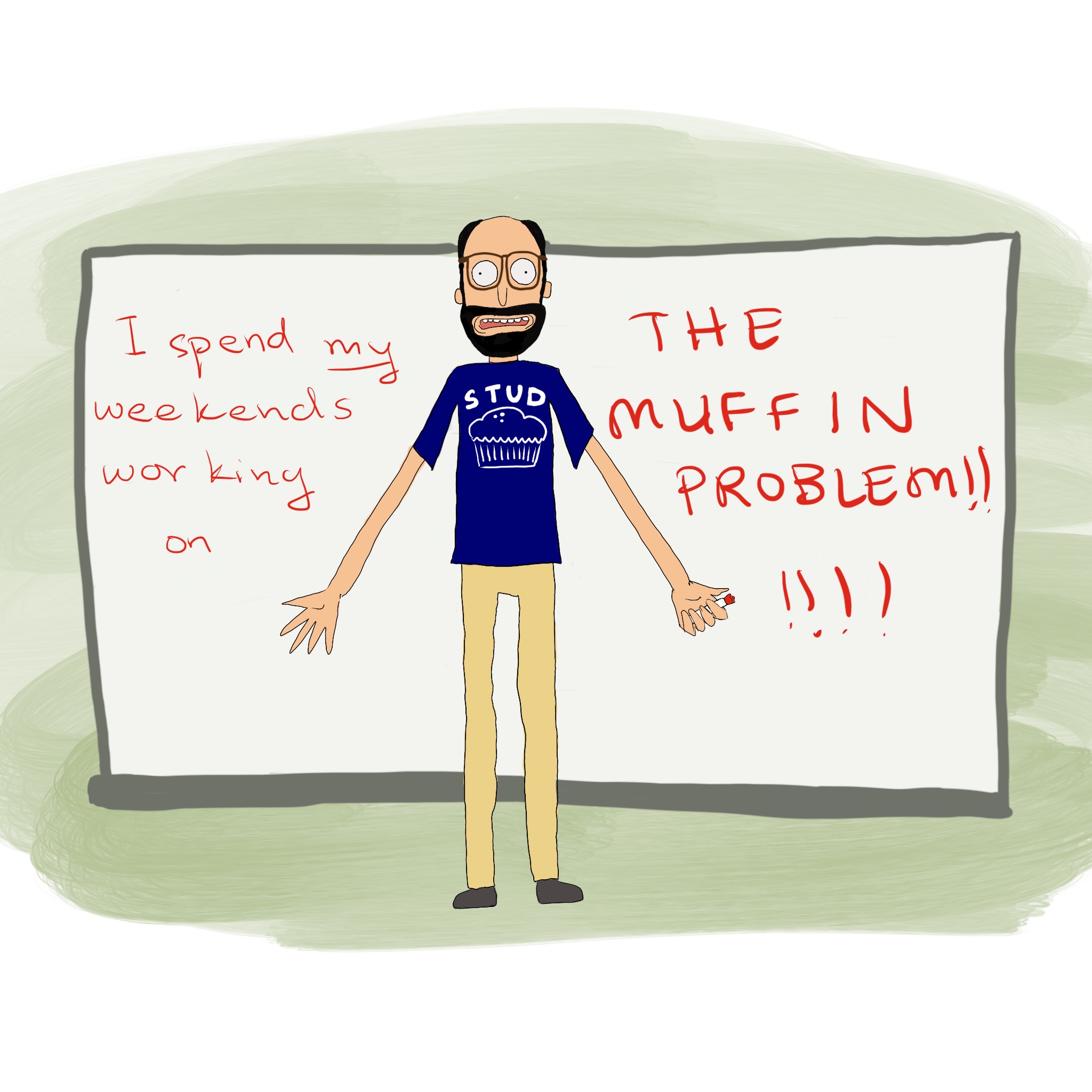
The Muffin Problem
I've been meaning to post on THE MUFFIN PROBLEM for at least a year. Its a project I've been working on for two years, but every time I wanted to post on it I thought.
I'm in the middle of a new result. I'll wait until I get it!
However, I was sort of forced to finally post on it since Ken Regan (with my blessing) posted on it. In fact its better this way- you can goto his post for the math and I get to just tell you other stuff.
The problem was first defined by Alan Frank in a math email list in 2009.
I'll define the problem, though for more math details goto Ken's post: here.
You have m muffins and s students. You want to give each student m/s piece and
divide the muffins to maximize the min piece. Let f(m,s) be the size of the min piece
in an optimal divide-and-distribute procedure.
Go and READ his post, or skim it, and then come back.
Okay, you're back. Some informal comments now that you know the problem and the math
1) I saw the problem in a pamplet at the 12th Gathering for Gardner. Yada Yada Yada I have 8 co-authors and 200 pages, and a paper in FUN with algorihtms You never know when a problem will strike you and be worth working on!
(The 8 coauthors are Guangiqi Cui, John Dickerson, Naveen Dursula, William Gasarch, Erik Metz,
Jacob Prinze, Naveen Raman, Daniel Smolyak, Sung Hyun Yoo. The 200 pages are here. The FUN with algorithms paper, only 20 pages, is here)
2) Many of the co-authors are HS students. The problem needs very little advanced mathematics (though Ken thinks it might connect to some advanced math later). This is a PRO (HS students can work on it, people can understand it) and a CON (maybe harder math would get us more unified results)
3) The way the research had gone is a microcosm for math and science progress:
We proved f(m,s) = (m/s)f(s,m) (already known in 2009) by Erich Friedman in that math email list)
Hence we need only look at m>s.
First theorem: we got a simple function FC such that
f(m,s) ≤ FC(m,s)
for MANY m,s we got f(m,s) = FC(m,s).
GREAT! - conjecture f(m,s) = FC(m,s)
We found some exceptions, and a way to get better upper bounds called INT.
GREAT! - conjecture f(m,s) = MIN(FC(m,s),INT(m,s))
We found some exceptions, and a way to get better upper bounds called ... We now have
conjecture
f(m,s) = MIN(FC(m,s), INT(m,s), ERIK(m,s), JACOB(m,s), ERIKPLUS(m,s), BILL(m,s))
and it looks like we still have a few exceptions.
This is how science and math works- you make conjectures which are false but the refutations lead
to better and better results.
Also, we have over time mechanized the theorems, a project called:
Making Erik Obsolete
since Erik is very clever at these problems, but we would like to not have to rely on that.
4) I have worked hard on this problem as is clear from this: picture
I'm in the middle of a new result. I'll wait until I get it!
However, I was sort of forced to finally post on it since Ken Regan (with my blessing) posted on it. In fact its better this way- you can goto his post for the math and I get to just tell you other stuff.
The problem was first defined by Alan Frank in a math email list in 2009.
I'll define the problem, though for more math details goto Ken's post: here.
You have m muffins and s students. You want to give each student m/s piece and
divide the muffins to maximize the min piece. Let f(m,s) be the size of the min piece
in an optimal divide-and-distribute procedure.
Go and READ his post, or skim it, and then come back.
Okay, you're back. Some informal comments now that you know the problem and the math
1) I saw the problem in a pamplet at the 12th Gathering for Gardner. Yada Yada Yada I have 8 co-authors and 200 pages, and a paper in FUN with algorihtms You never know when a problem will strike you and be worth working on!
(The 8 coauthors are Guangiqi Cui, John Dickerson, Naveen Dursula, William Gasarch, Erik Metz,
Jacob Prinze, Naveen Raman, Daniel Smolyak, Sung Hyun Yoo. The 200 pages are here. The FUN with algorithms paper, only 20 pages, is here)
2) Many of the co-authors are HS students. The problem needs very little advanced mathematics (though Ken thinks it might connect to some advanced math later). This is a PRO (HS students can work on it, people can understand it) and a CON (maybe harder math would get us more unified results)
3) The way the research had gone is a microcosm for math and science progress:
We proved f(m,s) = (m/s)f(s,m) (already known in 2009) by Erich Friedman in that math email list)
Hence we need only look at m>s.
First theorem: we got a simple function FC such that
f(m,s) ≤ FC(m,s)
for MANY m,s we got f(m,s) = FC(m,s).
GREAT! - conjecture f(m,s) = FC(m,s)
We found some exceptions, and a way to get better upper bounds called INT.
GREAT! - conjecture f(m,s) = MIN(FC(m,s),INT(m,s))
We found some exceptions, and a way to get better upper bounds called ... We now have
conjecture
f(m,s) = MIN(FC(m,s), INT(m,s), ERIK(m,s), JACOB(m,s), ERIKPLUS(m,s), BILL(m,s))
and it looks like we still have a few exceptions.
This is how science and math works- you make conjectures which are false but the refutations lead
to better and better results.
Also, we have over time mechanized the theorems, a project called:
Making Erik Obsolete
since Erik is very clever at these problems, but we would like to not have to rely on that.
4) I have worked hard on this problem as is clear from this: picture
Tuesday, August 07, 2018
The Future of TCS Workshop, celebrating V Vazirani 60th, now online
On June 29, 2018, a workshop was held, in conjunction with STOC 2018, to celebrate the accomplishments of Vijay Vazirani on the occasion of his 60th birthday, organized by his PhD students, Aranyak Mehta, Naveen Garg and Samir Khuller. The workshop was called "TCS: Looking into the Future" and true to the title, it was precisely that! In front of a large, enthusiastic audience, left over from STOC, the star-studded lineup of speakers outlined some of the most avant-garde, far out ideas on the future of computing. Fortunately, this exciting and highly thought-provoking set of talks was recorded for posterity and is available for all to view here
THE LAST WORD `here' IS THE LINK to the website which has links to the four talks.
THE LAST WORD `here' IS THE LINK to the website which has links to the four talks.
The speakers were:Len Adleman, Manuel Blum, Richard Karp, Leonard Schulman, Umesh Vazirani.
1) I URGE you to all WATCH those talks!
2) I really like it when talks are available on line after the fact so even if you didn't go (I didn't) you can still see the talks later.
3) So many talks to watch, so little time, alas!
4) Sorry for the white background for this post- that happens sometimes. NO comments on it please.
Sunday, June 27, 2021
Someone thinks I am a fine artist! Why?
A while back I got an email asking me to submit to a Fine Arts Journal. Why me? Here are some possibilities:
1) They were impressed with my play:
Sure he created the universe, but would he get Tenure? (see here) which did get into a play-writing contest and was performed (one of the actresses scolded me since I took a slot from a real playwright).
2) They were impressed with my Daria Fan Fiction (see the four entries here labelled as Daria Fan Fiction).
3) They were impressed with my play JFK: The Final chapter (see here). Unlikely since this was rejected by a play writing contest and is not well known (as opposed to my other works in the fine arts which are well known?)
4) They were impressed with my collection of satires of Nobel Laureate Bob Dylan (here) .
5) They were impressed with some subset of (a) complexityblog, (b) Problems with a Point, (c) Mathematical Muffin Morsels, and (d) Bounded Queries in Recursion Theory. Or maybe just having 3 books on amazon is their threshold. If it's complexityblog then Lance and I should co-author something for them.
6) It is a vanity-journal where you pay to publish. So why email me who (a) is not an artist, (b) is not a fine artist, and most important (3) does not think of himself as a fine artist. The PRO of emailing me or people like me is they cast a wide net. The CON is--- there is no CON! It costs nothing to email me, and emailing me does not affect their credibility. That still raises the question of how they got my name.
7) Could it be a phishing? If I click on something in the email would they get my credit card number? Their email begins Dear Professor not Dear Professor Gasarch. So they know I am a professor. Then again, I have known of ugrads who get emails that begin Dear Professor. (The emails to HS student Naveen and ugrad Nichole in the story I tell here were addressed to Dear Professor.)
8) They mistook me for my parents who, in 1973, put together an anthology of short stories titled Fiction:The Universal elements, for a Freshman Comp course my mom taught, see here. I note that their book ranks around 18,000,000, so even that explanation is unlikely. Actually the rank changes a lot- it was 12,000,000 this morning. Still, not what one would call a best seller. It's fun to see what is doing better: Bounded Queries in Recursion Theory (currently at around rank 6.000.000) or Fiction: The Universal Elements.
If I ever get one of these emails from a History Journal I will submit my Satirical Ramsey Theory and the History of Pre-Christian England: An Example of Interdisciplinary Research (see here) just to see what happens- but I will stop short of paying-to-publish. Or maybe I will pay-to-publish so that the next time I try to fool a class with it I can point to a seemingly real journal which has the article.
Subscribe to:
Posts (Atom)