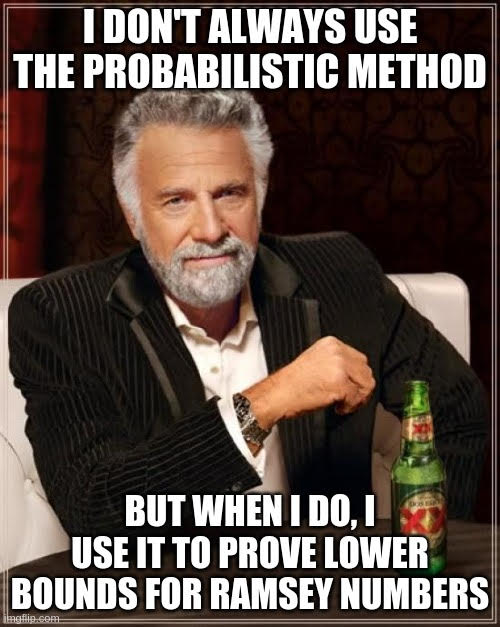
My REU program had a Ramsey Meme Contest.
The winner was Saadiq Shaik with this entry:
I Don't Always...
I challenge my readers to come up with other Ramsey Memes! or Complexity Memes! or point me to some that are already out there.
Showing posts sorted by relevance for query Meme. Sort by date Show all posts
Showing posts sorted by relevance for query Meme. Sort by date Show all posts
Monday, June 22, 2020


Sunday, December 11, 2022
Commercials are not logical. FTX edition.
Some people asked me to comment on FTX since I teach Cryptography. My insights are no better than anyone else's; however, I have wanted to do a blog post about the illogic of commercials, so I will do that with FTX as an example.
All conversations in the post are fictional.
------------------------------------
Alice: Bob, why did you invest $1,000,000 with FTX?
Bob: Because Tom Brady endorsed it. (See here for an article about that and here for a commercial Tom Brady did for FTX.)
Alice: But Tom Brady is a football player, not a finance person.
Bob: Well... I know that now.
(For an absolutely fantastic---and now ironic---commercial for FTX , see here.)
------------------------------------------------------------
The people in commercials are paid to hawk the product.
a) Are they experts? In the above case, about FTX, NO, they are not. So the commercial should not convince anyone to buy the product.
b) There are commercials where the people are experts. For example, a basketball player endorsing a sneaker brand (not quite an expert, but they do use the product). But even this should not work since the viewers KNOW that the person is being PAID to tell us it's a good product.
c) Commercial spokespeople (Geico's Gecko, Progressive's Flo, Dos Equis---the world's most interesting man, see his commercial here and a Ramsey Meme based on it here) are even stranger- they are fictional characters who are urging me to buy something. So the question "Are they experts?'' doesn't even make sense. Someone pretending to be someone else is also pretending to like a product they do not use.
d) Some commercials pretend to be informative but are not. For example, the insurance companies seem to brag about something that ALL of the insurance companies do such as bundling or not-paying-for-what-you-don't-need.
e) A truly new product may have an informative commercial, just to tell me that it's out there. For example, Stephen Colbert's Americone Dream Ice Cream, which is awesome. (My spellchecker thinks Americone is not a word. This time they are probably right.)
f) SO, if I did a commercial for Stephen Colbert's Americone Dream Ice Cream would you try it? Let's say I wasn't being paid and I truly did it for my love of that ice cream. This STILL doesn't make sense--- my tastes and yours may differ. However, you can try it, and decide, and it costs far less than $1,000,000.
---------------------------------------
So what are we left with? The only commercials that make logical sense would be those where
a) the person is an expert,
b) the person is not being paid,
c) the person is telling you something about the product that distinguishes it from its competitors OR it's a new product, and
d) it's not a matter of taste---there is an absolute standard that is easily understood.
Do you know of ANY commercials like that? Influencers who are NOT paid by the people whose product they are hawking (are there such influencers?) might begin to qualify.
------------------------------------------------------
So LOGICALLY commercials should not work. So why do they?
a) They don't. It's possible they just aren't that effective. See here for "DON"T WORK'' and here for 8 times when it did work. I think this is a great commercial (watch it to the end) but it does not make me want to go out and buy soup. (Stan Freberg wrote some GREAT commercials. They are on YouTube and I recommend them highly for entertainment. He also has several great novelty-song albums.)
b) Indirectly. They build brand awareness.
c) Because people are stupid. This is not an interesting answer since I still want to know what their reasoning is, whether or not it's faulty.
d) Because you are part of a movement. Drink the Uncola (7UP) to be rebellious! Or the 1984-Apple commercial (see here). These are both odd since drinking 7UP or having an Apple Computer seem to me to be the opposite of rebellious.
e) Buying the product to express your philosophy:
Ted: Carol, why did you invest $1,000,000 in FTX?
Carol: Because I believe in effective altruism.
Ted: Do you still?
Carol: This might need a rethink. But for now I'll invest by getting a Freedom Unlimited credit card that gets cash back since Kevin Hart says I should (see here).
Sunday, July 12, 2020
Ronald Graham: A summary of blog Posts We had about his work
To Honor Ronald Graham I summarize the blog posts we had about his work.
1) Blog post New Ramsey Result that will be hard to verify but Ronald Graham thinks its right which is good enough for me.
Wikipedia (see here) says that in the early 1980's (can't Wikipedia be more precise than that?) Ronald Graham conjectured the following:
For all 2-colorings of N, there exists x,y,z all the same color such that (x,y,z) form a Pythagorean triple.
I cannot imagine he did not also conjecture this to be true for all finite colorings.
I suspect that when he conjectured it, the outcomes thought to be likely were:
a) A purely combinatorial (my spell check says that combinatorial is not a word. Really? It gets 14,000,000 hits) proof. Perhaps a difficult one. (I think Szemeredi's proof of his density theorem is a rather difficult but purely combinatorial proof).
b) A proof that uses advanced mathematics, like Roth's proof of the k=3 case of Sz-density, or Furstenberg's proof of Sz theorem.
c) The question stays open though with some progress over the years, like R(5).
What actually happened was
d) A SAT Solver solves it AND gets exact bounds:
For all 2-colorings of {1,...,7285} there is a mono Pythag triple.
There exists a 2-coloring of {1,...,7284} with no mono Pythag triple.
I wonder if this would have been guessed as the outcome back in the early 1980's.
-------------------------------------------------------------------------------
2) Blog Post Ronald Graham's Other Large Number- well it was large in 1964 anyway
Let
a(n) = a(n-1) + a(n-2)
I have not given a(0) and a(1). Does there exists rel prime values of a(0) and a(1) such that for all n, a(n) is composite.
In 1964 Ronald Graham showed yes, though the numbers he found (with the help of 1964-style computing) were
a(0) = 1786772701928802632268715130455793
a(1) = 2059683225053915111058164141686995
I suspect it is open to get smaller numbers, though I do not know.
------------------------------------------------------------------------------
3) Blog Post Solution to the reciprocals problem
Prove or disprove that there exists 10 natural numbers a,...,j such that
2011= a+ ... + j
1 = 1/a + ... + 1/j
I had pondered putting this on a HS math competition in 2011; however, the committee thought it was too hard. I blogged on the problem asking for solutions, seeing if there was one that a HS student could have gotten. The following post (this one) gave those solutions. My conclusion is that it could have been put on the competition, but its a close call.
All of the answers submitted had some number repeated.
So I wondered if there was a way to do this with distinct a,...,j.
I was told about Ronald Grahams result:
For all n at least 78, n can be written as the sum of DISTINCT naturals, where the sum of
the reciprocals is 1.
This is tight: 77 cannot be so written.
Comment on that blog DID include solutions to my original problem with all distinct numbers
----------------------------------------------------------------------
4) Blog Post A nice case of interdisplanary research tells the story of how the study of history lead to R(5) being determined (see here for the actual paper on the subject). One of the main players in the story is the mathematician
Alma Grand-Rho.
Note that this is an anagram of
Ronald Graham.
What is the probability that two mathematicians have names that are anagrams. I suspect very small. However, see this blog post to see why the probability is not as small as it might be.
-----------------------------------------------------------------------
5) Blog Post Winner of Ramsey Meme Contest This post didn't mention Ronald Graham; however I think he would have liked it.
Subscribe to:
Posts (Atom)