Computational Complexity and other fun stuff in math and computer science from Lance Fortnow and Bill Gasarch
Monday, March 06, 2023
Peer Review
Thursday, March 02, 2023
Goodbye Dilbert
Scott Adams, creator of Dilbert, had a racist rant in a video he posted last week. As a result most newspapers that carried the comic strip are dropping Dilbert, including our local Chicago Tribune. I fully support these moves. Much as I believe in separating the art from the artist, it's different when the artist is living and profiting from their art.
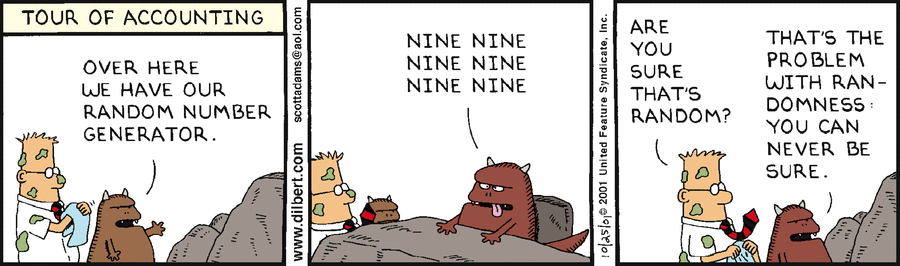
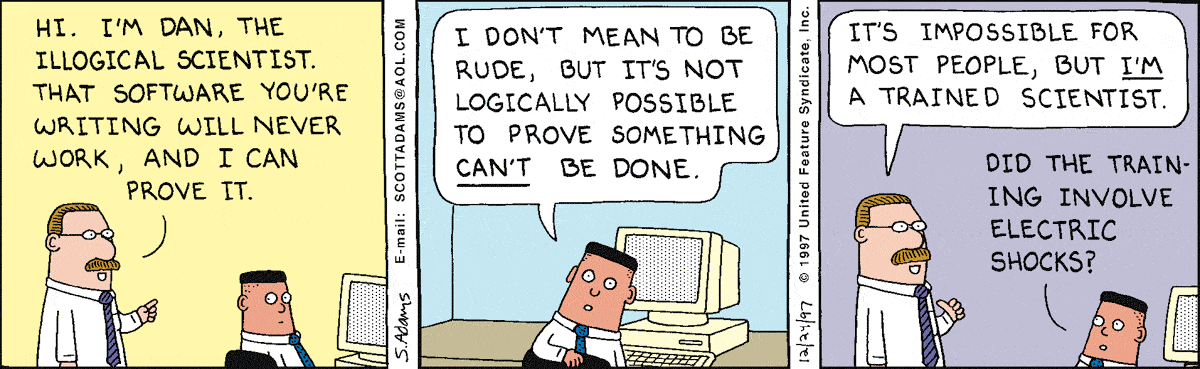
So we need to say to Dilbert, making the end of an era. Dilbert started in 1989 as a strip that captured the absurdities of the work place in an anonymous tech company, predating movies like Office Space and shows like Better Off Ted and Silicon Valley. I used Dilbert strips (with permission) in my book, namely this strip to introduce Kolmogorov complexity and this strip to describe my research area. Just call me Dan.
Farewell to Dilbert, Dogbert, Wally, Alice, Asok, the pointy-haired boss and the rest. I won't miss Scott Adams, but I will miss his creations.
Monday, February 27, 2023
I wish we had less students in a Class. Demographics says I may get my wish.
According to this article, in the near future LESS people will be going to college. There is even a name for this upcoming shift: The Enrollment Cliff. Why?
Is it Covid-related? Is it that College has gotten to expensive? To liberal? To much cancel culture? To many dead white males in the core? The core is to multicultural? Online learning is stealing our students?
No. The reason is actually very boring and does not serve anyone's political agenda. (thats not quite right). Or any agenda. And you can probably guess the cause from the title of this blog post.
For some years up until 2007 the birth rate was slowly dropping. Then there was a large drop in the birth rate after the recession of 2007, and the birth rate has never really recovered. And the recession might not have that much to do with it-- the long term move from an agricultural society (where kids are an economic gain) to an industrial one (where, after child labor laws and the expense of college, kids are an economic loss- though that can be debated) has resulted in a very long term decline in births.
And from personal experience, I know (a) very few people who have 4 or more kids, (b) there is NO stigma about having 0 kids as there once was. Of course the sample size of people I know may be skewed.
ANYWAY, what will this mean for colleges?
a) Harvard, Yale, etc will not be affected. Plenty of people will still apply. Note that they draw from all of American and also internationally.
b) Colleges that draw from a local area may be affected a lot since they depend on locals, and that population may be shrinking.
c) Schools in between Harvard and Small colleges- hard to say.
d) The sports betting places paying schools to allow them to promote on campus (and in some cases helping them promote it) may find far less students to sucker into this loser's game. See my blog on this topic here
Univ of MD has around 4000 Computer Science majors (depending on who tells you this its either a brag or a complaint). In the Spring of 2023 there are three lectures of Discrete math of sizes 240, 270, and 90. Each of those also has recitations of 30 (or so) each. If the decline is gradual (either from demographics or from the CS majors bubble finally bursting, or from the other reasons above) then I am sure we can handle it. If it declines very suddenly we may have a problem adjusting.
One caveat to this that I've heard is that immigration will save us. Maybe. But America is politically going in the opposite direction. The counterargument of without immigration there will be less students going to college is not that compelling to most Americans. There are other more intelligent and compelling pro-immigration arguments. However, American politics is no longer interested in compelling and logical arguments. (The notion that it once was may be nostalgia for a time that never was.)
Thursday, February 23, 2023
The Virtual Grad Student
Martin Haug, who is working on a LaTeX alternative Typst, asked me if I had updates on a LaTeX rant from 2011. I haven't seen any new serious backward compatibility problems. We have easier collaboration through on-line editors like Overleaf. We have got closer to WSYWIG thanks to quick compiling but still not at the level of Word or Google Docs. The big problem of user friendliness remains. There's a reason LaTeX has its own Stack Exchange.
But we live in a new machine learning world. Can we use generative AI to make LaTeX easier to use?
Mandatory Disclaimer: Generative AI can sometimes create inaccurate, inappropriate or previously-published material. You are ultimately responsible for the contents of your paper no matter how you produced it.
Since I sometimes think of LaTeX as a programming language for papers, I tweeted
Can we have GitHub co-pilot for LaTeX?
— Lance Fortnow (@fortnow) February 17, 2023
Thanks for the responses. The answer to the question is yes, GitHub Copilot works for LaTeX if you edit LaTeX in a programming environment like VS Code, Neovim or Jet Brains. It helps with formatting of formulas and pictures, less so on the text itself. I made a video so you can see how it works.
Latext AI offers a chrome extension that will let you generate text via GPT in Overleaf based on a prompt or previous text, though Latext requires a subscription after a one-week trial. You can also just cut and paste between any text editor and ChatGPT.
ChatGPT notoriously makes up references if you ask for them. Can we have a good system that finds relevant articles to cite and adds them automatically into your bibliography?
Ideally all these should work together seamlessly, suggestions that happen as you type. A true co-pilot for research papers.
There are many more tools out there, feel free to add them to the comments. I expect the integration to improve over time as we develop new APIs and models.
I look forward to the days of a virtual grad student: Here's a research goal and an idea to get there. Now go figure out the details and write the paper.
It will be a long wait.
Sunday, February 19, 2023
It is more important than ever to teach your students probability (even non-stem students)
(This topic was also covered here.)
You are a college president. An online betting company says We will give you X dollars if you allow us to promote online gambling at your University.
I suspect you would say NO.
Too late- it's already happening. A link to a NY times article about this is: here. I urge you to read the entire article. It's worse than it sounds.
My thoughts
0) I wondered if a company needed permission to promote a product on a campus. I am not sure of the answer; however, in some cases a school HELPED with the promotion:
a) During a game there are announcements reminding students that they can place a sports bet! It's easy! It's fun!
b) Links on the schools website to sports gambling sites
c) References to sports betting in emails that goto students.
This is WAY BEYOND allowing a company to promote.
1) Some points from the article
Some aspects of the deals also appear to violate the gambling industry's own rules against marketing to underage people. The ``Responsible Marketing Code'' published by the American Gaming Association, the umbrella group for the industry, says sports betting should not be advertised on college campuses.
``We are not seeing enough oversight, transparency, and education to support the rollout of these kinds of deals'' said Michael Goldman who teaches sports marketing at the Univ of San. Fran.
During the pandemic, many universities struggled financially ...To fill those holes public and private universities nationwide have been struggling to line up new revenue sources, including by arranging sponsorship deals. (MY THOUGHTS- They don't quite say it, but it seems like the extra money is going back to sports programs. I would be happier if it went into academics- and to be fair, maybe some of it does.)
2) Online gambling is more addictive than in-person gambling. And it's easier since you don't have to leave your dorm room to do it.
3) The school gets money and teaches the students that everything is for sale. So it's a win-win (I am kidding.)
4) Should a college take money to allow the promotion of tobacco or alcohol or (if it becomes legal) heroin? I see NO difference between those and online gambling. (See here)
5) I am in favor of all of those things being legal (maybe not heroin but I am open to debate on that) however, there is a big difference between making something legal, and promoting it.
6) Silver Lining: This may encourage more students, even non-STEM students, to learn probability. Either advertise it honestly:
Take Probability to find out that Sports Betting is a Loser's Game
Or advertise it dishonestly
Take Probability to find out how you can win at Sports Betting!
Thursday, February 16, 2023
Blurry JPEG or Frozen Concentrate
Ted Chiang in a recent New Yorker article likened ChatGPT to a blurry JPEG, i.e. a "lossy compression" of the web. It's a good article but the analogy isn't quite right, there's a different kind of compression happening. Think of all human written knowledge as a random example of what could have been generated and we remove the randomness, like water is removed to make concentrated orange juice. We then add water (or randomness) to get back some version of the original.
Lossless compression, like gzip, gives a compressed version of some data with the ability to reconstruct it exactly. It corresponds nicely to Kolmogorov complexity where K(x) is the smallest program p that generates the string x. p is a lossless compression of x.
Lossy compression, like JPEG, often allows much higher compression but with some error. In Kolmogorov terms you are trading off the size of the program p and some error function between x and the output of p. Most compression programs for pictures, music and video use algorithms designed for the specific medium. You can also use machine learning to get lossy compression by training both the compression and decompression algorithms.
Lossy compression tries to recreate the original picture. Generative AI, like ChatGPT, takes a different approach. Let's consider Wikipedia as this is the example used by Chiang. For any specific topic, there are many different ways to write a Wikipedia article, as good as or better than the article that currently exists. ChatGPT doesn't need to recreate anything close to the original article, just one that explains topic well. What we want is a description of a program p that corresponds to a set of possible Wikipedia articles, of which the real article is a random example of this set. An ideal version of ChatGPT would choose a random article from this set. Dall-E, generative AI for art, works a similar way, creating art that is a random example of what art might have been.
In terms of Kolmogorov complexity, this corresponds to the Kolmogorov Structure Function, basically the smallest program p such that p describes a set S of size m that contains x. with |p| + log m ≈ K(x). The string x is just a random element of S, you can get a string like it by picking an element of S at random.
There is no recursive algorithm that will find p and we also need to limit ourselves to p that are computationally efficient, which means that generative AI algorithms may never be ideal and will sometimes make mistakes. That doesn't mean we shouldn't use them just that we need to be wary of their limitations. As the saying goes "All models are wrong, but some are useful".
Sunday, February 12, 2023
When is a paper `Easily Available' ?
I was looking at the paper
PSPACE-Completeness of reversible deterministic systems
by Erik Demaine, Robert Hearn, Dylan Hendrickson, and Jayson Lynch (see here) and came across the following fascinating result which I paraphrase:
The problem of, given balls on a pool table (though it can be one you devise which is not the standard one) and each balls initial position and velocity, and a particular ball and place, it is PSPACE complete to determine if that ball ever gets to that place.
Demaine et al. stated that this was proven by Edward Fredkin and Tommaso Toffoli in 1982 (see here for a link to the 1982 paper, not behind a paywall). Demaine et al. gave an easier proof with some nice properties. (Just in case the link goes away I downloaded the paper to my files and you can find it here.)
I needed the bib reference for the FT-1982 paper and rather than copy it from Demaine et al. I wanted to cut-and-paste, so I looked for it in DBLP. I didn't find the 1982 paper but I did find a book from 2002 that reprinted it. The book, Collision-based computing, has a website here. The book itself is behind a paywall.
On the website is the following curious statement:
[This book] Gives a state-of-the-art overview of an emerging topic, on which there is little published literature at the moment. [The book] Includes 2 classic paper, both of which are widely referred to but are NOT EASILY AVAILABLE (E. Fredkin and T. Toffoli: Conservative Logic, and N . Margolous Physics-Like Models of Computation).
The caps are mine.
Not easily available? I found a link in less than a minute, and I used it above when I pointed to the paper.
But the book IS behind a paywall.
Perhaps Springer does not know that the article is easily available. That would be odd since the place I found the article is also a Springer website.
The notion of EASILY AVAILABLE is very odd. While not quite related, it reminds me of when MIT Press had to pay a few thousand dollars for permission (that might not be the legal term) to reprint Turing's 1936 paper where he defined Turing Machines (he didn't call them that), which is on line here (and other places), for Harry Lewis's book Ideas that created the future.
Thursday, February 09, 2023
Why Can't Little Chatty Do Math?
Monday, February 06, 2023
After you are notified that an article is accepted...
After just one round of referees reports
(they send me the reports, I made the corrections, they were happy) I got email saying my paper on proving the primes are infinite FROM Schur's theorem in Ramsey was ACCEPTED. Yeah! Now What?
1) The journal send me an email with a link GOOD FOR ONLY FIFTY DAYS to help me publicize the article. Here is the link:
https://authors.elsevier.com/
Will this really help? The article is already on arxiv. (ADDED LATER: the link on arxiv is here.) Also, I can blog about it, but how do non-bloggers publicize their work? Do they need to?
(ADDED LATER: A commenter wanted to know why I am publishing in an Elsevier journal. This was a memorial issue in honor of Landon Rabern (see here) a combinatorist who died young. I was invited to submit an article.)
QUESTION: Is this common practice? If so, what do you do with those links? Email them to all of your the people who should care about the article?
2) I got some forms to fill out that asked how many offprints I wanted. While my readers can probably guess what that means, I will remind you: paper copies of the article. I filled out the form:
I want 0 of them.
They still wanted to know the address to send the 0 copies to, so I gave that as well.
Does anyone actually get offprints anymore? That seems so 1990's. With everything on the web I tend to email people who want article pointers. In fact, that happens rarely - either nobody wants to read my articles (quite possible) or they find them on my website (quite possible).
In 1991 when I went up for tenure the dept wanted 15 copies of every article I wrote so they could send my letter writers (and others) all my stuff. Rumor is that the Governor of Maryland got a copy of every article I ever wrote. I hoped he was a fan of oracle constructions.
In 1998 when I went up for full prof they did not do this, assuming that the letter writers could find what the needed on the web. I do wonder about that- it might have been a nice courtesy to send them stuff directly and that would be a use for offprints. Depends on if my letter writers prefer reading online or on paper. They could of course print out my papers, but again- as a courtesy perhaps we should have supplied the papers.
QUESTION: Do you order a non-zero number of offprints and if so why?
3) The journal offered to have my article to be open access at their site for a price. I did not do this as, again, the article is already on arxiv.
QUESTION: Is there a reason to have your article formally open-access given that its already on arixv?
4) One of my co-authors on a different article asked me When will it appear IN PRINT? I can't imagine caring about that. Its already on arxiv and I doubt having it in a journal behind paywalls will increase its visibility AT ALL. The only reason to care about when it appears IN PRINT is so I can update my resume from TO APPEAR to the actual volume and number and year.
QUESTION: Aside from updating your resume do you care when an article that was accepted appears IN PRINT? And if so why?
Thursday, February 02, 2023
Responsibility
Nature laid out their ground rules for large language models like ChatGPT including
No LLM tool will be accepted as a credited author on a research paper. That is because any attribution of authorship carries with it accountability for the work, and AI tools cannot take such responsibility.
Let's focus on the last word "responsibility". What does that mean for an author? It means we can hold an author, or set of authors, responsible for any issues in the paper such as
- The proofs, calculations, code, formulas, measurements, statistics, and other details of the research.
- Any interpretation or conclusions made in the article
- Properly citing related work, especially work that calls into question the novelty of this research
- The article does not contain text identical or very similar to previous work.
- Anything else described in the article.
Tuesday, January 31, 2023
Why does pi come up so often? I don't know either but ...
Here is how history DID unfold:
1) People noticed that the ratio of the circumference to the diameter of ANY circle is always the same, it's a number between 3 and 4, roughly 3.14 or as my Dad would say, exactly 22/7 (see this blog post). On the web (see here) is a claim that Euler first used the symbol pi since it is the first letter of a Greek word for Circumference. I've seen other sites that claim someone less famous and its the first letter of a Greek work for Perimeter.
But in any case pi was known (though not called that) a LONG time ago.
2) MUCH LATER people noticed
1/1^2 + 1/2^2 + 1/3^2 + ... = pi^2/6 (Euler showed this in 1735, see here. That site says that it was Basel's problem to determine the sum. Yeah for Basel--- his name lives on even after his problem was solved! This did not happen for Baudet and Vazsonyi. If you don't know what they conjectured--- well, that proves my point. ADDED LATER: commenter Robert pointed out that Basel is NOT a person's name but a cities name. I am delighted to know that!)
1 - 1/3 + 1/5 - 1/7 + 1/9 ... = pi/4 (Leibniz showed this in 1676, see here. A good Quora site on that sum is here.)
(There are other series where pi comes up as well.)
3) People wonder Why did pi, which has to do with CIRCLES, end up in INFINITE SERIES?
What if history unfolded the other way:
1) People noticed
1/1^2 + 1/2^2 + 1/3^2 + ... =a^2/6 (Euler did that in 1735, see here.)
1 - 1/3 + 1/5 - 1/7 + 1/9 ... = b/4 (Leibniz showed this, see here. A good Quora site on that sum is here.)
and they noticce that a=b and is between 3 and 4, closer to 3. They decide to call it pi for no good reason.
(There are other series where pi comes up as well.)
2) MUCH LATER people noticed that this same funny constant pi was the ratio of circumference to diameter in any circle.
3) People wonder Why did pi, which has to do with INFINITE SERIES, end up in CIRCLES?
The following comic captures the dichotomy: here
Thursday, January 26, 2023
Back to the 90's
The current state of computer science reminds me of the early excitement of the Internet in the mid-90's. By the beginning of the 90's, computers landed in many homes and most offices. Computers had modems, connected through the phone lines. Various online service networks, CompuServe, Prodigy, AOL, MSN, started up which provided some basic information and communication but were mostly walled gardens.
But then came the mosaic web browser in 1993. There weren't many web pages and they looked awful. There is a special place in hell for whomever invented the <blink> tag. But the ability to link to other pages, local or anywhere else on the web, was a game changer. I quickly created a web page so people could download my papers, to try it out and because I got tired of responding to email requests for them. People experimented with all different kinds of things on the web. Companies tried to figure out what to put on web pages. The online service networks reluctantly put browsers on their sites.
In the mid-90's the Internet was exciting but messy. Search engines would brag about the number of pages they searched but the ranking lacked relevance. Every CS job talk in every subarea, including theory, focused on the Internet. VC money flowed into Internet-related companies no matter how silly. It wasn't until Google using the PageRank algorithm gave us a good search engine, the dot-com bust drove out the bad companies and cloud computing gave us good platforms that we got to the Internet we have today, for better or for worse.
We're at that messy stage with machine learning. We can see the game-changing potential of the technology but far too many problems limit our ability to use them. VC money flows into new ML startups while our traditional Internet companies are shedding jobs. Will the transformers paper be this generation's PageRank or do we need another trick to take the next step? If the Internet is any guide, we'll get past this early stage, the market will shake out, only to develop even more challenges down the line.
Sunday, January 22, 2023
The Betty White Award for 2022
In Dec 2021 I noted in this post, which was my 1000th post ever (according to Ken Regan, see here) that Betty White had the misfortune of dying on Dec 31, 2021, so AFTER the People we said goodbye to in 2021 articles had already appeared.
That might not be quite right since when she died it was Jan 1 SOMEWHERE in the world. I learned a new phrase- AWE- AnyWhere on Earth. But no, she was not mentioned in the People we said goodbye to in 2022 articles.
The Betty White award goes to a celebrity that had the same fate- dying too late in the year to be mentioned in those articles. I had not thought of what criteria I would use if there is more than one option, and indeed, this year there are three candidates that I know of.
Pele was the greatest soccer player of all time. Died Dec 29, 2022, at the age of 82.
Barbara Walters was a famous broadcast journalist. Died Dec 30, 2022, at the age of 93.
Pope Emeritus Benedict was a prior Pope (obviously). Died Dec 31, 2022 at the age of 95. He died at 9:34AM Vatican Time. I do not think he died on Jan 1, 2023 AWE though that would not disqualify him since he surely will not be in the 2023 People we say goodbye to in 2022 articles.
So which one should get the award?
The term famous means famous when they died. They were all much more famous some years ago than they are now. I am using famous when they died as a criteria.
a) I am not sure who is more famous internationally- Pele or Pope Emeritus Benedict. Walters is not famous internationally.
b) Walters is more famous in America. I think Benedict is second, though its hard to tell. Frankly none of the three are that famous in America. Walters was at one time. Fame is fleeting!
c) Benedict died older and later in the year.
d) Of the three, one was prominent in one of worlds largest religions. The others were a broadcast journalist and a former Pope.
Rather than try to find a well defined criteria, I will give it the Betty White award to all three of them.
ADDED LATER: Lance has tweeted a poll so you can vote on who you think should have won the ward. The poll has you vote for one of the three, so you can't vote for two of the three, or (as I would have done) vote for all three.
Note that Martin Davis avoided being considered for the award since he died on Jan 1, 2023.
Thursday, January 19, 2023
Meta-Complexity
I'm sure many of you long-time readers are asking, "Why all this big focus on machine learning in your posts and tweets? You are the 'Computational Complexity' blog! You've barely said a word about meta-complexity."
So what is meta-complexity? From what I can tell the term goes back a few years but really came into wide use in computational complexity in the past year. The Computational Complexity Conference held an invited talk on meta-complexity by Rahul Santhanam, and the Simons Institute is hosting a research program this spring on the topic.
As the name suggests, meta-complexity studies the complexity of computing the complexity of various problems. It's a term that encompasses recent research into the Minimum Circuit Value Problem (given the truth-table of a Boolean function, find the size of the smallest circuit that computes it) and the complexity of time-bounded Kolmogorov complexity.
To quote from the Simons page
Meta-complexity provides a unifying framework for a variety of important tasks in several important areas of computer science, including computational complexity, proof complexity, cryptography, and learning theory. These areas are all intimately linked, but only recently are these links being made explicit and studied more closely. For example, learning can be interpreted as solving search versions of the Minimum Circuit Size Problem and related problems. Basing primitives such as one-way functions and indistinguishability obfuscation on standard complexity assumptions is one of the main objectives in theoretical cryptography. Important recent directions involving meta-complexity within proof complexity, such as lifting and automatability, strengthen analogies and connections between proof complexity and circuit complexity. In addition, independence results such as the natural proofs framework have intuitive interpretations in terms of meta-complexity. These connections have led to several recent breakthroughs, including quasi-polynomial time PAC-learning algorithms for constant-depth circuits with parity gates, new worst-case to average-case reductions for NP problems, a new complexity-theoretic characterization of one-way functions, and the NP-hardness of automating resolution.
Not to mention the theorem of the year, Shuichi Hirahara's proof that determining the minimum circuit of a partially specified function is NP-complete.
When you get down to it meta-complexity is all about learning, determining the complexity of finding programs. You cannot escape it.
To dive deeper into meta-complexity check out the videos of the Simons meta-complexity bootcamp.
Monday, January 16, 2023
ChatGPT tried to write an obit for Martin Davis. What it got right, wrong, and what to make of it.
When Martin Davis passed away Lance emailed me what he got from using ChatGPT to do an obit. Here it is and I also note what it got wrong.
-------------------------------------------------------------------------
Born in 1928 in Brooklyn, New York, Davis received his bachelor's degree from Brooklyn College in 1950 [WRONG-1948] and his Ph.D. from the University of Chicago in 1953 [WRONG- it was Princeton in 1950]. He went on to have a distinguished career, with positions at the Institute for Advanced Study, the University of California, Berkeley, and New York University, where he spent the majority of his career.
Davis made significant contributions to the field of mathematics, particularly in the areas of computational complexity theory, recursive function theory, and mathematical logic. His work on the Davis-Putnam-Robinson-Matiyasevich algorithm [ADDED LATER BASED ON A COMMENT: WRONG-The DPRM theorem is that there is NO algorithm. It is not an algorithm.] helped establish the connection between logic and computers [WRONG- THE CONNECTION BETWEEN LOGIC AND COMPUTERS WAS ALREADY WELL KNOWN. CONNECTION BETWEEN COMPUTABILITY AND POLYNOMIALS WOULD HAVE BEEN BETTER] and has had major implications for the field of computer science.
In addition to his academic pursuits, Davis was also a dedicated teacher and mentor. He was a popular and engaging speaker, known for his wit and clarity in explaining complex mathematical concepts. He inspired and encouraged countless students throughout his career and left a lasting impact on the mathematical community.
Davis was the recipient of many prestigious awards and honors, including the ACM Turing Award [WRONG- DAVIS NEVER WON A TURING AWARD], the highest honor in computer science, in 1994. He was also a member of the National Academy of Sciences and the American Academy of Arts and Sciences. [I WAS ABLE TO VERIFY THAT HE WAS IN THE AMERICAN ACAD. I WAS NOT ABLE TO VERIFY THAT HE WAS IN THE NATIONAL ACAD, BUT I DO NOT KNOW.]
Martin Davis will be greatly missed by his colleagues, students, and friends. His contributions to mathematics and computer science will not be forgotten and will continue to inspire future generations of mathematicians and scientists.
-------------------------------------------------------------------------
This raises some questions
a) It got some factual things wrong. This surprised me. Its also a cautionary note: when you using ChatGPT for a first draft you need to check factual information.
b) I was going to take the obit and modify it for my post. I found that I could not do this, not because of the mistakes in it, but because its not what I wanted to emphasize. See my obit post here.
c) Will this make bloggers jobs and other jobs easier by just posting modified versions of things ChatGPT outputs? This is both a hope (less work) and a fear (no work). Options:
c1) Much like farming, there will be a transition period where people are out of work but in the long term its a good thing that instead of 90% of people working on farms its 3%. So people transitioned (or the next generation did) to other jobs. (One could argue if this is really a good thing, though I've heard farming was VERY HARD WORK so people are happier not being farmers.)
c2) The jobs that are going away, there will NOT be replacement jobs and we are looking at an economic and psychological catastrophe.
d) Even before ChatGPT I had heard of using a program to output a sports story about little league games for very local papers.
e) The obvious fear: will students have ChatGPT produce their papers for them? In its current state the students would have to modify the paper. A few ways this could go:
e1) Analog to calculators: Students used to have to memorize multiplication up to 20x20 but now we let t hem use calculators. Students used to have to write papers, now we let them use ChatGPT and modify. This may be forced on us as opposed to something we want to do.
e2) There will be a fierce fight where teachers what students to NOT use ChatGPT but its hard to stop them.
e3) ChatGPT will get much better. Even so, there will still be some things its bad at. Students won't know which is which, or won't care.
e4) I am tempted to say it won't affect math but I think it might for, say, standard proofs by induction, standard calculations from calculus (we already have programs that can differentiate and integrate- has that affected how Calculus is taught or graded?).
Thursday, January 12, 2023
Semantic Search for the Blog
As Google started to limit academic storage, I started looking at Google Takeout and started wondering what I could do with all that data. I downloaded all the posts from the blog, since we use Google's blogger, and ran them through OpenAI's Ada Embedding. The Ada embedding maps text up to 8192 words into a point on the 1536-dimensional unit sphere. You can measure the similarity between two embeddings via a simple dot product, giving you the cosine of the angle between them.
So I created a semantic search for the blog. Go ahead and try it out.
Monday, January 09, 2023
Martin Davis Passed Away on Jan 1, 2023
As you probably already know from other sources, Martin Davis passed away on Jan 1, 2023, at the age of 94. His wife Virginia died a few hours later.
He majored in math at Brooklyn College and graduated in 1948.
He got his PhD under Alonzo Church at the Princeton in 1950.
Two years for a PhD seems fast!
His Phd was on Recursion theory.
In it he conjectured that Hilbert's tenth problem (below) is undecidable.
He is known for the following (if you know more, please leave a comment).
1) Hilbert's Tenth Problem.
Hilbert posed 23 problems in the year 1900 for mathematicians to work on
over the next 100 years. Hilbert's tenth problem, in modern terminology, was
Find an algorithm that will, given a polynomial p \in Z[x_1,...,x_n],
determine it has a Diophantine solution (that is, a_1,...,a_n\in Z
such that p(a_1,...,a_n)=0).
In Hilbert's article he did say in a preface to all of the problems. Here is the exact quote:
Occasionally it happens that we seek the solution under insufficient hypotheses or in an incorrect sense, and for this reason do not succeed. The problem then arises: to show the impossibility of the solution under the given hypotheses or in the sense contemplated.
Hilbert had hoped that this problem would lead to deep results in number theory. And it has to some extend. However this went from being a problem in number theory to a problem in logic. That might not be quite right: the result did use number theory.
In 1961 Davis-Putnam-Robinson showed that the problem is undecidable IF you also allow exponentials. This may have been a turning point for the conventional wisdom to shift from `Probably Solvable' to `Probably Unsolvable.'
Martin Davis predicted that the H10 would be shown undecidable by a young Russian by the end of the decade. He was correct. Yuri Matiyasevich did indeed prove H10 undecidable in 1970. By all account Davis was delighted. When the result is cited usually all four people are credited which is as it should be. He wrote an excellent exposition of the complete proof from soup to nuts in:
Hilbert's tenth problem is unsolvable, American Math Monthly, Volume 80, No 4, 233-269.
When I first heard of this result I assumed that the number of variables and the degree to get undecidability was huge. I was wrong. I wrote a survey of H10 emphasizing what happens if you bound the degree and the number of variables, see here
2) SAT Solvers. Davis-Putnam-Logemann-Loveland outlined a SAT Solver, or really a class os SAT Solvers. While I doubt it was the first SAT Solver, it was an early one that tried to cut down on the time needed.
3) He wrote the following books:
Computability and Unsolvability (1958, reprinted 1982)
Applied Non-Standard Analysis (1977, reprinted 2014)
Computability, Complexity, and Languages: Fundamentals of Theoretical Computer Science (1994 (with Elaine Weyuker)
The Universal Computer: The Road from Leibniz to Turing (2000, reprinted as
Engines of Logic: Mathematicians and the origin of the computer)
The Undecidable: Basic Paper on undecidable propositions, unsolvable problems and computable functions (2004)
4) He was a recursion theorist who could actually program a Turing Machine to really do things. There are still some people who do that- getting the UTM down to a small number of states, and the work (the Wolfram Challenge), and the Busy Beaver Function (see Scott Aaronson's open problems column here,
but I think this is done less by academic recursion theorists than it used to be. I do not have my students in Automata Theory write any TM code. Clyde Kruskal, who had that same course from Martin Davis, thinks that I should.
4) For more on Martin Davis see this obit here and/or his Wikipedia page here
Tuesday, January 03, 2023
Positional Encoding
Given the excitement over ChatGPT, I spent part of the winter recess trying to understand the underlying technology of Transformers. After trying various tutorials, I found the best explanation comes in the original 2017 paper, Attention is All you Need. This is my attempt to figure out positional encoding in transformers with some naive questions. Let me know if I'm completely off base.
Earlier models like Recurrent Neural Nets and Convolutional NNs worked under the assumption that information close by was more likely to be correlated. Machine learning seems to improve as the models make fewer and fewer assumptions about the data and transformers use positional data with no predisposed favoritism to nearby inputs.
The attention paper uses the following encoding for positions. Let α(j) = 10000-j/d where d is the dimension of the input embedding, i.e. the number of numbers used to represent each word of the input. We encode position p as d/2 pairs of numbers cos(p α(j)) and sin(p α(j)), for j ranging from 1 to d/2. They chose this function because relative positions are easy to address. We can address a relative position of a fixed k by a linear combination of cos(p α(j)) and sin(p α(j)) using the addition rules of cos and sin.
cos ((p+k) α(j)) = cos(k α(j)) cos(p α(j)) - sin(k α(j)) sin(p α(j))
sin ((p+k) α(j)) = cos(k α(j)) sin(p α(j)) + sin(k α(j)) cos(p α(j))
The d-dimensional vector of position encodings is added to the input embedding.
Why is the position encodings added to the input embedding?
I scoured the Internet and can't seem to find a good reason for this, other than it seems to work. Wouldn't the linear combinations to handle relative positions muddle up the input embedding? Since the input embedding is learned, perhaps some parts of the embedding are made zero or very small so the positional embedding stands out. Why not concatenate the two, have separate inputs for the input embedding and the positions? You wouldn't need to fully double the dimension since you would no longer need to match the dimension of the input encoding.
Why not use complex numbers?
I see cos(p α(j)) and sin(p α(j)) and immediately think of them as the real and imaginary parts of ep α(j) i. So why not just do the positional encodings as complex numbers? This paper suggests multiplying ep α(j) i with the input embedding, i.e., the input is embedding into the amplitude and the position by the phase. That makes more sense. You can now multiply by ep α(k) i to get the relative position j+k without affecting the input embedding.
I don't see a good reason not to use complex numbers for transformers, given that most learning packages and GPUs can handle complex numbers just fine. Even if you don't want to use complex numbers you could multiply the sin and cos versions of the positional encoding instead of adding to achieve a similar effect.
How about positional encoding for outputs?
Transformers output words in order but that makes it harder to relate outputs that are far apart. So why not give positional encoding to the outputs. A post-processor could then put the outputs in the correct order. More generally, how about outputting a program that produces the real output? We know transformers can generate code, and this way can handle operations that transformers normally struggle with, like multiplication or sorting.
Wednesday, December 21, 2022
Complexity Year in Review 2022
Complexity result of the year goes to
Consider the following version of Occam's Razor: find the smallest program consistent with your data. Hirahara shows that solving this problem is randomly hard for NP. The paper also takes a major step to understanding the complexity of the Minimum Circuit Size Problem, a major area of study in computational complexity over the past few years.
Runner up goes to Maximum Flow and Minimum-Cost Flow in Almost-Linear Time by Li Chen, Rasmus Kyng, Yang P. Liu, Richard Peng, Maximilian Probst Gutenberg and Sushant Sachdeva. The title speaks for itself.
In the computing world, 2022 has become the year of machine learning taking over. It seemed like almost every week we saw a new ML breakthrough from AlphaTensor, improving on Strassen, to AlphaFold mapping out the structure of nearly every known protein. AI generating new text, pictures and code and playing Diplomacy. Not to mention ChatGPT that will disrupt education and everything else. Enough to almost make us forget the tech layoffs and the downfall of Twitter as we know it.
We remember Fred Brooks, Juris Hartmanis, Joel Moses, Rolf Niedermeier, Alexander Vardy, Gerhard Woeginger and Fastlane.
Thanks to our guest posters Boaz Barak, David and Tomas Harris, Jonathan Katz, David Marcus, Jelani Nelson, Prahalad Rajkumar and Aravind Srinivasan.
Bill and I wish you the best for the holidays and look forward to keeping you informed and entertained with minimal AI assistance.
Sunday, December 18, 2022
Voter Suppression, Harvard Style
The following appeared on Harry Lewis's blog, here, hence it is written in his voice, though it is a co-authored. You'll see why later. I then have some comments on it.
------------------------------------------
Voter Suppression, Harvard-Style
(This piece is jointly authored by Harry Lewis (Harvard) and Bill Gasarch
(University of Maryland at College Park). Harry was Bill's PhD Advisor.)
There are elections in Hong Kong, but to get on the ballot you have to be nominated by a committee controlled by Beijing government.
Elections for the Harvard Board of Overseers—one of Harvard’s two governing bodies—are almost as well-controlled. A Harvard Alumni Association (HAA) nominating committee curates a slate of candidates, from which alumni make their selections.
But an alternative route to get on the Harvard ballot exists, at least in theory. So-called “petition” candidates have always been rare—but after several climate activists were elected in 2020, the rules were changed to make it even harder. Among other things, the number of petitions to get on the ballot was raised by a factor of fifteen, to more than three thousand.
This year, noted civil libertarian Harvey Silverglate, concerned about freedom of expression at Harvard, is trying to make it onto the ballot.
The authors are computer scientists. We are neither technologically naĂŻve nor afraid of computers. Harry has long been concerned about issues of student freedom and Harvard governance, and suggested to Bill, Harry’s sometime PhD student, that he sign Silverglate’s petition. This is an account of Bill’s trip through the resulting electronic purgatory.
To add your name, you have to fill out a web form. To access the web form, you need a HarvardKey. To get a HarvardKey, you have to fill out another web form. So far, so good.
The HarvardKey web form wanted Bill’s 10-digit HAA ID, which he was told to find on the address sticker of his copy of a recent Harvard Magazine (sent to all alumni). Bill had one handy, so he looked and found … a 9-digit number. He tried entering that number—no luck. He noticed it began with three 0s, and tried adding a fourth—that did not work either.
The web form had a number to call. Someone answered, and said some information would be needed before dealing with digits. Name (fine). Year of degree (fine). MIDDLE name (well, fine, though no one but Bill’s mother ever used it, and only when indignant). Date of birth (well, OK, but now we’re getting into territory we don’t casually reveal any more). When he got his MASTER’s degree. Bill did not know—that’s just something Harvard gives en route to the PhD. Turned out he actually didn’t need to know, an estimate was good enough. The person on the phone gave him his HAA ID, which bore no relation to the number on his address sticker.
Let’s pause there. Some people never call tech support because they have never found it helpful to do so. Any such person with a 9-digit address sticker number could not participate in the petition process.
Bill entered his HAA ID and received an error message saying that … KEY-5003 was missing. Happily, Bill had kept the support person on the phone (this was not his first rodeo).
Missing KEY-5003 turned out to mean that Harvard did not have his email address. He supplied it and was told he would get an email confirmation later in the day.
He did get an email later in the day. It listed eleven steps to claim his HarvardKey. Step 6 was to wait for a confirming email (he thought this WAS the confirming email), but after step 5 the system told him he was not in the system and it could not continue.
Another call to a support line. No, Bill was told, he has to wait 24 hours to get his email address updated, and would not get a confirming email. Just try tomorrow. Like the email said. Except that it didn’t say that, nor had the person he spoke to on the previous call.
Bill waited 24 hours and tried again, and got a little further through the eleven steps—and then was told to wait ANOTHER 24 hours for the account to activate.
24 hours later he tried again, from home, and failed again. Then he went to his office and succeeded—no clue why.
Now finally he got to the petition, which required Bill’s graduation year—and Silverglate’s, which Bill found but shouldn’t have been needed since this petition was specific to Silverglate.
Three days and two phone calls to sign the petition. To be fair, the people Bill spoke to on the phone were kind and helpful. Probably they themselves were struggling with the systems.
And we knew already that HAA is technologically challenged. A few weeks ago, it abruptly announced that it could no longer handle email forwarding. After alumni blowback, it just as abruptly announced that it would NOT end its forwarding service—oddly, while cautioning that the service was unlikely ever to work very well.
When election officials want to suppress the vote somewhere, they under-resource the voting process, forcing voters to cross town and wait in long lines. What happened to Bill is so comical that it is hard to imagine that the specifics were intentional. On the other hand, under-resourcing the petitioning process, allowing it to be so defective, misinformed, and hard to use that many people won’t exercise their franchise—isn’t that a form of voter suppression?
Why not be true to Harvard’s motto, Veritas, and just post on the web, For the alumni to choose the Overseers is an anachronism. Today’s alumni voters can’t be trusted to do it wisely. Since we can’t get rid of this system, we are going to make it all but impossible to nominate by petition. Try if you wish, but if you do, abandon all hope, ye who enter here.
-------------------------
I originally emailed Harry what I had to do to sign the petition with my point being
`Yes, I am a luddite but that has NOTHING TO DO with why I am having a problem.''
(I had meant to do a blog on that topic. I may still.)
Harry saw this for what it was- Voter Suppression. He wrote the Op-Ed using my story and made me a co-author. (We have never published together so it amused me that our first pub together would be 37 years after he was my advisor- perhaps a record. Does having a joint blog post count?) What is above is basically that Op-Ed (I think the version Harry submitted omitted that my mom is the only one who uses my middle name.)
He submitted this as an Op-Ed to three places sequentially.
1) The New York Times turned us down (not a surprise) by not even acknowledging it had been submitted (really?).
2) The Boston Globe turned us down (a surprise).
3) The Harvard Crimson turned us down (a shock!).
Voter Suppression followed by censorship.
AND back to the original issue: Harvey does not have enough people on the petition yet. I urge you to READ Harry Lewis's post on Harvey here and IF you are a Harvard Alumni AND you agree that Harvey would be a good overseer THEN sign the petition. Or at least try.