In this post I speculated on why I could not find anywhere a table of which cases of Hilbert's 10th problem were solvable, unsolvable, and unknown. (I then made such a table. It was very clunky, which may answer the question.)
I told my formal lang theory class about Hilbert's 10th problem as a natural example of an undecidable question- that is, an example that had nothing to do with Turing Machines. On the final I asked
Give an example of an undecidable problem that has nothing to do with Turing Machines.
Because of the pandemic this was a 2-day take home final which was open-book, open-notes, open-web. So they could have looked at my slides.
And indeed, most of them did give Hilbert's 10 problem (more formally, the set of all polynomials in many vars over Z which have a Diophantine solution).
But some did not. Some said there could never be such a problem (this is an incorrect answer), Some were incoherent. One just wrote ``Kruskal Trees'' (not sure if he was referring to MSTs or WQOs or to something that Clyde Kruskal did in class one day).
One student said that the problem of, given a CFG G, is the complement of L(G) also CFG.
This is indeed undecidable and does not have to do with TMs. I doubt the student could have proven that. I doubt I could have proven that. I do not doubt that my advisor Harry Lewis could have proven that, and indeed I emailed him asking for a proof and he emailed me a sketch, which I wrote out in more detail here.
The most interesting answer was given by some students who apparently looked at the web (rather than at my slides) for lists of problems and found the following called Matrix Mortality:
{ (M_1,...,M_L) : such that some product of these matrices (you are allowed to use a matrix many times) is the 0 matrix}
Why was this the most interesting? The TA did not know this problem was undecidable until he saw it on the exams and looked it up. I did not know it was undecidable until my TA told me.
I then raised the question: How many matrices to you need and how big do their dimensions have to be?
Unlike H10, there IS a table of this. In this paper they have such a table. I state some results:
Undecidable:
6 matrices, 3x3
4 matrices, 5x5
3 matrices 9x9
2 matrices 15x15
Decidable
2 matrices 2x2
So there are some gaps to fill, but there is not the vast gulf that exists between dec and undec for Hilberts 10th problem. I also note that the paper was about UNDEC but mentioned the DEC results, where as the papers on H10 about UNDEC seem to never mention the DEC.
I am glad to know another natural Undec problem and I will likely tell my students about it next spring. And much like H10, I won't be proving it.
An open problem in education: how come some of my students got it wrong? gave an answer that was not in my notes or slides? One student told me it was easier to google
Natural Undecidable Questions
then look through my slides. Another one said:
In class you said `this is a natural undecidable problem'.
On the exam you said `a problem that does not mention Turing Machines'
I did not know they were the same.
That student submitted the Matrix problem stated above. It IS a fair point that `natural' is an
undefined term. But the problem on the final used the well defined concept `does not mention Turing Machines'
Sunday, July 05, 2020


Monday, June 29, 2020
Can you name a famous living Chemist? Can anyone?
I was re-watching the Greatest-of-all-time Jeopardy championship and the following happen (I paraphrase)
----------------------
Alex Trebek: The category is Chemistry and we have a special guest reading the clues.
Darling: I wonder who that will be.
Bill: Hmm. I assume some famous chemist.
------------------------
So who was it? Bryan Cranston, the actor who PLAYED chemist Walter White on Breaking Bad.
Why couldn't they get a famous living chemist to read the clues?
My guess: there are no famous living chemists.
The number of famous living scientists is fairly short and they are often known for things that are not quite their science. Some are famous because the popularize science (deGrasse Tyson, Dawkins) or because of something unusual about their life (Hawkings when he was alive) or for something else entirely that they did (Ted Kaczynski). Are any famous for the actual work that they do in the science?
Andrew Wiles was famous for a brief time, and even made People Magazine's 25 most intriguing people of the year list in the early 1990's (after he solved Fermat's Last Theorem). So he was famous but it was short lived.
Terry Tao was on the Colbert Report (see here) after he won the Fields Medal, the MacAuthor Genius award, and the Breakthrough prize. And even that fame was short lived.
I looked at the web page of Nobel Prize winners, here.
The only Chemistry Nobel's I recognized were Marie Curie, Irene Joilet-Curie (Marie's Daughter), and Erst Rutherford.
The only Physics Nobel's I recognized were
Richard Feynman,
Eugene Wigner (for writing about The unreasonable effectiveness of mathematics in the natural sciences),
Richard Hofstadter (since he was the father of Douglas H and an uncle of Leonard H)
Andrew Geim (since he won both an Ig-Noble prize and a Nobel prize, see here)
Wolfgang Pauli (I've heard the term `Pauli Principle" though I did not know what it was until I looked it up while preparing this blog. I prob still don't really know what it means.)
Enrico Fermi
Erwin Schrodinger
Paul Dirac
Robert Millikan
Albert Einstein
Max Karl Ernest Ludwig Planck (I thought his last name was `Institute')
Johannes Diderik van der Waals
Pierre Curie
Marie Curie
So, some questions:
a) Am I wrong? Are there famous living chemists I never heard of? Are there any famous living scientists who are famous for their work in science?
b) If I am right then was there ever a time when there were famous scientists?
c) If there was such a time, what changed?
(I ask all of this non-rhetorically and with no agenda to push.)
Monday, June 22, 2020
Winner of Ramsey Meme Contest
My REU program had a Ramsey Meme Contest.
The winner was Saadiq Shaik with this entry:
I Don't Always...
I challenge my readers to come up with other Ramsey Memes! or Complexity Memes! or point me to some that are already out there.
The winner was Saadiq Shaik with this entry:
I Don't Always...
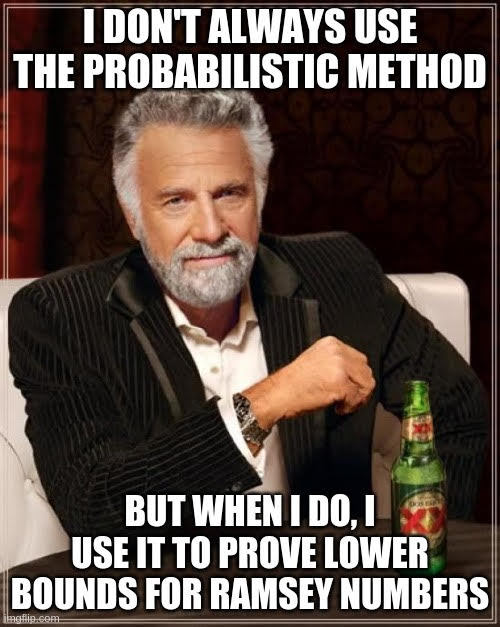
I challenge my readers to come up with other Ramsey Memes! or Complexity Memes! or point me to some that are already out there.
Thursday, June 18, 2020
On Chain Letters and Pandemics
Guest post by Varsha Dani.
My 11-year-old child received a letter in the mail. "Send a book to the first person named," it said, "then move everyone's name up the list, add your own name and send copies of the letter to six friends. In a few weeks you will receive 36 books from all over the world!". Wow. When I first encountered chain letters in the mid eighties, it was postcards, but even then it hadn't taken me in. Since then I hadn't seen one of these in a long time, but I guess with a lot of people suddenly at home for extended periods, people crave both entertainment and a connection to others.
What's wrong with chain letters? Well quite apart from the fact that they are illegal, even a child can comprehend that the number of books (or postcards or other gifts) received must equal the number sent, and that for every participant who does get a rich reward, there will be many who get nothing.
But there is another kind of chain communication going around. It is an email, asking the recipient to send a poem or meditation to somebody, and later they will receive many communications of the same sort. How endearing. Poetry. Sweetness and Light. No get-rich-quick pyramid schemes here. What's wrong with that?
Of course, it depends on what one means by "wrong". Maybe you like exchanging poetry with strangers. Maybe you don't find it onerous or wish that your spam filter would weed it out. But let's leave aside those issues and look at the math alone. You send the email to two friends, each of whom forwards it to two of their friends and so on. So the number of people the email reaches ostensibly doubles every step. Exponential growth. But in fact that is not what the graph of human connections looks like. Instead, what happens is that the sets of friends overlap, so that after a while the growth stops being exponential and tapers down.
Where else have we seen something like that? Oh, right. The pandemic. The virus jumps from infected people to the people they meet, and from them to the people they meet and so on. Initially, that's exponential growth fof new cases, but after a while it tapers off, forms a peak and then starts to decrease. Why? Because eventually there is overlap in the sets of people that each infected person is "trying" (unintentionally) to infect, and a newly infected person who got the virus from one or many previously infected people is still just one newly infected person.
So the chain letter spreads just like a virus. Indeed if one were to, somewhat fancifully, think of the chain letter as an independent entity whose goal is to self-replicate, then it looks even more like a virus, and, like a virus, it can only achieve its self-replication goal through the help of a host. But here's a way in which it is not like a virus. Once one has got the virus and recovered, one (hopefully) does not get it again. Not so the chain letter, of which one may get many copies over time! So maybe you will get some gifts or poetry, but you will likely also get more requests for them!
So what's wrong with the poetry chain email? It depends on your perspective. To those of you who are wistfully waiting for that Poem from a Stranger, I dedicate the following to you.
An open letter to my 2n dearest friends:
A letter came for me today
It promised wondrous ends
If only I would forward it
To just two other friends.
If they in turn should send it on
to two more that they know,
the goodwill that we're sending out
would grow and grow and grow.
Is this as pleasant as it seems?
Alas, dear friends, it's not.
This exponential growth can lead
To quite a sticky spot.
Friends of friends of friends of mine
May very well be linked
The further that the letters go.
These folks are not distinct!
Ensuring there's no overlap
Is a logistic* pain.
As you will see, when you receive
That letter yet again.
So while you're stuck at home this year
And pacing in your room.
Pick up the phone and make a call
Or see your friends on Zoom.
Your real thoughts would make me smile.
Chain letters are a con.
Do everyone a favor and
Don't send that letter on!
--------------
Monday, June 15, 2020
Presentations of Diffie-Helman leave out how to find g
When I first taught Diffie Helman I read the following
1) Alice and Bob agree on p a prime and g a generator
2) Alice picks a, sends g^a to Bob, Bob picks b, sends g^b to Alice
3) Alice computes (g^b)^a and Bob computes (g^a)^b so they both have g^{ab}
I knew how to find a prime- pick a number of length n (perhaps make sure the last digit is not even) and test for primality, if not then try again, you'll get one soon enough. I did not know how to find g. I had thought you first find p, and then given p you find g. I then figured out that you make actually pick p to be a safe prime, so q=(p-1)/2 is a prime, and then just pick random g and test them via computing g^2 and g^q: if neither is 1 then g is a generator. You will find a generator soon enough.
That was all fine. But how come my source didn't say how to find g.?You need to know that to run the algorithm. That was years ago. Then I wondered how common it is for an explanation to not say how to find g. So I Googled ``Diffie-Helman'' I only record those that had some technical content to them, and were not about other DH such as Elliptic Curves.
0) The Original DH paper Page 34: alpha is a fixed primitive element of GF(alpha). No mention of how to find either the prime q or the prim root alpha.
1) Wikiepdia: ... protocol uses the mult group of integers mod p, where p is a prime and g is a prim root mod p. NO mention of how they find p or g.
2) Wolfram's MathWorld: They agree on two prime numbers g and p, where p is large and g is a prim root mod p. In practice it is good to choose p such that (p-1)/2 is also prime. They mention (p-1)/2 but not for the reason I give. (There are algorithms for Discrete Log that do well if (p-1)/2 has many factors.)
3) Comparatech: Alice and Bob start out by deciding two numbers p and g. No mention of how to find p or g.
4) Searchsecurity Won't bother quoting, but more of the same, no mention of how to find p or g.
5) The Secret Security Wiki Alice and Bob agree on p and g.
6) Science Direct More of the same.
7) Notes from a UCLA Crypto Course YEAH! They say how to find g.
8) Brilliant (yes that really is the name of this site) Brilliant? Not brilliant enough to realize you need to say how to find p and g.
9) OpenSSL Hard to tell. Their intuitive explanation leaves it out, but they have details below and code that might have it.
I looked at a few more but it was the same story.
This is NOT a RANT or even a complaint, but its a question:
Why do so few expositions of DH mention how to find p,g? You really need to do that if you really want to DO DH.
Speculation
1) Some of the above are for the laymen and hence can not get into that. But some are not.
2) Some of them are for advanced audiences who would know how to do it. Even so, how to find the generator really needs to be mentioned.
3) Goldilocks: Some papers are for the layman who would not notice the gap, and some papers are for the expert who can fill in the gap themselves, so no paper in between. I do not believe that.
4) The oddest of the above is that the original paper did not say how to find g.
1) Alice and Bob agree on p a prime and g a generator
2) Alice picks a, sends g^a to Bob, Bob picks b, sends g^b to Alice
3) Alice computes (g^b)^a and Bob computes (g^a)^b so they both have g^{ab}
I knew how to find a prime- pick a number of length n (perhaps make sure the last digit is not even) and test for primality, if not then try again, you'll get one soon enough. I did not know how to find g. I had thought you first find p, and then given p you find g. I then figured out that you make actually pick p to be a safe prime, so q=(p-1)/2 is a prime, and then just pick random g and test them via computing g^2 and g^q: if neither is 1 then g is a generator. You will find a generator soon enough.
That was all fine. But how come my source didn't say how to find g.?You need to know that to run the algorithm. That was years ago. Then I wondered how common it is for an explanation to not say how to find g. So I Googled ``Diffie-Helman'' I only record those that had some technical content to them, and were not about other DH such as Elliptic Curves.
0) The Original DH paper Page 34: alpha is a fixed primitive element of GF(alpha). No mention of how to find either the prime q or the prim root alpha.
1) Wikiepdia: ... protocol uses the mult group of integers mod p, where p is a prime and g is a prim root mod p. NO mention of how they find p or g.
2) Wolfram's MathWorld: They agree on two prime numbers g and p, where p is large and g is a prim root mod p. In practice it is good to choose p such that (p-1)/2 is also prime. They mention (p-1)/2 but not for the reason I give. (There are algorithms for Discrete Log that do well if (p-1)/2 has many factors.)
3) Comparatech: Alice and Bob start out by deciding two numbers p and g. No mention of how to find p or g.
4) Searchsecurity Won't bother quoting, but more of the same, no mention of how to find p or g.
5) The Secret Security Wiki Alice and Bob agree on p and g.
6) Science Direct More of the same.
7) Notes from a UCLA Crypto Course YEAH! They say how to find g.
8) Brilliant (yes that really is the name of this site) Brilliant? Not brilliant enough to realize you need to say how to find p and g.
9) OpenSSL Hard to tell. Their intuitive explanation leaves it out, but they have details below and code that might have it.
I looked at a few more but it was the same story.
This is NOT a RANT or even a complaint, but its a question:
Why do so few expositions of DH mention how to find p,g? You really need to do that if you really want to DO DH.
Speculation
1) Some of the above are for the laymen and hence can not get into that. But some are not.
2) Some of them are for advanced audiences who would know how to do it. Even so, how to find the generator really needs to be mentioned.
3) Goldilocks: Some papers are for the layman who would not notice the gap, and some papers are for the expert who can fill in the gap themselves, so no paper in between. I do not believe that.
4) The oddest of the above is that the original paper did not say how to find g.
Monday, June 08, 2020
The Committee for the Adv. of TCS- workshop coming up SOON!
(Posted by request from Jelani Nelson.)
The Committee for the Advancement of Theoretical Computer Science (CATCS)
is organizing a Visioning workshop. The primary objective of the workshop
is for TCS participants to brainstorm directions and talking points for TCS
program managers at funding agencies to advocate for theory funding.
There was some question of whether or not it would run this summer, but
YES, it is going to run.
If you are interested then reply (at the link below) by June 15.
This is SOON so click that link SOON.
The time commitment is 4-5 hours during the week of July 20-July 24 for
most participants, or roughly 10 hours for those who are willing to
volunteer to be group leaders.
The link to sign up is:
Tuesday, June 02, 2020
How to handle grades during the Pandemic
In March many Colleges sent students home and the rest of the semester was online. This was quite disruptive for the students. Schools, quite reasonably, wanted to make it less traumatic for students.
So what to do about grades? There are two issues. I state the options I have heard.
ISSUE ONE If P/F How to Got About it?
1) Grade as usual.
2) Make all classes P/F.
PRO: Much less pressure on students.
CON: Might be demoralizing for the good students.
3) Make all classes P/F but allow students to opt for letter grades BUT they must decide before the last day of class. Hence teachers must post cutoffs before the final is graded
CON: Complicated and puts (a) teachers in an awkward position of having to post cutoffs before the final, and (b) puts students in an awkward position of having to predict how well they would do.
CON: A student can blow off a final knowing they will still get a D (passing) in the course.
PRO: Good students can still get their A's
CAVEAT: A transcript might look very strange. Say I was looking at a graduate school applicant and I see
Operating Systems: A
Theory of Computation: P
I would likely assume that the Theory course the student got a C. And that might be unfair.
3) Make all classes P/F but allow students to opt for letter grades AFTER seeing their letter grades.
PRO: Less complicated an awkard
PRO: A students blah blah
CAVEAT above still applies.
ISSUE TWO If P/F what about a D in the major
At UMCP COMP SCI (and I expect other depts)
a D is a passing grade for the University
but
a D is not a passing grade for the Major.
So if a s CS Major gets a D in Discrete Math that does not count for the major--- they have to take it over again.
But if classes are P/F what do do about that.
Options
1) Students have to take classes in their major for a letter grade.
CON: The whole point of the P/F is to relieve pressure on the students in these hard times.
PRO: None.
2) Students taking a course in their major who get a D will still get a P on the transcript but will be told that they have to take the class over again.
3) Do nothing, but tell the students
IF you got a D in a course in your major and you are taking a sequel, STUDY HARD OVER THE SUMMER!
4) Do nothing, but tell the teachers
Students in the Fall may have a weak background. Just teach the bare minimum of what they need for the major.
(Could do both 3 and 4)
SO- what is your school doing and how is it working?
So what to do about grades? There are two issues. I state the options I have heard.
ISSUE ONE If P/F How to Got About it?
1) Grade as usual.
2) Make all classes P/F.
PRO: Much less pressure on students.
CON: Might be demoralizing for the good students.
3) Make all classes P/F but allow students to opt for letter grades BUT they must decide before the last day of class. Hence teachers must post cutoffs before the final is graded
CON: Complicated and puts (a) teachers in an awkward position of having to post cutoffs before the final, and (b) puts students in an awkward position of having to predict how well they would do.
CON: A student can blow off a final knowing they will still get a D (passing) in the course.
PRO: Good students can still get their A's
CAVEAT: A transcript might look very strange. Say I was looking at a graduate school applicant and I see
Operating Systems: A
Theory of Computation: P
I would likely assume that the Theory course the student got a C. And that might be unfair.
3) Make all classes P/F but allow students to opt for letter grades AFTER seeing their letter grades.
PRO: Less complicated an awkard
PRO: A students blah blah
CAVEAT above still applies.
ISSUE TWO If P/F what about a D in the major
At UMCP COMP SCI (and I expect other depts)
a D is a passing grade for the University
but
a D is not a passing grade for the Major.
So if a s CS Major gets a D in Discrete Math that does not count for the major--- they have to take it over again.
But if classes are P/F what do do about that.
Options
1) Students have to take classes in their major for a letter grade.
CON: The whole point of the P/F is to relieve pressure on the students in these hard times.
PRO: None.
2) Students taking a course in their major who get a D will still get a P on the transcript but will be told that they have to take the class over again.
3) Do nothing, but tell the students
IF you got a D in a course in your major and you are taking a sequel, STUDY HARD OVER THE SUMMER!
4) Do nothing, but tell the teachers
Students in the Fall may have a weak background. Just teach the bare minimum of what they need for the major.
(Could do both 3 and 4)
SO- what is your school doing and how is it working?
Monday, May 25, 2020
Oldest Living Baseball Players- can you estimate...
(The Baseball season is delayed or cancelled, so I post about baseball instead.)
This post is going to ask a question that you could look up on the web. But what fun with that be?
The following statements are true
1) Don Larsen, a professional baseball player who played from 1953 to 1967, is still alive. He is 90 years old (or perhaps 90 years young---I don't know the state of his health). He was born Aug 7, 1929. He is best know for pitching a perfect game in the World Series in 1956, pitching for the Yankees. He played for several other teams as well, via trades (this was before free agency).
(CORRECTION- I wrote this post a while back, and Don Larsen has died since then.)
2) Whitey Ford, a professional baseball player who played from 1950 to 1967, is still alive. He is 91 years old (or perhaps 91 years young---I don't know the state of his health). He was born Oct 21, 1928. He had many great seasons and is in the hall of fame. He played for the New York Yankees and no other team.
3) From 1900 (or so) until 1962 there were 16 professional baseball teams which had 25 people each. From 1962 until 1969 there were 20 teams which had 25 people each. There were also many minor league teams.
4) The youngest ballplayers are usually around 20. The oldest around 35. These are not exact numbers
SO here is my question: Try to estimate
1) How many LIVING retired major league baseball players are there now who are older than Don Larsen?
2) How many LIVING retired major league baseball players are of an age between Don and Whitey?
3) How many LIVING retired major league baseball players are older than Whitey Ford?
Give your REASONING for your answer.
This post is going to ask a question that you could look up on the web. But what fun with that be?
The following statements are true
1) Don Larsen, a professional baseball player who played from 1953 to 1967, is still alive. He is 90 years old (or perhaps 90 years young---I don't know the state of his health). He was born Aug 7, 1929. He is best know for pitching a perfect game in the World Series in 1956, pitching for the Yankees. He played for several other teams as well, via trades (this was before free agency).
(CORRECTION- I wrote this post a while back, and Don Larsen has died since then.)
2) Whitey Ford, a professional baseball player who played from 1950 to 1967, is still alive. He is 91 years old (or perhaps 91 years young---I don't know the state of his health). He was born Oct 21, 1928. He had many great seasons and is in the hall of fame. He played for the New York Yankees and no other team.
3) From 1900 (or so) until 1962 there were 16 professional baseball teams which had 25 people each. From 1962 until 1969 there were 20 teams which had 25 people each. There were also many minor league teams.
4) The youngest ballplayers are usually around 20. The oldest around 35. These are not exact numbers
SO here is my question: Try to estimate
1) How many LIVING retired major league baseball players are there now who are older than Don Larsen?
2) How many LIVING retired major league baseball players are of an age between Don and Whitey?
3) How many LIVING retired major league baseball players are older than Whitey Ford?
Give your REASONING for your answer.
Tuesday, May 19, 2020
Obit for Richard Dudley
Richard M. (Dick) Dudley died on Jan. 19, 2020 (NOT from Coronavirus).You can find obituaries for him here, here, and here and an interview with him from 2019 here.
Professor Dudley worked in Probability and Statistics. His work is now
being used in Machine Learning. Here is a guest-post-obit by
David Marcus who had Prof. Dudley as his PhD Thesis Advisor.
-----------------------------------
Guest Blog Obit by David Marcus:
Dick was my thesis advisor at M.I.T. After I got my Ph.D. in 1983, I went
to work in industry, so did not work closely with him, as some of his other
students did. But, I enjoyed working with him very much in graduate school.
Dick was very precise. His lecture notes and articles (and later his books)
said exactly what needed to be said and didn't waste words. In his classes,
he always handed out complete lecture notes, thus letting you concentrate
on the material rather than having to take a lot of notes.
Dick was very organized, but his office had piles of papers and journal
articles everywhere. There is a picture here.
Before Dick was my advisor, I took his probability course. My orals were
going to be towards the end of the term, and I was going to use probability
as one of my two minor areas. So, I spent a lot of time studying the
material. Dick gave a final exam in the course. The final exam was unlike
any other final exam I ever took: The exam listed twelve areas that had
been covered in the course. The instructions said to pick ten and for each
area give the main definitions and theorems and, if you had time, prove the
theorems. Since I had been studying the material for my orals, I didn't
have much trouble, but if I hadn't been studying it for my orals, it would
have been quite a shock!(COMMENT FROM BILL: Sounds like a lazy way to make up an exam, though on this
level of may it works. I know of a prof whose final was
Make up 4 good questions for the final. Now Solve them.
)
Once Dick became my advisor, Dick and I had a regular weekly meeting. I'd
tell him what I'd figured out or what I'd found in a book or journal
article over the last week and we'd discuss it and he'd make suggestions.
At some point, I'd say I needed to think about it, and I'd leave. I never
did find out how long these meetings were supposed to last because I was
always the one to end them.(COMMENT FROM BILL: It's good someone ended them! Or else you might never
had graduated :-) )
When I began working with Dick, he said he already had a full
load of students, but he would see if he had something I could work on. The
problem Dick came up with for me to work on was to construct a
counterexample to a theorem that Dick had published. Dick knew his
published proof was wrong, and had an idea of what a counterexample might
look like, so suggested I might be able to prove it was a counterexample.
In retrospect, this was perhaps a risky thesis problem for me since if the
student gets stuck, the professor can spend time figuring out how to do it.
But, in this case, presumably Dick had already put some effort into it
without success. Regardless, with Dick's guidance, I was able to prove it,
and soon after got my Ph.D.(COMMENT FROM BILL: Sounds risky since if Dick could not do it, maybe it's too hard.)
In 2003 there was a conference in honor of Dick's 65th birthday. All of his
ex-students were invited, and many of them attended. There was a day of
talks, and we all went out to dinner (Chinese food, if I recall correctly)
in the evening. At dinner, I asked Dick if any of his other students had
written a thesis that disproved one of his published theorems. He said I
was the only one.(COMMENT FROM BILL: Really good that not only was he okay with you disproving
his theorem, he encouraged you to!)
Thursday, May 14, 2020
Awesome Video from Women In Theory!
Below is an awesome video made by WIT (Women In Theory) on May 10, 2020 to celebrate the women in our field and in place of the Women in Theory Workshop that was supposed to take place
@Simons in June. ENJOY:
Monday, May 11, 2020
And the winners are ....
The Computational Complexity Conference has announced the accepted papers for the 2020 now virtual conference. Check them out!
Speaking of the complexity conference, my former PhD student Dieter van Melkebeek will receive the ACM SIGACT Distinguished Service award for his leadership in taking the conference independent. They grow up so fast!
Robin Moser and Gábor Tardos will receive the Gödel Prize for their work giving a constructive proof of the Lovász Local Lemma, one of my truly favorite theorems as it gave a far stronger bound, a shockingly simple and efficient algorithm and an incredibly beautiful proof. Back in 2009 Moser gave my all-time favorite STOC talk on an early version of the paper. I (and others) sat amazed as his algorithm and proof came alive. During the talk I asked Eric Allender sitting next to me "Are we really seeing a Kolmogorov complexity proof of the Lovász Local Lemma?" Yes, we did.
Cynthia Dwork will receive the Knuth prize given for her life's work. The prize would be justified by her work on distributed computing alone but it is her leadership in formalizing Differential Privacy, one of the coolest concepts to come out of the theoretical computer science community this century, that will leave her mark in theory history.
Thursday, May 07, 2020
Vidcast on Conferences
Bill and Lance have another socially-distanced vidcast, this time with Lance telling the story of two conferences (ACM Economics and Computation and the Game Theory Congress). As mentioned in the video the Game Theory Congress has been postponed to next year. Also mentioned in the video, for a limited time you can read Lance's book on P v NP on Project Muse.
Monday, May 04, 2020
Why is there no (d,n) grid for Hilbert's Tenth Problem?
Hilbert's 10th problem, in modern language is:
Find an algorithm that will, given a poly over Z in many variables, determine if it has a solution in Z.
This problem was proven undecidable through the work of Davis, Putnam, Robinson and then
Matiyasevich supplied the last crucial part of the proof.
Let H10(d,n) be the problem with degree d and n variables.
I had assumed that somewhere on the web would be a grid where the dth row, nth col has
U if H10(d,n) is undecidable
D if H10(d,n) is decidable
? if the status of H10(d,n) was unknown.
I found no grid. I then collected up all the results I could find here
This lead to the (non-math) question: Why is there no grid out there? Here are my speculations.
1) Logicians worked on proving particular (d,n) are undecidable. They sought solutions in N. By contrast number theorists worked on proving particular (d,n) decidable. They sought solutions in Z.. Hence a grid would need to reconcile these two related problems.
2) Logicians and number theorists didn't talk to each other. Websites and books on Hilbert's Tenth problem do not mention any solvable cases of it.
3) There is a real dearth of positive results, so a grid would not be that interesting. Note that we do not even know if the following is decidable: given k in Z does there exists x,y,z in Z such that
x^3 +y^3+ z^3 = k. I blogged about that here
4) For an undecidable result for (d,n) if you make n small then all of the results make d very large.
For example
n=9, d= 1.6 x 10^{45} is undecidable. The status of n=9, d=1.6 x 10^{45} -1 is unknown.
Hence the grid would be hard to draw.
Frankly I don't really want a grid. I really want a sense of what open problems might be solved. I think progress has gone in other directions- H10 over other domains. Oh well, I want to know about
n=9 and d=1.6 x 10^{45}-1. (parenthesis ambiguous but either way would be an advance.)
Friday, May 01, 2020
Predicting the Virus
As a complexity theorist I often find myself far more intrigued in what we cannot compute than what we can.
In 2009 I posted on some predictions of the spread of the H1N1 virus which turned out to be off by two orders of magnitude. I wrote "I always worry that bad predictions from scientists make it harder to have the public trust us when we really need them to." Now we need them to.
We find ourselves bombarded with predictions from a variety of experts and even larger variety of mathematicians, computer scientists, physicists, engineers, economists and others who try to make their own predictions with no earlier experience in epidemiology. Many of these models give different predictions and even the best have proven significantly different than reality. We keep coming back to the George Box quote "All models are wrong, but some are useful."
So why do these models have so much trouble? The standard complaint of inaccurate and inconsistently collected data certainly holds. And if a prediction changes our behavior, we cannot fault the predictor for not continuing to be accurate.
There's another issue. You often here of a single event having a dramatic effect in a region--a soccer game in Italy, a funeral in Georgia, a Bar Mitzvah in New York. These events ricocheted, people infected attended other events that infected others. This becomes a complex process that simple network models can never get right. Plenty of soccer games, funerals and Bar Mitzvahs didn't spread the virus. If a region has hadn't a large number of cases and deaths is it because they did the right thing or just got lucky. Probably something in between but that makes it hard to generalize and learn from experience. We do know that less events means less infection but beyond that is less clear.
As countries and states decide how to open up and universities decide how to handle the fall semester, we need to rely on some sort of predictive models and the public's trust in them to move forward. We can't count on the accuracy of any model but which models are useful? We don't have much time to figure it out.
Wednesday, April 29, 2020
A Guest Blog on the Pandemic's affect on disability students
I asked my Grad Ramsey Theory class to email me about whatever thoughts they have on the pandemic that they want to share with the world, with the intend of making some of them into a blog post. I thought there would be several short thoughts for one post. And I may still do that post. But I got a FANTASTIC long answer from one Emily Mae Kaplitz. Normally I would ask to shorten or edit a guest post, but I didn't do that here since that might make it less authentic.
Here is Emily Kaplitz's email (with her enthusiastic permission)
--------------------------------------------------------------------------------------
Ok so this might be super ranty, (It definitely is.) but I think it is super important to bring up in a blog post written by an academic that will be probably read by other academics.
The students that are being most affected by this pandemic with online learning are disability students. As a disability student, we carefully cultivate the way that we learn best based off of years of trial and error. This is harder than anything else, we have to face in our lifetime. Most of the time disability students are left on the back burner and that statement is so much more prevalent right now. My friends brother is autistic. He is struggling so much right now because he is at home. Disability students learn what environment works best for them and at home is usually not the best place. We have to split our lives into different boxes that each have different tools to help us get our brains to focus and work well when we need them too. Disability students will rely on everything being planned out, so that they can succeed. Teachers and professors cannot understand the stress and strain that having to work at home puts on the student. Every time I go to another school, it is a struggle to figure out what new thing I need to add into the mix and what old thing I need to throw away. It's exhausting, but when I go from one school to another I at least know that the basics are the same. I sit in a classroom, the professors lecturer, and then I do work at home that is assigned to me. Changing to online changes that dynamic so much. A professor cannot see when a student is visibly struggling with a topic because we'll all behind computers. A neurotypical person might ask, "well why don't you just ask a question? Why don't you just let the professor know that you don't understand". Let me answer that simply. If all your life you've been silenced because of something that you cannot control, is your first reaction to speak out or to stay silent. It is so hard for disability students to ask a question after we've been labeled the dumb kid. Every time we ask a question, we always have the thought of: is this going to make me sound stupid. We've worked so hard to eliminate that word from our vocabulary and from others who will throw that word back at us. Disability students are being left in the hands of their parents and teachers/professors who do not understand us and our needs even if they try to or want to. It is so hard for us to explain what our normal is because we don't live your normal and therefore don't know the difference. Many disability students have their confidence slashed the moment they enter a classroom and realize that they are not like the other kids. Even more so because they don't understand why they aren't. Disability students are one of the most hard-working individuals when we have a cheerleader to cheer us on because it's hard. It's harder than anything anyone has to do. Because no one listens to you when you are stupid and no one cares for you if you're not easy to care for unless they are given a specific reason to. Fighting a losing battle every day is awful. Now imagine all of your weapons that you have carefully crafted over the years have been taken away and you are left defenseless. While we have things like ADS that are supposed to help support us, it's not enough. Just like putting a Band-Aid on an open infected wound will not be enough. Now more than ever we need to learn from this as academics. We need to learn that helping disability students does not only help disability students. It helps all students because all students learn differently. All students if given the chance can excel at any field that we put them in. We just have to figure out the best way to get that student to shine. That is one of the reasons why I am a PhD student right now. I saw in the tutoring center at my undergrad how many students came to me with so much frustration about something they are doing in class. Both students with disabilities and without. These students are constantly apologizing because they don't understand something. In one session by just changing the way that we talk about a subject the student was able to get it in less time than the professor taught it. I've had students come to me after an exam and tell me that the only reason they got the grade that they did was because in their head was my voice coaching them on a subject. We are not teaching optimally. We are teaching the way that it has been done for years and years and years and that is not the best way to teach. It might be the best way to teach the strongest links but really the link that matters the most is the weakest link that will snap under pressure because you can't pull a tractor with a broken link. Disability students think differently. Imagine how many impossible problems we can solve when we have people that think differently. But that's just my two cents as a disability student who is struggling and sees other disability students struggling every day. And really just wants to help all students succeed.
I blame any misspellings, grammar errors, and run on sentences on my speech to text and text to speech. This was a long email and if we were on tumblr, I would post a potato at the end. Since we aren't, I will leave this email with this. Thank you for taking the time to read this rant. Even if you don't include this in your blog post, I believe one person reading this has made the difference.
Thanks!
Emily Mae Kaplitz
Wednesday, April 22, 2020
Monday, April 20, 2020
The Summer Virtual Conference Season
Both STOC and Complexity have announced they will go virtual for the summer. ICALP moved from Beijing to Saarbrücken to online. I expect every major summer conference and workshop will be cancelled, postponed or virtualized.
Most CS conferences serve as publication venues and can't be cancelled or postponed. So how do we virtualize a conference? The ACM has an evolving virtual conferences best practices guide. Putting the talks and poster sessions online is not trivial, but relatively straightforward. Personally I go to conferences mostly not for the talks but for the interactions with other participants--the receptions, meal time and just hanging in the hallways. The ACM document describes some approaches like Dagstuhl-style randomized virtual dinner tables. The IEEE VR conference tried virtual reality through Mozilla hubs. None of these can truly replicate the on-site experience.
Let me mention two other meetings the Game Theory Congress held every four years due to be held in Budapest and the CRA Snowbird Conference, a meeting of CS department chairs and computing leadership, held every other summer in Utah. Both meetings are not archival publications venues though have several talks and panels. But the main purpose of both is mostly to bring people together, game theorists and CS leaders. I hope they postpone rather than virtualize these meetings. Rather get together a year late than pretend to get together now.
Wednesday, April 15, 2020
Theoretical Computer Science for the Future
Guest post by the TCS4F initiative
(Antoine Amarilli, Thomas Colcombet, Hugo Férée, Thomas Schwentick)
The manifesto can be signed by individual researchers (like you, dear reader!), by research groups, and by organizers of conferences and workshops. Currently, over 50 researchers have signed it. The goal of TCS4F is also to start organizing a community of concerned researchers, across theoretical computer science, to think about the issue of climate change and how to adjust what we do, in particular our travel habits.
We need your help to make this initiative a success and help theoretical CS lead the way towards a sustainable, carbon-neutral future:
TCS4F is an initiative by theoretical computer scientists who are
concerned about that other major crisis of our time: climate change. We
anticipate that the climate crisis will be a major challenge of the
decades to come, that it will require major changes at all levels of
society to mitigate the harm that it will cause, and that researchers in
theoretical computer science, like all other actors, must be part of the
solution and not part of the problem.
Our initiative is to propose a manifesto to commit
to a reduction of greenhouse gas emissions: following IPCC goals, the
objective is to reduce by at least 50% before 2030 relative to pre-2020
levels. The manifesto is more than a simple expression of concern,
because it is a pledge with concrete objectives. However, it does not
prescribe specific measures, as we believe this discussion is not
settled yet and the right steps to take can vary depending on everyone's
practices.
The manifesto can be signed by individual researchers (like you, dear reader!), by research groups, and by organizers of conferences and workshops. Currently, over 50 researchers have signed it. The goal of TCS4F is also to start organizing a community of concerned researchers, across theoretical computer science, to think about the issue of climate change and how to adjust what we do, in particular our travel habits.
We need your help to make this initiative a success and help theoretical CS lead the way towards a sustainable, carbon-neutral future:
- If you agree with our concerns and are ready to commit to reducing your carbon footprint, consider signing the manifesto. Signing is open to all researchers in theoretical CS in the broadest possible sense.
- Advertise your support of the manifesto (e.g., by putting one of our badges on your webpage). Talk in your research teams and departments about the manifesto, and see if you can gather support for signing the manifesto collectively as a research group.
- If you are involved in conferences and workshops, start a discussion about the carbon footprint of the event, and whether the event could commit to the manifesto's goal. Indeed, now that conferences across the globe are moving online because of the COVID-19 pandemic, it is a good time to discuss how conferences could evolve towards more sustainable models.
- Spread the word about the issue of climate change and the TCS4F initiative, and encourage discussion of this important challenge in our communities.
As theoretical researchers, we are not used to discussing uncomfortable
non-scientific questions like the effects of our activities on the
world. However, we believe that the magnitude of the climate crisis
obliges us to act now as a community. We are confident that great
changes can be achieved if we do not limit our creativity to our
specific research areas and also use it to re-think our way to do
research.
Sunday, April 12, 2020
John Conway Dies of Coronvirus
John Conway passed away on April 11, 2020 of the Coronovirus. He is the first person I knew (for some definition of `know') who has died of it. I suspect this is true of many readers of this blog.
(Fellow bloggers Scott Aaronson and Terry Tao have already posted about John Conway,
here and here. I suspect there will be others and when they do I will add it here.
ADDED LATER: nice xkcd here
John Conway is a great example of how the line between recreational math and serious math is .... non-existent? not important? Take our pick.
Examples
1) Conway invented Surreal Numbers. These can be used to express infinitely big and infinitely small numbers. One can even make sense of things like square root of infinity. Conway's book is called On Numbers and Games (see here and here) Two free sources: here and here.
(Fellow bloggers Scott Aaronson and Terry Tao have already posted about John Conway,
here and here. I suspect there will be others and when they do I will add it here.
ADDED LATER: nice xkcd here
John Conway is a great example of how the line between recreational math and serious math is .... non-existent? not important? Take our pick.
Examples
1) Conway invented Surreal Numbers. These can be used to express infinitely big and infinitely small numbers. One can even make sense of things like square root of infinity. Conway's book is called On Numbers and Games (see here and here) Two free sources: here and here.
Note that Conway defined surreals in terms of games. Are they fun games? Probably not, but they are games!
2) Conway's Game of Life (you really do need to use his name, note the contrast between The game of life here and Conway's Game of Life here
The game is simple (and this one IS fun). You begin with some set of dots placed at lattice points, and a set of rules to tell how they live, die, or reproduce. The rules are always the same. Different initial patterns form all kinds of patterns. Sounds fun! Is it easy to tell, given pattern P1 and P2 whether, starting with P1 you can get to P2. No. Its undecidable.
So this simple fun game leads to very complicated patterns.
And nice to have an undecidable problem that does not mention Turing Machines. (I will tell the students it is undecidable this semester, though I won't be proving it.)
This is the ultimate book on NIM games.
4) The above is probably what the readers of this blog are familiar with; however, according to his Wikipedia page (see here) he worked in Combinatorial Game Theory, Geometry, Geometric Topology, Group Theory, Number Theory, Algebra, Analysis, Algorithmics and Theoretical Physics.
He will be missed.
Monday, April 06, 2020
Subscribe to:
Posts (Atom)