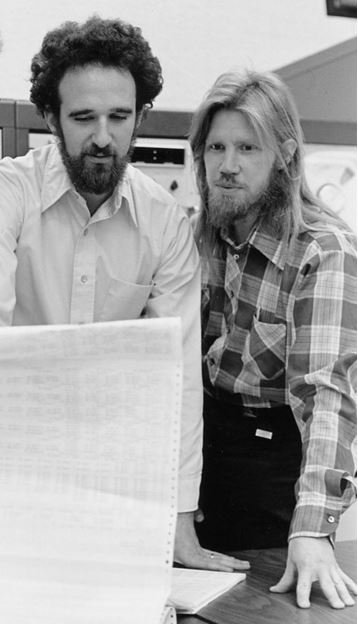
David Johnson, a leader and advocate for algorithms and all of theoretical computer science, passed away yesterday at the age of 70. A truly sad day for us all.
David's 1979 book with Michael Garey, Computers and Intractability: A Guide to the Theory of NP-Completeness, is still the best reference on the topic and perhaps the single most important resource in any computer scientist's library. David Johnson also wrote the NP-completeness column for the Journal on Algorithms and later the ACM Transactions on Algorithms, as well as "A Catalog of Complexity Classes" for the 1990 Handbook of Theoretical Computer Science. David founded the Symposium on Discrete Algorithms (SODA), a conference that is now often mentioned with STOC and FOCS as a top theory venue. He created the DIMACS algorithms challenges. He led SIGACT from 1987-1991, really transforming that organization, and served as its face for many years thereafter. I'm only scratching the surface of what he's done for the community, and can think of no one who put more effort into making the theoretical computer science as strong as it is.
Of course David was a great researchers as well, working on NP-completeness and approximation algorithms.
He received an ACM Fellow in 1995, the first SIGACT Distinguished Service prize in 1997 and the Knuth Prize in 2010. He used his Knuth prize lecture to push for practical applications for our algorithms. Just last month he was elected into the National Academy of Engineering.
I worked with David Johnson closely on various SIGACT activities. David never missed a STOC and we always invited him to the SIGACT Executive Committee dinners, not because he had an official role, but because he was David Johnson. I truly respected and admired David and glad I could call him a friend. We'll miss him deeply. STOC and SODA just won't be the same without him.
Computational Complexity and other fun stuff in math and computer science from Lance Fortnow and Bill Gasarch
Wednesday, March 09, 2016
Monday, March 07, 2016
When do we care about the constants?
I've been reading two books recently: Asymptopia by Joel Spencer (He turns 70 soon! Workshop for it!. My nephew things that celebrating your bday with a workshop would be... odd) and The Joy of Factoring by Simon Wagtaff. In terms of content they are on two different topics. In terms of practicality they are different: Asymptopia is clearly a pure math book (there is one chapter on algorithms, but the rest is really pure math) whereas The Joy of Factoring is very practical in that it focuses on real algorithms for the important (for crytography) practical problem of factoring. However, there is one thing the books had in common: They both often care about multiplicative constants.
Example from Asymptopia: They gave better and better lower bounds on Ramsey numbers:
(1) R(k) ≥ (1+o(1))(k/e sqrt(2)) 2k/2 roughly (1+o(1))(0.26)2k/2
(2) R(k) ≥ (1+o(1))(k/e) 2k/2 roughly (1+o(1))(1+o(1))(0.37)k/2
(3) R(k) ≥ (1+o(1))(k/sqrt(2)) 2k/2 roughly (1+o(1))(0.71)k/2
(It may be hard to read so I will clarify- the o(1) is little-o, a term that goes to 0 as k gets large.)
The first lower bound uses the prob method and you the reader has prob seen it or could prob derive it yourself. Prob. The second lower bound uses prob and a clever way of coloring and then tossing out some vertices. The third lower bound uses the Local Lovasz Lemma.
Note that for this problem Joel Spencer cared about the constant.
Example from The Joy of Factoring: Since many (but not all!) factoring algorithms do not have rigorously proven run times (Number Theory is Hard!) it's harder to give clean examples here. The book often refers to tricks to get constants down and the notion that constants matters permeates the book. Here is one rigorous example of caring about constants:
Fermat's difference-of-squares algorithm goes as follows: We want to factor N. Let x=floor(sqrt(N)). Test each of the following numbers for being a square and stop when you get a square: x2-N, (x+1)2-N, (x+2)2 - N, etc. When you find an r such that (x+r)2-N=y2 then you have (x+r-y)(x+u+y)=N. Almost surely this is a nontrivial factorization of N. (This algorithm is worse than the trivial sqrt(N) algorithm in some cases; however, it has some of the ideas needed for more sophisticated algorithms including the Quadratic Sieve.) Of course, one might be looking for the right r a long time. How long:
Let a be the largest divisor of N that is ≤ \sqrt(N). Let k=a/sqrt(N). Then the search will take
1+ (1-k)2sqrt(N)/(2k)
Again note that there are no hidden multiplicative constants.
So when do we care about constants and why?
1) If you are working on an algorithm for a problem people really want to solve then you need the constants to be small.
2) If you can get good bounds on the exact constants then you should.
3) If you have a technique and try it out you might end up just improving the constant. Even so, you have showed that the technique has merit.
4) Improving the constant may show progress which will later lead to more important improvements.
5) Chicken and Egg: Here is an example from Asymptopia where he didn't care about the constant: Fix ε. Given three points in the unit square what is the prob that their area will be ≤ ε ? He showed its Θ(ε).This proof is very nice. Tracking the constants used in his proof looks tedious. In order to care about the constants perhaps we need an interesting proof about them. To look for a proof technique that applies to them perhaps we need to care in the first place. Chicken and Egg?
Example from Asymptopia: They gave better and better lower bounds on Ramsey numbers:
(1) R(k) ≥ (1+o(1))(k/e sqrt(2)) 2k/2 roughly (1+o(1))(0.26)2k/2
(2) R(k) ≥ (1+o(1))(k/e) 2k/2 roughly (1+o(1))(1+o(1))(0.37)k/2
(3) R(k) ≥ (1+o(1))(k/sqrt(2)) 2k/2 roughly (1+o(1))(0.71)k/2
(It may be hard to read so I will clarify- the o(1) is little-o, a term that goes to 0 as k gets large.)
The first lower bound uses the prob method and you the reader has prob seen it or could prob derive it yourself. Prob. The second lower bound uses prob and a clever way of coloring and then tossing out some vertices. The third lower bound uses the Local Lovasz Lemma.
Note that for this problem Joel Spencer cared about the constant.
Example from The Joy of Factoring: Since many (but not all!) factoring algorithms do not have rigorously proven run times (Number Theory is Hard!) it's harder to give clean examples here. The book often refers to tricks to get constants down and the notion that constants matters permeates the book. Here is one rigorous example of caring about constants:
Fermat's difference-of-squares algorithm goes as follows: We want to factor N. Let x=floor(sqrt(N)). Test each of the following numbers for being a square and stop when you get a square: x2-N, (x+1)2-N, (x+2)2 - N, etc. When you find an r such that (x+r)2-N=y2 then you have (x+r-y)(x+u+y)=N. Almost surely this is a nontrivial factorization of N. (This algorithm is worse than the trivial sqrt(N) algorithm in some cases; however, it has some of the ideas needed for more sophisticated algorithms including the Quadratic Sieve.) Of course, one might be looking for the right r a long time. How long:
Let a be the largest divisor of N that is ≤ \sqrt(N). Let k=a/sqrt(N). Then the search will take
1+ (1-k)2sqrt(N)/(2k)
Again note that there are no hidden multiplicative constants.
So when do we care about constants and why?
1) If you are working on an algorithm for a problem people really want to solve then you need the constants to be small.
2) If you can get good bounds on the exact constants then you should.
3) If you have a technique and try it out you might end up just improving the constant. Even so, you have showed that the technique has merit.
4) Improving the constant may show progress which will later lead to more important improvements.
5) Chicken and Egg: Here is an example from Asymptopia where he didn't care about the constant: Fix ε. Given three points in the unit square what is the prob that their area will be ≤ ε ? He showed its Θ(ε).This proof is very nice. Tracking the constants used in his proof looks tedious. In order to care about the constants perhaps we need an interesting proof about them. To look for a proof technique that applies to them perhaps we need to care in the first place. Chicken and Egg?
Wednesday, March 02, 2016
Changing This Ancient Art Into a Science
The ACM announced yesterday that they will award the 2015 Turing Award to Whitfield Diffie and Martin Hellman for contributions to modern cryptography. The Turing award is the highest honor in all of computing. John Markoff in the New York Times also has the story.
Diffie and Hellman are best known for public-key cryptography, the brilliant idea that one could communicate secretly with someone you haven't communicated previously. Without public-key cryptography there would be no e-commerce. Equally important Diffie and Hellman brought computational complexity to bare, moving cryptography into its modern age. I strongly recommend reading their 1976 gem New Directions in Cryptography (PDF) particularly the introduction and chapter 6 where Diffie and Hellman connect cryptography to computational complexity and the P v NP problem itself defined only five years earlier. Here's the first paragraph:
We stand today on the brink of a revolution in cryptography. The development of cheap digital hardware has freed it from the design limitations of mechanical computing and brought the cost of high grade cryptographic devices down to where they can be used in such commercial applications as remote key cash dispensers and computer terminals. In turn, such applications create a need for new types of cryptographic systems which minimize the necessity of secure key distribution channels and supply the equivalent of a written signature. At the same time, theoretical developments in information theory and computer science show promise of providing provably secure cryptosystems, changing this ancient art into a science.
One question for which I shall offer no opinion: Should Ralph Merkle have been a co-recipient of this award?
Monday, February 29, 2016
It works in practice, but does it work in theory (Pollard's Factorization algorithm)
Throughout this post I ignore polylog factors.
It is trivial to factor N in time N1/2. Pollard's rho-algorithm (see my write up here or Wikipedia Entry) for factoring does bette expected time N1/4. Or does it? It works well in practice but has not been proven to work well in theory. (If I missed some paper that DID prove it works well in theory please leave a polite comment.)
Here we state a conjectures that, if true, will show that Pollard's algorithm is in time (randomized) N1/4. Let p be a prime. Let c be in {2,...,p-1}.
Let fc(x)= x2 + c mod p.
x1 will be specified in the conjecture. xi is f(xi-1).
For at least half of the elements x1 in {2,...,p-1} and at least half of the elements c in {2,...,p-1} the sequence x1, x2,... will have a repeat within the first O(p1/2) items.
This is thought to be true since it is thought that the sequence is random-enough so that the birthday paradox will work. Still... no proof.
When reading some algorithms papers the interest is in getting an algorithm that you can PROVE the run time of. By contrast, papers on factoring and discrete log and other things that are used to break crypto systems the interest is more in getting something that actually works. I have to learn to stop thinking ``but they haven't proven that!'' and start thinking ``Oh, yes, that would work''. And to be fair, for Pollard's algorithms and others (e.g., quad sieve, number field sieve, which do better in practice than Pollard for large enough numbers) there are REASONS to think they will work well.
More generally, theoretical and applied work may need different mentalities.
Thursday, February 25, 2016
Primary Game Theory
[Nominations open for the SIGACT Distinguished Service Prize. Deadline: April 1]
The US presidential primaries have not gone as expected as you can see from the crazy shifts in the prediction markets. This year besides the usual democratic/republican split, we have an establishment/non-establishment split in both parties. Back in my day outside candidates like Trump, Cruz and Sanders would have run as independents like Ross Perot and John Anderson.
Despite the split, the establishment candidates focus more on themselves than the establishment. Christie's attack on Rubio in New Hampshire may have handed Trump the election and it certainly didn't save Christie's campaign. Kasich should just drop out now if he cares about keeping the nomination for an establishment candidate--it's just not his year, though maybe he's playing some game theory of his own.
The democratic side does not offer such interesting game theory, since we have a two horse race. Mostly a one horse race because the delegate math doesn't work well for Sanders.
Let's look at the election from the point of view of a hypothetical Georgia voter voting on Super Tuesday next week. Such a voter can choose which primary to vote on in election day.
Clinton will easily win Georgia but as long as Bernie gets at least 15% of the vote (likely), delegates will be allocated proportionally. So a vote in the democratic primary could affect a delegate but less likely to to affect who will be the nominee than on the Republican side. Unless Bernie surprises in South Carolina, the hypothetical voter may opt to vote in the Republican primary instead.
The republican delegate allocation rules most likely mean that the candidates receiving at least 20% of the votes will get a proportional allocation of 31 delegates and the winner in each of the 14 congressional districts gets two delegates while the runner up gets one. Looking at the polls, Trump will easily win the election with Cruz and Rubio hovering about 20%. A single vote could affect 6 delegates (20% of Georgia's at large 31 delegates). A vote for Kasich or Carson would not net Kasich or Carson any delegates but could bolster Trump by pushing Rubio's vote percentage down towards that 20% mark.
This scenario plays out across the Super Tuesday primaries. Trump is favored to win in every state voting that day except Cruz's Texas. If Rubio can get at least 20% of the vote in those states he keeps the race alive and could make up ground in winner-take-all states coming up later. Kasich doesn't draw much voters but enough that by not dropping out he may help close out this election on Tuesday. Game theory indeed.
In an early primary season already full of surprises we may see many more. It would be a lot more fun to watch if the fate of the US and the entire world didn't depend on the outcome.
The US presidential primaries have not gone as expected as you can see from the crazy shifts in the prediction markets. This year besides the usual democratic/republican split, we have an establishment/non-establishment split in both parties. Back in my day outside candidates like Trump, Cruz and Sanders would have run as independents like Ross Perot and John Anderson.
Despite the split, the establishment candidates focus more on themselves than the establishment. Christie's attack on Rubio in New Hampshire may have handed Trump the election and it certainly didn't save Christie's campaign. Kasich should just drop out now if he cares about keeping the nomination for an establishment candidate--it's just not his year, though maybe he's playing some game theory of his own.
The democratic side does not offer such interesting game theory, since we have a two horse race. Mostly a one horse race because the delegate math doesn't work well for Sanders.
Let's look at the election from the point of view of a hypothetical Georgia voter voting on Super Tuesday next week. Such a voter can choose which primary to vote on in election day.
Clinton will easily win Georgia but as long as Bernie gets at least 15% of the vote (likely), delegates will be allocated proportionally. So a vote in the democratic primary could affect a delegate but less likely to to affect who will be the nominee than on the Republican side. Unless Bernie surprises in South Carolina, the hypothetical voter may opt to vote in the Republican primary instead.
The republican delegate allocation rules most likely mean that the candidates receiving at least 20% of the votes will get a proportional allocation of 31 delegates and the winner in each of the 14 congressional districts gets two delegates while the runner up gets one. Looking at the polls, Trump will easily win the election with Cruz and Rubio hovering about 20%. A single vote could affect 6 delegates (20% of Georgia's at large 31 delegates). A vote for Kasich or Carson would not net Kasich or Carson any delegates but could bolster Trump by pushing Rubio's vote percentage down towards that 20% mark.
This scenario plays out across the Super Tuesday primaries. Trump is favored to win in every state voting that day except Cruz's Texas. If Rubio can get at least 20% of the vote in those states he keeps the race alive and could make up ground in winner-take-all states coming up later. Kasich doesn't draw much voters but enough that by not dropping out he may help close out this election on Tuesday. Game theory indeed.
In an early primary season already full of surprises we may see many more. It would be a lot more fun to watch if the fate of the US and the entire world didn't depend on the outcome.
Monday, February 22, 2016
What is a `previous publication'?
Here are the guidelines about submission to STOC 2015 with regard to
submitting a prior published paper. I assume that most of the Theory Conferences have a similar policy.
Prior and Simultaneous Submissions: The conference will follow SIGACT's policy on prior publication and simultaneous submissions. Abstract material which has been previously published in another conference proceedings or journal, or which is scheduled for publication prior to July 2015, will not be considered for acceptance at STOC 2015. The only exception to this policy are prior or simultaneous publications appearing in the Science and Nature journals. SIGACT policy does not allow simultaneous submissions of the same (or essentially the same) abstract material to another conference with published proceedings. The program committee may consult with program chairs of other (past or future) conferences to find out about closely related submissions.
Here is a question that I ask non-rhetorically. What if Alice has a paper in arXiv in 2010 and submits it to STOC in 2012. Technically it has not been published before. However, it certainly is not new.
Should this be allowed? Under the current rules of course YES. Should the rules be changed? A paper can be out there without it being published. Should the rules be changed to reflect this? I think NOT since it might be hard to define carefully and I don't want people to discourage posting on arXiv.
Should the committee be allowed to take its not-newness into account in judging it? Do they already? And the notion of well known or out there are subjective.
BOB: This paper has been known about for years.
EVE: Well, I didn't know about it, so for ME its new!
There might be a newness/quality trade off. If Donna posted her proof that P=NP in 2020 but submitted it to STOC 2030, I think it would still get in. By contrast if Bob posts a proof of a good but not great paper that is STOC-worthy in 2020, and then submits it in 2030,, I think it would not get in.
Then again, by 2030 maybe we will have changed the prestige-conference model we currently use.
submitting a prior published paper. I assume that most of the Theory Conferences have a similar policy.
Prior and Simultaneous Submissions: The conference will follow SIGACT's policy on prior publication and simultaneous submissions. Abstract material which has been previously published in another conference proceedings or journal, or which is scheduled for publication prior to July 2015, will not be considered for acceptance at STOC 2015. The only exception to this policy are prior or simultaneous publications appearing in the Science and Nature journals. SIGACT policy does not allow simultaneous submissions of the same (or essentially the same) abstract material to another conference with published proceedings. The program committee may consult with program chairs of other (past or future) conferences to find out about closely related submissions.
Here is a question that I ask non-rhetorically. What if Alice has a paper in arXiv in 2010 and submits it to STOC in 2012. Technically it has not been published before. However, it certainly is not new.
Should this be allowed? Under the current rules of course YES. Should the rules be changed? A paper can be out there without it being published. Should the rules be changed to reflect this? I think NOT since it might be hard to define carefully and I don't want people to discourage posting on arXiv.
Should the committee be allowed to take its not-newness into account in judging it? Do they already? And the notion of well known or out there are subjective.
BOB: This paper has been known about for years.
EVE: Well, I didn't know about it, so for ME its new!
There might be a newness/quality trade off. If Donna posted her proof that P=NP in 2020 but submitted it to STOC 2030, I think it would still get in. By contrast if Bob posts a proof of a good but not great paper that is STOC-worthy in 2020, and then submits it in 2030,, I think it would not get in.
Then again, by 2030 maybe we will have changed the prestige-conference model we currently use.
Thursday, February 18, 2016
Posting Papers
In the ancient days of the 80's, if someone wanted a paper from you, they would ask and you would mail via post. Sometimes I would get a self-addressed envelope asking for a certain paper. Departments would maintain collections of local technical reports. Someone could request a paper, an admin would make a copy, slap on a cover and send it out.
Sometimes I wonder why I bother and just let people use Google Scholar or DBLP to find my papers. I guess I'm just not ready to give up this record of my research life.
In the 90's, we started distributing papers by email, but then who you sent papers to started to matter. As soon as we had a browser in 1993, for fairness, though more because I got tired of responding to paper requests, I put together a page that had electronic copies of all my papers. Over the years those files have gone from postscript to pdf and the page started as html and later I used bib2html which I kept going on my old Chicago CS account that nobody bothered turning off. Bib2html failed to work for me last week, I asked the twitterverse for an alternative and they answered. I went with bibbase and now can reveal my new paper page. Pretty easy to tell from the page when I started as a department chair. I kept the old page active just in case but it will no longer be updated.
Sometimes I wonder why I bother and just let people use Google Scholar or DBLP to find my papers. I guess I'm just not ready to give up this record of my research life.
Sunday, February 14, 2016
∑{p≤ n} 1/p = ln(ln(n)) + o(1). read it here because....
(Last April fools day I posted four links to stories that seemed absurd and asked which one was false. They all were true. I recently came across five stories that all seem absurd but are all real, but three of them can't wait until April 1 since they are about current political events. Here they are:
Amazon to open many brick-and-mortar stores.
Why John Kasich got second place in New Hampshire (whch was better than expected).
Jim Gilmore's (who?) low expectations,
Why Ben Carson left Iowa.
airpnp- not about P vs NP
Donald Trump defends.... (I added this one on March 14)
And now back to our regularly scheduled blog)
A while back Larry Washington (number theorist at UMCP) showed me a simple proof that
∑p ≤ n 1/p = ln(ln(n)) + o(1)
(p goes through all the primes ≤ n.)
Recently I tried to remember it and could not so I looked on the web and... I could not find it! I found proofs that the sum is at least ln(ln(n)) as part of a proof that the series diverges, but could not find a simple proof of the equality.
I asked Larry Washington to email me the proof, and then (and this happens often) while waiting for the response I came up with it.
Anyway, to try to avoid what Lance pondered, the deterioratation of math over time, I post the proof here.Read it here since you probably can't find this proof elsewhere.
I continue to be amazed at both what IS and IS NOT on the web.
(ADDED LATER- one of the comments pointed to links on the web that DO contain the proofs I could not find.)
Amazon to open many brick-and-mortar stores.
Why John Kasich got second place in New Hampshire (whch was better than expected).
Jim Gilmore's (who?) low expectations,
Why Ben Carson left Iowa.
airpnp- not about P vs NP
Donald Trump defends.... (I added this one on March 14)
And now back to our regularly scheduled blog)
A while back Larry Washington (number theorist at UMCP) showed me a simple proof that
∑p ≤ n 1/p = ln(ln(n)) + o(1)
(p goes through all the primes ≤ n.)
Recently I tried to remember it and could not so I looked on the web and... I could not find it! I found proofs that the sum is at least ln(ln(n)) as part of a proof that the series diverges, but could not find a simple proof of the equality.
I asked Larry Washington to email me the proof, and then (and this happens often) while waiting for the response I came up with it.
Anyway, to try to avoid what Lance pondered, the deterioratation of math over time, I post the proof here.Read it here since you probably can't find this proof elsewhere.
I continue to be amazed at both what IS and IS NOT on the web.
(ADDED LATER- one of the comments pointed to links on the web that DO contain the proofs I could not find.)
Thursday, February 11, 2016
Test of Time Award- a good idea but...
The ESA Conference (European Symposium on Algorithms) has a test-of-time award
which
recognizes outstanding papers in algorithms research that were published in the ESA proceedings 19-21 years ago and which are still influential and stimulating the field today.
This sounds like a great idea- some papers are more influential then people might have thought when they first got into ESA, and some papers are less influential then people might have thought. And I am happy that Samir Khuller (my chair) and Sudipto Guha (a grad student when the paper was written) won it for their paper Approximating Algorithms for Connected Dominating Sets.
But there are two things that are not quite right.
1) 19-21 years. That seems like a very small window. '
2) The paper has to have been published in ESA.
Together this makes the job of the panel that decides the award easier as they only have to look at three years of conferences. But there are many fine papers in algorithms that are not in ESA and there may be an awesome three year period and then a draught, so the window seems short.
But rather than complain let me ask some well defined questions:
Are there any other awards with a lower limit (in this case 19 years) on how long the paper has to be out, so that its influence can be better appreciated? This is a good idea, though 19 seems high. Awards for a lifetime of work are often similar in that the are given after the works influence is known.
Are there any other awards that restrict themselves to ONE conference or journal? Of course best-paper and best-student-paper awards to that, but I don't know of any others.
ADDED LATER: A commenter says that there are LOTS of test-of-time awards associated to conferences:
see here
STOC, FOCS, SODA, CCC don't have them so I foolishly thought that was representative.
That raises another question - why do some conferences have it and some dont'?
which
recognizes outstanding papers in algorithms research that were published in the ESA proceedings 19-21 years ago and which are still influential and stimulating the field today.
This sounds like a great idea- some papers are more influential then people might have thought when they first got into ESA, and some papers are less influential then people might have thought. And I am happy that Samir Khuller (my chair) and Sudipto Guha (a grad student when the paper was written) won it for their paper Approximating Algorithms for Connected Dominating Sets.
But there are two things that are not quite right.
1) 19-21 years. That seems like a very small window. '
2) The paper has to have been published in ESA.
Together this makes the job of the panel that decides the award easier as they only have to look at three years of conferences. But there are many fine papers in algorithms that are not in ESA and there may be an awesome three year period and then a draught, so the window seems short.
But rather than complain let me ask some well defined questions:
Are there any other awards with a lower limit (in this case 19 years) on how long the paper has to be out, so that its influence can be better appreciated? This is a good idea, though 19 seems high. Awards for a lifetime of work are often similar in that the are given after the works influence is known.
Are there any other awards that restrict themselves to ONE conference or journal? Of course best-paper and best-student-paper awards to that, but I don't know of any others.
ADDED LATER: A commenter says that there are LOTS of test-of-time awards associated to conferences:
see here
STOC, FOCS, SODA, CCC don't have them so I foolishly thought that was representative.
That raises another question - why do some conferences have it and some dont'?
Monday, February 08, 2016
The Moral Hazard of Avoiding Complexity Assumptions
Moshe Vardi's CACM editor letter The Moral Hazard of Complexity-Theoretic Assumptions practically begs a response from this blog. I also encourage you to read the discussion between Moshe and Piotr Indyk and a twitter discussion between Moshe and Ryan Williams.
I take issue mostly with the title of Vardi's letter. Unfortunately we don't have the tools to prove strong unconditional lower bounds on solving problems. In computational complexity we rely on hardness assumptions, like P ≠ NP, to show that various problems are difficult to solve. Some of these assumptions, like the strong exponential-time hypothesis, the Unique Games Conjecture, the circuits lower bounds needed for full derandomization, are quite strong and we can't be completely confident that these assumptions are true. Nevertheless computer scientists will not likely disprove these assumptions in the near future so they do point to the extreme hardness of solving problems like getting a better than quadratic upper bound for edit distance or a better than 2-ε approximation for vertex cover.
If you read Vardi's letter, he doesn't disagree with the above paragraph. His piece focuses instead on the press that oversells theory results, claiming the efficiency of Babai's new graph isomorphism algorithm or the impossibility of improving edit distance. A science writer friend once told me that scientists always want an article to be fully and technically correct, but he doesn't write for scientists, he writes for the readers who want to be excited by science. Scientists rarely mislead the press, and we shouldn't, but do we really want to force science writers to downplay the story? These stories might not be completely accurate but if we can get the public interested in theoretical computer science we all win. To paraphrase Oscar Wilde, as I tweeted, the only thing worse than the press talking about theoretical computer science results is the press not talking about theoretical computer science results.
I take issue mostly with the title of Vardi's letter. Unfortunately we don't have the tools to prove strong unconditional lower bounds on solving problems. In computational complexity we rely on hardness assumptions, like P ≠ NP, to show that various problems are difficult to solve. Some of these assumptions, like the strong exponential-time hypothesis, the Unique Games Conjecture, the circuits lower bounds needed for full derandomization, are quite strong and we can't be completely confident that these assumptions are true. Nevertheless computer scientists will not likely disprove these assumptions in the near future so they do point to the extreme hardness of solving problems like getting a better than quadratic upper bound for edit distance or a better than 2-ε approximation for vertex cover.
If you read Vardi's letter, he doesn't disagree with the above paragraph. His piece focuses instead on the press that oversells theory results, claiming the efficiency of Babai's new graph isomorphism algorithm or the impossibility of improving edit distance. A science writer friend once told me that scientists always want an article to be fully and technically correct, but he doesn't write for scientists, he writes for the readers who want to be excited by science. Scientists rarely mislead the press, and we shouldn't, but do we really want to force science writers to downplay the story? These stories might not be completely accurate but if we can get the public interested in theoretical computer science we all win. To paraphrase Oscar Wilde, as I tweeted, the only thing worse than the press talking about theoretical computer science results is the press not talking about theoretical computer science results.
Thursday, February 04, 2016
Go Google Go
In 2009 I posted about a surprising new approach that moved computer Go from programs that lose to beginners to where it could beat good amateurs. That approach, now called Monte Carlo Tree Search, involves evaluating a position using random game play and doing a bounded-depth tree search to maximize the evaluation.
Google last week announced AlphaGo, a program that uses ML techniques to optimize MCTS. This program beat the European Go champion five games to none, a huge advance over beating amateurs. In March AlphaGo will play the world Go champion, Lee Sedol, in a five game match. The world will follow the match closely (on YouTube naturally). For now we should keep our expectations in check, Deep Blue failed to beat Kasparov in its first attempt.
Google researchers describe AlphaGo in detail in a readable Nature article. To oversimplify they train deep neural nets to learn two functions, the probability of a win from a given position, and the probability distribution used to choose the next move in the random game play in MCTS. First they train with supervised learning based on historical game data between expert players and then reinforcement learning by basically having the program play itself. AlphaGo uses these functions to guide the Monte Carlo Tree Search.
AlphaGo differs quite a bit from chess algorithms.
Google last week announced AlphaGo, a program that uses ML techniques to optimize MCTS. This program beat the European Go champion five games to none, a huge advance over beating amateurs. In March AlphaGo will play the world Go champion, Lee Sedol, in a five game match. The world will follow the match closely (on YouTube naturally). For now we should keep our expectations in check, Deep Blue failed to beat Kasparov in its first attempt.
Google researchers describe AlphaGo in detail in a readable Nature article. To oversimplify they train deep neural nets to learn two functions, the probability of a win from a given position, and the probability distribution used to choose the next move in the random game play in MCTS. First they train with supervised learning based on historical game data between expert players and then reinforcement learning by basically having the program play itself. AlphaGo uses these functions to guide the Monte Carlo Tree Search.
AlphaGo differs quite a bit from chess algorithms.
- AlphaGo uses no built-in strategy for Go. The same approach could be used for most other two player games. I guess this approach would fail miserably for Chess but I would love to see it tried.
- Machine learning has the nice property that you can train offline slowly and then apply the resulting neural nets quickly during gameplay. While we can refine the chess algorithms offline but all the computation generally happens during the game.
- If a computer chess program makes a surprising move, good or bad, one can work through the code and figure out why the program made that particular move. If AlphaGo makes a surprising move, we'll have no clue why.
- I wonder if the same applies to human play. A chess player can explain the reasoning behind a particular move. Can Go players do the same or do great Go players rely more on intuition?
Machine learning applications like AlphaGo seemingly tackle difficult computational problems with virtually no built-in domain knowledge. Except for generating the game data for the supervised learning, humans play little role in how AlphaGo decides what to do. ML uses the same techniques to translate languages, to weed out spam, to set the temperature in my house, and in the near future to drive my car. Will they prove our theorems? Time will tell.
Monday, February 01, 2016
Math questions that come out of the Iowa Caucus
Link for info I refer to here
Jim Gilmore, republican, has 0% of the vote. Does that mean that literally NOBODY voted for him?
Hillary beat Bernie , but BOTH get 21 delegates. I hardly call that a win. I call that a tie.
Why do we refer to Hillary and Bernie by their first names, but most of the republicans by their last name. The only exception is Jeb! who we call Jeb to dist from his brother. Also, I think he wants to play down his relation to his brother. Not that it will matter.
Cruz/Trump/Rubio will get 8,7,6 delegates.(This might change but not by a lot). I'd call that a tie. Later states will be winner-take-all which make no sense in a race with this many people (though it may go down soon-- Huckabee has already suspended his campaign which seems like an odd way of saying I quit). But in winner-take-all states there will be real winners. Why are there winner-take-all states? It was a deal made so that those states wouldn't move their primaries up.
This is a terrible way to pick a president. I don't mean democracy which is fine, I mean the confusing combination of Caucus's and Primaries, with some states winner-take-all, some by proportion, and Iowa and NH having... more power than they should. This was NOT a planned system it just evolved that way. But its hard to change.
If you are a registered Republican but want Hillary to win then do you (1) vote for the republican you like the best, or (2) vote for the Republican that Hillary can most easily beat. The problem with (2) is that you could end up with President Trump.
Stat analysis of polls and looking at past trends have their limits for two reasons:
1) The amount of data is small. The modern primary system has only been in place since 1972. Some nominations are incumbents which are very different from a free-for-all. The only times both parties had free-for-alls were 1988, 2000, 2008, and 2016.
2) Whatever trends you do find, even if they are long term (e.g., the tallest candidate wins) might just change. The old Machine Learning warning: Trends hold until they don't.
Most sciences get BETTER over time. Polling is a mixed bag. On the one hand, using modern technology you can poll more people. On the other hand, people have so many diff ways to contact them that its hard to know what to do. For example, its no longer the case that everyone has a landline.
Is this headline a satire?:here
AI project- write a program that tells political satire from political fact. Might be hard.
My wife pointed out that
Hillary WINS since she didn't lose!
Bernie WINS since an insurgent who TIES the favorite is a win
Cruz WINS since... well, he actually DID win
Trump WINS since his support is mostly real and he didn't collapse. And he was surprisingly gracious in his concession speech. (This is the weakest `he WINS' argument on this list)
Rubio might be the BIG WINNER since he did way better than expected. Thats a rather odd criteria and it makes people want to set their expectations low.
SO--- like a little league game where they all tried hard, THE'RE ALL WINNERS!
The American Public--- not so much.
Jim Gilmore, republican, has 0% of the vote. Does that mean that literally NOBODY voted for him?
Hillary beat Bernie , but BOTH get 21 delegates. I hardly call that a win. I call that a tie.
Why do we refer to Hillary and Bernie by their first names, but most of the republicans by their last name. The only exception is Jeb! who we call Jeb to dist from his brother. Also, I think he wants to play down his relation to his brother. Not that it will matter.
Cruz/Trump/Rubio will get 8,7,6 delegates.(This might change but not by a lot). I'd call that a tie. Later states will be winner-take-all which make no sense in a race with this many people (though it may go down soon-- Huckabee has already suspended his campaign which seems like an odd way of saying I quit). But in winner-take-all states there will be real winners. Why are there winner-take-all states? It was a deal made so that those states wouldn't move their primaries up.
This is a terrible way to pick a president. I don't mean democracy which is fine, I mean the confusing combination of Caucus's and Primaries, with some states winner-take-all, some by proportion, and Iowa and NH having... more power than they should. This was NOT a planned system it just evolved that way. But its hard to change.
If you are a registered Republican but want Hillary to win then do you (1) vote for the republican you like the best, or (2) vote for the Republican that Hillary can most easily beat. The problem with (2) is that you could end up with President Trump.
Stat analysis of polls and looking at past trends have their limits for two reasons:
1) The amount of data is small. The modern primary system has only been in place since 1972. Some nominations are incumbents which are very different from a free-for-all. The only times both parties had free-for-alls were 1988, 2000, 2008, and 2016.
2) Whatever trends you do find, even if they are long term (e.g., the tallest candidate wins) might just change. The old Machine Learning warning: Trends hold until they don't.
Most sciences get BETTER over time. Polling is a mixed bag. On the one hand, using modern technology you can poll more people. On the other hand, people have so many diff ways to contact them that its hard to know what to do. For example, its no longer the case that everyone has a landline.
Is this headline a satire?:here
AI project- write a program that tells political satire from political fact. Might be hard.
My wife pointed out that
Hillary WINS since she didn't lose!
Bernie WINS since an insurgent who TIES the favorite is a win
Cruz WINS since... well, he actually DID win
Trump WINS since his support is mostly real and he didn't collapse. And he was surprisingly gracious in his concession speech. (This is the weakest `he WINS' argument on this list)
Rubio might be the BIG WINNER since he did way better than expected. Thats a rather odd criteria and it makes people want to set their expectations low.
SO--- like a little league game where they all tried hard, THE'RE ALL WINNERS!
The American Public--- not so much.
Thursday, January 28, 2016
We Still Can't Beat Relativization
As we celebrate our successes in computational complexity here's a sobering fact: We have had no new non-relativizing techniques in the last 25 years.
A little background: In 1975, a few years after Cook established the P v NP problem, Baker, Gill and Solovay created two sets A and B such that every NP machine that could ask questions about A could be simulated by a P machine that could ask questions to A and there is some language accepted by an NP machine that could ask questions to B that cannot be solved by a P machine that could ask questions to B. In other words PA = NPA but PB ≠ NPB.
All the known proof techniques at the time relativized, i.e., if you proved two classes were the same or different, they would be the same of different relative to any set. BGS implied that these techniques could not settle the P v NP problem.
In the 80's and 90's we got very good at creating these relativized worlds and, with a couple of exceptions, we created relativized worlds that make nearly all the open questions of complexity classes between P and PSPACE both true and false.
There were some results in the that were non-relativizing for technical uninteresting reasons. In the late 80s/early 90s we had some progress, results like NP having zero-knowledge proofs, co-NP (and later PSPACE) having interactive proofs and NEXP having (exponential-sized) probabilistically checkable proofs, despite relativized worlds making those statements false. But then it stopped. We had a few more nonrelativizing results but those just used the results above, not any new techniques.
In 1994 I wrote on survey on what relativization meant post-interactive proofs, still mostly up to date. We have seen new barriers put up such as natural proofs and algebrization, but until we can at least get past traditional relativization we just cannot make much more progress with complexity classes.
A little background: In 1975, a few years after Cook established the P v NP problem, Baker, Gill and Solovay created two sets A and B such that every NP machine that could ask questions about A could be simulated by a P machine that could ask questions to A and there is some language accepted by an NP machine that could ask questions to B that cannot be solved by a P machine that could ask questions to B. In other words PA = NPA but PB ≠ NPB.
All the known proof techniques at the time relativized, i.e., if you proved two classes were the same or different, they would be the same of different relative to any set. BGS implied that these techniques could not settle the P v NP problem.
In the 80's and 90's we got very good at creating these relativized worlds and, with a couple of exceptions, we created relativized worlds that make nearly all the open questions of complexity classes between P and PSPACE both true and false.
There were some results in the that were non-relativizing for technical uninteresting reasons. In the late 80s/early 90s we had some progress, results like NP having zero-knowledge proofs, co-NP (and later PSPACE) having interactive proofs and NEXP having (exponential-sized) probabilistically checkable proofs, despite relativized worlds making those statements false. But then it stopped. We had a few more nonrelativizing results but those just used the results above, not any new techniques.
In 1994 I wrote on survey on what relativization meant post-interactive proofs, still mostly up to date. We have seen new barriers put up such as natural proofs and algebrization, but until we can at least get past traditional relativization we just cannot make much more progress with complexity classes.
Sunday, January 24, 2016
When do we stop giving the original reference?
I was preparing a talk which included my result that there is a sane reduction 4-COL \le 3-COL (the paper is here) when I realized that if I am going to claim the reduction is by Gasarch then I should find out and credit the person who proved 3-COL NP-complete (I assume that the result 3-COL \le 4-COL is too trivial to have an author). I could not find the ref on the web (I am sure that one can find it on the web, but a cursory glance did not yield it). The reference was not in Goldreich's complexity book, nor the CLR Algorithms book. I suspect its not in most recent books.
The reference is Stockmeyer, SIGACT NEWS 1973,
Few modern paper references Cook or Levin's original papers for the Cook-Levin Theorem. I've even heard thats a sign its a crank paper.
Few modern papers reference Ramsey's original paper for Ramsey's Theorem.
But the questions arises--- when is a result such common knowledge that a ref is no longer needed?
A result can also go through a phase where the reference is to a book that contains it, rather than the original paper.
On the one hand, one SHOULD ref the original so that people know who did it and what year it was from. On the other hand there has to be a limit to this or else we would all be refering to Euclid and Pythagoras.
Where does Stockmeyer's result fall? I do not know; however, I've noticed that I didn't reference him, and I will correct that.
Thursday, January 21, 2016
The Growing Academic Divide
So reads the Report on the Modern Language Association Job Information List. The MLA is the main scholarly organization for the humanities in the US. The bright spot--we aren't Japan.The decreases of the past three years bring the number of advertised jobs to a new low, below the level reached after the severe drop between 2007–08 and 2009–10.
Meanwhile in computer science we continue to see large enrollment increases in major, minors and students just wanting to take computer science courses. In the upcoming CRA Snowbird Conference "a major focus of the conference will be booming enrollments, with a short plenary followed by parallel sessions devoted to the topic, its various ramifications, and ideas to help you deal with it, including best practices for managing growth."
The 2015 November CRA News had 83 pages of faculty job ads, up from 75 in 2014 and 34 in 2012. This doesn't even count that fact that many departments are looking to hire two, three, four or more positions in CS. It will be an interesting job market this spring.
All of this is driven by jobs. We can't produce enough strong computer scientists to fill industry demand. And it's becoming increasingly hard for a humanities major to get a good first job.
It's nice to be on the side of growth but it's a shame that faculty hiring seems to be a zero-sum game. We need poets as well as nerds. We've help create a world where we have made ourselves indispensable but is this a world we really want to live in?
Monday, January 18, 2016
Is it okay to praise an article or book in an article or book?
I recently had a paper accepted (YEAH!). The referees had some good corrections and one that puzzled me.
you wrote ``our proof is similar to the one in the wonderful book by Wilf on generationg functions [ref]''. You should not call a book wonderful as that is subjective. You can say it's well known.
I asked a pretension of professors about this. Is it okay to praise an article or book? Is it okay to state an opinon? Would the following be acceptable:
1) In Cook's groundbreaking paper SAT was shown to be NP-complete. It IS grounbreaking, so maybe thats okay.
2) Ramsey's paper, while brilliant, is hard for the modern reader to comprehend. Hence we give an exposition. If I am writing an exposition then I might need to say why the original is not good to read so this is informative.
3) Ryan Williams proved an important lower bound in [ref]. Is this okay to write? For most people yes, but NOT if you are Ryan Williams. (He never wrote such.)
4) William Gasarch proved an unimportant lower bound in [ref]. Is this okay to write ? Only if you ARE William Gasarch (He never wrote such).
The version that will be in a journal will indeed NOT call Wilf's book wonderful. The version on arXiv which will be far more read (not behind a paywall) will call Wilf's book wonderful.
you wrote ``our proof is similar to the one in the wonderful book by Wilf on generationg functions [ref]''. You should not call a book wonderful as that is subjective. You can say it's well known.
I asked a pretension of professors about this. Is it okay to praise an article or book? Is it okay to state an opinon? Would the following be acceptable:
1) In Cook's groundbreaking paper SAT was shown to be NP-complete. It IS grounbreaking, so maybe thats okay.
2) Ramsey's paper, while brilliant, is hard for the modern reader to comprehend. Hence we give an exposition. If I am writing an exposition then I might need to say why the original is not good to read so this is informative.
3) Ryan Williams proved an important lower bound in [ref]. Is this okay to write? For most people yes, but NOT if you are Ryan Williams. (He never wrote such.)
4) William Gasarch proved an unimportant lower bound in [ref]. Is this okay to write ? Only if you ARE William Gasarch (He never wrote such).
The version that will be in a journal will indeed NOT call Wilf's book wonderful. The version on arXiv which will be far more read (not behind a paywall) will call Wilf's book wonderful.
Thursday, January 14, 2016
A limit on the DFA-CFG divide for finite sets
It is easy to see that for Ln = {a,b}*a{a,b}2n
There IS a CFG of size O(n)
ANY DFA is of size double-exp-in-n
I was wondering if we can increase this gap. That is, a statment like: For all but a finite number of n there exists a lang Ln such that
There IS a CFG of size O(n)
ANY DFA is of size triple-exp-in-n.
I also looked at finite sets. For COMPLIMENT of { ww : |w|=2n }
There IS a CFG of size O(n)
ANY DFA (in fact any DPDA) is of size double-exp-in-n.
This is stated in my paper here though the real interesting math needed to get it are in here where they get lower bounds on the size of CFG's, generalizing techniques from here.
SO my question still stands- can we get a triple exp separation? I have shown that this CANNOT be achieved with finite sets:
THEOREM: If L is a finite lang then there exists n such that (1) Any CFG in Chomsky Normal Form for L has to be of size \ge log n, AND (2) there IS a DFA of size 2n.
Proof: Let n be such that the longest string in L if of length n. In order for a Chomsky Normal Form grammar to generate this string it needs \ge log n nonterminals. Since the lang has at most 2n
strings in it, there is a DFA of size 2n for it.
End of proof.
So I have shown that one approach won't work. I am hoping that YOU know an approach to get
a trip-exp-sep and leave a comment about it.
There IS a CFG of size O(n)
ANY DFA is of size double-exp-in-n
I was wondering if we can increase this gap. That is, a statment like: For all but a finite number of n there exists a lang Ln such that
There IS a CFG of size O(n)
ANY DFA is of size triple-exp-in-n.
I also looked at finite sets. For COMPLIMENT of { ww : |w|=2n }
There IS a CFG of size O(n)
ANY DFA (in fact any DPDA) is of size double-exp-in-n.
This is stated in my paper here though the real interesting math needed to get it are in here where they get lower bounds on the size of CFG's, generalizing techniques from here.
SO my question still stands- can we get a triple exp separation? I have shown that this CANNOT be achieved with finite sets:
THEOREM: If L is a finite lang then there exists n such that (1) Any CFG in Chomsky Normal Form for L has to be of size \ge log n, AND (2) there IS a DFA of size 2n.
Proof: Let n be such that the longest string in L if of length n. In order for a Chomsky Normal Form grammar to generate this string it needs \ge log n nonterminals. Since the lang has at most 2n
strings in it, there is a DFA of size 2n for it.
End of proof.
So I have shown that one approach won't work. I am hoping that YOU know an approach to get
a trip-exp-sep and leave a comment about it.
Monday, January 11, 2016
A question in Formal Lang Theory about Size of Desc of Languages.
(This post is inspired by me thinking more about this blog entry and this paper.)
Upper bounds on n are really O(n).
Lower bounds of f(n) are really Omega(f(n))
DPDA = Deterministic Push Down Automata
NDFA = Nondet. Finite Aut.
DFA = Det. Finite Aut.
It is known that FOR ALL n there is a lang Ln such that there is an NDFA of size n, but ANY DFA for Ln is of size at least 2n : Ln = (a,b)*a(a,b)n. for DFA-exactly 2n, NDFA- n+2. One can also get 2n and n.
It is known that FOR ALL n there is a lang Ln such that there is a DPDA of size n, but ANY NDFA for Ln is of size at least roughly 2n size: Ln={a2n }. (ADDED LATER TO CLARIFY- NOTE THAT
Ln is a one-element set, hence regular.)
Can we acheive both at the same time? Is the following true: for all n there exists Ln such that
1) There is a size n DPDA for Ln.
2) Any NDFA for Ln requires size 2n.
3) There IS an NDFA for Ln of size 2n.
4) Any DFA for Ln requires size 22n.
If we replace DPDA with PDA then { (a,b)*a(a,b)2n } works.
Wednesday, January 06, 2016
Rūsiņš Freivalds (1942-2016)
Rūsiņš Mārtiņš Freivalds passed away on Monday from a heart attack at the age of 73. I met Freivalds several times often through Carl Smith, who passed away himself in 2004. Rūsiņš, Carl, Bill, myself and a couple of others have a joint paper on inductive inference and measure theory. Freivalds is the sixth co-author I've lost and it never gets easier.
Rūsiņš Freivalds did much of the early work in probabilistic algorithms and automata, and in inductive inference, a computability-theoretic approach to learning. In the 70's he found fast probabilistic algorithms for checking multiplication of integers and matrices. More recently he has looked at quantum finite automata. He supervised several PhD students including Andris Ambainis, one of the leading researchers in quantum algorithms.
Mostly I remember Freivalds as the leader of the Latvian theoretical computer science community and just an extremely nice and friendly colleague. I am glad to have known and worked with him.
Rūsiņš Freivalds did much of the early work in probabilistic algorithms and automata, and in inductive inference, a computability-theoretic approach to learning. In the 70's he found fast probabilistic algorithms for checking multiplication of integers and matrices. More recently he has looked at quantum finite automata. He supervised several PhD students including Andris Ambainis, one of the leading researchers in quantum algorithms.
Mostly I remember Freivalds as the leader of the Latvian theoretical computer science community and just an extremely nice and friendly colleague. I am glad to have known and worked with him.
Sunday, January 03, 2016
Predictions for 2016
This is the first post of 2016! (that is not a factorial). Hence I will make some predictions and at the end of the year I'll see how I did
1) The USA Prez election will have two main candidates: Hillary Clinton and Ted Cruz. Clinton will win by floating rumors that Cruz was born in a foreign country.
2) There will be a proof that there exists a constant c such that the methods that got a lower bound of (3+1/86)n on an explicit function cannot be extended to cn.
3) P vs NP will not be solved. But see next point.
4) I will be asked to look at at least two resolutions of P vs NP. This year I was asked to look at two
proofs that P=NP. Neither was correct.
5) GI will still not be in known to be in P.
6) There will be a proof that Babai's techniques cannot get GI into P.
7) The fact that 2016=25327 will be useful in a math competition.
8) Posting a video of a talk (as Babai did) will become an acceptable way to claim a result, rather than having a paper on arXiv. Getting a paper in a Journal will become less and less relevant for big results.
(This is a topic for a later blog post.)
9) The Unique Game conjecture... When it was first stated it seemed like maybe it could be proven or disproven. The longer it stays open the harder it seems. Clyde Kruskal tells me that a good method for guessing how long a problem will stay open is how long its been open. So I'll predict it won't be resolved this year. However, by that reasoning, I will always predict it will not be resolved in the following year.
10) There will be a big data breach. The security protocols used were never proven secure, though that won't be what caused the breach. Nor was it caused because of a really fast factoring or DL algorithm.
11) Comp Sci enrollment will continue to rise.
12) Leave your predictions in the comments!
1) The USA Prez election will have two main candidates: Hillary Clinton and Ted Cruz. Clinton will win by floating rumors that Cruz was born in a foreign country.
2) There will be a proof that there exists a constant c such that the methods that got a lower bound of (3+1/86)n on an explicit function cannot be extended to cn.
3) P vs NP will not be solved. But see next point.
4) I will be asked to look at at least two resolutions of P vs NP. This year I was asked to look at two
proofs that P=NP. Neither was correct.
5) GI will still not be in known to be in P.
6) There will be a proof that Babai's techniques cannot get GI into P.
7) The fact that 2016=25327 will be useful in a math competition.
8) Posting a video of a talk (as Babai did) will become an acceptable way to claim a result, rather than having a paper on arXiv. Getting a paper in a Journal will become less and less relevant for big results.
(This is a topic for a later blog post.)
9) The Unique Game conjecture... When it was first stated it seemed like maybe it could be proven or disproven. The longer it stays open the harder it seems. Clyde Kruskal tells me that a good method for guessing how long a problem will stay open is how long its been open. So I'll predict it won't be resolved this year. However, by that reasoning, I will always predict it will not be resolved in the following year.
10) There will be a big data breach. The security protocols used were never proven secure, though that won't be what caused the breach. Nor was it caused because of a really fast factoring or DL algorithm.
11) Comp Sci enrollment will continue to rise.
12) Leave your predictions in the comments!
Subscribe to:
Posts (Atom)