The results of a non-binding electronic vote showed 60% would prefer going independent from any society with most of the rest recommending a joint ACM/IEEE meeting. Going independent is far from free, it requires considerable volunteer hours every year to keep the conference going and only 17% of the respondents indicated a willingness to help. The steering committee is asking for volunteer commitments by May 8 and also potential donations to provide start-up funds for an independent symposium. There may be an organizational meeting preceding or following the conference, watch the home page for details.
Sunday, May 04, 2014
(IEEE) Conference on Computational Complexity
The 29th IEEE Conference on Computational Complexity will be held in Vancouver June 11-13. Student travel award deadline is TOMORROW Monday May 5th extended to May 9, early registration deadline is May 17. Don't buy your airline tickets before you read the rest of this post.
The results of a non-binding electronic vote showed 60% would prefer going independent from any society with most of the rest recommending a joint ACM/IEEE meeting. Going independent is far from free, it requires considerable volunteer hours every year to keep the conference going and only 17% of the respondents indicated a willingness to help. The steering committee is asking for volunteer commitments by May 8 and also potential donations to provide start-up funds for an independent symposium. There may be an organizational meeting preceding or following the conference, watch the home page for details.
The results of a non-binding electronic vote showed 60% would prefer going independent from any society with most of the rest recommending a joint ACM/IEEE meeting. Going independent is far from free, it requires considerable volunteer hours every year to keep the conference going and only 17% of the respondents indicated a willingness to help. The steering committee is asking for volunteer commitments by May 8 and also potential donations to provide start-up funds for an independent symposium. There may be an organizational meeting preceding or following the conference, watch the home page for details.


Thursday, May 01, 2014
Favorite Theorems: Equilibrium
The past decade has seen an explosion of work tying together theoretical computer science and micro-economics. Much has come in the area of market design, where tools and ideas from the algorithms community apply nicely in developing auctions that achieve some close to idea outcome.
In complexity, the most exciting work studied the problem of finding equilibriums of games. How does one find a Nash Equilibrium when each player's payoffs are given by a matrix. In a 2-player zero-sum game (my gain is your loss), one can easily find equilibriums using linear programming. But if we have unrelated payoffs, computing the equilibrium can be much more difficult.
In complexity, the most exciting work studied the problem of finding equilibriums of games. How does one find a Nash Equilibrium when each player's payoffs are given by a matrix. In a 2-player zero-sum game (my gain is your loss), one can easily find equilibriums using linear programming. But if we have unrelated payoffs, computing the equilibrium can be much more difficult.
- The Complexity of Computing a Nash Equilibrium by Constantinos Daskalakis, Paul Goldberg and Christos Papadimitriou
- Settling the Complexity of Two-Player Nash Equilibrium by Xi Chen and Xiaotie Deng
Daskalakis et al. showed that computing the Nash Equilibrium between three players in PPAD-complete and Chen and Deng extended their work to 2-player games. PPAD represents a search problem, solvable if P = NP though not believed to be NP-hard.
You don't have to know the formal definition of PPAD to appreciate this work. PPAD corresponds to a discrete version of the Brouwer fixed-point theorem, the critical tool in proving that Nash Equilibriums exist. One proof of the fixed-point theorem uses Sperner's Lemma, also PPAD-complete. The New York Times has a nice example of using Sperner's Lemma to fairly divide up the rent among three friends who share an apartment with different sized rooms.
Paul Goldberg wrote a nice survey on these and related results, such as finding equilibria in markets.
Sunday, April 27, 2014
The Big bang Theory hits close to home
On a recent episode of The Big Bang Theory Sheldon gives up String theory because, after working on it for 20 years, he has nothing to show for his efforts. I have been asked `is anyone working on P vs NP or have they given up because after 20 years of effort they have nothing to show for their efforts.'' Aside from GCT I don't know if anyone is ``working on it'' though it depends on what ``working on it'' means.
During the episode there were some random things about science that were said. If it was math I may have a sense if it was nonsense or not. Here I am not quite sure, so I list some and see what you think, or what you know, or what you think you know.
During the episode there were some random things about science that were said. If it was math I may have a sense if it was nonsense or not. Here I am not quite sure, so I list some and see what you think, or what you know, or what you think you know.
- A physicist named Barry says that he's not a String Theorist- he's a String Pragmatist. Is there such a thing as a String Pragmatist?
- Sheldon referred to his attempt to compactify extra dimensions. Do string theorists do that?
- Penny said that giving up a field is like breaking off a relationship. What do you think of that? When I stopped doing computability and started doing combinatorics it was not a clean break. I gradually stopped looking at logic journals and started looking at combinatorics journals. But there are awkward moments- like when I study Computable Combinatorics.
- Does the magazine Cosmopolitan really have an article on how to deal with a breakup in, to quote Sheldon, literally every single issue.
- Is Geology:Science like the Kardashians:real celebrities? Actually, since the notion of a celebrity is just to be well known, I suppose the Kard's ARE real celebrities. But the real questions is- do Physicists look down on Geology?
- Is Standard Model Physics less advanced than string theory?
- Is Calculation of nuclear matrix elements a fad?
- Are string theory books so large that a bully would use one to hit someone over the head with? (There is a really heavy book on gravity which is better and more appropriate.)
- Has string theory made any progress towards proving that it's correct in the last 20 years?
- Will the TV-RESET rule make it such that Sheldon is back doing string Theory soon? This is also called the Dirty-Harry rule: no matter how many times Dirty Harry is kicked off the force, he's back by the next movie. Sometimes by the next scene.
Thursday, April 24, 2014
Libraries Without Books
Georgia Tech in its library renovation will move the vast majority of its books into a combined Emory/Tech Library Service Center off-campus. Very few people use the stacks anymore, particularly at this institute dominated by engineering and computer science.
As a young assistant professor at the University of Chicago in the 90's, I averaged about one trip a day to the joint Math/CS library to track down research papers or old books to find various mathematical definitions and theorems. These days I can access all these papers online and get access to mathematical definitions through Wikipedia and other sites.
I miss seeing the papers near the papers I'm looking for. I remember running across a paper grappling with the union of two complexity classes, which inspired this blog post. In order to prove a theorem about context-free languages, we relied on a characterization buried in a 1966 textbook on the topic. The Chicago library had three copies of that book, so I suppose someone once taught from it, a whole course on Context-Free Languages in the 60's.
I last time tracked down books in the library (at Northwestern) to research the history of P v NP for my book, which will itself likely soon follow the others into these "service centers". I can't remember the last time I went to the library to track down information for research purposes.
There's much to miss about looking up research materials in a library. But I also miss my electric typewriter, my almanac and my World Book encyclopedia collection. Can't stop progress.
As a young assistant professor at the University of Chicago in the 90's, I averaged about one trip a day to the joint Math/CS library to track down research papers or old books to find various mathematical definitions and theorems. These days I can access all these papers online and get access to mathematical definitions through Wikipedia and other sites.
I miss seeing the papers near the papers I'm looking for. I remember running across a paper grappling with the union of two complexity classes, which inspired this blog post. In order to prove a theorem about context-free languages, we relied on a characterization buried in a 1966 textbook on the topic. The Chicago library had three copies of that book, so I suppose someone once taught from it, a whole course on Context-Free Languages in the 60's.
I last time tracked down books in the library (at Northwestern) to research the history of P v NP for my book, which will itself likely soon follow the others into these "service centers". I can't remember the last time I went to the library to track down information for research purposes.
There's much to miss about looking up research materials in a library. But I also miss my electric typewriter, my almanac and my World Book encyclopedia collection. Can't stop progress.
Monday, April 21, 2014
Changing the ORDER you teach things in might help A LOT
I am teaching the undergrad jr/sr course Elementary Theory of Computation
which is Reg Langs, Context free Langs, Computability theory, P and NP.
Over the last few years I've changed some of the content (I dumped CFLs-- don't worry, they cover them some in the Prog Langs course) but more to my point today changed the ORDER I do things in
Change 1: Do P and NP first and Computability later. While this is not historically accurate (which may be why the order was what it was)
this is better pedagogically. Why? Consider the following reductions:
1) Given a FORMULA phi produce a graph G and a number k such that
phi is in SAT iff (G,k) is in CLIQ
2) Given a MACHINE M_e produce a MACHINE M_i such that
M_e(e) halts iff M_j halts on at least 10 numbers.
Students have always found the second more confusing since the input and the output are both machines (and the reduction itself is done by a machine)
where as the first one seems like a REAL transformation- you input a FORMULA
and get out a GRAPH and a NUMBER.
There are two other reasons to do P NP first:
(1) Sometimes the last topic in a course gets short changed, and P NP is
more important than Computability, so better if Computability gets short changed.
(2) Lets say I could do P NP in either April or May. If I do it in April and someone resolves it in May, the students can get excited about it since they know about it. If I do it in May and its resolved in April then the students
cannot share in the joy of the discovery. This reason may become more relevant in the year 2214.
Change 2: I used to do the Cook-Levin Theorem (SAT is NP-complete) and
then do a reduction like SAT \le CLIQ. This semester I did SAT \le CLIQ first
and Cook-Levin later. Why? Because SAT\le CLIQ is better pedagogically (note- pedagogically is today's word on my word-of-the-day calendar) since the Cook-Levin reduction is harder and deals with Turing Machines as opposed to more familiar objects like Formulas and Graphs.
More generally- the order you teach things in may matter, and changing it is relatively easy.
which is Reg Langs, Context free Langs, Computability theory, P and NP.
Over the last few years I've changed some of the content (I dumped CFLs-- don't worry, they cover them some in the Prog Langs course) but more to my point today changed the ORDER I do things in
Change 1: Do P and NP first and Computability later. While this is not historically accurate (which may be why the order was what it was)
this is better pedagogically. Why? Consider the following reductions:
1) Given a FORMULA phi produce a graph G and a number k such that
phi is in SAT iff (G,k) is in CLIQ
2) Given a MACHINE M_e produce a MACHINE M_i such that
M_e(e) halts iff M_j halts on at least 10 numbers.
Students have always found the second more confusing since the input and the output are both machines (and the reduction itself is done by a machine)
where as the first one seems like a REAL transformation- you input a FORMULA
and get out a GRAPH and a NUMBER.
There are two other reasons to do P NP first:
(1) Sometimes the last topic in a course gets short changed, and P NP is
more important than Computability, so better if Computability gets short changed.
(2) Lets say I could do P NP in either April or May. If I do it in April and someone resolves it in May, the students can get excited about it since they know about it. If I do it in May and its resolved in April then the students
cannot share in the joy of the discovery. This reason may become more relevant in the year 2214.
Change 2: I used to do the Cook-Levin Theorem (SAT is NP-complete) and
then do a reduction like SAT \le CLIQ. This semester I did SAT \le CLIQ first
and Cook-Levin later. Why? Because SAT\le CLIQ is better pedagogically (note- pedagogically is today's word on my word-of-the-day calendar) since the Cook-Levin reduction is harder and deals with Turing Machines as opposed to more familiar objects like Formulas and Graphs.
More generally- the order you teach things in may matter, and changing it is relatively easy.
Friday, April 18, 2014
Announcements
Time for a short rundown of announcements.
- STOC will be held May 31-June 3 in New York City. Early registration and hotel deadline is April 30. Student travel support requests due by this Monday.
- The newly renamed ACM Conference on Economics and Computation (EC '14) will be held in Palo Alto June 8-12. Early registration deadline is May 15. Hotel deadline is May 19th but the organizers suggest booking early because Stanford graduation is June 13.
- The Conference on Computational Complexity will be held June 11-13 in Vancouver. Local arrangements information will be posted when available.
- The ACM Transactions on Algorithms is searching for a new Editor-in-Chief. Nominations due May 16.
- Several of the ACM Awards have been announced. Robert Blumofe and Charles Leiserson will receive the Paris Kanellakis Theory and Practice Award for their "contributions to robust parallel and distributed computing."
- Belated congratulations to new Sloan Fellows Nina Balcan, Nayantara Bhatnagar, Sharon Goldberg, Sasha Sherstov, David Steurer and Paul Valiant.
Thursday, April 17, 2014
Should you reveal a P = NP algorithm?
A reader asks
What would you do if you could prove that P=NP with a time-complexity of n2 or better... moreover, would you publish it?
There are all these statements of the good that could come of it. But how would the government react in its present state? Would it ever see the light of day? How would a person be treated if they just gave it away on the internet? Could a person be labeled a threat to national security for giving it away?I consider this a completely hypothetical and unlikely scenario. If you think this applies to you, make sure you truly have a working algorithm. Code it up and mint yourself some bitcoins, but not enough to notice. If you can't use your algorithm to mint a bitcoin, you don't have a working algorithm.
The next step is up to you. I believe that the positives of P v NP, like their use in curing diseases for example, greatly outweigh the negatives. I would first warn the Internet companies (like was done for heartbleed) so they can modify their systems. Then I would just publish the algorithm. Once the genie is out of the bottle everyone can use it and the government wouldn't be able to hide it.
If you can find an algorithm so can others so you should just take the credit or someone else will discover it. I don't see how one can get into trouble for revealing an algorithm you created. But you shouldn't take legal advice from this blog.
Once again though no one will take you seriously unless you really have a working algorithm. If you just tell Google you have an algorithm for NP-complete problem they will just ignore you. If you hand them their private keys then they will listen.
Sunday, April 13, 2014
Factorization in coNP- in other domains?
I had on an exam in my grad complexity course to show that the following set is in coNP
FACT = { (n,m) : there is a factor y of n with 2 \le y \le m }
The answer I was looking for was to write FACTbar (the complement) as
FACTbar = { (n,m) | (\exists p_1,...,p_L) where L \le log n
for all i \le L we have m < p_i \le n and p_i is prime (the p_i are not necc distinct)
n =p_1 p_2 ... p_L
}
INTUITION: Find the unique factorization and note that the none of the primes are < m
To prove this work you seem to need to use the Unique Factorization theorem and you need
that PRIMES is in NP (the fact that its in P does not help).
A student who I will call Jesse (since that is his name) didn't think to complement the set so instead he wrote the following CORRECT answer
FACT = { (n,m) | n is NOT PRIME and forall p_1,p_2,...,p_L where 2\le L\le log n
for all i \le L, m< p_i \le n-1 , (p_i prime but not necc distinct).
n \ne p_1 p_2 ... p_L
}
(I doubt this proof that FACT is in coNP is new.)
INTUITION: show that all possible ways to multiply together numbers larger than m do not yield n,
hence n must have a factor \le m.
Here is what strikes me- Jesse's proof does not seem to use Unique Factorization. Hence it can be used in other domains(?). Even those that do not have Unique Factorization (e.g. Z[\sqrt{-5}]. Let D= Z[\alpha_1,...,\alpha_k] where the alpha_i are algebraic. If n\in D then let N(n) be the absolute value of the sum of the coefficients (we might want to use the product of n with all of its conjugates instead, but lets not for now).
FACT = { (n,m) : n\in D, m\in NATURALS, there is a factor y in D of n with 2 \le N(y) \le m}
Is this in NP? Not obvious (to me) --- how many such y's are there.
Is this the set we care about? That is, if we knew this set is in P would factoring be in P? Not obv (to me).
I suspect FACT is in NP, though perhaps with a diff definition of N( ). What about FACTbar?
I think Jesse's approach works there, though might need diff bound then log L.
I am (CLEARLY) not an expert here and I suspect a lot of this is known, so my real point is
that a students diff answer then you had in mind can be inspiring. And in fact I am inspired to
read Factorization: Unique and Otherwise by Weintraub which is one of many books I've been
meaning to read for a while.
FACT = { (n,m) : there is a factor y of n with 2 \le y \le m }
The answer I was looking for was to write FACTbar (the complement) as
FACTbar = { (n,m) | (\exists p_1,...,p_L) where L \le log n
for all i \le L we have m < p_i \le n and p_i is prime (the p_i are not necc distinct)
n =p_1 p_2 ... p_L
}
INTUITION: Find the unique factorization and note that the none of the primes are < m
To prove this work you seem to need to use the Unique Factorization theorem and you need
that PRIMES is in NP (the fact that its in P does not help).
A student who I will call Jesse (since that is his name) didn't think to complement the set so instead he wrote the following CORRECT answer
FACT = { (n,m) | n is NOT PRIME and forall p_1,p_2,...,p_L where 2\le L\le log n
for all i \le L, m< p_i \le n-1 , (p_i prime but not necc distinct).
n \ne p_1 p_2 ... p_L
}
(I doubt this proof that FACT is in coNP is new.)
INTUITION: show that all possible ways to multiply together numbers larger than m do not yield n,
hence n must have a factor \le m.
Here is what strikes me- Jesse's proof does not seem to use Unique Factorization. Hence it can be used in other domains(?). Even those that do not have Unique Factorization (e.g. Z[\sqrt{-5}]. Let D= Z[\alpha_1,...,\alpha_k] where the alpha_i are algebraic. If n\in D then let N(n) be the absolute value of the sum of the coefficients (we might want to use the product of n with all of its conjugates instead, but lets not for now).
FACT = { (n,m) : n\in D, m\in NATURALS, there is a factor y in D of n with 2 \le N(y) \le m}
Is this in NP? Not obvious (to me) --- how many such y's are there.
Is this the set we care about? That is, if we knew this set is in P would factoring be in P? Not obv (to me).
I suspect FACT is in NP, though perhaps with a diff definition of N( ). What about FACTbar?
I think Jesse's approach works there, though might need diff bound then log L.
I am (CLEARLY) not an expert here and I suspect a lot of this is known, so my real point is
that a students diff answer then you had in mind can be inspiring. And in fact I am inspired to
read Factorization: Unique and Otherwise by Weintraub which is one of many books I've been
meaning to read for a while.
Wednesday, April 09, 2014
Favorite Theorems: Extended Formulations
The first couple of favorite theorems took place at the beginning of the last decade, but recent years have brought exciting results as well, such as the limitations of using linear programs to solve hard problems.
- Linear vs. semidefinite extended formulations: exponential separation and strong lower bounds by Samuel Fiorini, Serge Massar, Sebastian Pokutta, Hans Raj Tiwary and Ronald de Wolf, STOC 2012 (ArXiv).
- The matching polytope has exponential extension complexity by Thomas Rothvoß. To appear in STOC 2014.
It all started with a paper by E.R. "Ted" Swart (the Deolalikar of the 80's) that claimed to show P = NP by giving a polynomial-time algorithm for Traveling Salesman based on linear programming. Yannakakis put the nail in that technique by showing that no symmetric linear program formulation can solve the traveling salesman problem. The TSP problem expressed as a linear program has many facets (multi-dimensional faces) but one could possibly have a higher dimensional polytope with a smaller number of facets that could project down to the TSP polytope. Yannakakis showed that these higher dimensional symmetric polytopes must still have many facets by showing an equivalence between the smallest number of facets and the monotone dimension of a slack matrix of the polytope describing the TSP.
Not much happened since the 80's until Fiorini et al. generalized the Yannakakis result to give exponential lower bounds on the number of facets of general non-symmetric extensions of the polytope for traveling salesman. They combine Yannakakis' techniques with some communication lower bounds due to Alexander Razborov. Their approach was inspired by quantum computing ideas but in the end they had a more conventional proof.
Last fall Rothvoß showed even stronger exponential lower bounds for the matching polytope through a "substantial modification" of Razborov's work. Since matching is in P, Rothvoß showed that there are polynomial-time computable problems that can be formulated, but not succinctly formulated, as linear programs.
There has also been recent work showing lower bounds approximating clique via linear programs.
Ankur Moitra gave an excellent talk at the recent Dagstuhl giving an overview of these results and the techniques involved. The next step: Show lower bounds for semidefinite programs.
Not much happened since the 80's until Fiorini et al. generalized the Yannakakis result to give exponential lower bounds on the number of facets of general non-symmetric extensions of the polytope for traveling salesman. They combine Yannakakis' techniques with some communication lower bounds due to Alexander Razborov. Their approach was inspired by quantum computing ideas but in the end they had a more conventional proof.
Last fall Rothvoß showed even stronger exponential lower bounds for the matching polytope through a "substantial modification" of Razborov's work. Since matching is in P, Rothvoß showed that there are polynomial-time computable problems that can be formulated, but not succinctly formulated, as linear programs.
There has also been recent work showing lower bounds approximating clique via linear programs.
Ankur Moitra gave an excellent talk at the recent Dagstuhl giving an overview of these results and the techniques involved. The next step: Show lower bounds for semidefinite programs.
Monday, April 07, 2014
How free is Randomness?
Matthew Green had a great post on the topic how do you know a random number generator is working. Gee, I just look at the sequence and see if it LOOKS random. Probably not the best idea. Actually people often found pattersn where there aren't any.
Reminds me of a the following apocryphal story which would have to have taken place before everyone had a computer: A teacher assigns the class a HW assignment to flip a coin 600 times and record H's and T's. He warns them that if they just try to come up with a random sequence without flipping he will know. Sure enough, a few of them had sequences with NO runs of 6 or more H's or T's. He knows they are faked. One of the students fessed up that yes, he just wrote down H's and T's in a way that looked random. But another student claims that he DID flip the coins, but when he saw a sequence of 6 H's in a row he changed it since he THOUGHT the teacher would spot it and THINK it wasn't random.
Is randomness a free resource? Papers in Complexity Theory strive to find good RNG's while papers in Crypto claim they already exist. Who is right?
Faulty RNG's are surely a problem for crypto protocols. But are they a problem for randomized algorithms? People really do use randomized algorithms to test primes. What other algorithms do people in the real world routinely use randomness for? (Not counting crypto protocols).Is it ever a problem?
I believe there are stories where a faulty RNG led to a crypto system being broken.
Are there stories where a faulty RNG led to a randomized algorithm being wrong?
Reminds me of a the following apocryphal story which would have to have taken place before everyone had a computer: A teacher assigns the class a HW assignment to flip a coin 600 times and record H's and T's. He warns them that if they just try to come up with a random sequence without flipping he will know. Sure enough, a few of them had sequences with NO runs of 6 or more H's or T's. He knows they are faked. One of the students fessed up that yes, he just wrote down H's and T's in a way that looked random. But another student claims that he DID flip the coins, but when he saw a sequence of 6 H's in a row he changed it since he THOUGHT the teacher would spot it and THINK it wasn't random.
Is randomness a free resource? Papers in Complexity Theory strive to find good RNG's while papers in Crypto claim they already exist. Who is right?
Faulty RNG's are surely a problem for crypto protocols. But are they a problem for randomized algorithms? People really do use randomized algorithms to test primes. What other algorithms do people in the real world routinely use randomness for? (Not counting crypto protocols).Is it ever a problem?
I believe there are stories where a faulty RNG led to a crypto system being broken.
Are there stories where a faulty RNG led to a randomized algorithm being wrong?
Friday, April 04, 2014
How I learn a result
There is a theorem I want to learn. How do I go about it? (How do YOU go about it?) I give an example here which also leads to pointers to some mathematics of interest.
A division of a cake between n people is PROPORTIONAL (henceforth prop.)
if everyone thinks they got (IN THEIR OWN MEASURE- AND PEOPLE CAN DIFFER WILDLY) at least 1/n. A division of a cake is ENVY FREE if everyone thinks they got the biggest (or tied) piece.
There are two kinds of protocols- Discrete and Moving Knife. I discuss Discrete here.
I had read several books on fair division (see here for a review) and had some interest in the topic. In particular (1) I knew the (fairly easy) discrete 3-person Envy Free protocol, but did not know (2) the rather complicated discrete 4-person Envy Free Protocol. And I wanted to learn it! How to do I do that (this isn't quite advice on how YOU should do it, but I am curious what you think of what I do AND what you do.)
A division of a cake between n people is PROPORTIONAL (henceforth prop.)
if everyone thinks they got (IN THEIR OWN MEASURE- AND PEOPLE CAN DIFFER WILDLY) at least 1/n. A division of a cake is ENVY FREE if everyone thinks they got the biggest (or tied) piece.
There are two kinds of protocols- Discrete and Moving Knife. I discuss Discrete here.
I had read several books on fair division (see here for a review) and had some interest in the topic. In particular (1) I knew the (fairly easy) discrete 3-person Envy Free protocol, but did not know (2) the rather complicated discrete 4-person Envy Free Protocol. And I wanted to learn it! How to do I do that (this isn't quite advice on how YOU should do it, but I am curious what you think of what I do AND what you do.)
- Find a good source for it. I used the original article from the American Math Monthly. It is NOT always the case that the original source is the best (I discussed this in another blog post.)
- Create a REASON to learn it with a deadline. I both agreed to teach it in seminar AND I volunteered to do an HONORS COURSE (interdisciplinary) on Fair Division (nickname: Cake Cutting). The first time I taught the course I didn't get to the theorem (getting my feet wet in both HONORS courses and the material was a limiting factor) but I have in subsequent years.
- While reading make HANDWRITTEN notes for the lecture I am going to give. I try to understand everything that I write down before going on, but sometimes, I have to go forward and then backward. I find myself redoing parts of the notes many times. The notes have many examples, pictures (which is why I don't type them initially), and counterexamples to check that the premises are needed. I check EVERY detail. What I present will be less detailed.
- Type in the notes. (mine for 4-envyfree are here ) For me, somehow, being forced to type it in I find corrections or better ways of saying or doing things. Also this produces notes for students or others. This MIGHT over time lead to survey articles or even textbooks but I DO NOT think in those terms. The notes that are produced are VERY GOOD FOR THE STUDENTS IN THE CLASS, or THE PEOPLE IN SEMINAR but NOT all that good for anyone else. (This may be why some textbooks are crap--- it is hard to turn class-specific notes into something anyone can use.)
- TOSS OUT the handwritten notes. Knowing you will do this makes the typewritten version better. Also its hard to keep track of where one puts handwritten notes. I used to keep a math notebook but its hard to find anything in it.
- In subsequent years when I teach the material I take my typewritten notes and make handwritten notes out of them. This force me to refresh on the material and I teach better if I can glance at notes that use large letters and symbols. If I do the course often enough I no longer need to. When I taught the Fair Division course in Fall 2013 I could do this proof off the top of my head.
- If the material is easy I may go straight to type and skip handwritten. This was the case for protocols for proportional cake cutting.
- I sometimes translate my notes, NOT to typed notes but to slides. There are some theorems whose ONLY writeup are my slides. I may or may not ever get them into notes (that's a tautology). I'll mention two but note that, even more than notes, slides are not really a good read unless you are taking the class. They are (1) An adaption of Mileti's proof of the infinite Canonical Ramsey Theory to the finite case- it gives pretty good bounds, though not the best known. Very good for teaching, so I may submit to Journal of Pedagogical Ramsey Theory. I am sure these slides contain a correct proof since I ran them by Mileti himself., who was surprised and delighted that someone got around to finitizing his proofs. The slides are here and here.(2) Using linear programming on some cake cutting problems. I doubt this is new, though I could not find it in the literature. I just did it for my class. Slides are here.
- If my GOAL is stuff for my class I may end up giving up. For example, I sort-of want to read the LOWER BOUND of Omega(nlogn) on number-of-cuts for n people, on prop. cake cutting due to Jeff Edmonds and Kirk Pruhs (this is Jeff Edmonds paper page). But the proof looks just a bit too hard for my students (recall- they are NOT math people, they are BRIGHT students from across majors). Knowing that I won't get to teach it to them I didn't quite have the motivation to look at it. I probably will someday--- for seminar.
- If its not just one paper but an entire area of knowledge I try to find all the papers in the area and make a website out of them. This is easier in a limited area. My Erdos Distance Problem Website has only 10 papers on it (its prob missing a few), where as my Applications of Ramsey Theory to TCS websiteApps has 63 papers on it (I am sure its missing many).
- One can get carried away with GATHERING papers as opposed to READING them.
- If at first you don't succeed, Try Try Again (credited to William Edward Hickson).
- If at first you don't succeed, give up, Then Try Try again. Then quit. There's no point in being a damn fool about it (credited to W.C. Fields)
- If at first you don't succeed then destroy all evidence that you tried.
- If at first you don't succeed, skydiving is not for you.
Tuesday, April 01, 2014
I am Bill Gasarch
I have a confession to make. Remember back in 2007 when I retired from the blog for about a year. I didn't actually retire at all but instead took the blog in a new direction by writing under the pseudonym William Ian “Bill” Gasarch, to be more playful and irreverent. All I had to do was be a little off the wall, add a FEW CAPITAL LETTERS and some mispellings and voila, same blog, new blogger. I’m especially proud of the fake conversations “Bill” had with his “relatives”.
Now that I have come out, I’d like to thank Samir Khuller to help me set up a website off Maryland’s CS page. The pictures of Bill are a friend of mine, a web programming consultant. Most of the rest of the links were plagiarized from the far corners of the Internet except for the God Play--wrote that one myself.
In 2008, I decided to return to the blog as myself and also continue as Bill. Great fun switching context between the two personalities. I particularly enjoyed doing the typecasts with the two personalities talking to each other.
I have to admit Dick has done me one better, with his teenage-chess-genius-turned-complexity-theorist alter ego Ken Regan.
I’m surprised how few people had caught on, after all how many of you have actually met Bill in person? But now that I have a respectable job, I realized it just wasn't right for me to keep fooling the community.
Now that I have come out, I’d like to thank Samir Khuller to help me set up a website off Maryland’s CS page. The pictures of Bill are a friend of mine, a web programming consultant. Most of the rest of the links were plagiarized from the far corners of the Internet except for the God Play--wrote that one myself.
In 2008, I decided to return to the blog as myself and also continue as Bill. Great fun switching context between the two personalities. I particularly enjoyed doing the typecasts with the two personalities talking to each other.
I have to admit Dick has done me one better, with his teenage-chess-genius-turned-complexity-theorist alter ego Ken Regan.
I’m surprised how few people had caught on, after all how many of you have actually met Bill in person? But now that I have a respectable job, I realized it just wasn't right for me to keep fooling the community.
Thursday, March 27, 2014
Should We Have a TCS Ethics Board?
We sometimes hear of the (rare) scientist who fakes data or results of experiments. In theoretical computer science one cannot fake a theorem, particularly an important result that will attract close scrutiny before publication in a conference or journal. But that doesn't mean we don't have academic improprieties from outright plagiarism to heated arguments over who should receive credit for a result.
If these issues involve submissions to a particular conference, journal or grant they generally get resolved through the program committee chair, editor-in-chief or program officer. But often these problems go beyond a particular venue.
What if we had a TCS Ethics Board composed of a few of the most trusted members of our community? For example, if two people argue whether or not they proved the same result independently, the board could first try to come to a mutually acceptable resolution and if that fails, make an independent assessment that could be used by PC chairs and EiCs.
For more egregious cases of intentional plagiarism and/or theft of ideas, the board could write a stern letter that would go the perpetrator's supervisor and possibly recommend banning that person from publishing in various TCS journal and conferences for a specified period of time.
The vast majority of TCS researchers are quite honest and to a fault share credit for their ideas, but every now and then some researchers, probably not even realizing they are acting unethically, create an atmosphere of distrust with their actions. An ethics board would show that we care about proper academic behavior and giving a confidential forum where people can address their grievances and hopefully resolve issues before, as had happened, driving people out of our field.
Sunday, March 23, 2014
The answer is either 0,1, or on the board
I have heard (and later told people) that the in a math course if you don't know the answer you should guess either 0 or 1 or something on the board. This works quite often.
I have heard that in a course on history of theater you should guess either
the theater burned down or prostitution. For example, the first musical
was The Black Crook and it happened because of a fire (see the pointer).
In upper level cell biology the guess is If only we could solve the membrane problem.
In a math talk you can always ask is the converse true? or Didn't Gauss prove that?
In computer science when someone asks me about a problem I say Its probably NP-complete.
In Christian Bible Study a good answer is either Salvation or Jesus. These are referred to as Sunday school answers.
If you know what the usual things to say in other fields is, please comment.
Thursday, March 20, 2014
Spring Breaking at Dagstuhl
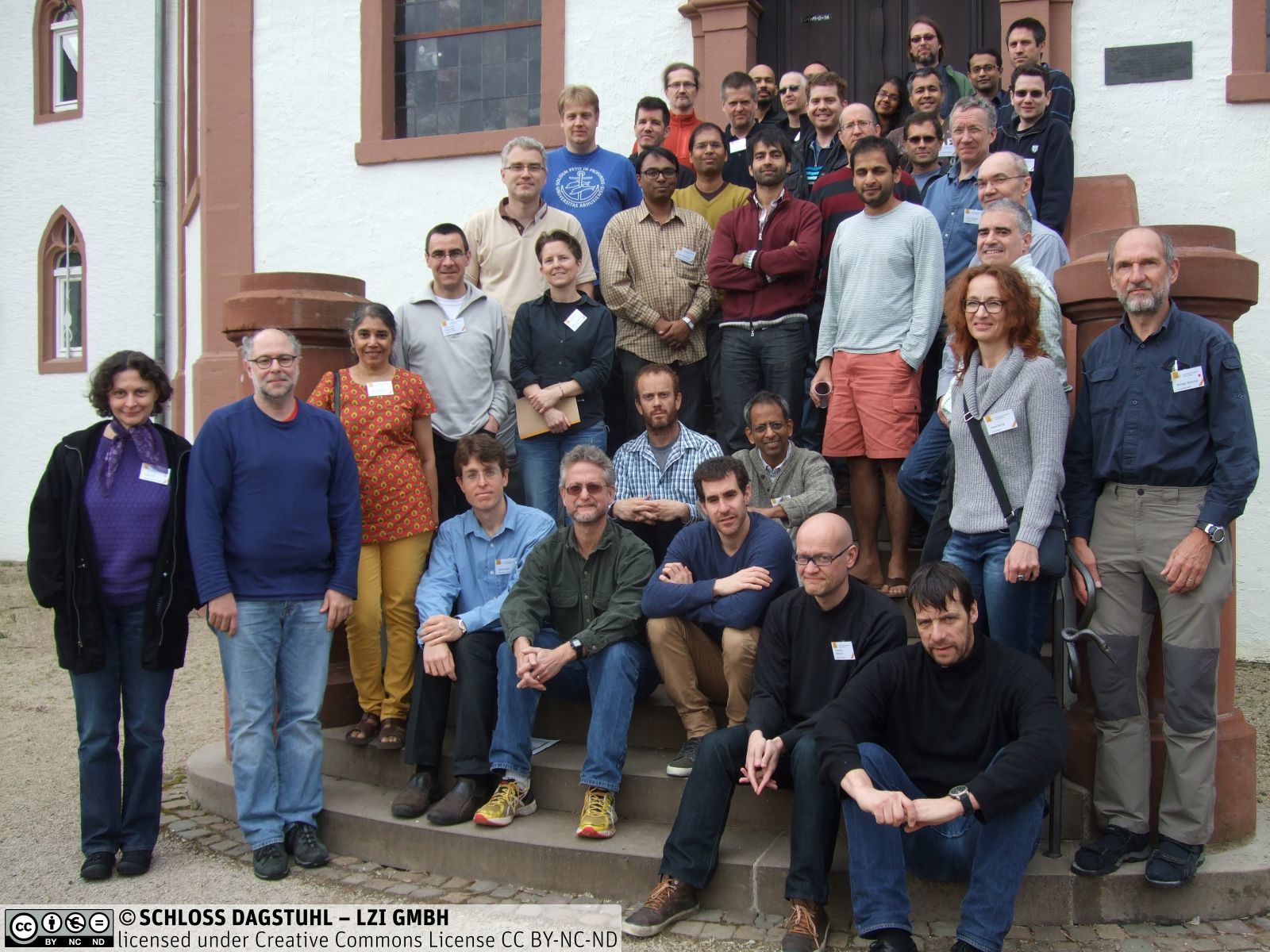
It's spring break at Georgia Tech and time to head to Germany for the Dagstuhl Seminar Computational Complexity of Discrete Problems. Lots of discussion on algebraic circuits, interactive coding, information complexity, pseudorandomness and much more.
This is a break for me, the ability to focus on complexity and research instead of hiring and administration. But even here, in rural Germany, one cannot completely escape the Internet and life back home.
Back in the states I'm hearing of the difficulty for theory students to find postdoc positions. Here I'm hearing of the difficulty of well-funded theory faculty in Europe finding postdocs. Not so bad to spend time on this side of the pond. Some of the positions are listed in the comments of the fall jobs post.
Want to organize your own Dagstuhl workshop? Proposals due by April 15. The Dagstuhl staff do an excellent job with most of the organizing, basically you just need to choose participants and talks.
The Dagstuhl library puts out the books authored by conference attendees and ask that authors sign those books. As this is the first Dagstuhl since The Golden Ticket appeared, I carried on the tradition.

Tuesday, March 18, 2014
Leslie Lamport wins Turing Award!
Leslie Lamport wins Turing Award!
See here for more details.
Leslie did work on reliability of systems and security that
(according to the article) is ACTUALLY BEING USED. So Real People
use his stuff.
He also developed LaTeX (building on TeX) which we all know and most
of us use. Academics use LaTeX but I honestly don't know how wide spread
it is outside of academia. However, this could be the first time that a Turing award winner did something that I used DIRECTLY (I am sure I use RSA and other things indirectly).
How well known is The Turing Award? its called `the nobel prize of computer science' but I think its far less well known than the Nobel Prize.
The Fields Medal and he Mill Prize got a big publicity boost when Perelman turned them down. But that only got them 15 minutes of fame, including a Stephen Colbert segment `whose not honoring me now'. So I will not be urging Leslie Lamport to turn down his Turing Award in order to give it more fame.
CONGRATULATIONS!
See here for more details.
Leslie did work on reliability of systems and security that
(according to the article) is ACTUALLY BEING USED. So Real People
use his stuff.
He also developed LaTeX (building on TeX) which we all know and most
of us use. Academics use LaTeX but I honestly don't know how wide spread
it is outside of academia. However, this could be the first time that a Turing award winner did something that I used DIRECTLY (I am sure I use RSA and other things indirectly).
How well known is The Turing Award? its called `the nobel prize of computer science' but I think its far less well known than the Nobel Prize.
The Fields Medal and he Mill Prize got a big publicity boost when Perelman turned them down. But that only got them 15 minutes of fame, including a Stephen Colbert segment `whose not honoring me now'. So I will not be urging Leslie Lamport to turn down his Turing Award in order to give it more fame.
CONGRATULATIONS!
Thursday, March 13, 2014
Cosmos from Generation to Generation
During high school, well before the world-wide web with its bloggers and YouTube, out came a series Cosmos that I watched religiously. Back then you had to watch a show when it was aired and no skipping of commercials, though Cosmos was a PBS (public-broadcasting) show so it didn't have any. Cosmos was hosted by the late great Carl Sagan. While I don't remember the contents of the show so much, I do remember being quite inspired by it and the show surely played a role in my future life as a scientist.
I went to Cornell as an undergrad just a year after Cosmos' broadcast. Carl Sagan was a legend on campus, though I saw him just once, in a debate over Ronald Reagan's Star Wars plan. Sagan did have an amazing house looking out over the Ithaca gorge that you could see from the suspension bridge I crossed every day.
Now my younger daughter is in high school and Neil deGrasse Tyson takes on the difficult task of updating Cosmos for this new generation. Molly and I watched the first episode last night. (I'm still blown away we can watch when we want and skip the commercials.) It really brought back memories of the original show and I was really touched when Tyson talked about meeting Sagan as a high school student.
Tyson is giving a talk at Georgia Tech next month. Tickets went on sale yesterday and sold out within hours. Incredible to see the return of the scientific superstar.
I went to Cornell as an undergrad just a year after Cosmos' broadcast. Carl Sagan was a legend on campus, though I saw him just once, in a debate over Ronald Reagan's Star Wars plan. Sagan did have an amazing house looking out over the Ithaca gorge that you could see from the suspension bridge I crossed every day.
Now my younger daughter is in high school and Neil deGrasse Tyson takes on the difficult task of updating Cosmos for this new generation. Molly and I watched the first episode last night. (I'm still blown away we can watch when we want and skip the commercials.) It really brought back memories of the original show and I was really touched when Tyson talked about meeting Sagan as a high school student.
Tyson is giving a talk at Georgia Tech next month. Tickets went on sale yesterday and sold out within hours. Incredible to see the return of the scientific superstar.
Monday, March 10, 2014
Why do we think P NE NP? (inspired by Scott's post)
Recently Scott Posted an excellent essay on reasons to think that P NE NP. This inspired me to post on the same topic. Inspired is probably the right word. Some of my post is copied and some of my post are my thoughts. A good test: if its intelligent and well thought out then its probably from Scott.
Why do scientists believe any particular theory? I state three reasons, though there are likely more:
(1) By doing Popperian experiments- experiments that really can fail. Their failure to fail helps to confirm the theory. This is common in Physics, though gets harder when the particles get smaller and string-like. (2) Great Explanatory power. Evolution is the main example here--- it's hard to do real experiments but one can look at the data that is already out there and find a theory that explains it all. (3) (Kuhn-light) It fits into the paradigm that scientists already have. This comes dangerously close to group think; however, if most of the people who have looked at problem X think Y, that should carry some weight.
Can we do Popperian experiments for P vs NP? For that matter can we do Popperian experiments in Mathematics? Goldbach's conjecture and the Riemann Hypothesis seem to have good empirical evidence. Though that kind of reasoning gets me nervous because of the following true story: Let li(x) = int_0^x dt/ln t.
Let pi(x) be the number of primes \le x. It is known that li(x) and pi(x) are VERY CLOSE. Empirical evidence suggested that li(x) \le pi(x) and this was conjectured. Skewes proved that there was an x for which li(x) \ge pi(x). His bound on x, the the Skewes' number ,was quite large, at one time the largest number to appear in a math paper (that record now belongs to Graham's Number). Then Littlewood, Skewes's advisor, showed that the sign of li(x)-pi(x) changes infinitely often. So the empirical evidence was not indicative.
There might also be empirical tests you can do for continuous math, especially if its related to physics so you can do physics experiments.
Have there been Popperian experiments to try to verify P NE NP? I am not quite sure what that means, but I do not think there have been (if I'm wrong please comment politely).
So we move on to Great Explanatory Power. Are there many different empirical facts out there for which P NE NP would explain them and give a unifying reason? Does a bear... Well, never mind, the answer is YES! I give one examples (from Scott's post) and two more. But note that there are MANY MANY MORE.
So in summary, I find that P NE NP has GREAT explanatory power. That makes it a very compelling conjecture. Let us apply this test to other conjectures.
Lastly, mini-Kuhnian. What do people in the field think? The polls on P vs NP that I conducted in 2002 and 2012 (see here) indicate that believe that P NE NP is growing- roughly 60% in 2002, roughly 80% in 2012. Some of the commentators on Scott's blog took that 20% of P=NP people to be relevant.
And indeed some of the P=NP people are both serious theorists and also not Dick Lipton (who seems to be who Lubos Motl points to) as a serious theorist who thinks P=NP).(ADDED LATER- SOME COMMENTERS HAVE INFORMED ME THAT LIPTON IS JUST OPEN TO THE POSS THAT P=NP. ) But some of those people emailed me that this was a protest vote, protesting the fields certainty that P=NP. I also note that three of them compared it to their voting or Ralph Nader in 2000, only with less drastic consequences.
I personally don't take `what people think' that seriously, but because of my polls we actually know what people think, so I put it out there.
Why do scientists believe any particular theory? I state three reasons, though there are likely more:
(1) By doing Popperian experiments- experiments that really can fail. Their failure to fail helps to confirm the theory. This is common in Physics, though gets harder when the particles get smaller and string-like. (2) Great Explanatory power. Evolution is the main example here--- it's hard to do real experiments but one can look at the data that is already out there and find a theory that explains it all. (3) (Kuhn-light) It fits into the paradigm that scientists already have. This comes dangerously close to group think; however, if most of the people who have looked at problem X think Y, that should carry some weight.
Can we do Popperian experiments for P vs NP? For that matter can we do Popperian experiments in Mathematics? Goldbach's conjecture and the Riemann Hypothesis seem to have good empirical evidence. Though that kind of reasoning gets me nervous because of the following true story: Let li(x) = int_0^x dt/ln t.
Let pi(x) be the number of primes \le x. It is known that li(x) and pi(x) are VERY CLOSE. Empirical evidence suggested that li(x) \le pi(x) and this was conjectured. Skewes proved that there was an x for which li(x) \ge pi(x). His bound on x, the the Skewes' number ,was quite large, at one time the largest number to appear in a math paper (that record now belongs to Graham's Number). Then Littlewood, Skewes's advisor, showed that the sign of li(x)-pi(x) changes infinitely often. So the empirical evidence was not indicative.
There might also be empirical tests you can do for continuous math, especially if its related to physics so you can do physics experiments.
Have there been Popperian experiments to try to verify P NE NP? I am not quite sure what that means, but I do not think there have been (if I'm wrong please comment politely).
So we move on to Great Explanatory Power. Are there many different empirical facts out there for which P NE NP would explain them and give a unifying reason? Does a bear... Well, never mind, the answer is YES! I give one examples (from Scott's post) and two more. But note that there are MANY MANY MORE.
- Set Cover problem: Given S_1,....S_m \subseteq {1,...,n} find the size of the smallest subset of S_1,...,S_m that covers the union of S_1,...,S_m. Chvatal showed in 1979 that one can find, i poly time, a subset of S_1,...,S_m that is (ln n)+OPT. Okay, great, an approximation. EMPIRICAL FACT: people seemed unable to improve on this at all. In 2013 Dana Moshkovitz proved that, assuming P\ne NP, this bound CANNOT be broken. Note that the algorithm of Chvatal and the lower bound of Moshkovitz have nothing to do with each other.
- Vertex cover: given a graph find the smallest set of vertices so that every edge has one of them as an endpoint. There is an algorthm that gives 2OPT. There is one that does ever so slightly better: (2-(1/sqrt(log V))OPT. In 2005 Dinur and Safra proved that, assuming P NE NP, there is no 1.36*OPT approximation. This does not match exactly but it still explains the lack of progress somewhat (more on this later when I discuss UQC).
- Max 3-SAT: given a 3-CNF formula find an assignment that maximizes the number of clauses satisfied. Karloff and Zwick proved that there is an algorithm that finds an assignment satisfying (7/8)*OPT. Hastad proved that, assuming P NE NP, (7/8)*OPT is the best you can do.
So in summary, I find that P NE NP has GREAT explanatory power. That makes it a very compelling conjecture. Let us apply this test to other conjectures.
- Sigma_2 \ne Pi_2. Does this assumption explain anything? Our inability to find a circuit for SAT. I dont know what else it implies. Same for Sigma_i vs Pi_i. This might qualify as mini-kuhnian: Sigma_2\ne Pi_2 fits into how we view the world.
- P=BPP. Almost every problem in BPP ended up falling into P over time. P=BPP would explain this. Also Nisan-Wigderson and its extensions make P=BPP fit into our world view.
- Unique Game Conjecture. This explains many upper and lower bounds that match, though nowhere near that of P NE NP. One of them is the constant 2 for VC. Even so, I find that compelling. (One of Scott's commenters said that all of the lower bounds from UGC are actually unified some how, so its not quite as compelling.)
- Factoring not in P. No real explanatory power here except that we seem to have a hard time finding an algorithm for Factoring.
- Graph Isom not in P. Similar to Factoring not in P.
Lastly, mini-Kuhnian. What do people in the field think? The polls on P vs NP that I conducted in 2002 and 2012 (see here) indicate that believe that P NE NP is growing- roughly 60% in 2002, roughly 80% in 2012. Some of the commentators on Scott's blog took that 20% of P=NP people to be relevant.
And indeed some of the P=NP people are both serious theorists and also not Dick Lipton (who seems to be who Lubos Motl points to) as a serious theorist who thinks P=NP).(ADDED LATER- SOME COMMENTERS HAVE INFORMED ME THAT LIPTON IS JUST OPEN TO THE POSS THAT P=NP. ) But some of those people emailed me that this was a protest vote, protesting the fields certainty that P=NP. I also note that three of them compared it to their voting or Ralph Nader in 2000, only with less drastic consequences.
I personally don't take `what people think' that seriously, but because of my polls we actually know what people think, so I put it out there.
Thursday, March 06, 2014
Favorite Theorems: Unique Games
Michel Goemans and David Williamson made a splash in the 90's using semidefinite programming to give a new approximation algorithm for the max-cut problem, a ratio of 2θ/(π(1-cos(θ)) minimized over θ between 0 and π, approximately 0.87856. Hard to believe that this ratio is tight, but it is assuming the unique games conjecture.
Khot and Oded Regev show that under the unique games conjecture that essentially the best algorithm for approximating vertex cover is to take all the vertices involved in a maximal matching.
Prasad Raghavendra gives a simple semidefinite programming approximation algorithm for any constraint satisfaction problem which is optimal under the UGC.
Sanjeev Arora, Boaz Barak and David Steurer describe an algorithm that given a unique game where 1-δ fraction of the edges can be satisfied, you can in time 2npoly(δ) find a coloring that satisfies a constant fraction of edges. This may or may not give evidence against the UGC.
Luca Trevisan has a nice recent survey on the unique games conjecture, covering much of the above and more, including beautiful connections between unique games and semidefinite programming.
- Optimal Inapproximability Results for MAX‐CUT and Other 2‐Variable CSPs? by Subhash Khot, Guy Kindler, Elchanan Mossel and Ryan O’Donnell
- Noise stability of functions with low influences: Invariance and optimality by Elchanan Mossel, Ryan O’Donnell and Krzysztof Oleszkiewicz
Khot and Oded Regev show that under the unique games conjecture that essentially the best algorithm for approximating vertex cover is to take all the vertices involved in a maximal matching.
Prasad Raghavendra gives a simple semidefinite programming approximation algorithm for any constraint satisfaction problem which is optimal under the UGC.
Sanjeev Arora, Boaz Barak and David Steurer describe an algorithm that given a unique game where 1-δ fraction of the edges can be satisfied, you can in time 2npoly(δ) find a coloring that satisfies a constant fraction of edges. This may or may not give evidence against the UGC.
Luca Trevisan has a nice recent survey on the unique games conjecture, covering much of the above and more, including beautiful connections between unique games and semidefinite programming.
Tuesday, March 04, 2014
Why are there so few intemediary problems in Complexity? In Computability?
There are thousands of natural PC problems. Assuming P NE NP how many natural problems are there that are
in NP-P but are NOT NPC? Some candidates are Factoring, Discrete Log, Graph Isom, some in group theory, and any natural sparse set. See
here for some more.
A student asked me WHY there are so few natural intermediary problems. I don't know but here are some
options:
- Bill you moron, there are MANY such problems. You didn't mention THESE problems (Followed by a list of problems
that few people have heard of but seem to be intermediary.)
- This is a question of Philosophy and hence not interesting.
- This is a question of Philosophy and hence very interesting.
- That's just the way it goes.
- By Murphy's law there will be many problems that we can't solve quickly.
At least in complexity theory there are SOME candidates for intermediary sets.
In computability theory, where we know Sigma_1 \ne \Sigma_0, there are no
candidates for natural problems that are c.e., not decidable, but not complete. There have been some attempts to show that there can't be any
such sets, but its hard to define ``natural'' rigorously. (There ARE sets that are c.e., not dec, not complete, but they are
constructed for the sole purpose of being there. My darling would call them `dumb ass' sets,
a terminology that my class now uses as well.)
A long time ago an AI student was working on classifying various problems in planning. There was one that was c.e. and not decidable
and he was unable to show it was complete. He asked me to help him prove it was not complete. I told him, without looking at it,
that it was COMPLETE!!!!!!!!! My confidence inspired him to prove it was complete.
So, aside from the answers above, is there a MATH reason why there are so few
intermediary problems in Complexity, and NONE in computability theory?
Is there some other kind of reason?
Subscribe to:
Posts (Atom)