Thursday, May 04, 2023

Breaking Ground in Isomorphism Testing: A Leap Forward for a Bottleneck Case of Group Isomorphism

Guest post by Josh Grochow and Youming Qiao

There has, quietly, been somewhat of a breakthrough in isomorphism testing. No, not as big as Babai's 2016 Graph Isomorphism in Quasipolynomial Time. But a first foothold in climbing a wall for which no one had gotten much off the ground before. The result, due to Xiaorui Sun in this year's STOC, is an algorithm for testing isomorphism of a certain class of groups - p-groups of class 2 and exponent p if you must know, but we'll get to that - in time \(n^{O(\log^{5/6} n)}\) where n is the order of the group. To understand why we're excited about this we have to tell a bit of a story. 

In the 1970s, when Graph Isomorphism was still a mystery, people also thought more widely about isomorphism testing of other combinatorial and algebraic structures. For finite groups of order n, Robert Tarjan realized that there is an \(n^{\log n+O(1)}\)-time algorithm, simply because a group of order n has a generating set of size \(\log n\). This observation was recorded by Gary Miller in a paper in STOC'78, and independently realized by Felsch and Neubüser. A natural question is then whether Group Isomorphism can be solved in time poly(n) where n is the group order.


Not only is this question natural from the perspective of studying groups computationally, it is also natural from the perspective of Graph Isomorphism. For Group Isomorphism reduces to Graph Isomorphism in polynomial-time (as does the isomorphism problem for any finite algebraic or relational structure, see Zemlyachenko, Korneenko, & Tyshkevich). While this has been known for a long time, Babai’s result on Graph Isomorphism brings the running times quite close: \(n^{O(\log^2 n)}\) for graphs, and \(n^{O(\log n)}\) for groups. So not only does Group Isomorphism stand in the way of getting Graph Isomorphism into P, but in our current state of knowledge, it even stands in the way of shaving off more than a single log in the exponent of the runtime.


Since the general Group Isomorphism problem seems difficult, attention turned to special classes of groups. It was not hard to see that isomorphism of Abelian groups could be computed in polynomial time. However, a group class that is just “one step away” from Abelian - groups G where, when you mod out by the center Z(G), what’s left is Abelian -  turned out to be difficult. Such groups are called class-2 nilpotent, and in one sense, their  group-theoretic structure is relatively straightforward: both G/Z(G) and Z(G) are Abelian. Yet, to devise an efficient isomorphism testing procedure turned out to be extremely difficult (see e.g. Garzon-Zalcstein, Rosenbaum-Wagner, O’Brien, Wilson), to the point that this is usually considered as a bottleneck for putting Group Isomorphism in P. 


Among class-2 nilpotent groups, the “key case” to resolve is widely believed, for several reasons, to be p-groups of class 2 and exponent p. In such groups, both the center Z(G) and quotient G/Z(G) are elementary abelian, i.e., of the form \((Z_p)^d\). Despite having an even simpler group-theoretic structure, this group class still turns out to be difficult! For a long time, the asymptotic growth of the exponent of the runtime for solving this restricted problem has not improved over the \(n^{\log n+O(1)}\)-time algorithm, which works for all groups.1


Xiaorui Sun’s result represents the first substantial improvement, cracking open this decades-old quest. His algorithm runs in time \(n^{O(\log^{5/6} n)}\), and its techniques are indeed novel. The starting point of this algorithm is to consider the following equivalent problem in (multi)linear algebra: let \(f, g:Z_p^d \times Z_p^d \rightarrow Z_p^e\) be two skew-symmetric bilinear maps. Do there exist change of bases A in \(GL(d, p)\) and B in \(GL(e, p)\), such that for all \(u, v\) in \(Z_p^d\), \(f(A(u), A(v))=B(g(u, v))\)?


Baer’s Correspondence sets up an equivalence of categories between p-groups of class 2 and exponent p, and skew-symmetric bilinear maps over \(Z_p\). This viewpoint allows Xiaorui to use multilinear algebra to study the structure of these bilinear maps. He also crucially depends on a result of Ivanyos and Qiao, which built on Wilson’s use of involutive algebras in this context. He also uses the individualization-and-refinement technique (but for matrix spaces, not graphs!), a characterization of spaces of matrices of low rank, and reducing a tensor to a “semi-canonical” form part of which is somewhat reminiscent of the Tucker decomposition.


All this results in an algorithm which solves the above problem on bilinear maps in time \(p^{(d+e)^{1.8} \log p}\). For groups of order \(p^n\) with \(\log_p(n)\) larger than \(\log^5 p\), Baer’s Correspondence then says that this algorithm does it; when \(\log_p n\) is smaller than \(log^5 p,\) he can fall back on the generator-enumerator algorithm, since the number of generators is at most \(log_p n\).


For us, who have been working on Group Isomorphism for more than a decade, Xiaorui’s result represents an exciting development on this classic algorithmic problem, and we look forward to seeing more progress in this direction in the near future. 


1Rosenbaum & Wagner improved the exponent to \(\frac{1}{2}\log {p(n)} + O(1)\), and later improved to \(\frac{1}{4}\log {p(n)} + O(1)\) for all groups, see p.5 of Le Gall & Rosenbaum. In 2014, at a conference on Groups, Computation, and Geometry organized by Wilson, Brooksbank, Hulpke, Kantor, and Penttila, it was concluded that modern practical methods, such as those used in GAP and MAGMA, still take \(n^{O(\log n)}\) steps in the worst case.

Monday, May 01, 2023

There are an infinite number of proofs that there are an infinite number of primes

In the last few years there have been four papers that prove the primes are infinite using some number theory and some Ramsey Theory. The papers are:

Van der Waerden and the primes by Alpoge. See here or here.

Squares in arithmetic progression and infinitely many primes by Granville. See here or here.

Fermat's last theorem implies the infinitude of primes by Elsholtz. See here or here.

Fermat's last theorem, Schur's theorem (in Ramsey Theory), and the infinitude of the primes by Gasarch See here and here.

(I included the arxiv version and the doi pointer.)

We also note that

1) Mestrovic has collected up 183 proofs that the primes are infinite, see here. Some of them are similar so if you mod out by similarity you would get fewer proofs. How many you get depends on your criteria for similarity. This comment applies to other theorems that have many proofs. 

2) Quanta recently published an article about the fact that there are an so many proofs, though highlighting the four mentioned above. See here. (This might be behind a paywall.) 

This raises the obvious question:

Why are there so many proofs that the primes are infinite? 

Some thoughts

1) Which other theorems have many proofs?

a) The Pythagorean Theorem. See here for the claim that there are 371 proofs. There is a recent claim of a proof using trigonometry here (this was thought to be impossible since it would involve a circular argument). 

b) According to Wikipedia (see here) The law of quadratic reciprocity has 240  proofs.  This paper here has some of them. That paper also shows 

QR IMPLIES primes infinite.

 Actually more: QR IMPLIES  primes \(\equiv 4 \pmod 5\) is infinite.

c) \(\sqrt 2\) is irrational has many proofs. I can't find a clean reference that states there are many proofs---if you know one, leave a comment. Wikipedia (see here) has five proofs, though there are many more. 

d) There is a mathoverflow post about theorems with many proofs here. I had thought only easy theorems had many proofs; however, there are several hard ones on this list. 

2) Primes are so basic that many parts of math can be used to proof they are infinite.

3) WHY do people do these proofs? For the four papers listed above, and likely for many of the other proofs,  the proof that primes are infinite is  a springboard to other questions or concepts. We look at those four papers: 

a) Alpoge's showed Van Der Waerden's theorem and Unique factorization IMPLIES primes infinite. Alpoge didn't use this as a springboard to other questions, but is amused that VDW can be used to prove primes infinite. I will note that the proof made me realize (a)  the proof of Unique Factorization does NOT use that primes are infinite, and (b) ANY integral domain with Unique Factorization has an infinite number of primes. 

b) Granville's showed VDW's Theorem and also a result of Fermat that there cannot be four squares in arithmetic progression IMPLIES primes infinite. He then uses this as a springboard to talk  about other interactions between Ramsey Theory and Number Theory.  Let Q(N) be the max number of squares in arithmetic sequence of length N. Find upper and lower asy bounds on Q(N). From Szemeredi's theorem (which is part of Ramsey theory) Szemeredi himself showed that for all \(\delta>0, Q(N) < \delta N\). Granville's paper shows how to get this result from a corollary to Faltings theorem. He also notes that better is known: \(Q(N) < N^{3/5 + \epsilon}\). 

c) Elsholtz showed Schur's theorem (for all c there is an S=S(c) such that for all c-colorings of {1,...,S} there exists x,y,z the same color such that x+y=z) and FLT (the n=3 case or n=4 case) IMPLIES primes infinite. He then looks at various INFINITE Ramsey Theorems that imply the primes are infinite.

d) Gasarch's proof is identical to Elsholtz. He then looks at (1) for domains with a finite number of primes, what goes wrong? (2) when does the proof apply to other integral domains? The last question involves looking at variants of FLT some of which are open questions. 

4) Gasarch also wondered about the following (though its not in his paper). The four papers above, and also other proofs that the primes are infinite, are of the form 

IMPLIES Primes are infinite

Are we really using A? How to pin this down? Find a logical system L such that 

1) From L one can show A IMPLIES Primes are infinite

2) From L one CANNOT prove Primes are infinite. (You may need some hardness assumption)

One can also examine this kind of question for other theorems like sqrt(2) is irrational. 

I have shown this to several people and am told its not doable. Oh well. 

I had a prior blog on this, after I saw Alpoge's proof,  see here.

ADDED LATER: a commenter left a link to a math overflow page that has information on the reverse mathematics of Euclid's theorem that the primes are infinite. The link is here.


5) USUALLY mathematicians want to (or should want to) find EASIER proofs of HARD theorems. 

For some of the proofs that primes are infinite, QR, \(\sqrt 2\) irrational, some other theorems that have many proofs, mathematicians want to find HARD proofs of EASY theorems. 


Wednesday, April 26, 2023

Comic Book Alignment

Talk about AI "alignment" makes me think of a time in the 1950s that a group of companies decided to

create an industry organization to self-govern their work to make sure that they were following the values of the time and avoid government oversight. Of course, I'm talking about the Comics Code Authority (CCA). 

Fueled by psychiatrist Fredric Wertham's book Seduction of the Innocent and a series of U.S. Congressional hearings, the comic publishers realized they needed to police themselves and formed a trade group, the Comics Magazine Association of America (CMAA). The CMAA created the Comics Code Authority (CCA) in 1954 to enforce a code of content guidelines that comic book publishers would adhere to. The Comics Code prohibited explicit violence, sexual content, and other adult themes in comic books, as well as a promoting a "positive portrayal" of authority figures and institutions. The CCA seal, which was a small stamp indicating that a comic book had been reviewed and approved by the organization, became a requirement for distribution by most newsstands and retailers pushing many publishers to follow the code.

I started reading comic books in the 1970s with the code in full swing. It was not a golden time for comic books with mostly bland, straightforward stories, and I gave it up as I went into high school. In college in the '80s, a friend brought me back into comics with some series, like Watchmen, having given up the code and the seal. I started reading comics voraciously, so much that I had to go cold turkey in grad school so I could focus on research. The code itself was abandoned in 2011 after even Archie Comics gave up using the seal.

There's not a direct parallel between comic book writers and large language models, but the principle is the same. If you try to enforce a collection of values, you will get blander, less interesting output. I'm not saying that all alignment is a bad idea, but that you need to realize you will lose something when you do.

Sunday, April 23, 2023

Thoughts on Gordon Moore

 Gordon Moore passed away on March 24, 2023. He was 94 years old. 

He is best known for the article 


Cramming more components onto integrated circuits. 

It appeared in the magazine Electronics (it is now defunct), Volume 38, No. 8, April 19, 1965. Do you need to track it down in the basement of your library. No. Its here and here. I wonder if Moore would have predicted that his article would be available easily over 50 years later. Or is it? Link rot is a serious problem so you might want to download it to your local files. Note that the first link is some sort of official version and the second version is my local version. Not clear which link will rot first. The article also has an addition which is an interview with Moore that was done later.

In the article Moore said that the number of components-per-circuit (I think that means chip) will double every year. Moore credits Dave House with modifying it to `doubling every 18 months' and Carver Mead with calling it `Moore's Law'.  Later it came to be quoted as computer SPEED would double every 18 months. We will take this to be Moore's Law in this blog post. 

Is Moore's law dead? Browsing Google the answer seems to be that it is slowing down but not dead yet. (IDEA for a comedy sketch: Redo the Monty Python Dead Parrot sketch about the death of Moore's law.) 

If Moore had 1 penny in April 1965 and it doubled every 18 months then how rich would he be now? How rich was he in April 2022? Compare the two numbers. 


Thursday, April 20, 2023

Health Tech


On Tuesday, at the behest of an alumnus, I spent the afternoon at HIMSS, a large health tech conference being held at the big convention center in Chicago. When I think of Health Tech, I imagine fancy medical devices, but most of the exhibitors were focused on software solutions.

Cybersecurity had the biggest theme area, no surprise given the devasting role ransomware has had on some hospital chains. The second largest theme area focused on Interoperability. Just a few years ago, the vast majority of medical data is transferred via fax. A few companies, like Epic Systems, dominate the electronic health records space and don't share nicely. There's a relatively new standard, FHIR, for transferring medical data, making it easily accessible via APIs while keeping it secure. Hopefully, we can finally kill off the fax machines in doctors offices. Patient Engagement was the other big theme area.

Of course the big discussion topics are about how AI will change health care. For example, the advances in electronic records have led to doctors spending far too much time entering data instead of seeing patients. AI could make data entry quick, easier or perhaps even unnecessary. Also AI could help provide functionality for triage and initial diagnoses, helping to extend the capabilities in a staff-limited environment and help bring down health-care costs. Many of the exhibited software systems boasted about using AI but it won't be until next year's meeting that we see the true integration of large-language models into health care technology.

Many of the challenges of technology in health care carry over to higher education. We don't generally use faxes, but why do we send transcripts by PDFs? Health and student data share similar privacy and security challenges, why can't we develop a FHIR-like system for higher education? Cybersecurity and Patient Student Engagement challenges loom large for universities as well. 

Thursday, April 13, 2023

My Week at Simons

This week finds me at the Simons Institute for Theoretical Computer Science in Berkeley California. Simons started about the same time I joined the administrative ranks and never had the opportunity to spend a full semester there. I can manage a shorter trip and purposely chose a week with no workshops and great visitors including Sam Buss, Russell Impagliazzo, Valentine Kabanets, Toni Pitassi, Ryan Williams, former student Rahul Santhanam and former postdocs Pavan Aduri and Vinod Variyam and many others including the next generations of complexity theory leaders. Simons is having programs on Meta-Complexity and an "extended reunion" for Satisfiability. Apparently I used to work on Meta-Complexity before it was a thing.

Computational complexity traditionally has tried to get ahead of new technologies, and modelled randomized, parallel, quantum computation and cryptography in the infancy of their development allowing complexity to help guide our understanding and development of these areas. In the last twenty years or so, complexity has migrated more towards mathematics, and has mostly missed technological changes like cloud computing, hierarchical memory models, edge and mobile computing for example. 

But the recent advances in optimization and machine learning cannot be ignored. There has certainly been plenty of discussion of ChatGPT and Russell gave an informal lecture yesterday trying to model large-language models at some level. I've been having some discussions about how complexity can answer questions like what it means for a model to be explainable. 

Complexity theory also ought to reckon that practically we seem to be getting the best of P = NP while avoiding losing cryptography simultaneously in Heuristica and Cryptomania among Russell's five worlds. Russell claims we're not in Heuristica, at least not now, since we can still generate hard to solve problems. But if our models aren't modeling the world we live in, perhaps it's time to rethink the models. 

Monday, April 10, 2023

Complexity and Explainable AI

About six years ago, I posted on why it was important to understand machine learning, mentioning trust, fairness, security and causality. But I then I brought in complexity.

What if P = NP? Would that help. Actually it would makes things worse. If you had a quick algorithm for NP-complete problems, you could use it to find the smallest possible circuit for say matching or traveling salesman but you would have no clue why that circuit works. 

Ryan Williams countered

If P=NP you could also find the shortest proof in your favorite formal system that the smallest possible circuit does what you wanted it to do, as well as any other claim you are wondering that may be true about the circuit. That proof might not be comprehensible to you, but it could be written in a format where proof assistant software such as HOL or Coq could parse it and convince you it is correct. So if P=NP (with feasible low constants) I think that would definitely help.

So if P = NP maybe you couldn't understand how the circuit works but any question about how it works you could answer. 

While we don't live in a world where P = NP, we are in a world where we can produce very strong learning algorithms where we can't understand the programs they produce. They are now powerful enough to apply Ryan's idea and use the algorithms themselves to understand the decisions they make.

For example I tried using Google Translate on a Hungarian obituary of Vera Sós. Hungarian does not use gendered pronouns and and the translation incorrectly produced male pronouns. I then fed the translation into ChatGPT which translated with the correct female pronouns. 

You can speculate why Google Translate uses male pronouns but you can't ask it why. But you can ask ChatGPT.

I used female pronouns in the translation because Vera T. Sós is a female name. Vera is a feminine given name, and since the context of the original text is about her life and accomplishments, it is appropriate to use female pronouns in the English translation to maintain clarity and accurately convey information about her.

So perhaps if you want to understand how ML works, perhaps we should seek stronger algorithms, not weaker ones, algorithms that can explain themselves. As they say, a dull knife is more dangerous than a sharp one.

Tuesday, April 04, 2023

Neil Jones (1941-2023)

Eric Allender graciously agreed to write this remembrance of Neil Jones.

Neil Jones passed away on March 27.

Neil's work had a profound impact on the field of computational complexity theory, although he was primarily known for his work in other areas of computer science.  For example, his 1998 ACM Fellow citation is "For outstanding contributions to semantics-directed compilation, especially partial evaluation, and to the theory of computation, formal models and their practical realization."  Note that there's no mention of "complexity" (except as it is bundled together with "theory of computation" -- and Jones also published in the area of computability theory).

So what were some ways that Neil influenced the development of computational complexity theory?

In 1972, in the 4th STOC conference, Neil collaborated with Alan Selman, to show that a notion that logicians had been studying since the 1950's coincided exactly with a natural complexity class.  More specifically, given a logical formula F, the "spectrum" of F is the set of numbers {n : F has a finite model of size n}.  What kinds of sets can be the spectrum of a first-order formula?  Is this class of sets closed under complement?  These were some of the questions that logicians had struggled with.  Jones and Selman gave a precise characterization, as NE (nondeterministic exponential time).  Thus the complement of every spectrum is a spectrum if and only if NE=coNE.  As D. Sivakumar points out in a LinkedIn comment on Neil's death: "The following year, Fagin proved that generalized spectra coincide with NP, and descriptive complexity theory was born."

Of course, a lot of other things were happening in the late 60's and early 70's:  Savitch proved Savitch's Theorem.  The first NP-completeness results appeared.  It appears that several people were trying to build on Savitch's theorem, to show that everything in P can be done in log2 space, and this motivated Steve Cook to define a problem ("Path Systems") and show (1) certain algorithms for Path Systems could not be implemented in small space, and (2) Path Systems has a small-space algorithm iff everything in P does.  This result of Cook's was similar in flavor to a theorem of Savitch, showing that a problem he called "Threadable Mazes" was in L if and only if NL=L.  Although these notions were clearly in the air, Jones (and -- simultaneously -- Meyer & Stockmeyer) were the first to explicitly formalize the notion of logspace reducibility (including closure under composition), and to notice that the NP-completeness results of Cook and Karp held also under logspace reducibility.  And Jones was the first one to go ahead and develop the general theory of logspace reducibility and the theory of completeness for subclasses of P (first for P itself (with Laaser), and later for NL (with Laaser and Lien)).  I think that this is when people started to get the idea that completeness was not a special property that only a few problems shared.  Rather: Nearly EVERY natural computational problem was likely to be complete for some reasonable complexity class.

Notably, Jones also recognized that logspace was overkill, when considering reductions.  He also wanted to have a really restricted notion of reducibility, so that one could talk meaningfully about problems being complete for L.  To this end, he defined "log-rudimentary" reducibility.  This was quite natural for him, since he had work previously on Smullyan's "Rudimentary Relations".  But log-rudimentary reductions never really caught on.  Instead, after Furst, Saxe, and Sipser kickstarted the study of AC0 circuits, a notion of AC0 reducibility was developed by Chandra, Stockmeyer, and Vishkin in the mid-1980's, which turned out to be very useful in classifying problems as being complete in various subclasses of P.  Much later, in 1991, I published a paper with Vivek Gore, showing that Neil's log-rudimentary reductions are precisely the same thing as uniform AC0 reducibility.  Thus Neil Jones had the insight to define and study a notion that would not become mainstream for another decade, and which still provides the best tool for classifying the complexity of natural problems in subclasses of P.

I only had the pleasure of meeting Neil once, during a visit to Copenhagen in 2004, although we would occasionally exchange some e-mail about topics in complexity.  It is interesting to note that the most recent paper on Neil's DBLP page deals with complexity classes.  I haven't spent much time looking at the paper, but I do see that the authors define a complexity class that lies between NL and P.  It might be interesting to see if this class coincides with SAC1 (also known as LogCFL).

I thank Lance and Bill for encouraging me to write a few lines about Neil's importance to the field. 

Saturday, April 01, 2023

Who's on April First


Carlos May waving to the crowd on April 1, 1972

Instead of the usual April Fools’ Day post, I present one of the best April Fools Day stunts ever. Here’s the text from an old Parade Magazine clipping I dug up recently that was published on April 1, 1985.

When it comes to innovative and wacky ideas in baseball, Bill Veeck was a true legend. As a team owner and promoter, Veeck was known for his creative approach to the sport, from planting ivy on the walls at Wrigley Field to his famous "exploding scoreboard" at Comiskey Park. But did you know about the time Veeck pulled off an unforgettable April Fools' stunt by having the 1972 Chicago White Sox wear the names from the classic "Who's on First?" sketch?

It was April 1, 1972, and the Chicago White Sox were getting ready to play a game that would go down in history. Bill Veeck had decided to pay homage to the iconic comedy routine by Bud Abbott and Lou Costello, considered by many the greatest comedy sketch ever performed. For those unfamiliar with the sketch, it revolves around a series of misunderstandings based on the names of the players on a fictional baseball team. The names sound like common phrases, leading to a hilariously confusing conversation.

In Veeck's version of the stunt, the White Sox players would take the field with the names of the "Who's on First?" team on the back of their jerseys. The players, initially skeptical of the idea, eventually embraced the spirit of April Fools' Day and played along.

As the game commenced, fans were treated to a scene straight out of the Abbott and Costello routine. Instead of their usual names, the players' jerseys featured names like "Who," "What," "I Don't Know," "Why," "Because," "Tomorrow," and "Today." Here was the starting lineup:

  1. Who - First Base: Dick Allen
  2. What - Second Base: Mike Andrews
  3. I Don't Know - Third Base: Bill Melton
  4. Why - Left Field: Carlos May
  5. Because - Center Field: Ken Berry
  6. Abbott - Right Field: Jay Johnstone
  7. I Don't Care - Shortstop: Luis Aparicio
  8. Today - Catcher: Ed Herrmann
  9. Tomorrow - Pitcher: Wilbur Wood
The right fielder is never named in the sketch. Pat Kelly pinch hit for Johnstone in the 6th wearing “Costello”. 

The confusion was not only limited to the fans in the stadium. The opposing team and the umpires struggled to keep track of the game, often leading to comical misunderstandings on the field. For instance, the umpire might have shouted, "Who's out!" only to be met with the response, "No, Who's on first!"

Though some traditional baseball fans were initially taken aback by the stunt, the majority embraced the humor, making the game one of the most memorable in White Sox history. It was a testament to Veeck's genius that he could seamlessly blend comedy with the sport he loved.

The "Who's on First?" game became a cherished part of baseball lore and added to the legend of Bill Veeck. It demonstrated his willingness to think outside the box, engage fans, and remind everyone that, at its core, baseball should be a source of fun and entertainment.

The 1972 Chicago White Sox "Who's on First?" April Fools' Day game captured the spirit of Bill Veeck's inventive approach to baseball. As we celebrate April Fools' Day this year, let's remember the time when the White Sox took the field with the most confusing lineup in baseball history and showed us all that, sometimes, laughter truly is the best medicine.

Wednesday, March 29, 2023

Alan Turing, The Opera


Last Thursday I attended the world premier of The Life and Death(s) of Alan Turing, a new production from Chicago Opera Theater composed by Justine Chen with the libretto (text) from David Simpatico.

The opera takes a mostly chronological trip through his life in seven scenes, focusing less on the computer science and more on Turing's struggle with homosexuality and his prosecution. Turing does fiddle with an old computer throughout the opera. The opera ends with a different take on his death (spoiler alert), where he attempts to upload his consciousness to escape his chemically castrated body. 

Between the scenes, a chorus chants random numbers and words as they floated on a scrim, in what the composer calls "chat clouds". 

These “chat clouds” transport the listeners with a sonic approximation of internet chatter, filled with information that brings them to the next moment. The aural depiction of these "chat clouds" was inspired by the animated movies and television series of Masamune Shirow's cyberpunk manga Ghost in the Shell. Another sonic influence was Walt Disney’s fantastical Snow White, one of Alan’s greatest obsessions.

I found them reminiscent of the Philip Glass' knee play from Einstein on the Beach. I really enjoyed these sequences, though another academic I ran into during intermission felt otherwise.

Over all I enjoyed the music and the opera, particularly the courtroom scene where Turing gave an impassioned defense though it turns out all in his head. The cast did well across the board, especially Jonathan Michie who sang Turing. 

Librettist David Simpatico (wearing jacking), Composer Justine Chen (in gown)
conductor Lidiya Yankovskaya behind her and Jonathan Michie (in red robe)

One can't help compare this opera to The (R)evolution of Steve Jobs, that I saw in Atlanta last year. Both operas chart a metaphysical journey of a computing giant through various important moments of their lives. During a Q&A I asked Simpatico about the two and he said he purposely avoided the Jobs opera so as to not affect how he wrote this one. Probably for the best.

Sunday, March 26, 2023

The SIGACT Book Review column list of books it wants reviewed

I am posting this for Nick Tran who is the current SIGACT Book Review Editor (before him it was Fred Green for about 6 years, and before him it was me (Bill Gasarch) for 18 years. Nobody should have the job for more than 6 years. No TV show should to on more than 6 years. The 6-year rule probably has other applications.)

Nick asked me to post the list of books that need reviewing. It is most of this post. 

If you spot one you want to review then email him (email address later)  the name of the  book you want to review and your postal address so he can send it to you or have it sent to you. Here are his specs:

Reviews of recently published or bucket-list books of interest to the TCS community are welcome. Manuscripts (NOTE FROM BILL `manuscripts'? Really? Sounds like the kind of thing you would FAX or postal mail) should be between 3 and 6 pages and include a brief introduction, a detailed content summary, an assessment of the work, and a recommendation to the book's targeted audience. 

Nick's email is ntran@scu.edu

The books are: 

ALGORITHMS

Knebl, H. (2020).  Algorithms and Data Structures: Foundations and Probabilistic Methods for Design and Analysis. Springer.

Roughgarden, T. (2022). Algorithms Illuminated: Omnibus Edition. Cambridge University Press.


MISCELLANEOUS COMPUTER SCIENCE

Amaral Turkman, M., Paulino, C., & Müller, P. (2019). Computational Bayesian Statistics: An Introduction (Institute of Mathematical Statistics Textbooks). Cambridge University Press.

Nakajima, S., Watanabe, K., & Sugiyama, M. (2019). Variational Bayesian Learning Theory. Cambridge University Press.

Hidary, J. D. (2021). Quantum Computing: An Applied Approach (2nd ed.). Springer.

Apt, K. R., & Hoare, T. (Eds.). (2022). Edsger Wybe Dijkstra: His Life, Work, and Legacy (ACM Books). Morgan & Claypool.

Burton, E., Goldsmith, J., Mattei, N., Siler, C., & Swiatek, S. (2023). Computing and Technology Ethics: Engaging through Science Fiction. The MIT Press.


DISCRETE MATHEMATICS AND COMPUTING

O’Regan, G. (2020). Mathematics in Computing: An Accessible Guide to Historical, Foundational and Application Contexts. Springer Publishing.

Rosenberg, A. L., & Trystram, D. (2020). Understand Mathematics, Understand Computing: Discrete Mathematics That All Computing Students Should Know. Springer Publishing.

Liben-Nowell, D. (2022). Connecting Discrete Mathematics and Computer Science (2nd ed.). Cambridge University Press.


CRYPTOGRAPHY AND SECURITY

Oorschot, P. . C. (2020). Computer Security and the Internet: Tools and Jewels (Information Security and Cryptography). Springer.


COMBINATORICS AND GRAPH THEORY

Golumbic, M. C., & Sainte-Laguë, A. (2021). The Zeroth Book of Graph Theory: An Annotated Translation of Les Réseaux (ou Graphes)—André Sainte-Laguë (1926) (Lecture Notes in Mathematics). Springer.

Beineke, L., Golumbic, M., & Wilson, R. (Eds.). (2021). Topics in Algorithmic Graph Theory (Encyclopedia of Mathematics and its Applications).  Cambridge University Press.


PROGRAMMING ETC.

Nielson, F., & Nielson, R. H. (2019). Formal Methods: An Appetizer. Springer.

Sanders, P., Mehlhorn, K., Dietzfelbinger, M., & Dementiev, R. (2019). Sequential and Parallel Algorithms and Data Structures: The Basic Toolbox. Springer.


MISCELLANEOUS MATHEMATICS

Kurgalin, S., & Borzunov, S. (2022). Algebra and Geometry with Python. Springer.


Thursday, March 23, 2023

A Strange Hiring Season

In my fall jobs post, I had trouble predicting this season's CS faculty job market but I didn't expect this:  strong supply and strong demand, something we haven't seen since the early '80s when the then young CS departments were ramping up.

We have a confluence of two forces that have both strengthened since my post back in November: The layoffs and hiring freezes at the major internet companies (Alphabet, Amazon, Apple, Meta and Microsoft) contrasted with major excitement in machine learning. I wrote the jobs post before ChatGPT was released and Amazon and Meta have since announced even more layoffs.

ML-mania is leading to very strong demand from undergrad and grad students for computing degrees. Across the US we have a record number of open faculty slots in computing as universities try to meet that need.

Meanwhile, PhDs who might have gone to industry are going on the academic job market instead. Also some tech researchers who have been laid off or spooked by the layoffs are considering academic jobs.

Between these two forces we will likely have a record number of faculty hires this year but we may see fewer senior people switching universities because good departments can fill their needs with junior faculty.

There is a mismatch of area. There is a big demand in CS departments to hire in machine learning because that is where the student interest is. ML is not where the big companies are cutting back. If you are on the market this year, position your research to make it relevant to learning, or at least that you are willing to teach ML courses.

By the way, this post is for computer science. Count yourself extremely lucky if you can get a tenure-track job in a non-computing field.

Sunday, March 19, 2023

New Upper Bound on R(k). WOW!

 R(k) is the least n such that for all 2-colorings of the edges of \(K_n\) there is a monochromatic \(K_k\)

(so there are k vertices such that the coloring restricted to the edges between those k vertices is constant)


Here is some history. If I miss a reference or a result, let me know in the comments


\(R(k) \le 2^{2k} = 4^k \) seems to be folklore and is a very old result. Proof could be shown to HS students. I have. Or 9 year old's who are good at math. I have. 


\(R(k)\le {2k-2 \choose k-1}\) which is approx \(\frac{4^k}{\sqrt k}\) was shown by Erdos and Szekeres in 1935. Proof could be shown to HS students. I have. Or 9 year old's who are good at math. I have. 


Thomson in 1988 got

$$R(k) \le \frac{4^k}{k^A\sqrt{\log k}}$$

for some A. This paper is behind paywalls so will be lost to history and I cannot comment on if the proof is easy or hard. (If you know of a link it, let me know and I will provide it). 

Conlon in 2006 got the denom to be super-poly. We omit the result but the paper is here. Proof used the next method of quasi-randomness. 

Sah  (his paper is here) optimized Conlon's technique to get 

$$R(k) \le 4^{k-c(\log k)^2}.$$

(According to the paper I will point to soon that has the major result, Sah's result is the best one can do with the Thomason-Conlon technique. In Complexity theory we may have formalized that and called it a barrier result.)

These results were interesting and used interesting techniques. However, the best known lower bound is  \(R(k) \ge 2^{k/2}\) (I've left out constants) so the REAL questions are

a) Can the 4 be replaced with a smaller number in the upper bound?

b) Is there a number a so that R(k) is essentially \(2^{ak}\)?  

We note in passing that the lower bound was proven by the Prob Method. That last statement obscures the history--- the Prob Method was invented by Erdos TO PROVE the lower bound. I've seen the prob method called an application of Ramsey Theory which is not quite right. Its more like Ramsey INSPIRED a technique that is used A LOT, including things that are actually practical. 

But  back to our story. SO, while all of the above results were interesting, were they making progress towards the REAL question? We can now say YES as progress HAS been made and DID use some of the techniques.

On March 16, 2023 Campos, Griffthis, Morris, Sahasrabudhe posted a paper on arxiv, here, that showed

$$R(k) \le (4-\epsilon)^k$$

 for some (quite small) epsilon. 

Here are some thoughts which are influenced by my email correspondence with Jacob Fox (an eminent combinatorist) on this topic.

1) I am NOT surprised that the result is true. 

2) I AM surprised that it's been proven. Lots of brilliant people have worked on this problem for many years so... .why now? Since its been open for around 70 years, I thought it would take another 70 years to crack.

3) Will this result lead to better results? I hope so!

4) Does R(k) have a nice upper bound? Not clear. The following is unlikely though something like it may be possible:

R(k) roughly\( (3.5)^k\) for k a power of a Fibonacci prime

R(k) roughly\( (3.8)^k \)othewise

5) (Jacob pointed me to this) There is a paper on Book-Ramsey Numbers that also (on page 2) notes a connection to Ramsey Numbers. The paper is here. A conjecture on Book-Ramsey will lead to a big improvement on Ramsey. Those kinds of results are odd since I can't tell if the upshot is

Lets work hard on Book-Ramsey so we can get better bounds on Ramsey!

or

Book-Ramsey is HARD so lets give up. (Who first said if at first you don't succeed, quit. Why make a damn fool of yourself? ?) 

6) The paper with the new result is 57 pages. It looks dense. I will wait for the movie.  I may have to wait a long time. 

Thursday, March 16, 2023

Identities in Computational Complexity

Guest post by Josh Grochow

On the birdsite, Jay Cummings tweeted:


And it got me thinking about identities in computational complexity. At first I thought: how many could there be? 10? After some thought and with some help, there turn out to be quite a few more than that, and I think they make a pretty good list!

Rules/comments on the list:

  • Some are relatively simple alternative characterizations, such as the various definitions of PH; most are pretty nontrivial theorems.
  • I didn't include existentially quantified oracle results (such as "there exists A such that PA=NPA"), despite them being some of my favorite results, because there'd be waaaay too many of those. Probably thousands? Ask Lance. In some circles he's known as the "oracle oracle" - as in, he's who you go ask if you want to know if a certain oracle exists. I did include identities involving oracles where one side of the identity didn't have an oracle, such as EXP=NPRKt or AlmostP=BPP (AlmostP is the class of languages L such that {A : L is in PA} has measure 1).
  • I also didn't include some important conditional equalities, such as "EXP in P/poly iff EXP=MA" or "NP in BPP iff NP=RP". I guess it's not really an "identity" if it's conditional. Games are only fun if the rules are at least a little constraining!
  • There are some surprising containments that either aren't equalities, or aren't known to be equalities, and I didn't include those either, despite some of them being very important. For example, BPP in Σ2P, other depth reduction results (such as the chasms at depth 4 and 3), and Beigel-Tarui/Yao.

One could teach a class based on a list like this and cover a lot of good ground, but I think it'd be sad to leave out any lower bounds. Actually, by my estimate, if you were teaching from "scratch" (say, starting after an undergrad algorithms class), this list, and all its implied prerequisite material, is already probably the equivalent of about 3-4 semester-long classes!

What other complexity identities did I miss?

Finally, without further ado, a list of (some) identities in computational complexity:

RP∩coRP=ZPP

CLS=PPAD∩PLS [from Paul Goldberg @paulwgoldberg]

quasi-poly Frege =quasi-poly noncommutative formula IPS

Space classes

PSPACE=NPSPACE

NL=coNL

L=SL

DET=LGapL (see Update 1)

Interactive Proofs

NP=PCP(O(log n), 3)

IP=PSPACE

AM = MAM = AMAM = ... [From Albert Atserias @atserias]

MIP=NEXP=PCP(poly,poly)

Alternating Turing machines

Σk P = ∃ Pik-1 P = NPΣk-1 P = ΣkTIME(poly(n)) [from Lance]

AP=PSPACE

APSPACE=EXP

Circuit classes within P

NC1=5-PBP

ACC0=branching programs over solvable monoids

P=AuxPDA

SAC1 = LogCFL [from Michael Levet @Michael_Levet]

REG = DSPACE(O(1)) = NSPACE(O(1)) [from Levet]

REG=DTIME1tape(o(n log n))

ACk = logk time on a CRCW PRAM

Quantum

QIP=PSPACE

MIP*=CE

QMAlog (1)=BQP [from Martin Schwarz @martin_schwarz]

QMAlog (poly)=QCMA [ditto] 

QAC0f = QNC0f [from Ale `Scinawa' Luongo @scinawa]

QMA(k) = QMA(2) for any k ≥ 2 [from Sarvagya Upadhyay @sarvagya82]

Algebraic complexity

VP=VNC2

VDET=VABP=VPs=VPws

VPe=VABP3

border-VPe=border-VABP2

For bilinear maps, tensor rank=Theta(algebraic circuit size)

Logical characterizations

FO=AC0

AC=NC=FO[poly(log)]

SO=NP

P = FO + LFP on ordered structures [thanks to Lance, and Michael Levet]

Kolmogorov-random strings as oracles

EXP=NPRKt

PSPACE=ZPPRKS

P=COMP∩{dtt reducible to RKU}

Almost-classes

AlmostP=BPP

AlmostNP=AM

AlmostPSPACE=BPexp.PSPACE


Updates
  1. March 17th update, h/t Eric Allender: Using Cook's original definition of DET as problems NC1-reducible to the integer determinant, apparently this equality is not known! See Eric's recent guest column in SIGACT News for details and a $1000-prize related to this question, along with many other interesting open questions.

Monday, March 13, 2023

Problems we assume are hard. Are they? ALSO- revised version of Demaine-Gasarch-Hajiaghayi is posted!

 (The latest version of 

Computational Intractability: A Guide to Algorithmic Lower Bounds

by Demaine-Gasarch-Hajiaghayi is posted here. Its new and improved: (1) we have made all or most of the corrections send to us by proofreaders,  (2) there is a chapter on quantum computing, (3) there is an index.  Feel free to read it and send us corrections! 

This post is related to it in that most of the problems-assumed-hard mentioned in this post were the basis for chapters of the book.)


We think SAT is hard because (1) its NPC, and (2) many years of effort have failed to get it into P. 

Imagine a world where we didn't have the Cook-Levin Theorem. We may still think SAT is hard. We may even take it as a hardness assumption to prove other things hard by showing SAT \le A. We may also be curious if they are equivalent and have lots of reductions A \le SAT. The reductions might be Karp or Cook. 

You do not have to imagine this world! We already have it- in different contexts. In other areas of complexity theory there are problems that are assumed hard, but for which there is no analog of Cook-Levin. Are they hard? They seem to be- but the evidence is empirical. Not that there's anything wrong with that. 

I will list out problems that 

a) we assume are hard, for some definition of  we and hard.

b) we have NO proof of that and NO completeness or hardness result.  ADDED LATER- a commenter wanted me to clarify this.

 For SAT there is a well defined set of problems, NP, defined independent of any particular problem (that is, NP was NOT defined as all sets Karp-Red to TSP or anything of the sort) and by Cook-Levin we have 

if SAT is in P then NP is contained in P.

For FPT (the class the commenter was interested in) there IS the result

if weighed k-SAT is in FPT then W[1] is contained in FPT.

but W[1] is DEFINED as the set of problems FPT reducible to Weft-1 circuits (some books use a different basic problems) which IN MY OPINION is not a natural class. One may disagree with this of course. 


COUNTERAUGMENT: but W[1] Was defined as all problems FPT-reducible to Weft-1 circuits. And this is not the same 

(I do not include hardness assumptions for crypto because that's not quite the same thing. Also there are just so many of them!) 

I am sure I missed some- which is where YOU come in! Please leave comments with additional problems that I forgot (or perhaps did not know) to include. 

1) 1vs2 cycle: Given a graph that you are guaranteed is 1 cycle or the union of 2 cycles, determine which is the case. This is assumed to be hard to parallelize (we omit details of defining that formally).  This has been used for lower bounds in parallelism. See here.

2) 3SUM: Given x1,..,xn an array of integers, are there 3 that add to 0? There is an O(n^2) algorithm. The hardness assumption is that, for all epsilon, there is no O(n^{2-\epsilon}) algorithm. This assumption has been used to get lower bounds in comp. geom. See the Wikipedia entry here or the introduction of this paper here. (ADDED LATER, a 2-pager on some algorithms for 3SUM including some randomized ones: here. A commenter asked about randomized algorithms. Perhaps the conjecture should be that no randomized algorithm is sub quadratic.) 

4) APSP (All Pairs Shortest Path) Given a graph G, find for each pair of vertices  the length of the shortest path. There is an O(n^3) algorithm. The hardness assumption is that, for all epsilon, there is no O(n^{3-epsilon}) algorithm. This assumption has been used to get lower bounds on graph problems. For more details see the introduction of this paper: here

5)  Weighted-SAT-k: Given a Boolean formula (it can be taken to be in 2CNF form) is there a satisfying assignment that has exactly k of the variables set to TRUE. This is assumed to not be fixed parameter tractable (that is no function f such that this problem is in  O(f(k)n^{O(1)}) time). Problems that are FPT-equiv to it are called W[1]-complete and are all thought to not be in FPT. W[2], W[t] are also defined but we omit this. W[1]-complete has also been defined in other ways, but I can't seem to find a Cook-Levin type theorem for them. 

6) Graph Isom.  One of he few problems that are in NP but thought to not be NP-complete and, at least for now, is not in P. Babai has shown its in quasi-poly time (n^{(log n)^{O(1)}). There is a notion of GI-hard: problems that, if they are in P then GI is in P. See he Wikipedia entry here. Most of the GI-hard problems are variants of GI, e.g., graph isom. for directed graphs. GI could be in P without unbelievable consequences for complexity and without terrifying consequences for cryptography. 

7) Unique Games Conj: I won't define it formally here, see the Wikipedia entry here. From UGC you get several approximation results are optimal. Does that argue for UGC being true-- having consequences we believe? I would say YES since in some cases the algorithm that gives a good approx has an alpha-approx for some weird number alpha, and assuming UGC you get the SAME alpha as a lower bound. 

8) Existential  Theory of the Reals. Easier for you to read the Wikipedia entry here. It is used for problems that are inbetween NP and PSPACE. (ADDED LATER: One of the commenters says that Blum-Shub-Smale showed ETR is complete for the real version of  NP, so this item should not be on my list.) 

9) Orthogonal vector conjecture. See this paper: here. This is used to show problems are not in subquadratic time. 

Possible research directions and thoughts

a) Try to prove a Cook-Levin type theorem for one of these problems.

b) Build classes analogous to the poly-hiearchy on one of these problems.

c) Ask bounded-query questions. For example: Are k queries to 3SUM more powerful than k-1 (This is a VERY Gasarchian question.) 

d) Try to prove that one of these problems is actually hard. That seems hard. Perhaps on a weaker model (thats prob already been done for at least one of them.)


Monday, March 06, 2023

Peer Review

I ran into a partner of a computer scientist at a social event who asked me "Is the publication system in CS screwed up or really screwed up?" If you don't know my response you haven't been reading this blog long.

Today let's talk about peer review. Kevin McCurley and Adam Mastroianni have recent, not so positive, takes on this topic. 

Peer review came out of a system where we had limited slots in journals and, in computer science, conferences and we had to make tough decisions. Journals and conferences would gain a reputation based somewhat on how difficult it was to get papers published there.

Now we have basically unlimited space to publish your results. And you definitely should do so, posting your papers on your own webpage, and a paper archive site like arXiv or ECCC. The research community would flourish in a world where everyone posts their paper online for public comment, people can promote their favorite papers on social media and we have a TikTok-system for recommending papers to you.

So why do we still need paper review? Mostly because we have to review researchers for jobs and grants, and with the questioning the value of recommendation letters, publication quality and quantity has become a stronger proxy for measuring people for better or for worse.

First of all, peer review is a cornerstone of science. Would you rather have papers reviewed by faceless bureaucrats who know little about the subject area? Or papers only ranked by manipulable statistics like citations.  

But the way we apply peer review, to decide acceptances in conferences, just adds too much randomness to the system. CS conferences have multiplied and continue to get increased submissions as the field grows. It's just impossible to maintain any sort of uniformity in quality of acceptances. Or too often, we find conference committees and funding panels playing it safe rather than take risks with new research. With so much randomness, it's best to try many papers instead of focusing on a stronger result, leading to too much incremental research, especially in academia. 

For hiring, promotion, tenure and funding decisions, we too often rely on short cuts, such as the number of papers accepted to major conferences. Those who don't win the conference lottery get disillusioned and often leave academia for industry and no one wins.

Thursday, March 02, 2023

Goodbye Dilbert

Scott Adams, creator of Dilbert, had a racist rant in a video he posted last week. As a result most newspapers that carried the comic strip are dropping Dilbert, including our local Chicago Tribune. I fully support these moves. Much as I believe in separating the art from the artist, it's different when the artist is living and profiting from their art.

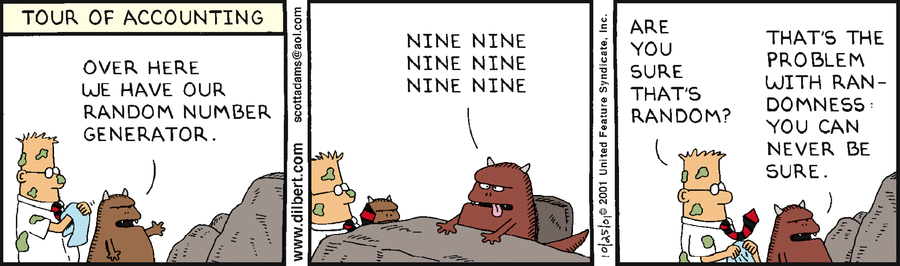
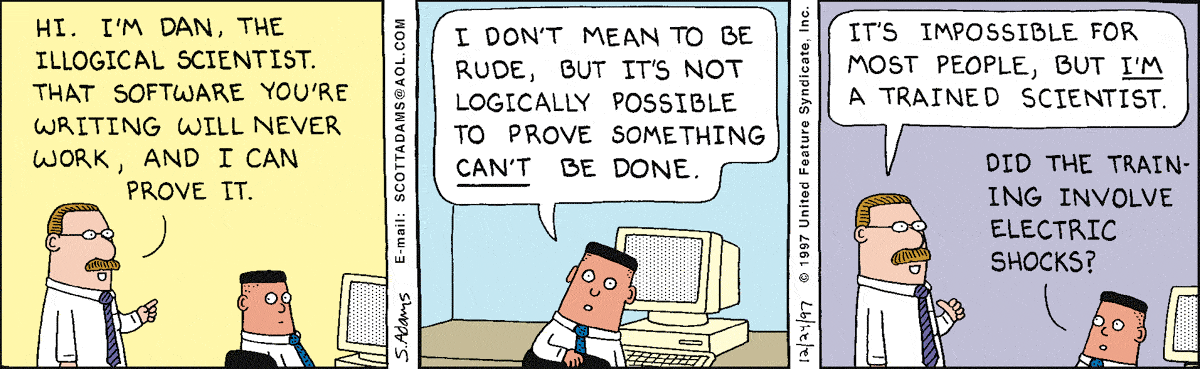
So we need to say to Dilbert, making the end of an era. Dilbert started in 1989 as a strip that captured the absurdities of the work place in an anonymous tech company, predating movies like Office Space and shows like Better Off Ted and Silicon Valley. I used Dilbert strips (with permission) in my book, namely this strip to introduce Kolmogorov complexity and this strip to describe my research area. Just call me Dan.

Farewell to Dilbert, Dogbert, Wally, Alice, Asok, the pointy-haired boss and the rest. I won't miss Scott Adams, but I will miss his creations.

Monday, February 27, 2023

I wish we had less students in a Class. Demographics says I may get my wish.

 According to this article, in the near future LESS people will be going to college. There is even a name for this upcoming shift: The Enrollment Cliff. Why?

Is it Covid-related?  Is it that College has gotten to expensive? To liberal? To much cancel culture?  To many dead white males in the core? The core is to multicultural? Online learning is stealing our students? 

No. The reason is actually very boring and does not serve anyone's political agenda. (thats not quite right).  Or any agenda. And you can probably guess the cause from the title of this blog post.

For some years up until 2007 the birth rate was slowly dropping. Then there was a large drop in the birth rate after the recession of 2007, and the birth rate has never really recovered. And the recession might not have that much to do with it-- the long term move from an agricultural society (where kids are an economic gain) to an industrial one (where, after child labor laws and the expense of college, kids are an economic loss- though that can be debated) has resulted in a very long term decline in births. 

And from personal experience, I know (a) very few people who have 4 or more kids, (b) there is NO stigma about having 0 kids as there once was.  Of course the sample size of people I know may be skewed. 

ANYWAY, what will this mean for colleges? 

a) Harvard, Yale, etc will not be affected. Plenty of people will still apply. Note that they draw from all of American and also internationally. 

b) Colleges that draw from a local area may be affected a lot since they depend on locals, and that population may be shrinking. 

c) Schools in between Harvard and Small colleges- hard to say. 

d) The sports betting places paying schools to allow them to promote on campus (and in some cases helping them promote it) may find far less students to sucker into this loser's game. See my blog on this topic here

Univ of MD has around 4000 Computer Science majors (depending on who tells you this its either a brag or a complaint). In the Spring of 2023 there are three lectures of Discrete math of sizes 240, 270, and 90. Each of those also has recitations of  30 (or so) each. If the decline is gradual (either from demographics or from the CS majors bubble finally bursting, or from the other reasons above) then I am sure we can handle it. If it declines very suddenly we may have a problem adjusting. 

One caveat to this that I've heard is that immigration will save us. Maybe. But America is politically going in the opposite direction. The counterargument of without immigration there will be less students going to college is not that compelling to most Americans. There are other more intelligent and compelling pro-immigration arguments. However, American politics is no longer interested in compelling and logical arguments. (The notion that it once was may be nostalgia for a time that never was.) 


Thursday, February 23, 2023

The Virtual Grad Student

Martin Haug, who is working on a LaTeX alternative Typst, asked me if I had updates on a LaTeX rant from 2011. I haven't seen any new serious backward compatibility problems. We have easier collaboration through on-line editors like Overleaf. We have got closer to WSYWIG thanks to quick compiling but still not at the level of Word or Google Docs. The big problem of user friendliness remains. There's a reason LaTeX has its own Stack Exchange

But we live in a new machine learning world. Can we use generative AI to make LaTeX easier to use?

Mandatory Disclaimer: Generative AI can sometimes create inaccurate, inappropriate or previously-published material. You are ultimately responsible for the contents of your paper no matter how you produced it.

Since I sometimes think of LaTeX as a programming language for papers, I tweeted

Thanks for the responses. The answer to the question is yes, GitHub Copilot works for LaTeX if you edit LaTeX in a programming environment like VS Code, Neovim or Jet Brains. It helps with formatting of formulas and pictures, less so on the text itself. I made a video so you can see how it works.

Latext AI offers a chrome extension that will let you generate text via GPT in Overleaf based on a prompt or previous text, though Latext requires a subscription after a one-week trial. You can also just cut and paste between any text editor and ChatGPT.

ChatGPT notoriously makes up references if you ask for them. Can we have a good system that finds relevant articles to cite and adds them automatically into your bibliography?

Ideally all these should work together seamlessly, suggestions that happen as you type. A true co-pilot for research papers.

There are many more tools out there, feel free to add them to the comments. I expect the integration to improve over time as we develop new APIs and models.

I look forward to the days of a virtual grad student: Here's a research goal and an idea to get there. Now go figure out the details and write the paper. 

It will be a long wait.

Sunday, February 19, 2023

It is more important than ever to teach your students probability (even non-stem students)

(This topic was also covered here.) 

You are a college president. An online betting company says  We will give you X dollars if you allow us to promote online gambling at your University.

I suspect you would say NO.

Too late- it's already happening. A link to a NY times article about this is: here. I urge you to read the entire article. It's worse than it sounds. 

My thoughts

0) I wondered if  a company needed permission to promote a product on a campus. I am not sure of the answer; however, in some cases a school HELPED with the promotion: 

a) During a game there are announcements reminding students that they can place a sports bet! It's easy! It's fun!

b) Links on the schools website to sports gambling sites

c) References to sports betting in emails that goto students.

This is WAY BEYOND  allowing a company to promote.

1) Some points from the article 

Some aspects of the deals also appear to violate the gambling industry's own rules against marketing to underage people. The ``Responsible Marketing Code'' published by the American Gaming Association, the umbrella group for the industry, says sports betting should not be advertised on college campuses. 

``We are not seeing enough oversight, transparency, and education to support the rollout of these kinds of deals'' said Michael Goldman who teaches sports marketing at the Univ of San. Fran. 

During the pandemic, many universities struggled financially ...To fill those holes public and private universities nationwide have been struggling to line up new revenue sources, including by arranging sponsorship deals. (MY THOUGHTS- They don't quite say it, but it seems like the extra money is going back to sports programs. I would be happier if it went into academics- and to be fair, maybe some of it does.) 

2) Online gambling is more addictive than in-person gambling. And it's easier since you don't have to leave your dorm room to do it. 

3) The school gets money and  teaches the students that everything is for sale. So it's a win-win (I am kidding.) 

4) Should a college take  money to allow the promotion of tobacco or alcohol or (if it becomes legal) heroin? I see NO difference between those and online gambling. (See here)

5) I am in favor of all of those things being legal (maybe not heroin but I am open to debate on that)  however, there is a big difference between making something legal, and promoting it.  

6) Silver Lining: This may encourage more students, even non-STEM students, to learn probability. Either advertise it honestly:


Take Probability to find out that Sports Betting is a Loser's Game


Or advertise it dishonestly


Take Probability to find out how you can win at Sports Betting!


Thursday, February 16, 2023

Blurry JPEG or Frozen Concentrate


Ted Chiang in a recent New Yorker article likened ChatGPT to a blurry JPEG, i.e. a "lossy compression" of the web. It's a good article but the analogy isn't quite right, there's a different kind of compression happening. Think of all human written knowledge as a random example of what could have been generated and we remove the randomness, like water is removed to make concentrated orange juice. We then add water (or randomness) to get back some version of the original. 

Lossless compression, like gzip, gives a compressed version of some data with the ability to reconstruct it exactly. It corresponds nicely to Kolmogorov complexity where K(x) is the smallest program p that generates the string x. p is a lossless compression of x.

Lossy compression, like JPEG, often allows much higher compression but with some error. In Kolmogorov terms you are trading off the size of the program p and some error function between x and the output of p. Most compression programs for pictures, music and video use algorithms designed for the specific medium. You can also use machine learning to get lossy compression by training both the compression and decompression algorithms.

Lossy compression tries to recreate the original picture. Generative AI, like ChatGPT, takes a different approach. Let's consider Wikipedia as this is the example used by Chiang. For any specific topic, there are many different ways to write a Wikipedia article, as good as or better than the article that currently exists. ChatGPT doesn't need to recreate anything close to the original article, just one that explains topic well. What we want is a description of a program p that corresponds to a set of possible Wikipedia articles, of which the real article is a random example of this set. An ideal version of ChatGPT would choose a random article from this set. Dall-E, generative AI for art, works a similar way, creating art that is a random example of what art might have been. 

In terms of Kolmogorov complexity, this corresponds to the Kolmogorov Structure Function, basically the smallest program p such that p describes a set S of size m that contains x. with |p| + log m ≈ K(x). The string x is just a random element of S, you can get a string like it by picking an element of S at random.

There is no recursive algorithm that will find p and we also need to limit ourselves to p that are computationally efficient, which means that generative AI algorithms may never be ideal and will sometimes make mistakes. That doesn't mean we shouldn't use them just that we need to be wary of their limitations. As the saying goes "All models are wrong, but some are useful".

Sunday, February 12, 2023

When is a paper `Easily Available' ?

I was looking at the paper 

                                PSPACE-Completeness of reversible deterministic systems

by Erik Demaine, Robert Hearn,  Dylan Hendrickson, and Jayson Lynch (see here) and came across the following fascinating result which I paraphrase:

The problem of, given balls on a pool table (though it can be one you devise which is not the standard one) and each balls initial position and velocity, and a particular ball and place, it is PSPACE complete to determine if that ball ever gets to that place. 

Demaine et al. stated that this was proven by Edward Fredkin and Tommaso Toffoli in 1982 (see here for a link to the 1982 paper, not behind a paywall). Demaine et al. gave an easier proof with some nice properties. (Just in case the link goes away I downloaded the paper to my files and you can find it here.) 

I needed the bib reference for the FT-1982 paper and rather than copy it from Demaine et al. I wanted to cut-and-paste, so I looked for it in DBLP. I didn't find the 1982 paper but I did find a book from 2002 that reprinted it. The book, Collision-based computing, has a website here. The book itself is behind a paywall.

On the website is the following curious statement:

[This book] Gives a state-of-the-art overview of an emerging topic, on which there is little published literature at the moment. [The book] Includes 2 classic paper, both of which are widely referred to but are NOT EASILY AVAILABLE (E. Fredkin and T. Toffoli: Conservative Logic, and N . Margolous Physics-Like Models of Computation). 

The caps are mine.

Not easily available? I found a link in less than a minute, and I used it above when I pointed to the paper. 

But the book IS behind a paywall. 

Perhaps Springer does not know that the article is easily available. That would be odd since the place I found the article is also a Springer website. 

The notion of EASILY AVAILABLE is very odd. While not quite related, it reminds me of when MIT Press had to pay a few thousand dollars for permission (that might not be the legal term) to reprint Turing's 1936 paper where he defined Turing Machines (he didn't call them that), which is on line here (and other places), for Harry Lewis's book Ideas that created the future. 


Thursday, February 09, 2023

Why Can't Little Chatty Do Math?

Despite OpenAI's claim that ChatGPT has improved mathematical capabilities, we don't get far multiplying large numbers.

L:What is 866739766 * 745762645?  C:647733560997969470

Typical for ChatGPT, the answer passes the smell test. It has the right number of digits and has correct first and last couple of digits. But the real answer is 646382140418841070,  quite different from the number given.

As far as I know, multiplication isn't known to be in TC0, the complexity class that roughly corresponds to neural nets. [Note Added: Multiplication is in TC0. See comments.] Also functions learned by deep learning can often be inverted by deep learning. So if AI can learn how to multiply, it might also learn how to factor. 

But what about addition? Addition is known to be in TC0 and ChatGPT performs better.


The correct answer is 1612502411, only one digit off but still wrong. The TC0 algorithm needs to do some tricks for carry lookahead that is probably hard to learn. Addition is easier if you work from right to left, but ChatGPT has trouble reversing numbers. There's a limit to its self-attention.


ChatGPT can't multiply but it does know how to write a program to multiply.


It still claims the result will be the same as before. Running the program gives the correct answer 646382140418841070. 

ChatGPT is run on a general purpose computer, so one could hope a later version that could determine when its given a math question, write a program and run it. That's probably too dangerous--we would want to avoid a code injection vulnerability. But still it could use an API to WolframAlpha or some other math engine. Or a chess engine to play chess. Etc. 

Monday, February 06, 2023

After you are notified that an article is accepted...

 After just one round of referees reports

(they send me the reports, I made the corrections, they were happy) I got email saying my paper on proving the primes are infinite FROM Schur's theorem in Ramsey was ACCEPTED. Yeah! Now What? 

1) The journal send me an email with a link GOOD FOR ONLY FIFTY DAYS to help me publicize the article. Here is the link:

https://authors.elsevier.com/a/1gTyD,H-cWw6X


Will this really help? The article is already on arxiv. (ADDED LATER: the link on arxiv is here.)  Also, I can blog about it, but how do non-bloggers publicize their work? Do they need to? 

(ADDED LATER: A commenter wanted to know why I am publishing in an Elsevier journal. This was a memorial issue in honor of Landon Rabern (see here) a combinatorist who died young.  I was invited to submit an article.) 

QUESTION: Is this common practice? If so, what do you do with those links? Email them to all of your the people who should care about the article?

2) I got some forms to fill out that asked how many offprints I wanted. While my readers can probably guess what that means, I will remind you: paper copies of the article. I filled out the form:

I want 0 of them.

They still wanted to know the address to send the 0 copies to, so I gave that as well.

Does anyone actually get offprints anymore? That seems so 1990's. With everything on the web I tend to email people who want article pointers. In fact, that happens rarely - either nobody wants to read my articles (quite possible) or they find them on my website (quite possible). 

In 1991 when I went up for tenure the dept wanted 15 copies of every article I wrote so they could send my letter writers (and others) all my stuff. Rumor is that the Governor of Maryland got a copy of every article I ever wrote. I hoped he was a fan of oracle constructions. 

In 1998 when I went up for full prof they did not do this, assuming that the letter writers could find what the needed on the web. I do wonder about that- it might have been a nice courtesy to send them stuff directly and that would be a use for offprints. Depends on if my letter writers prefer reading online or on paper. They could of course print out my papers, but again- as a courtesy perhaps we should have supplied the papers. 

QUESTION: Do you order a non-zero number of offprints and if so why? 

3) The journal offered to have my article to be open access at their site for a price. I did not do this as, again, the article is already on arxiv.

QUESTION: Is there a reason to have your article formally open-access given that its already on arixv? 

4) One of my co-authors on a different article asked me When will it appear IN PRINT?  I can't imagine caring about that. Its already on arxiv and I doubt having it in a journal behind paywalls will increase its visibility AT ALL. The only reason to care about when it appears IN PRINT is so I can update my resume from TO APPEAR to the actual volume and number and year. 

QUESTION: Aside from updating your resume do you care when an article that was accepted appears IN PRINT? And if so why? 


Thursday, February 02, 2023

Responsibility

Nature laid out their ground rules for large language models like ChatGPT including

No LLM tool will be accepted as a credited author on a research paper. That is because any attribution of authorship carries with it accountability for the work, and AI tools cannot take such responsibility.

Let's focus on the last word "responsibility". What does that mean for an author? It means we can hold an author, or set of authors, responsible for any issues in the paper such as

  • The proofs, calculations, code, formulas, measurements, statistics, and other details of the research.
  • Any interpretation or conclusions made in the article
  • Properly citing related work, especially work that calls into question the novelty of this research
  • The article does not contain text identical or very similar to previous work.
  • Anything else described in the article.
The authors should take reasonable measures to ensure that a paper is free from any issues above. Nobody is perfect and if you make a mistake in a paper, you should, as with all mistakes, take responsibility and acknowledge the problems, do everything you can to rectify the issues, such as publishing a corrigendum if needed, and work to ensure you won't make similar mistakes in the future.

Mistakes can arise outside of an author's actions. Perhaps a computer chip makes faulty calculations, you relied on a faulty theorem in another paper, your main result appeared in a paper fifteen years ago in an obscure journal, a LaTeX package for the journal created some mistakes in the formulas or a student who helped with the research or exposition took a lazy way out, or you put too much trust in AI generative text. Nevertheless the responsibility remains with the authors. 

Could an AI ever take responsibility for an academic paper? Would a toaster ever take responsibility for burning my breakfast?