Showing posts sorted by date for query typecast. Sort by relevance Show all posts

Sunday, January 30, 2022

Regan Lipton celebrates my 1000th blog post and random thoughts this inspires

Ken Regan emailed me recently asking if our software could tell how many blogs I had done (not how many Lance+Bill had done). We didn't know how to do that but he managed it anyway. Apparently he was more interested in this question than either Lance or I was. 

But the answer was interesting: My1000th post of Complexityblog was about Betty White dying at just the wrong time to be in those those we say goodbye to articles that appear CLOSE to the end of the year. (I don't know why, but I think the fact that my 1000th post was on Betty White is just awesome!) The post is here. He was asking this because he thought (correctly) that I was around 1000 and wanted to do a tribute blog to me (actually it was done by Lipton and Regan- more on that later). And indeed they did do the post, its here.

RANDOM THOUGHT ONE

While preparing it Ken asked me about my papers.  This brings up the more general question: When looking at your old work what do you think? Common reactions are

1) Gee, I was smarter then. That was very clever. OH, now I remember, my co-author did it. 

2) Gee, I was dumber then. I could do that argument so much better now. 

3) Why did I care about Muffins so much to write a book about it? (Replace Muffins with whatever you worked on and book with the venue it appeared in.) 

Item 3 is probably the most common: As a graduate student one works on things without really have a vision of the field (though the advisor can mitigate this) so what you work on may seem odd later on. And ones tastes can change as well. 

RANDOM THOUGHT TWO

Ken and Dick write actual posts together. I find that amazing! By contrast, the extent of Lance and my interactions about the blog are: 

a) Someone died. Which of us should do the blog obit? or get a guest blogger.?(Whenever Lance phones me on the telephone I answer who died and usually someone did.) 

b) Which of us does the April Fools Day post this year (we usually alternate, or do we)?

c) I plan on doing 2 posts close together- a question and an answer, so when do you NOT plan on blogging so I can do that.

d) Someone proved X. Which of us should blog? Or should we get a guest blogger?

e) Establish a general rule for the year like Bill will post Sunday's, Lance Thursdays.

f) I ask Lance for technical help on the blog. How do you get rid of the white background when I cut and paste?

g) Sometimes one of us wants commentary on a blog we are working no- but that is rare. Though I asked Lance for this post and he added a few things to this list.

h) Sometimes I look at one of his posts before it goes out and offer commentary, or vice versa. Also rare.

i) Lance writes the end of year posts, but always with my input. We jointly choose the theorem of the year.

j) The very rare joint posts.

k) If we happen to be in the same place at the same time, like Dagsthul, we'll do a typecast capturing our conversations. In the past we've also had podcasts and vidcasts together.


Thursday, March 21, 2019

Back at Dagstuhl

Participants and Their Research Interests

This week I'm in Germany for the Dagstuhl workshop on Computational Complexity of Discrete Problems well timed for Georgia Tech spring break. No Bill, so no typecast, no family, just a bunch of fellow theorists. New this year, beer.

Dagstuhl always had bottled beer (and wine), after all this is Germany. However, Ronen Shaltiel is living his lifelong dream of bringing a keg to Dagstuhl. Turns out Dagstuhl had a refrigerator/tap for a beer keg, one only needs to order and pay for the beer. Ronen's daughter designed a special logo, though the keg contains Bitburger, a fine German pilsner. Prost to Ronen and thanks for the beer.


Of course the fun is hanging with colleagues old and new. Talking about open problems old and new. Used to solve more of them back in the day, now it seems harder.

I did learn a new old theorem, planarity testing, whether you can embed a given graph in the plane so no two edges cross, is computable in log space. In 2000 Eric Allender and Meena Mahajan showed that you can test for planarity in symmetric log space, basically the complexity class whose complete problem is undirected connectivity. In 2005, Omer Reingold famously showed that undirected connectivity is computable in log-space. Thus planarity testing is in log-space, a result you might have missed if you didn't know both papers.

This came out in Eric's talk on his work with Archit Chauhan, Samir Datta and Anish Mukherjee showing that checked whether there is a directed path from a given node s to a given node t in planar graphs can be computed by concurrent-read exclusive-write on parallel random-access machines in logarithmic time, and thus likely weaker than directed s-t paths on general graphs.

Monday, October 01, 2018

Muffin Math

Lance: It's Friday afternoon and the Dagstuhl workshop has ended. We have some time before we need take off so how about one final typecast.

Bill: Always a good idea.

Lance: First the exciting news, Nitin Saxena won the Shanti Swarup Bhatnagar prize for 2018,
Nitin Saxena
according to the many Indians at Dagstuhl, the most prestigious science prize in the country. The awards were announced on Wednesday during the workshop. He's the S in AKS.

Bill: That's really impressive. He was only two-years old when AKS had log-depth sorting networks.

Lance: Bill, you moron. You're thinking of Ajtai-Komlós-Szemerédi. I'm talking Agrawal-Kayal-Saxena Primes in P, topic of my second ever blog post. Nitin, an undergrad at that time, didn't just sit on his laurels--he has had awesome results on algebraic circuit complexity that truly justify this prize.

Bill: Well congrats to Nitin. Moving on, let's talk math.

Lance: We're at Dagstuhl so we have to call it computer science.

Bill: Ronen Shaltiel gave a great but depressing talk, Indistinguishability by adaptive procedures with advice, and lower bounds on hardness amplification proofs.

Lance: Nobody sings the Dagstuhl Blues.

Bill: Suppose you had a hard function and want to covert it to a harder function, known in the biz as hardness amplification. For constant depth circuits we have hardness results but no known process for amplification. For larger classes, like constant depth circuits with threshold gates, we do know ways to amplify.

Lance: But we have not hardness results there? Where are you going with this?

Bill: Ronen put it nicely, "We can only amplify hardness where we don't have it". Ronen and his colleagues proved results along those lines. Lance, does that depress you.

Lance: Not as much as the sprained ankle that made me miss that talk. My turn to pick a favorite talk. I loved Michael Forbes Hitting Sets for the Closure of Small Circuits. You take algebraic circuits with a parameter epsilon and take the limit as epsilon goes to zero. Forbes and Amir Shpilka show a PSPACE algorithm to find small sets containing non-zeros of these functions. These kinds of functions are studied in the GCT approach to lower bounds.

Bill: What lower bounds is this aiming to solve?

Lance: Showing the computation difference between the determinant and the permanent.

Josh Alman: You've left out the most exciting part of the conference.

Bill and Lance: So Josh, what was that?

Josh Alman: The world debut debut performance of Stud Muffin and Smilin' Sam singing "Do You Work on Muffin Math?"


Lance: That awesome duo looks familiar Bill. Where I have seen them before?

Bill: That Sam can really tickle the ivories.

Lance: And Stud was definitely in the room.

Bill: On that note, take us out.

Lance: In a complex world, keep it simple.

Thursday, September 27, 2018

Still Typecasting from Dagstuhl

Lance: Bill, in our typecast earlier this week I said you were older than me. But 68? You don't look day over 66.

Bill: Neither do you. But seriously, why do you think I'm 68?

Lance: I just Google'd "How old is Bill Gasarch?"

Bill: Don't believe everything you read on the Internet. I'm really 58.

Lance: Prove it.

Bill: Here's my driver's license.

Lance: Bill you don't drive. And it literally says "NOT A DRIVER'S LICENSE" on the back. But it is an official State of Maryland Identification card stating that you were born in 1959. Are you saying I should trust the state of Maryland over Google?

Bill: Yes, because they pay my salary. Back to Dagstuhl. Let's talk about the talks. William Hoza gave a nice talk about hitting sets for L (deterministic small space) vs RL (randomized small space)  but when I asked him when will we prove L = RL he said not for fifty years. Grad students are not supposed to be that pessimistic.

Lance: You mean realistic. Though I'd guess more like 10-20 years. I wouldn't even be surprised if NL (nondeterministic log space) = L.

Arpita Korwar: I say 10-15 years.

Bill: Can we put that in the blog?

Lance: Too late. Bill I heard you were the stud muffin this week.

Bill: Yes, I talked about the muffin problem. Got a problem with that?

Lance: Needed milk. I saw this talk two years ago and now you have cool theorems. Who would've thought if you have 24 muffins and 11 people you can allocate 24/11 muffins and the smallest piece is 19/44, and that's the best possible for maximizing the smallest piece.

Bill: I can't believe you actually listened to the talk and didn't fall asleep.

Lance: zzzzzz. Did you say something?

Bill: Never mind. Eric Allender talked about the minimum circuit-size problem: Given a truth-table of a function f is there a circuit for f less that a given size w. The problem is frustrated, just consider the following theorem: if MCSP is NP-complete then EXP does not equal ZPP (exponential time in zero-error probabilistic polynomial-time).

Lance: Do you think EXP = ZPP?

Bill: No, the result only tells us it will be hard to prove MSCP is NP-complete without informing us whether or not it is NP-complete. Allender did show that under projections it isn't NP-complete (Editor's Note: I should have said log-time projections see Eric's comment. SAT and all your favorite NP-complete problems are complete under log-time projections). MSCP might be complete under poly-time reductions but not under weaker reductions.

Lance: Reminds me of the Kolmogorov random strings that are hard for the halting for Turing reductions but not under many-one reductions.

Bill: Everything reminds you of the Kolmogorov strings.

Lance: As they should.

Bill: I liked Michal Koucký's talk on Gray codes.

Lance: Shouldn't that be grey codes. We're not in the UK.

Bill: It's the color you moron. It's named after Frank Gray.

Lance: You are smarter than you look, not bad for a 68 year old. I missed Koucký's talk due to a sports injury, but he did catch me up later.

Bill: I never put Lance and sports in the same sentence before.

Lance: And I never put Bill and driving together. It's a new day for everything. Koucký showed how to easily compute the next element in the Gray code querying few bits as long as the alphabet size is of size 3.

Bill: Which contrasts Raskin's 2017 paper that shows with a binary alphabet you need to query at least half the bits.

Lance: Hey you stole my line.

Bill: That's not possible. You are editing this. I think this typecast has gone long enough. Take us out.

Lance: In a complex world, best to keep it simple.

Tuesday, September 25, 2018

Lance and Bill go to Dagstuhl: The Riemann Edition

Lance: Welcome to our typecast directly from Dagstuhl in Southwestern Germany for the 2018 edition of the seminar on Algebraic Methods in Computation Complexity. Say hi Bill.

Bill: Hi Bill. So Lance are you disappointed we didn't go to Heisenberg for the Michael Atiyah talk claiming a solution to the Riemann Hypothesis.

Lance: I knew how fast I was going but I got lost going to Heisenberg. I think you mean the Heidelberg Laureate Forum a 100 miles from here. From what I heard we didn't miss much. For those who care here is the video, some twitter threads and the paper.

Bill: Too bad. When I first heard about the claim I was optimistic because (1) László Babai proved that graph isomorphism is in quasipolynomial-time at the age of 65 and (2) since Atiyah was retired he had all this time to work on it. Imagine Lance if you were retired and didn't have to teach or do administration, could you solve P vs NP? (This gets an LOL from Nutan Limaye)

Lance: I'll be too busy writing the great American novel. Before we leave this topic, don't forget about the rest of the Laureate Forum, loads of great talks from famous mathematicians and computer scientists. Why didn't they invite you Bill?

Bill: They did but I rather be at Dagstuhl with you to hear about lower bounds on matrix multiplication from Josh Alman. Oh, hi Josh I didn't see you there.

Josh: Happy to be here, it's my first Dagstuhl. I'm flying around the world from Boston via China to get here. Though my friends say it's not around the world if you stay in the Northern hemisphere. They are a lot of fun at parties. But not as much fun as matrix multiplication.

Bill: So Josh, what do you have to say about matrix multiplication. Is is quadratic time yet?

Josh: Not yet and we show all the current technique will fail.

Bill: Wouldn't Chris Umans disagree?

Kathryn Fenner: You shouldn't pick on Canadians [Ed note: Josh is from Toronto]. Pick on students from your own country.

Josh: (diplomatically) I think Chris Umans has a broader notion of what counts as known methods. There are some groups that aren't ruled out but we don't know how to use them.

Chris: Very well put. The distinction is between powers of a fixed group versus families of groups like symmetric groups. The later one seems like the best place to look.

Lance: Thanks Chris. Josh, what are your impressions of Dagstuhl so far?

Josh: I like the sun and grass. I wish it was easier to get here.

Lance: This is only the first day. You haven't even found the music room yet, past the white room, past the billiard room where Mr. Green was murdered with the candlestick. Oh hi Fred Green. Luckily Dr. Green is still alive. I remember my first Dagstuhl back in February of 1992.

Josh: Two months before I was born.

Lance: Way to make me feel old.

Bill: You are old.

Lance: You are older. Believe it or not six from that original 1992 meeting are here again this week: The two of us, Eric Allender, Vikaurum Arvind, Uwe Schöning and Jacobo Torán. Amazing how accents show up as we talk.

Bill: What did I sleep through this morning before Josh's talk?

Lance: Amnon Ta-Shma talked about his STOC 2017 best paper and Noga Ron-Zewi showed some new results on constructive list-decoding.

Bill: Let's do this again later in the week. Lance, takes us out.

Lance: In a complex world, best to keep it simple.

Friday, October 07, 2016

Typecasting from Avi's 60th Celebration

Lance: Live from the Institute for Advanced Study in Princeton, New Jersey, Bill and I are doing a typecast from the Avi Wigderson 60th Birthday Celebration. Hi Bill.


Bill: Hi Lance. Last time I saw you was for the Mike Sipser 60th birthday and next for Eric Allender and Michael Saks.


L: New Jersey again. The Garden State.


B: New Jersey rocks! After all Bruce Springsteen is from here.


L: So was I.


B: You both rock! You are better at math. But I don’t want to hear you sing. I got in last night. How was the first day of the conference.


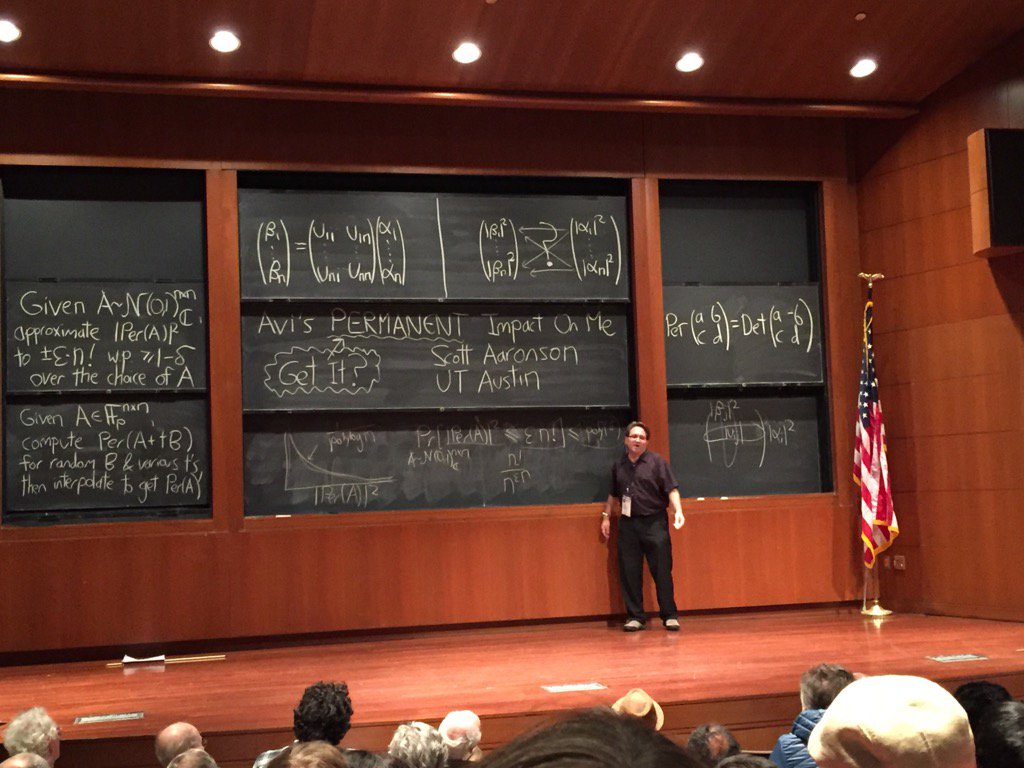
L: There’s two kinds of talks at a celebration like this. Some people who survey how Avi has shaped the field and their research in particular. Scott Aaronson gave a great talk titled “Avi’s Permanent Impact on me” on how a survey talk on the permanent problem eventually led to Scott’s work on boson sampling.


CuCIPRoXgAA8fRQ.jpg-large


Most people though are giving talks on their latest and greatest research. At least they have some good Avi jokes to start their talks.


B: So what category did Oded Goldreich’s “Canonical depth-three Boolean circuits for multi-linear functions, Multi-linear circuits with general gates, and matrix rigidity” talk fit in.


L: Oded did say the title was a joke and he did start with an Avi story, Actually it was a Silvio and Shafi story about when to leave for the airport.


B: I liked Alex Lubotzky’s ruminations on pure math versus computer science. He went into pure math thinking computer scientists had to know how to use computers. Had he known that they didn't he may have gone into computer science. He likes that his work on expanders has “applications” to computer science.


L: How did you like the rest of his talk.


B: I don’t know--it’s still going on.


L: Once I gave a talk at a logic meeting about generic oracles. People came up to me afterwards so excited that logic had such applications in computer science.


B: I liked Noga Alon’s talk “Avi, Graphs and Communication”. There is a fixed graph G on k nodes with k players each with an n bit string. How many bits do they to communicate over the edges to determine if all the strings are identical? Basically if the graph is 2-connected you need half of the trivial kn bits.


[Intermission]


L: A day has passed and we find ourselves talking again on Friday at IAS. It’s a beautiful day and we are sitting on lawn chairs on the IAS grounds. This is how Einstein must have felt.


B: Although he wouldn’t be skipping a talk on quantum physics.We are listening in through the magic of the Internet.


I liked Noam Nisan’s talk on the complexity of pricing. Perhaps surprisingly a seller can do better bundling two independent items than using individual prices. I plan to use that example in my fair division class. I may even do a short blog post.


L: I can’t wait. Madhu gave a great talk on low-degree polynomials and how error-correcting have gone from obscurity in theoretical computer science in the early 90’s to a standard tool just a few years later. And we have Madhu (inspired by Avi) to thank for that.


B: Eyal Wigderson, son of you know who, is a grad student studying neuroscience. Talked on “Brains are Better Computers than Computers” which I found flattering.


L: He was talking about rats, not your brain Bill.


B: Should I feel complemented or insulted?


L: Yes.


B: It’s kind of nice to have a birthday person’s child talk a conference like this. In TCS there are several including Paul Valiant who talked at Les Valiant’s 60th, Tal Rabin talked at Michael Rabin’s 80th, father and son Edmonds are here, and Molly Fortnow will surely talk at Lance Fortnow’s 60th. I remember when she interviewed us.


L: Let’s leave it at that.


B: Silvio Micali “knighted” Avi and used Byzantine agreement to improve bitcoin-like chains. I was  enlightened to learn bitcoin is so expensive only five companies do it regularly.


L: When people claim to solve P = NP I asked them to mine a few bitcoins and get back me. I have yet to see any bitcoins.


B: I asked them to find Ramsey of 5. I’m still waiting.


L: On that note time to say goodbye until we meet again.


B: Allender/Saks New Jersey again! Take us out Lance.


L: In a complex world, best to keep it simple, and


B/L: HAPPY BIRTHDAY AVI!


Avi_Mosaic_HiRes_small.jpg

Wednesday, September 24, 2014

Typecasting in Dagstuhl

After this pre-recorded typecast, we learned of the tragic death of Alexey Chervonenkis, the C of VC dimension, a huge loss to the learning community. We’ll have a proper obit soon. Now onto the typecast.

Lance: Hello and welcome to Dagstuhl for our first typecast since the 2014 Complexity Conference. Howdy Bill.

Bill: Hi Lance. Are you enjoying Dagstuhl?

Lance: I always have fun at Dagstuhl especially when you are here Bill.

Bill: I have not seen you at many talks.

Lance: So maybe you should go to more talks Bill.

Bill: Never mind. As you told me Scott is writing a blog book. Should we too?

Lance: Something we discussed many times.

Bill: How about a slightly different idea? At the end of this year you will have had FIVE lists of TEN best theorems. (Doing math in his head) That’s FIFTY theorems. There’s a book with a unified theme.

Lance: And I’m glad you’re going to write it.

Bill: That’s not exactly what I had in mind. But I’m happy to help you write it?

Lance: Do you think there are people who would want to buy this book?

Bill: I need your help BLOG AUDIENCE. Leave a comment to say if you would read this book. Would you read the book if you have to pay for it?

Lance: I certainly wouldn’t.

Bill: You don’t count. But they (points to the audience) do. [Bill leaves to get ice cream and comes back] I’m sure it will sell well in Silicon Valley.

Lance: Speaking of Silicon Valley, that was one tough post to write on MSR-SVC, basically an obituary post for a research lab.

Bill: Isn’t rather grim calling it an obituary?

Lance: Exactly.

Bill: Do you always give one word answers?

Lance: No.

Bill: You are man of few words.

Lance: You are a man of a few words too many.

Bill: Yes, I like to keep conversations flowing.

Lance: Indeed you are of the few extroverts in complexity. Introverts like me think deeply of what to say before we say it.

Bill: Did you just insult me? How did an introvert like you become a department chair?

Lance: I fake it well. [Quickly changing topic] I hear there’s exciting news out of Maryland. And I’m not talking about the Orioles.

Bill: We’re getting a new building, The Brendan Iribe Center for Computer Science and Innovation.

Lance: Because there’s no innovation in computer science. Brendan who?

Bill: He co-founded Oculus which was sold to Facebook for Ackerman of O(1) dollars.

Lance: Sounds exciting. It is one pretty ugly building you are in now.

Bill: Moving on, how the Complexity Conference in Vancouver?

Lance: You didn’t read my blog post?

Bill: [Reading blog post] Wow, no best paper and only 66 participants. Seems a bit lower than last year.

Lance: We were correlated with STOC last year and next year at FCRC as well. Though not with the IEEE anymore.

Bill: Is complexity theory dying?

Lance: The talks at this Dagstuhl alone prove otherwise.

Bill: I particularly liked David Zuckerman’s talk about using statistical sum-product theorems to create non-malleable codes. Why is it so empty in here?

Lance: It’s a rare sunny day at Dagstuhl and we’re inside doing this typecast. What other topics are exciting you at Dagstuhl?

Bill: There’s a resurgence of interest in VP and VNP, Valiant’s algebraic analogues of P and NP and genuine optimism that VP <> VNP might be provable in the near future.

Lance: There is some great work there but let’s wrap this up while we have still have some daylight.

Bill: You know what to say Lance.

Lance: In a complex world, best to keep it simple.

Monday, September 22, 2014

Goodbye MSR-SVC

This week I'm back at Dagstuhl for the Workshop on Algebra in Complexity Theory. Bill is here as well and we hope to have a typecast for you later this week.

The big discussion is the closing of Microsoft Research in Silicon Valley last week. The 50 researchers at MSR-SVC included 15 in a strong theory group. Luckily I captured the page last night as Microsoft has eliminated all mention of the lab from its web site. Just like the novel 1984: Microsoft doesn't have a research lab in Silicon Valley. Microsoft never had a research lab in Silicon Valley.

I visited MSR-SVC a couple of times, once inspiring a 2005 blog post on The New Research Labs. Cynthia Dwork was just starting to think about differential privacy. Jason Hartline, then a researcher at SVC, would later help me grow theory at Northwestern. In 2008 I took a trip there with Northwestern economist Mark Satterthwaite talking on how to connect CS and economics.

Omer Reingold, a favorite theorem author, writes his farewell to MSR. Sergey Yekhanin was supposed to be at Dagstuhl this week but unfortunately cancelled after getting the news. There have been rumors of changes in Microsoft Research since Satya Nadella took over as CEO but the suddenness of the closure of MSR-SVC took everyone by surprise. Computer scientists sent out on the streets well-off the usual hiring cycle. Many other Bay Area institutions will try to help in the short term and I would hope these researchers will find a new permanent home by the next academic year. Luca and Michael also chime in.

Industrial labs come and go but we should remember their legacy. Even as the scientists move on, the research they produce always remain part of our discipline.

Thursday, June 06, 2013

Complexity Typecast

Lance: Welcome to another exciting typecast coming from sunny Stanford University. I'm with Bill at the 28th Conference on Computational Complexity. Hi Bill, I see you're now at Mizzou.

Bill: Yes, my name tag says Univ. of Missouri but the body is still at Maryland. But Missouri is the Show-Me State and I don't believe theorems until you show me the proof.

Lance: Interesting name tags going around. Joshua Brody is at the University of Aarhus in Windsor, Vermont. But outside the name tags, this has been a well-run meeting.

Bill: Indeed. So Lance, anything seem different this year.

Lance: I'm noticing a few trends at both STOC and Complexity. Both have strong attendance this year, especially for West Coast meetings, and more papers than usual. Though fewer women attendees and I'm not sure why.

Bill: I was at a computability meeting at Iowa recently where there six women but they were the same six women from twenty years ago. That does not bode for the future.

Lance: I think that says more about computability as I'm guessing all the attendees were there twenty years ago.

Bill: I resemble that remark. Let's talk math. At one you were a Kolmogorov skeptic, now you are a believer.

Lance: Yes once I actually used it for a theorem I saw the light.

Bill: Speaking of light, are you now a quantum believer? Ronald de Wolf gave an awesome talk on the applications of quantum techniques to classical theorems. Were you convinced?

Lance: There are times that thinking quantumly can help generate good theorems. Nice to see quantum is good for something.

Bill: They didn't have quantum back in the days of the first complexity conference in 1986.

Lance: Yes the world was classical back then, just like the world was flat in 1400. No one here remembers that complexity meeting in 1400 but I have seen a few people from the original 1986 meeting.

Bill: Besides us, Eric Allender, Jonathan Buss, Steve Homer and Osamu Watanabe. Whether we remember anything from those days...

Lance: I remember meeting you for the first time. I was just a first-year grad student and I walked into a room with you and David Barrington talking at light speed. I thought you were both so smart.

Bill: Sorry to disappoint you. So Eric is the last man standing?

Lance: Yes, since I missed complexity last year, Eric Allender is the only person to have attended all 28 Complexity meetings. He does not want that to be his claim to fame.

Bill: Back in '86 I could follow 2/3 of 3/4 of the talks. Now I can follow 1/8 of 1/4 of all the talk. Have I gotten dumber or have the talks gotten harder?

Lance: Yes.

Bill: Thank you Lance, how about you?

Lance: Yes. More the techniques are quite different than the more computability type tools we used back in the day.

Bill: A field must change or die. I'm glad we're changing unlike certain areas of math I will not mention.

Lance: Speaking of change...

Bill: There are 242 ways of changing a dollar into pennies, nickels, dimes and quarters.

Lance: I did not know that! Moving on, what do you think of Joan Feigenbaum's suggestions on changing STOC?

Bill: I'll do a blog post on this later, but I'm generally in favor of more people on the PC (2-tiered), more papers in conference (3 parallel sessions) and more workshops, invited papers and posters.

Lance: So Bill ready to wrap it up?

Bill: Yes, it's time.

Lance: So remember, in a complex world best to keep it simple. And buy my book.

Thursday, November 15, 2012

A Simple PSPACE-Complete Problem

Back in the typecast last month I promised a simple PSPACE-complete game in a future post. Here it is:

The SET GAME

Given: A collection of finite sets S1,...,Sk.

The Game: Each player takes turns picking a non-empty set Si. Remove the elements of Si from all the sets Sj. The player who empties all the sets wins.

This game came up in a discussion I had with Steve Fenner trying to extend his student's work that Poset Games were PSPACE-complete. The PSPACE-completeness of determining a winner of the SET GAME is an easy reduction from from Poset Games.

An open question: Do we still get PSPACE-completeness if the size of the Si are bounded? I don't even know the answer if the sets have size at most two.

Wednesday, October 17, 2012

Dagstuhl Typecast

Nerd Shot from Dagstuhl Seminar 12421


Lance: Welcome to another Typecast from beautiful Schloss Dagstuhl. I’m here with Bill for the Workshop on Algebraic and Combinatorial Methods in Computational Complexity.

Bill: Beautiful? I thought this place was designed to be ugly so that we actually get work done.

Lance: So what work did you get done today, BIll?

Bill: I watched the debate. And you?

Lance: Steve Fenner and I came up with the easiest to describe PSPACE-complete problem ever!

Bill: Was it one of those poset things that you and Steve’s students work on.

Lance: A generalization of poset games but easier to describe. But we are getting off topic...

Bill: as did Obama and Mitt.

Lance: Bill my two minutes aren’t up yet. Anyway you’ll have to read about this new PSPACE-complete problem in a future post.

Bill: Since you didn’t ask, let me tell you about my favorite talk, Rank bounds for design matrices and applications by new Rutgers professor Shubhangi Saraf (Powerpoint). Despite the awful title

Lance: which is why I skipped that talk

Bill: it used complexity theory techniques to prove new things in math, a generalization of the Sylvester-Gallai theorem. You have n points on the plane...

Lance: Wait Bill, It will take longer to tell the S-G theorem than it would have to explain the new PSPACE-complete problem!

[Steve Fenner shows up with beer in hand. He goes off to get Lance one too.]

Bill: OK, I’ll leave this for a later post. What was your favorite talk?

Lance: Believe it or not it was an algorithms talk. Atri Rudra gave a very simple algorithm to do a join operation motivated by reconstructing 3-d collections of points from projections. [Powerpoint]

Bill: Yes, and it may have applications to complexity as most real world algorithms do.

[Steve arrives with Lance’s Beer. There is much happiness.]
Steve: My favorite talk so far was Rahul Santhanam’s [abstract] Reminded me of the good old days of complexity.

Lance: Let the guy give me beer and he thinks he can weasel his way into our typecast.

Bill: Lance, that’s how I got started in this business.

Lance: Rahul had some clever co-author, didn’t he?

Steve: No one important. Lance something?

Harry Buhrman: I like the GCT talk by Josh Grochow. [abstract]

Bill: In the future we’ll all have to learn GCT to get started in this field. I’m glad I’m living in the past. Lance, you paid me the highest compliment in my talk. You didn’t fall asleep and you even picked a fight with me.

Lance: Only because I had to stay awake to help the audience understand your confusing presentation.

Bill: It was only one slide.

Lance: It was only one fight.

Bill: I still feel as complimented as a bit that’s just been toggled .

Lance: I’m happy for you. Actually, it was not that bad a result. Now that’s my highest compliment.

Harry: Hey, this isn’t fair, we’ve haven’t heard all the talks yet.

[Both Harry and Steve are talking later tonight]

Lance: Life isn’t fair, get over it.

Bill: Let’s call it a day.

Lance: Watch my twitter feed later this week for a special musical complexity tribute.

Bill: I can’t wait.

Lance: So until next time, remember that in a complex world, best to keep it simple.