Maryland is looking to hire lecturers and my chai Samir wants me to post it on my blog. I think he overestimates the power of the blog, however, here is the link. I could use this to launch into a post about either the value of lecturers or how to handle the fact that CS enrollment is so high, but I've already posted on those in the past: here and here. (ADD- Actually my chair wanted me to post on all of our hiring which also includes professors, so see here)
Mohammad Hajiaghayi is the Program chair of the SPAA conference and wants me to post it on my blog. I think he overestimates the power of the blog, however here is the link. I could use this to launch into a post about the prestige-conference model of academia, or other conference issues, or parallelism, but these topics have also already appeared on the blog, mostly by Lance.
But here is the real question: Is it easier or harder to get information (e.g., UMCP CS is looking for a lecturer, SPAA call for papers is out) than it used to be.
EASIER: We have so many different mechanisms. Blogs, email, FACEBOOK, Twitter. Conferences used to have posters as well- I don't think I"ve seen one for a while. (If someone knows where some of the
old posters are, on line, please leave a comment- some of them were real neat!).
HARDER: we all get too much email (for those still on email), and get too much input in general. Hence things can get lost. I'm on so many mailing lists for talks that I actually MISS talks I want to goto since I tend to ignore ALL of those emails.
If you WANT to find something out, is that easier. If you want to find out
when is the SPAA conference
yes- you can Google it.
For something like
what schools are advertising they want to hire a lecturer?
prob yes though I am not quite sure where to look.
There are things out there that if you knew about them you would want to know, but you are not quite sure how to look. Do we come across them more or less than we used to. I think more since, at least in my case, people I know email me stuff they think I will care about and they are usually right (Ramsey Theory, Cake Cutting papers, and satires of Nobel Laureate Bob Dylan find there way to my inbox.)
Monday, October 31, 2016


Thursday, October 27, 2016
Get Ready
My daughters, now in college, never knew a time when they couldn't communicate with anyone instantaneously. Molly, now 18, takes pride having the same birth year as Google. They have never in their memory seen a true technological change that so dramatically affects the world they live in. But they are about to.
The 50's and 60's saw a transportation revolution. The Interstate highway system made local and national car and truck travel feasible. The jet engine allowed short trips to faraway places. The shipping container made transporting a good, made anywhere in the world, cheaper than producing it.
We could have national and worldwide academic conferences. China became a superpower by shipping us low-cost goods. Dock worker jobs, the kind held by Archie Bunker, have morphed and shrunk, even as the number of imported goods has grown.
In the 90's we had a communications revolution. The cell phone kept us connected all the time. The home computer and the Internet gave us immediate access to the world's information and Google helped us sort through it.
It fundamentally changed how we interacted. No longer did we need to make plans in advance. Eventually we would have little need for encyclopedias, almanacs, maps, or physical media for music, photos and movies. Not to mention new types of companies and the transformation of how businesses could work with their employees and contractors spread across the world.
That brings us to today. We are at the brink, if it hasn't already started, of an intelligence revolution, the combination of big data, machine learning and automation. The initial obvious transformation will come from autonomous cars, which will change not only how we get from point A to point B but how we plan roads, businesses and where we live. Beyond that work itself will change as we will continue to automate an ever growing number of white collar jobs. As with every transformation, the world we live in will change in unforeseen ways, hopefully more good than bad.
I really look forward to watching these changes through my daughter's eyes, to see how this new society directly affects them as they start their working lives. And how their children will one day see an old-fashioned automobile with relics like foot pedals and a steering wheel and be shocked that their parents once drove cars themselves.
The 50's and 60's saw a transportation revolution. The Interstate highway system made local and national car and truck travel feasible. The jet engine allowed short trips to faraway places. The shipping container made transporting a good, made anywhere in the world, cheaper than producing it.
We could have national and worldwide academic conferences. China became a superpower by shipping us low-cost goods. Dock worker jobs, the kind held by Archie Bunker, have morphed and shrunk, even as the number of imported goods has grown.
In the 90's we had a communications revolution. The cell phone kept us connected all the time. The home computer and the Internet gave us immediate access to the world's information and Google helped us sort through it.
It fundamentally changed how we interacted. No longer did we need to make plans in advance. Eventually we would have little need for encyclopedias, almanacs, maps, or physical media for music, photos and movies. Not to mention new types of companies and the transformation of how businesses could work with their employees and contractors spread across the world.
That brings us to today. We are at the brink, if it hasn't already started, of an intelligence revolution, the combination of big data, machine learning and automation. The initial obvious transformation will come from autonomous cars, which will change not only how we get from point A to point B but how we plan roads, businesses and where we live. Beyond that work itself will change as we will continue to automate an ever growing number of white collar jobs. As with every transformation, the world we live in will change in unforeseen ways, hopefully more good than bad.
I really look forward to watching these changes through my daughter's eyes, to see how this new society directly affects them as they start their working lives. And how their children will one day see an old-fashioned automobile with relics like foot pedals and a steering wheel and be shocked that their parents once drove cars themselves.
Monday, October 24, 2016
Exaggeration is one thing but this is....
This website is about the history of math and lists famous mathematicians. The ones from the 20th century are biased towards logic, but you should go there yourself and see who you think they left out.
There entry on Paul Cohen is... odd. Its here. I quote from it:
-------------------------------------
His findings were as revolutionary as Gödel’s own. Since that time, mathematicians have built up two different mathematical worlds, one in which the continuum hypothesis applies and one in which it does not, and modern mathematical proofs must insert a statement declaring whether or not the result depends on the continuum hypothesis.
-------------------------------------
When was the last time you had to put into the premise of a theorem CH or NOT-CH?
I did once here in an expository work about a problem in combinatorics that was ind of set theory since it was equivalent to CH. Before you get too excited it was a problem in infinite combinatorics having to do with coloring the reals.
I suspect that at least 99% of my readers have never had to insert a note in a paper about if they were assuming CH or NOT-CH. If you have I'd love to hear about it in the comments. And I suspect
you are a set theorist.
Paul Cohen's work was very important--- here we have an open problem in math that will always be open (thats one interpretation). And there will sometimes be other problems that are ind of ZFC or equiv to CH or something like that. But it does not affect the typical mathematician working on a typical problem.
I have a sense that its bad to exaggerate like this. One reason would be that if the reader finds out
the truth he or she will be disillusioned. But somehow, that doesn't seem to apply here. So I leave it to the reader to comment: Is it bad to exaggerate Paul Cohen's (or anyone's) accomplishments? And if so,
then why?
There entry on Paul Cohen is... odd. Its here. I quote from it:
-------------------------------------
His findings were as revolutionary as Gödel’s own. Since that time, mathematicians have built up two different mathematical worlds, one in which the continuum hypothesis applies and one in which it does not, and modern mathematical proofs must insert a statement declaring whether or not the result depends on the continuum hypothesis.
-------------------------------------
When was the last time you had to put into the premise of a theorem CH or NOT-CH?
I did once here in an expository work about a problem in combinatorics that was ind of set theory since it was equivalent to CH. Before you get too excited it was a problem in infinite combinatorics having to do with coloring the reals.
I suspect that at least 99% of my readers have never had to insert a note in a paper about if they were assuming CH or NOT-CH. If you have I'd love to hear about it in the comments. And I suspect
you are a set theorist.
Paul Cohen's work was very important--- here we have an open problem in math that will always be open (thats one interpretation). And there will sometimes be other problems that are ind of ZFC or equiv to CH or something like that. But it does not affect the typical mathematician working on a typical problem.
I have a sense that its bad to exaggerate like this. One reason would be that if the reader finds out
the truth he or she will be disillusioned. But somehow, that doesn't seem to apply here. So I leave it to the reader to comment: Is it bad to exaggerate Paul Cohen's (or anyone's) accomplishments? And if so,
then why?
Thursday, October 20, 2016
Alternate Histories
Imagine if we had a machine that let us change some earlier moment in history and see what developed. We wouldn't actually change history--that would lead to paradoxes and other disasters, but we could see what would develop. Suppose Archduke Ferdinand was never assassinated. How would that have changed 20th century history and beyond?
The same could be said for an academic field. Science flows like a story, with building results from other results, "standing on the shoulders of giants" so to say. But not all theorems are dependent on earlier ones and suppose that things happened in a different order. How would that have changed our field?
Points to ponder:
Suppose Gauss was alive today instead of two centuries ago. Would he still be as famous? Would there be a big hole in mathematics that would have been left for the current Gauss to solve?
Suppose Fermat's last theorem was still a conjecture. Would there be more budding mathematicians inspired by the wonders of that famous open problem like my generation was? Would the Clay Mathematics Institute still have produced a list of those millennial problems, including P v NP?
Suppose we knew Primes in P back in 1975. Would randomized algorithms and subsequent derandomization techniques have happened without its prime example? Same for Undirected connectivity in log space. These both are small cheats as the AKS and Reingold proofs are at their core derandomization arguments and may not have happened if we didn't think about randomized algorithms.
What if someone settled P vs NP right after Cook? Would it have stopped most of the research in computational complexity theory? Would it depend on whether P = NP was answered positively or negatively?
What if you were never born? Ultimately that would be the only true measure of your influence in the world. What if your research somehow prevented other great theorems from happening? Would you even want to see the results of that experiment?
The same could be said for an academic field. Science flows like a story, with building results from other results, "standing on the shoulders of giants" so to say. But not all theorems are dependent on earlier ones and suppose that things happened in a different order. How would that have changed our field?
Points to ponder:
Suppose Gauss was alive today instead of two centuries ago. Would he still be as famous? Would there be a big hole in mathematics that would have been left for the current Gauss to solve?
Suppose Fermat's last theorem was still a conjecture. Would there be more budding mathematicians inspired by the wonders of that famous open problem like my generation was? Would the Clay Mathematics Institute still have produced a list of those millennial problems, including P v NP?
Suppose we knew Primes in P back in 1975. Would randomized algorithms and subsequent derandomization techniques have happened without its prime example? Same for Undirected connectivity in log space. These both are small cheats as the AKS and Reingold proofs are at their core derandomization arguments and may not have happened if we didn't think about randomized algorithms.
What if someone settled P vs NP right after Cook? Would it have stopped most of the research in computational complexity theory? Would it depend on whether P = NP was answered positively or negatively?
What if you were never born? Ultimately that would be the only true measure of your influence in the world. What if your research somehow prevented other great theorems from happening? Would you even want to see the results of that experiment?
Tuesday, October 18, 2016
This university does not discriminate based on....
I recently came across the following (I delete the name of the school)
and also add my own comments in caps as they relate to UMCP hiring
of professors.
X-University, located in YZ, in hiring professors
does not discriminate on the basis of
race
color . COULD AN HBCU DISCRIMINATE AGAINST WHITE PROFESSORS?
religious HAS NEVER COME UP. COULD A RELIGIOUS SCHOOL DISCRIMINATE ON THIS BASIS?
creed I LOOKED UP HOW IT DIFFERS FROM RELIGIONS- CREED COULD BE ANY SET OF BELIEFS. WHAT IF ONE OF CANDIDATES BELIEVES ARE REPREHENSIBLE BUT WOULD NOT INTERFERE WITH THEIR JOB? JUST ASKING.
age WHAT IF YOU WANT SOMEONE THERE LONG-TERM?
and also add my own comments in caps as they relate to UMCP hiring
of professors.
X-University, located in YZ, in hiring professors
does not discriminate on the basis of
race
color . COULD AN HBCU DISCRIMINATE AGAINST WHITE PROFESSORS?
religious HAS NEVER COME UP. COULD A RELIGIOUS SCHOOL DISCRIMINATE ON THIS BASIS?
creed I LOOKED UP HOW IT DIFFERS FROM RELIGIONS- CREED COULD BE ANY SET OF BELIEFS. WHAT IF ONE OF CANDIDATES BELIEVES ARE REPREHENSIBLE BUT WOULD NOT INTERFERE WITH THEIR JOB? JUST ASKING.
age WHAT IF YOU WANT SOMEONE THERE LONG-TERM?
gender. COULD A WOMEN'S (MEN'S) SCHOOL DISCRIMINATE AGAINST MEN (WOMEN)?
gender identity or expression I THINK THIS IS A NEW ONE TO
COVER TRANS AND SIMILAR THINGS. ITS NOT SEXUAL ORIENTATION WHICH IS BELOW.
national origin HAS NEVER COME UP. EVEN SO, I WOULD NEVER HIRE A WISIAN. See here for why.
marital status WE CAN"T EVEN ASK IF THEY HAVE A SPOUSE WHICH MAY BE HARD FOR TELLING THEM SOME SELLING POINTS OF THE AREA- GOOD FOR MARRIED PEOPLE? GOOD FOR SINGLE PEOPLE? COULD A RELIGIOUS SCHOOL HOLD AGAINST THEM THAT YOU WERE LIVING WITH SOMEONE BUT NOT MARRIED TO THEM?
ancestry I CAN"T IMAGINE THIS COMING UP.
present or past history of mental disorder I"M SURPRISED ABOUT THIS ONE SINCE I WOULD THINK HAVING A PRESENT MENTAL DISORDER IS RELEVANT TO THE JOB. THEN AGAIN, GODEL AND CANTOR PROB HAD SOME MENTAL DISORDERS.
learning disability HAS NEVER COME UP. I HAVE NEVER EVEN SEEN A GRAD STUDENT WITH A LEARNING DISABILITY SO IT MIGHT NOT COME UP FOR A WHILE.
physical disability HAS NEVER COME UP. I CAN SEE IT COMING UP.
political belief HAS NEVER COME UP. I WONDER IF IT COMES UP MORE IN A POLYSCI OR HISTORY DEPT.
veteran status HAS NEVER COME UP. COULD A MILITARY SCHOOL PREFER VETERANS?
sexual orientation HAS NEVER COME UP. BUT COULD.
genetic information THIS MAY BE RELEVANT IN THE FUTURE. PERHAPS THE NEAR FUTURE. SCARY?
non-position-related criminal record. WHICH CRIMES ARE POSITION RELATED? THIS COULD BE A LEGAL QUAGMIRE . MURDERING SOMEONE IN A BAR FIGHT IS NOT POSITION RELATED BUT MURDERING A STUDENT WHO COMPLAINED ABOUT A GRADE IS. OTHER CASES MAY NOT BE AS CLEAR CUT.
Thursday, October 13, 2016
2016 Fall Jobs Post
The weather cools down, the leaves change color and you start thinking about what you plan to do after you graduate. As a public service every year about this time, we offer up links and advice for the job search for PhDs in theoretical computer science.
For computer science faculty positions best to look at the ads from the CRA and the ACM. For theoretical computer science specific postdoc and faculty positions check out TCS Jobs and Theory Announcements. If you have jobs to announce, please post to the above and/or feel free to leave a comment on this post.
It never hurts to check out the webpages of departments or to contact people to see if positions are available. Even if theory is not listed as a specific hiring priority you may want to apply anyway since some departments may hire theorists when other opportunities to hire dry up. Think global--there are growing theory groups around the world.
I expect hiring this year to be similar to recent years. Most departments looking to dramatically expand in computer science but with a preference for the more applied areas that the students and the companies that will hire them desire. You can make yourself more valuable by showing a willingness to participate and teach beyond core theory. Machine learning, data science and information security are areas of great need where theorists can play a large role.
A bad job talk can sink your job prospects. Know your audience and particularly for faculty positions create a talk that can express your results and importance to those outside of theory. Pictures help, complex formulas and heavy text work against you. Practice your talk in front of non-theory students and faculty. You will greatly increase your chances if you can sell yourself as a valuable colleague, not just a smart theorist who will prove great things in isolation.
Good luck out there and I look forward to seeing your names on the Spring 2017 jobs post.
For computer science faculty positions best to look at the ads from the CRA and the ACM. For theoretical computer science specific postdoc and faculty positions check out TCS Jobs and Theory Announcements. If you have jobs to announce, please post to the above and/or feel free to leave a comment on this post.
It never hurts to check out the webpages of departments or to contact people to see if positions are available. Even if theory is not listed as a specific hiring priority you may want to apply anyway since some departments may hire theorists when other opportunities to hire dry up. Think global--there are growing theory groups around the world.
A bad job talk can sink your job prospects. Know your audience and particularly for faculty positions create a talk that can express your results and importance to those outside of theory. Pictures help, complex formulas and heavy text work against you. Practice your talk in front of non-theory students and faculty. You will greatly increase your chances if you can sell yourself as a valuable colleague, not just a smart theorist who will prove great things in isolation.
Good luck out there and I look forward to seeing your names on the Spring 2017 jobs post.
Tuesday, October 11, 2016
Ideal courses for a comp sci dept/I'm glad we don't do it
I once heard it said:
In our data structures course we read Knuth and ignore the proofs
In our algorithms course we read Knuth and ignore the code.
And indeed, there are many topics where the theory-part is in one course and the programming is in another.
With that in mind, here is a different way to offer courses (some depts already do some of this).
1) A course in Algorithms AND Data Structures. Actually I have seen this title on courses but its usually just a theory course. I mean you REALLY PROOF and CODE. Might need to be a year long.
2) Crypto AND Security. You learn crypto and security together and do both. If you only did the crypto relevant to security it might be a semester long and in fact it might already be being done. But I am thinking of really combining these courses--- code and prove. Might be a year long.
3) Formal lang Theory and Practice of Compilers. You do DFA, NDFA, CFG, but also do compiler design. If you also want to do P, NP, and decidability (spell check thinks that decidability is not a word!) then might not quite connect up with compilers, then again in might with theorems like: CFG equivalence is undecidable. Might be a year long.
4) Machine learning AND Prob/stat.
PROS: Theory and Practice would be more united.
CONS: Having year-long courses is hard for the students scheduling their courses. Would having just one semester of any of the above courses make sense?
CONS: Harder to find someone to teach these courses. I'll confess that I prefer to teach formal lang theory without any programming in it.
CAVEAT: I think theorists coming out now know more of the practical counterpart of their area than I did and perhaps than people of my generation did.
CAVEAT: A much less radical thing to do is to put more security in to crypto, more about compilers into Formal Lang Theory, etc. But thats a bit odd now since we DO have a course in security, and a course in compilers. Even so, seems to be a good idea and this I know many schools are doing.
In our data structures course we read Knuth and ignore the proofs
In our algorithms course we read Knuth and ignore the code.
And indeed, there are many topics where the theory-part is in one course and the programming is in another.
With that in mind, here is a different way to offer courses (some depts already do some of this).
1) A course in Algorithms AND Data Structures. Actually I have seen this title on courses but its usually just a theory course. I mean you REALLY PROOF and CODE. Might need to be a year long.
2) Crypto AND Security. You learn crypto and security together and do both. If you only did the crypto relevant to security it might be a semester long and in fact it might already be being done. But I am thinking of really combining these courses--- code and prove. Might be a year long.
3) Formal lang Theory and Practice of Compilers. You do DFA, NDFA, CFG, but also do compiler design. If you also want to do P, NP, and decidability (spell check thinks that decidability is not a word!) then might not quite connect up with compilers, then again in might with theorems like: CFG equivalence is undecidable. Might be a year long.
4) Machine learning AND Prob/stat.
PROS: Theory and Practice would be more united.
CONS: Having year-long courses is hard for the students scheduling their courses. Would having just one semester of any of the above courses make sense?
CONS: Harder to find someone to teach these courses. I'll confess that I prefer to teach formal lang theory without any programming in it.
CAVEAT: I think theorists coming out now know more of the practical counterpart of their area than I did and perhaps than people of my generation did.
CAVEAT: A much less radical thing to do is to put more security in to crypto, more about compilers into Formal Lang Theory, etc. But thats a bit odd now since we DO have a course in security, and a course in compilers. Even so, seems to be a good idea and this I know many schools are doing.
Friday, October 07, 2016
Typecasting from Avi's 60th Celebration
Lance: Live from the Institute for Advanced Study in Princeton, New Jersey, Bill and I are doing a typecast from the Avi Wigderson 60th Birthday Celebration. Hi Bill.
Bill: Hi Lance. Last time I saw you was for the Mike Sipser 60th birthday and next for Eric Allender and Michael Saks.
L: New Jersey again. The Garden State.
B: New Jersey rocks! After all Bruce Springsteen is from here.
L: So was I.
B: You both rock! You are better at math. But I don’t want to hear you sing. I got in last night. How was the first day of the conference.
L: There’s two kinds of talks at a celebration like this. Some people who survey how Avi has shaped the field and their research in particular. Scott Aaronson gave a great talk titled “Avi’s Permanent Impact on me” on how a survey talk on the permanent problem eventually led to Scott’s work on boson sampling.
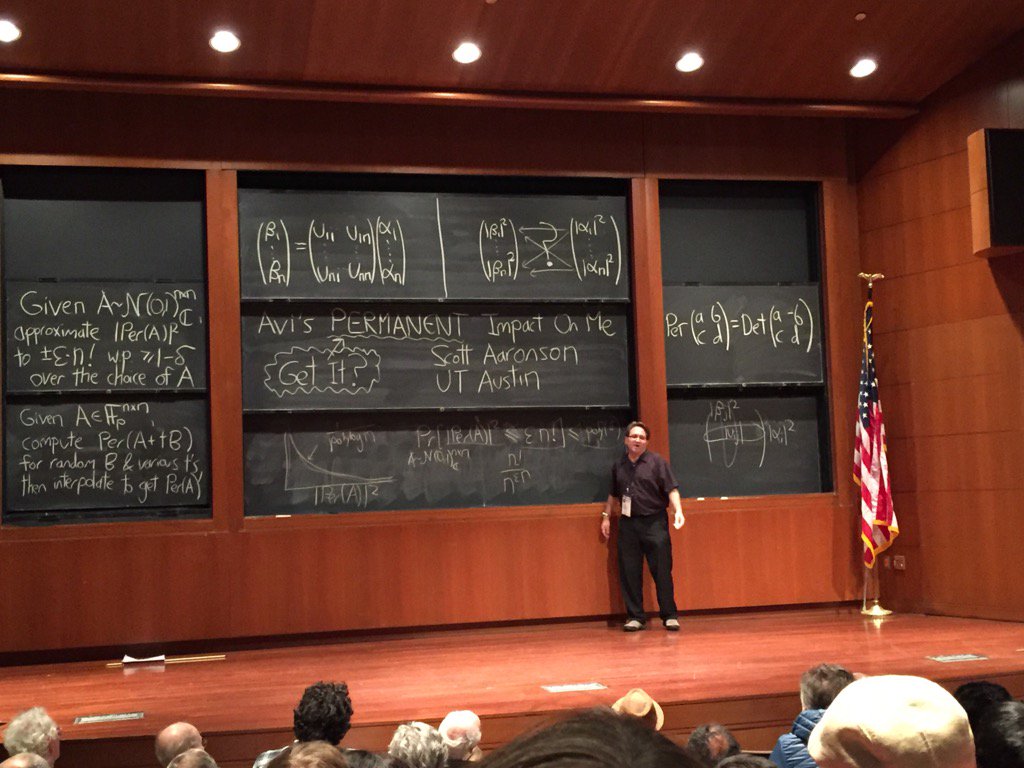
Most people though are giving talks on their latest and greatest research. At least they have some good Avi jokes to start their talks.
B: So what category did Oded Goldreich’s “Canonical depth-three Boolean circuits for multi-linear functions, Multi-linear circuits with general gates, and matrix rigidity” talk fit in.
L: Oded did say the title was a joke and he did start with an Avi story, Actually it was a Silvio and Shafi story about when to leave for the airport.
B: I liked Alex Lubotzky’s ruminations on pure math versus computer science. He went into pure math thinking computer scientists had to know how to use computers. Had he known that they didn't he may have gone into computer science. He likes that his work on expanders has “applications” to computer science.
L: How did you like the rest of his talk.
B: I don’t know--it’s still going on.
L: Once I gave a talk at a logic meeting about generic oracles. People came up to me afterwards so excited that logic had such applications in computer science.
B: I liked Noga Alon’s talk “Avi, Graphs and Communication”. There is a fixed graph G on k nodes with k players each with an n bit string. How many bits do they to communicate over the edges to determine if all the strings are identical? Basically if the graph is 2-connected you need half of the trivial kn bits.
[Intermission]
L: A day has passed and we find ourselves talking again on Friday at IAS. It’s a beautiful day and we are sitting on lawn chairs on the IAS grounds. This is how Einstein must have felt.
B: Although he wouldn’t be skipping a talk on quantum physics.We are listening in through the magic of the Internet.
I liked Noam Nisan’s talk on the complexity of pricing. Perhaps surprisingly a seller can do better bundling two independent items than using individual prices. I plan to use that example in my fair division class. I may even do a short blog post.
L: I can’t wait. Madhu gave a great talk on low-degree polynomials and how error-correcting have gone from obscurity in theoretical computer science in the early 90’s to a standard tool just a few years later. And we have Madhu (inspired by Avi) to thank for that.
B: Eyal Wigderson, son of you know who, is a grad student studying neuroscience. Talked on “Brains are Better Computers than Computers” which I found flattering.
L: He was talking about rats, not your brain Bill.
B: Should I feel complemented or insulted?
L: Yes.
B: It’s kind of nice to have a birthday person’s child talk a conference like this. In TCS there are several including Paul Valiant who talked at Les Valiant’s 60th, Tal Rabin talked at Michael Rabin’s 80th, father and son Edmonds are here, and Molly Fortnow will surely talk at Lance Fortnow’s 60th. I remember when she interviewed us.
L: Let’s leave it at that.
B: Silvio Micali “knighted” Avi and used Byzantine agreement to improve bitcoin-like chains. I was enlightened to learn bitcoin is so expensive only five companies do it regularly.
L: When people claim to solve P = NP I asked them to mine a few bitcoins and get back me. I have yet to see any bitcoins.
B: I asked them to find Ramsey of 5. I’m still waiting.
L: On that note time to say goodbye until we meet again.
B: Allender/Saks New Jersey again! Take us out Lance.
L: In a complex world, best to keep it simple, and
B/L: HAPPY BIRTHDAY AVI!

Tuesday, October 04, 2016
A Second Order Statement true in (R,+) but not (Q,+)
In my last post I asked
Is there a first order statement true in (R,+) but false in (Q,+)
Is there a second order statement true in (R,+) but false in (Q,+)
First order: No.
One reader said it followed from the Lowenheim-Skolem Theorem. I can believe this but don't see how.
One reader said the theory of (Q,+) is complete. True, but would like a reference.
I would prove it by a Duplicator-Spoiler argument.
Second order: Yes
Some readers thought I had < in my language. I do not so I think that examples using < do not work- unless there is someway to express < in my language.
Some readers thought that second order meant you could quantify over functions. My intent was just to be able to quantify over sets.
Some had the right answers. The one I had in mind was
There exists A,B such that A,B are subgroups with at least two elements that only intersect at 0.
Here is a writeup.
Thursday, September 29, 2016
Give a second order statement true in (R,+) but false in (Q,+) or show there isn't one
Here is a logic question I will ask today and answer next week. Feel free to leave comments with
the answer- you may come up with a different proof than me and that would be great!
Our lang will have the usual logic symbols, quantification over the domain, quantification over subsets of the domain (so second order) the = sign, and the symbol +
Examples of sentences:
(∀ x)(∀ y)[ x+y=y+x]
true over Q,R,N. False in S_n for n\ge 4 (group of perms of n elements)
(∃ x)(∀ y)[ x+y=y]
true in Q, R by taking 0. not true in {1,2,3,...}
Lets assume it is true and call the x 0
(∀ x)(∃ y)[x+y=0]
True in Q, R, Z, not true in N.
QUESTION ONE: Is there any sentence in the first order theory that is TRUE over (Q,+) but
FALSE over (R,+)?
QUESTION TWO: Is there any sentence in the second order theory that is TRUE over (Q,+)
but false over (R,+)?
the answer- you may come up with a different proof than me and that would be great!
Our lang will have the usual logic symbols, quantification over the domain, quantification over subsets of the domain (so second order) the = sign, and the symbol +
Examples of sentences:
(∀ x)(∀ y)[ x+y=y+x]
true over Q,R,N. False in S_n for n\ge 4 (group of perms of n elements)
(∃ x)(∀ y)[ x+y=y]
true in Q, R by taking 0. not true in {1,2,3,...}
Lets assume it is true and call the x 0
(∀ x)(∃ y)[x+y=0]
True in Q, R, Z, not true in N.
QUESTION ONE: Is there any sentence in the first order theory that is TRUE over (Q,+) but
FALSE over (R,+)?
QUESTION TWO: Is there any sentence in the second order theory that is TRUE over (Q,+)
but false over (R,+)?
Tuesday, September 27, 2016
Who's Afraid
The playwright Edward Albee passed away earlier this month at the age of 88. I had never actually seen any of his plays so I took the opportunity to watch the 1966 movie Who's Afraid of Virginia Woolf? based on the play.
The play has four characters, George, a history professor in his forties and his wife Martha, the daughter of the University's president. Joining them for a late get together is a young biology professor and his wife. The movie had an incredible cast: Richard Burton, Elizabeth Taylor, George Segal and Sandy Dennis. All nominated for academy awards. The women won.
 The movie covers many themes, mostly revolving around the disintegrating relationship between George and Martha. George did not live up to his potential as a drunk Martha did not hesitate to point out in front of all of them.
Nevertheless Albee captures a fear many academics have. That one day we may wake up and realize we've become that bog. Stuck in our job because we can't afford to give up tenure, but just going through the motions. It's a fear that motivates us, to make us continually try to do new things and achieve new heights. But it's also a reminder that academics is a long career and one that could bog down before we even notice.
Edward Albee writes a play incredibly uncomfortable to watch yet impossible not to. So rare to see that in mainstream plays or movies today.
The play has four characters, George, a history professor in his forties and his wife Martha, the daughter of the University's president. Joining them for a late get together is a young biology professor and his wife. The movie had an incredible cast: Richard Burton, Elizabeth Taylor, George Segal and Sandy Dennis. All nominated for academy awards. The women won.

I actually fell for him. And the match seemed practical too. For a while Daddy thought George had the stuff to take over when he was ready to retire. Anyway, I married the S.O.B. I had it all planned out. First he'd take over the History Department, then the whole college. That's how it was supposed to be! That was how it was supposed to be. All very simple. Daddy thought it was a good idea too. For a while!
Until he started watching for a couple of years and and started thinking it wasn't such a good idea. That maybe Georgie-boy didn't have the stuff! That he didn't have it in him! George didn't have much push. He wasn't aggressive. In fact, he was sort of a flop! A great big, fat flop!
So here I am, stuck with this flop, this bog in the History Department. Who's married to the president's daughter who's expected to be somebody. Not just a nobody! A bookworm who's so goddamn complacent he can't make anything out of himself.The movie reflects an earlier time in academics, when all the professors were white males and success was measured by taking charge of a department.
Nevertheless Albee captures a fear many academics have. That one day we may wake up and realize we've become that bog. Stuck in our job because we can't afford to give up tenure, but just going through the motions. It's a fear that motivates us, to make us continually try to do new things and achieve new heights. But it's also a reminder that academics is a long career and one that could bog down before we even notice.
Edward Albee writes a play incredibly uncomfortable to watch yet impossible not to. So rare to see that in mainstream plays or movies today.
Thursday, September 22, 2016
Boris Trakhtenbrot (1921-2016)
I woke up this morning to two pieces of news. Subhash Khot has just been named a MacArthur Fellow, the "genius" award, for his work on unique games. But I also just learned about Monday's passing of the great Russian theorist Boris Trakhtenbrot at the age of 95.
 Trakhtenbrot has a number of important results in automata theory, model theory and logic to name just a few areas. In computational complexity we know him best for the Gap Theorem which he proved independently with Allan Borodin. Roughly the gap theorem states that for any computable f there is a computable time-bound t such that DTIME(t) = DTIME(f(t)), every problem solvable in time f(t) can also be solved in time t. For example there is a time bound t such that DTIME(t) = DTIME(2t). This doesn't violate the time hierarchy since t may not be time-constructible. There is nothing special about time here, it works for space or any abstract complexity measure.
Borodin and Trakhtenbrot worked independently because they sat on different sides of the iron curtain during the cold war which very little communication in between. Boris Trakhtenbrot wrote A Survey of Russian Approaches to Perebor (Brute-Force Searches) Algorithms (PDF) that traces this early history of Russian theory. He didn't hold back discussing some of the academic politics in Russia that stifled research into computational complexity and gave us a window into the Russian scientific community in the mid-20th century.
Thankfully the iron curtain has been replaced by a global internet and we can do science together. Let's hope it stays that way.

Borodin and Trakhtenbrot worked independently because they sat on different sides of the iron curtain during the cold war which very little communication in between. Boris Trakhtenbrot wrote A Survey of Russian Approaches to Perebor (Brute-Force Searches) Algorithms (PDF) that traces this early history of Russian theory. He didn't hold back discussing some of the academic politics in Russia that stifled research into computational complexity and gave us a window into the Russian scientific community in the mid-20th century.
Thankfully the iron curtain has been replaced by a global internet and we can do science together. Let's hope it stays that way.
Wednesday, September 14, 2016
Academic Rankings Foster Competition
This week US News and World Report released their undergraduate rankings earlier this week. A time for schools to brag. US News and World Report used to publish an actual weekly news magazine, now they mostly just focuses on rankings. Besides various categories of undergrad institutions USN&WR ranks engineering and business programs. There are many other ranking systems of varying quality but in the US we take the USN&WR rankings the most seriously.
Computer Science does not get an undergraduate ranking. Computer engineering does--not the same. CS does get rankings as a PhD program, last time in 2014. I've posted on rankings in 2005, on the failed NRC rankings of 2010, on using metrics for rankings, and Bill had his own so-called non-controversial thoughts on rankings.
In the September CACM, Moshe Vardi wrote his editor's column entitled Academic Rankings Considered Harmful
More importantly rankings cause us to compete against each other. Every CS department wants to raise their rankings (or stay on top) and use that goal to work on strengthening their departments and use rankings to make the case to upper administration and alumni to get the resources needed to continue to grow. By the nature of rankings, not everyone can rise up but we all get better in the process.
Computer Science does not get an undergraduate ranking. Computer engineering does--not the same. CS does get rankings as a PhD program, last time in 2014. I've posted on rankings in 2005, on the failed NRC rankings of 2010, on using metrics for rankings, and Bill had his own so-called non-controversial thoughts on rankings.
In the September CACM, Moshe Vardi wrote his editor's column entitled Academic Rankings Considered Harmful
Academic rankings, in general, provide highly misleading ways to inform academic decision making by individuals. An academic program or unit is a highly complex entity with numerous attributes. An academic decision is typically a multi-objective optimization problem, in which the objective function is highly personal. A unidimensional ranking provides a seductively easy objective function to optimize. Yet such decision making ignores the complex interplay between individual preferences and programs' unique patterns of strengths and weaknesses. Decision making by ranking is decision making by lazy minds, I believe.No potential grad student should decide based solely on rankings but neither can we expect them to solve a highly-complex multi-objective highly-personal optimization problem over all 266 PhD-granting CS departments. They will find ways to narrow down their list of schools somehow and a reasonable independent ranking of CS departments can certainly help.
More importantly rankings cause us to compete against each other. Every CS department wants to raise their rankings (or stay on top) and use that goal to work on strengthening their departments and use rankings to make the case to upper administration and alumni to get the resources needed to continue to grow. By the nature of rankings, not everyone can rise up but we all get better in the process.
Saturday, September 10, 2016
Noam Nisan wins the Knuth Prize

I've known Noam since we were fellow grad students in Berkeley in 1985 and we have become good friends and colleagues. Noam Nisan started his career in computational complexity and Luca posts about several of his seminal works in derandomization, interactive proofs, communication and circuit complexity. I'll focus this post on Nisan's 1992 paper with Mario Szegedy, On the degree of boolean functions as real polynomials.
Let f be a Boolean function on n variables and p a n-variate polynomial over the reals and suppose for every x in {0,1}n, |f(x)-p(x)| ≤ 1/3. Nisan and Szegedy show that the decision tree complexity of f is bounded by a polynomial in the degree of f. The decision tree complexity of a function is the number of bits one has to query to determine whether f is 0 or 1.
The theorem didn't have an immediate application but soon afterwards I told Noam we found a result that followed from his paper. His ears perked up until I told him the actual result (if P = PSPACE then P = AWPP relative to a Cohen generic oracle).
Later on Nisan-Szegedy would have direct applications to quantum computing, showing that quantum, random and deterministic decision tree complexity for total functions are polynomially related. Just last STOC we saw two papers giving tighter bounds on these relationships.
In 1997 Noam Nisan walked away from complexity and soon thereafter became one of the founding players in algorithmic game theory, co-organizing the 2001 DIMACS workshop that would kickstart this field. He won the 2012 Gödel Prize for his early work on algorithmic mechanism design with Amir Ronen.
Nisan and Szegedy begat one of my most frustrating open questions on the relationship between rational functions and decision tree complexity. I have an application for it but I don't think you really want to know.
Wednesday, September 07, 2016
Why I Don't Believe in ET
Is there life on other planets? The naive answer is "of course, why should Earth be special." What makes a lottery winner special? We could have just won the life lottery and the losers aren't around to complain.
The more scientific approach uses variants of the Drake Equation. I'll use the variant from the recent paper A New Empirical Constraint on the Prevalence of Technological Species in the Universe by Frank and Sullivan.
Frank and Sullivan's computations show that we expect there to only be life on Earth, say A=0.01 then f = flfift must be at most 2.5 x 10⁻²⁴.
Seems small but is it really? 2.5 x 10⁻²⁴ is roughly the probability of flipping 78 coin tosses and having them all come up heads. Maybe life requires 78 50/50 independent events to occur. Or 1060 independent events each with 95% probability. 1060 doesn't seem that big.
Our attempts at finding life, whether by SETI or Mars soil or UFOs have so far turned up nothing substantial. We just might be the only ones out there.
By no means am I arguing that we give up the search. I could be wrong, f could be much larger than 2.5 x 10⁻²⁴. Let's keep looking, perhaps exploring the ice caps of Mars or the moons of Jupiter, keep listening the the stars, explore new ways to probe the galaxy. It would be incredible to find extraterrestrial life, but just don't be surprised if we don't.
The more scientific approach uses variants of the Drake Equation. I'll use the variant from the recent paper A New Empirical Constraint on the Prevalence of Technological Species in the Universe by Frank and Sullivan.
We define the ‘‘A-form’’ of the Drake equation, which describes the total number of technological species that have ever evolved anywhere in the currently observable Universe:
A = Nfpnpflfift
where N is the total number of stars, fp is the fraction of those stars that form planets, np is the average number of planets in the habitable zone of a star with planets, fl is theI first encountered the Drake equation in high school from Carl Sagan's book Cosmos. The conclusion that there must be life out there from the equation never satisfied me because of our inability to measure the f values.
probability that a habitable zone planet develops life, fi is the probability that a planet with life develops intelligence, and ft is the probability that a planet with intelligent life develops technology (of the ‘‘energy intensive’’ kind such as that of our own civilization).
Frank and Sullivan's computations show that we expect there to only be life on Earth, say A=0.01 then f = flfift must be at most 2.5 x 10⁻²⁴.
Seems small but is it really? 2.5 x 10⁻²⁴ is roughly the probability of flipping 78 coin tosses and having them all come up heads. Maybe life requires 78 50/50 independent events to occur. Or 1060 independent events each with 95% probability. 1060 doesn't seem that big.
Our attempts at finding life, whether by SETI or Mars soil or UFOs have so far turned up nothing substantial. We just might be the only ones out there.
By no means am I arguing that we give up the search. I could be wrong, f could be much larger than 2.5 x 10⁻²⁴. Let's keep looking, perhaps exploring the ice caps of Mars or the moons of Jupiter, keep listening the the stars, explore new ways to probe the galaxy. It would be incredible to find extraterrestrial life, but just don't be surprised if we don't.
Tuesday, August 30, 2016
I have consulted four times. Really!
Those who know me know that I work on stuff that is not readily applied. Or perhaps not applied at all. Certainly my current state of knowledge does seem like it would be useful to a company. Many theorists, at one time in their lives, were excellent programmers. (For example, Lance helped write a program that played Othello see here and an email system see here.) I have no such stories. I took ugrad compiler design and ugrad Operating Systems as a grad student (not at the same time!).
I was taking Operating systems and TAing Aut theory. Dave (I forget his last name) was taking Aut theory and TAing Operating systems. We both got B's which you can regard as either very good or very bad planning.
Anyway, I never was a programmer. Could I have been a good programmer? Irrelevant! Would real world experience have helped my research? Very hard to know, but prob yes.
Four times I have worked for a real world company of some sort (never for more than a two months) and I always wondered Gee, I don't know anything they would care about. But in all four cases they seem to like what I did for them. Why?
For two of the four I signed an NDA (Non Disclosure Agreement) so I will need to talk in general terms.
1) I was hired to find out which of two ways to schedule jobs was better. I did some easy math, did some easy simulations, found out that it didn't matter much. I think they knew that, but having someone with a PhD tell them comforted them.
2) I was hired to find out why the Operating System was so slow. I had already had the course in OS but it didn't help at all. I did some easy math that identified some of the problems, but told them that they had a more overwhelming problem and what it was. I think they sort-of knew this, but I clarified it for them. AFTER the course I took a course in queuing theory since the job peaked my interest. If I had the course before the job it would not have helped.
3) I was hired to do some statistical work. I wrote a report detailing the methods that I used, and then I used them. Everything I did was elementary statistics. The techniques were standard. But they really appreciated having it all laid out for them. Originality was not needed, just using known stuff.
4) A company working on SAT Solvers- I helped clear up some misconceptions they had.
I suspect that 3/4 of the people reading this blog could do 3/4 of the consulting I've done. What I learned from these experiences is
(1) just knowing math in a general sense may be all they need,
(2) you can pick up what you need,
(3) sometimes they just need someone with a degree to tell them what they already know.
In all four cases I was intrigued by having to solve a REAL problem as opposed to a CLEAN math problem.
I was taking Operating systems and TAing Aut theory. Dave (I forget his last name) was taking Aut theory and TAing Operating systems. We both got B's which you can regard as either very good or very bad planning.
Anyway, I never was a programmer. Could I have been a good programmer? Irrelevant! Would real world experience have helped my research? Very hard to know, but prob yes.
Four times I have worked for a real world company of some sort (never for more than a two months) and I always wondered Gee, I don't know anything they would care about. But in all four cases they seem to like what I did for them. Why?
For two of the four I signed an NDA (Non Disclosure Agreement) so I will need to talk in general terms.
1) I was hired to find out which of two ways to schedule jobs was better. I did some easy math, did some easy simulations, found out that it didn't matter much. I think they knew that, but having someone with a PhD tell them comforted them.
2) I was hired to find out why the Operating System was so slow. I had already had the course in OS but it didn't help at all. I did some easy math that identified some of the problems, but told them that they had a more overwhelming problem and what it was. I think they sort-of knew this, but I clarified it for them. AFTER the course I took a course in queuing theory since the job peaked my interest. If I had the course before the job it would not have helped.
3) I was hired to do some statistical work. I wrote a report detailing the methods that I used, and then I used them. Everything I did was elementary statistics. The techniques were standard. But they really appreciated having it all laid out for them. Originality was not needed, just using known stuff.
4) A company working on SAT Solvers- I helped clear up some misconceptions they had.
I suspect that 3/4 of the people reading this blog could do 3/4 of the consulting I've done. What I learned from these experiences is
(1) just knowing math in a general sense may be all they need,
(2) you can pick up what you need,
(3) sometimes they just need someone with a degree to tell them what they already know.
In all four cases I was intrigued by having to solve a REAL problem as opposed to a CLEAN math problem.
Thursday, August 25, 2016
1956 Was a Fine Vintage
Bill sends me an email last week with the subject "Our field is getting old!" and talks about upcoming 60th birthday/retirement conferences he's invited to, all of which I've been invited to as well. Bill's subject line should have read "We're getting old."
Here's what's upcoming:
Here's what's upcoming:
- Avi Wigderson's 60th celebration before FOCS in New Jersey, October 5-8. Avi is a giant in computational complexity and the event has an amazing line-up of speakers.
- Albert Meyer's retirement celebration at MIT, November 11.
- Rod Downey's 60th symposium in New Zealand, January 5-8.
- Eric Allender and Michael Saks will have a joint 60th celebration at DIMACS in New Jersey, January 26-27.
Surely I've missed some. Feel free to add in the comments.
Theoretical computer science has a tradition of holding a symposium in honor of a 60th birthday, typically organized by the PhD students. I co-organized such a celebration for my advisor Michael Sipser two years ago. 60 is a good age, a time to look back but not quite the end of a career.
 |
| Janos Simon giving toast to Juris Hartmanis (center). |
The first 60th I attended was for Juris Hartmanis, one of the founders of computational complexity, back in 1988 at the 3rd Structure in Complexity Theory (now Computational Complexity Conference) meeting in DC. The conference announcement required everyone to wear a jacket and tie, the first and probably last time I will see a bunch of complexity theorists all dressed up.
Juris was also the first faculty retirement I attended in 2001 at Cornell. Retirement celebrations are generally organized by the department.
Many of the first generation of CS theorists from the 60's and 70's are hitting retirement age. The 1980s saw an explosion in CS theory PhDs and many of them turn 60 in the near future. Expects lots of celebrations, great speakers and remembering many great careers.
Monday, August 22, 2016
Chrisitan Comment on the Jesus Wife Thing misses the important point
In 2012 a Professor of Divisinity at Harvard, Karen King, announced that she had a fragment that seemed to indicate that Jesus had a wife. It was later found to be fake. The article that really showed it was a fake was in the Atlantic monthly here. A Christian Publication called Breakpoint told the story: here.
When I read a story about person X being proven wrong the question upper most in my mind is: how did X react? If they retract then they still have my respect and can keep on doing whatever work they were doing. If they dig in their heels and insist they are still right, or that a minor fix will make the proof correct (more common in our area than in history) then they lose all my respect.
The tenth paragraph has the following:
Dr. King should have been more careful and more curious (though hindsight is wonderful) initially. However, her admitting it was probably a forgery (probably?) is ... okay. I wish she was more definite in her admission but... I've seen far worse.
A good scholar will admit when they are wrong. A good scholar will look at the evidence and be prepared to change their minds.
Does Breakpoint itself do this when discussing homosexuality or evolution or global warming. I leave that to the reader.
However, my major point is that the difference between a serious scientist and a crank is what one does when confronted with evidence that you are wrong.
When I read a story about person X being proven wrong the question upper most in my mind is: how did X react? If they retract then they still have my respect and can keep on doing whatever work they were doing. If they dig in their heels and insist they are still right, or that a minor fix will make the proof correct (more common in our area than in history) then they lose all my respect.
The tenth paragraph has the following:
Within days of the article’s publication, King admitted that the fragment is probably a forgery. Even more damaging, she told Sabar that “I haven’t engaged the provenance questions at all” and that she was “not particularly” interested in what he had discovered.
Dr. King should have been more careful and more curious (though hindsight is wonderful) initially. However, her admitting it was probably a forgery (probably?) is ... okay. I wish she was more definite in her admission but... I've seen far worse.
A good scholar will admit when they are wrong. A good scholar will look at the evidence and be prepared to change their minds.
Does Breakpoint itself do this when discussing homosexuality or evolution or global warming. I leave that to the reader.
However, my major point is that the difference between a serious scientist and a crank is what one does when confronted with evidence that you are wrong.
Thursday, August 18, 2016
Predicting in Changing Environments
The New York Times yesterday ran a story connecting climate change to the Louisiana flooding.
The National Weather Service reports that parts of Louisiana have received as much as 31 inches of rain in the last week, a number Dr. Easterling called “pretty staggering,” and one that exceeds an amount of precipitation that his center predicts will occur once every thousand years in the area.In short climate change means our old prediction models of the weather no longer apply. On top of that, new models that tried to take into account climate change predicted heavier rains but not in that area of the country.
Dr. Easterling said that those sorts of estimates were predicated on the idea that the climate was stable, a principle that has become outdated.
The third National Climate Assessment, released in 2014 by the United States Global Change Research Program, showed that “the amount of rain falling in very heavy precipitation events” had been significantly above average since 1991.
However, the research did not identify the South as one of the areas of greatest concern; the increase was found to be greatest in the Northeast, Midwest and Upper Great Plains regions of the United States.
The weather is hardly the only predictions gone bad this year. From Nate Cohn's What I Got Wrong About Donald Trump
Did he have a 1 percent chance to win when he descended the escalator of Trump Tower last June? Twenty percent? Or should we have known all along?We also had bad predictions on Brexit and one factor in the 2008 financial crisis was a heavy reliance on historical patterns of housing prices.
Was Mr. Trump’s [republican nomination] victory a black swan, the electoral equivalent of World War I or the Depression: an unlikely event with complex causes, some understood at the time but others overlooked, that came together in unexpected ways to produce a result that no one could have reasonably anticipated?
Or did we simply underestimate Mr. Trump from the start? Did we discount him because we assumed that voters would never nominate a reality-TV star for president, let alone a provocateur with iconoclastic policy views like his? Did we put too much stock in “the party decides,” a theory about the role of party elites in influencing the outcome of the primary process?
The answer, as best I can tell, is all of the above.
I do think we — and specifically, I — underestimated Mr. Trump. There were bad assumptions, misinterpretations of the data, and missed connections all along the way.
We have at our fingertips incredible prediction tools from machine learning models to prediction markets. Not all things change, our models trained to recognize cat pictures will continue to recognize cat pictures for a long time running. But as we continue to rely more and more on data driven predictions and decisions, be prepared for more and more surprises as underlying changes in the environmental, political and financial climates can pull the rug out from under us.
Monday, August 15, 2016
Is the examiner being pedantic? Whats really going on here?
The following are two real conversations. For each one: (1) Is the examiner correct?, and
(2) Where and when do you think this conversation took place?
I give the answers below so you may want to read, stop and think, and then read on.
CONVERSATION ONE:
EXAMINER: What is the definition of a circle?
STUDENT: The set of points equidistant from a given point.
EXAMINER: Wrong! It is the set of ALL points equidistant from to a given point.
CONVERSATION TWO:
EXAMINER: What is the definition of a circle?
STUDENT: It is the set of all points equidistant from a given point.
EXAMINER: WRONG! You did not specify that the distance is nonzero.
AN ANSWER I HAVE HEARD FROM SOME NON-MATHEMATICIANS: Since math people are pedantic and formal to an absurd level the examiner is correct.
REAL ANSWER: Nobody in math would be that pedantic. In the old USSR, entrance exams for
Moscow State University were rigged so that Jewish students could not pass. The following is a quote from
Bella Abramovna Subbbotovskaya and the Jewish People's university, By G. Szpiro. Notices of the AMS Vol 54, . 1326--1330. Article is here
The first story in it happened to Edward Frenkel when he was a 16-year-old taking the oral entrance exam to Moscow State University in 1984, recounted in his book Love and Mathematics, which I reviewed here.
BEGIN QUOTE
Jews -- or applicants with Jewish-sounding names -- were singled out for special treatment. On one occasion a candidate was failed for answering the question what is the definition of a circle with
the set of points equidistant to a give point. The correct answer, the examiner said, was the set of all points equidistant to a given point. On another occasion an answer to the same question was deemed incorrect because the candidate had failed to stipulate that the distance had to be nonzero.
END QUOTE
A different technique used on the entrance exams was to give Jewish students problems that had simple solutions which were extremely difficult to find. The simplicity of the solution made appeals and complaints difficult. Some of these problems and their history is in this article:
Killer Problems by Tanya Khovanova and Alexey Radul, The American Mathematical Monthly ,Vol 119, pp. 815--829.Article is here (link is to arxiv version where title is Jewish Problems.)
This is of course apalling; however, I have another issue to raise. Not allowing some part of your population to contribute is just... idiotic. What I really want to know is why did they do this when it so clearly worked against their interests. How would an intelligent defender of this system defend it? By intelligent I mean someone who knows that Jews are not FILL IN ANY FALSE NEGATIVE BELIEF ABOUT JEWS. By intelligent I also mean someone who actually sees the downside. In other words, how would they fill in the following sentence:
The downside is that people who are talented in math and other fields do not get to contribute to our society, but the upside is FILL IN THE BLANK.
For more information on this, but not really an answer to my question, see the Wikipedia entry on anti-semitism in Russia here.
(2) Where and when do you think this conversation took place?
I give the answers below so you may want to read, stop and think, and then read on.
CONVERSATION ONE:
EXAMINER: What is the definition of a circle?
STUDENT: The set of points equidistant from a given point.
EXAMINER: Wrong! It is the set of ALL points equidistant from to a given point.
CONVERSATION TWO:
EXAMINER: What is the definition of a circle?
STUDENT: It is the set of all points equidistant from a given point.
EXAMINER: WRONG! You did not specify that the distance is nonzero.
AN ANSWER I HAVE HEARD FROM SOME NON-MATHEMATICIANS: Since math people are pedantic and formal to an absurd level the examiner is correct.
REAL ANSWER: Nobody in math would be that pedantic. In the old USSR, entrance exams for
Moscow State University were rigged so that Jewish students could not pass. The following is a quote from
Bella Abramovna Subbbotovskaya and the Jewish People's university, By G. Szpiro. Notices of the AMS Vol 54, . 1326--1330. Article is here
The first story in it happened to Edward Frenkel when he was a 16-year-old taking the oral entrance exam to Moscow State University in 1984, recounted in his book Love and Mathematics, which I reviewed here.
BEGIN QUOTE
Jews -- or applicants with Jewish-sounding names -- were singled out for special treatment. On one occasion a candidate was failed for answering the question what is the definition of a circle with
the set of points equidistant to a give point. The correct answer, the examiner said, was the set of all points equidistant to a given point. On another occasion an answer to the same question was deemed incorrect because the candidate had failed to stipulate that the distance had to be nonzero.
END QUOTE
A different technique used on the entrance exams was to give Jewish students problems that had simple solutions which were extremely difficult to find. The simplicity of the solution made appeals and complaints difficult. Some of these problems and their history is in this article:
Killer Problems by Tanya Khovanova and Alexey Radul, The American Mathematical Monthly ,Vol 119, pp. 815--829.Article is here (link is to arxiv version where title is Jewish Problems.)
This is of course apalling; however, I have another issue to raise. Not allowing some part of your population to contribute is just... idiotic. What I really want to know is why did they do this when it so clearly worked against their interests. How would an intelligent defender of this system defend it? By intelligent I mean someone who knows that Jews are not FILL IN ANY FALSE NEGATIVE BELIEF ABOUT JEWS. By intelligent I also mean someone who actually sees the downside. In other words, how would they fill in the following sentence:
The downside is that people who are talented in math and other fields do not get to contribute to our society, but the upside is FILL IN THE BLANK.
For more information on this, but not really an answer to my question, see the Wikipedia entry on anti-semitism in Russia here.
Subscribe to:
Posts (Atom)