We had an incredible year for theorems in 2015, the strongest year in computational complexity in the last decade. Topping the list as the theorem of the year is László Babai's quasipolynomial-time algorithm for graph isomorphism. A little risky because nobody, including Babai himself, has fully verified the proof but given Babai's reputation and the warm reception of his lectures, I have little doubt it will all work out. Again I strongly recommend watching the video of Babai's first lecture. Not only is Babai a great researcher but he's an excellent speaker as well. For the those up to the challenge, the paper is now available as well.
Beyond Babai's result we had a great year including random oracles separating the polynomial-time hierarchy, the (3+1/86)n size lower bound for general circuits, Terry Tao's solution to the Erdős discrepancy problem, explicit constructions of Ramsey Graphs and new bounds on threshold circuits.
We celebrated 50 years of computational complexity and Moore's law, the centenary of Hamming and the bicentenaries of Ada Lovelace and George Boole, the latter giving us the Boolean algebra. In 2016 we will celebrate the centenary of the person who used those bits to describe information.
We thank our guest posters Dylan McKay and Thomas Zeume. Dylan's metric group problem is still open if anyone wants to try and crack it.
In 2015 we continue to see CS departments struggle to meet the demand of students and industry. US universities faced many difficult challenges including dealing with race relations, freedom of speech and safety issues. Too much tragedy in the US and abroad, and a far too divisive political campaign. Here's hoping for reason to prevail in 2016.
We remember Gene Amdahl, Alberto Apostolico, Barry Cooper, George Cox, Jiří Matoušek, John Nash, Leonard Nimoy, Hartley Rogers Jr., Donald Rose, Karsten Schwan and Joe Traub.
Wishing everyone a Happy New Year and a successful 2016.
Monday, December 28, 2015


Tuesday, December 22, 2015
Guns and Crypto
“We believe it would be wrong to weaken security for hundreds of millions of law-abiding customers so that it will also be weaker for the very few who pose a threat,” said a spokesperson from Smith & Wesson on the recent calls for increased gun control.
The quote was actually from Apple on a proposed British law that would require the company to devise methods to break into iPhone communications.
In the wake of Paris and San Bernardino we've heard calls for controls on both guns and cryptography with eerily similar arguments coming from defenders. If we ban guns/crypto then only bad people will have guns/crypto. Any attempts to limit guns/crypto is a slippery slope that takes away our constitutional rights and our freedoms.
I don't have a gun but I do use encryption, built into the iPhone and the various apps and browsers I use to communicate. Fat lot of good it does me as hackers stole my personal information because I shopped at Home Depot and Target. Because my health insurance runs through Anthem. Because I voted in the State of Georgia.
I am a strong believer in individual rights, a person should be able to use cryptography to protect their communications and a gun, if they wish, to protect their family. But I do see the value in gaining access in communications to stop a terrorist as well as making it harder for them to get the weapons to carry out their acts. Why can't the fingerprint technology that unlocks my iPhone also unlock a gun? The gun/crypto advocates don't trust to government to implement any restrictions reasonably and thus fight any changes.
No laws can completely eliminate or even restrict guns or crypto but they can make it harder to use. The challenges aren't technological, we can create guns or crypto protocols that perform as we want them to perform. The challenges are social, finding the right balance between rights and security and governments we can trust to enforce that balance.
The quote was actually from Apple on a proposed British law that would require the company to devise methods to break into iPhone communications.
In the wake of Paris and San Bernardino we've heard calls for controls on both guns and cryptography with eerily similar arguments coming from defenders. If we ban guns/crypto then only bad people will have guns/crypto. Any attempts to limit guns/crypto is a slippery slope that takes away our constitutional rights and our freedoms.
I don't have a gun but I do use encryption, built into the iPhone and the various apps and browsers I use to communicate. Fat lot of good it does me as hackers stole my personal information because I shopped at Home Depot and Target. Because my health insurance runs through Anthem. Because I voted in the State of Georgia.
I am a strong believer in individual rights, a person should be able to use cryptography to protect their communications and a gun, if they wish, to protect their family. But I do see the value in gaining access in communications to stop a terrorist as well as making it harder for them to get the weapons to carry out their acts. Why can't the fingerprint technology that unlocks my iPhone also unlock a gun? The gun/crypto advocates don't trust to government to implement any restrictions reasonably and thus fight any changes.
No laws can completely eliminate or even restrict guns or crypto but they can make it harder to use. The challenges aren't technological, we can create guns or crypto protocols that perform as we want them to perform. The challenges are social, finding the right balance between rights and security and governments we can trust to enforce that balance.
Monday, December 21, 2015
Blog Followers
If you follow this or any other Blogger-based blog via a non-Google account, you'll need to follow with a Google account instead. Details.
Wednesday, December 16, 2015
Simons and Berkeley
The Simons Institute for the Theory of Computing in Berkeley held two programs this fall, Fine-Grained Complexity and Algorithm Design and Economics and Computation both ending this week. It would have been a great fall for me to spend there as I have strong connections in both groups, but as a department chair and father to a high-school senior it would have been impossible to be away from Atlanta for an extended period of time.
But I did manage some short trips, my first to Simons. In September I went to attend the workshop on Connections Between Algorithm Design and Complexity Theory but had to leave early and to make up for it I visited for a few days last week as well. The Simons Institute has taken over Calvin Lab, a circular building on the UC Berkeley campus. Lecture rooms on the first floor, wide-open working spaces on the second floor where most people congregate and visitor offices on the third floor. It's not just the space but an incredible group of complexity theorists and EC types there this fall.
The year marks thirty years since I spent that not-so-happy year of grad school in Berkeley. The city of Berkeley has mellowed a bit. When I lived there before, many recent graduates didn't leave and instead remained in their cheap rent-controlled apartments. Now you see almost a bimodal distribution centered around college-aged students and late middle-aged residents. Berkeley housing is getting hard to find again, this time because of overflow from limited affordable housing in San Francisco. Still Berkeley seems like a city that has never grown up. I guess people like it that way.
But I did manage some short trips, my first to Simons. In September I went to attend the workshop on Connections Between Algorithm Design and Complexity Theory but had to leave early and to make up for it I visited for a few days last week as well. The Simons Institute has taken over Calvin Lab, a circular building on the UC Berkeley campus. Lecture rooms on the first floor, wide-open working spaces on the second floor where most people congregate and visitor offices on the third floor. It's not just the space but an incredible group of complexity theorists and EC types there this fall.
The year marks thirty years since I spent that not-so-happy year of grad school in Berkeley. The city of Berkeley has mellowed a bit. When I lived there before, many recent graduates didn't leave and instead remained in their cheap rent-controlled apartments. Now you see almost a bimodal distribution centered around college-aged students and late middle-aged residents. Berkeley housing is getting hard to find again, this time because of overflow from limited affordable housing in San Francisco. Still Berkeley seems like a city that has never grown up. I guess people like it that way.
Thursday, December 10, 2015
Ada Lovelace (1815-1852)
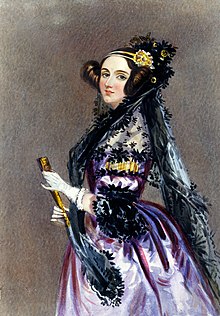
Ada, daughter of the poet Lord Byron, showed an early talent in mathematics. At age 17 she became a friend of Charles Babbage, inventor of the difference engine and proposed a more complex analytic engine. Babbage gave a talk at the University of Turin and Ada had the task of translating an article written by Italian engineer Luigi Menabrea based on the talk. Ada did more than just translate, she added her own thoughts which included a program that could be run on the analytic engine computing a specific sequence of numbers. The analytic engine never got built and Ada never saw her program run but nevertheless she gets credit as the first computer programmer and most notably in 1980 the US Department of Defense named their preferred computer language "Ada" in her honor.
Here's to Lady Ada Lovelace, born way too far ahead of her time.
Monday, December 07, 2015
crank math and crank people
In the same week I got email claming:
1) Babai had shown that GI is in quasipoly time.
2) Opeyemi Enoch, a Nigerian Mathematician, solved the Riemann hypothesis.
I believe Babai's claim since (a) he's worked on the problem a lot and is a known expert, (b) the result is believable, and (c) the math we know now seem up to the task.
I do not believe Enoch's claim. It would be unfair for me to not believe it because I never heard of him. However, my sources in math say that RH is not in a position to be solved. Also, articles I've read on the web including this article seem to say things that cast doubts on it such as this quote:
motivation to solve the problem came from his students, who brought it to him with the hope of making 1 million ``off the internet''
Bobby Jindall (who?) dropped out of the Prez race (why am I bringing this up? Is he working on RH?) Bobby Jindall was a Rhodes Scholar. (why am I bringing this up? Wait and see.)
In 2003 I was in a Taxi (ask your grandparents what Taxi's were before we had Uber) and the driver began telling me lots of conspiracies--- there is no Gold in Fort Knx, the novel Goldfinger was Ian Flemmings attempt to tell us this, Reagan was shot because he knew this, and the American Presidency is controlled by a secret cabal. I pointed out that if that's the case how did George Bush Sr (clearly a member of the Cabal) lose to Bill Clinton. His answer: Bill Clinton was a Rhodes Scholar and the Cabal is controlled by Rhode Scholars.
Its hard to argue with a conspiracy theorist about the past. But you can challenge him to predict the future. So I told him ``if you can predict who will be the Democratic Nominee for Prez in 2004 then I will look at your website and take it seriously. If not, then not'' He smiled and just said ``Wesley Clark was a Rhodes scholar'' If I had asked him who would be the republican nominee in 2016 then he might have said ``Bobby Jindal is a Rhodes Scholar''
The way to expose conspiracy theorists, astrologers, and The National Inquirer is to take their predictions seriously and test them. I wonder why anyone believes these things given their track record.
Judging math things is different- A math paper can be read and should stand on its own.
Thursday, December 03, 2015
Moonshots
In 1961 Kennedy said "this nation should commit itself to achieving the goal, before this decade is out, of landing a man on the Moon and returning him safely to the Earth". In 1969 Neil Armstrong and Buzz Aldrin walked on the moon and returned to earth safely. In the 46 years hence man has gone no further.
Bill Gates founded Microsoft to place "a computer on every desk and in every home". Once he succeeded, Microsoft lost its way. Their current mission takes a different tact "Empower every person and every organization on the planet to achieve more."
In my life I've seen many a moonshot succeed, from a computer chess program that can beat the best humans, the classification of finite simple groups and the proof of Fermat's last theorem. They all seem to end up with a "Now what?". If you have a finite mission, you can only achieve finite things. We often think of moonshots as an amazing challenge but they serve as limits as well.
In computing we have a law that has become a mission, that the power of computing doubles roughly every two years. These improvements have enabled the incredible advances in learning, automation and connectivity that we see today. We keep making better computers because we don't have a limit just a goal of getting better than where we are today.
When I first started writing grant proposals, a senior faculty member chided me for saying "the ultimate goal of computational complexity is prove P ≠ NP". He said that would kill any grant proposals after we did settle the question. While we are in no danger of solving this problem in the near future, eventually we will and I'd hate to see the field whither afterwards.
My favorite mission comes from Star Trek, particularly the TNG version with "Its continuing mission: to explore strange new worlds, to seek out new life and new civilizations, to boldly go where no one has gone before."
Bill Gates founded Microsoft to place "a computer on every desk and in every home". Once he succeeded, Microsoft lost its way. Their current mission takes a different tact "Empower every person and every organization on the planet to achieve more."
In my life I've seen many a moonshot succeed, from a computer chess program that can beat the best humans, the classification of finite simple groups and the proof of Fermat's last theorem. They all seem to end up with a "Now what?". If you have a finite mission, you can only achieve finite things. We often think of moonshots as an amazing challenge but they serve as limits as well.
In computing we have a law that has become a mission, that the power of computing doubles roughly every two years. These improvements have enabled the incredible advances in learning, automation and connectivity that we see today. We keep making better computers because we don't have a limit just a goal of getting better than where we are today.
When I first started writing grant proposals, a senior faculty member chided me for saying "the ultimate goal of computational complexity is prove P ≠ NP". He said that would kill any grant proposals after we did settle the question. While we are in no danger of solving this problem in the near future, eventually we will and I'd hate to see the field whither afterwards.
My favorite mission comes from Star Trek, particularly the TNG version with "Its continuing mission: to explore strange new worlds, to seek out new life and new civilizations, to boldly go where no one has gone before."
Sunday, November 29, 2015
One more sign that a Journal is bogus. Or is it?
I went to an AMS conference with my High School Student Naveen (who presented this paper) and an ugrad from my REU program Nichole (who presented this paper). Note that this is a math conference- low prestige, mostly unrefereed, parallel sessions, but still a good place to pick up some new problems to work on and learn some things, and meet people.
Both Naveen and Nichole later got email from a journal urging them to submit their work! They were also invited to be on the Editorial Board! I can understand inviting a HS student who is a SENIOR to be on an editorial board, but Naveen is a SOPHMORE!
Naveen and Nichole both emailed me asking what this was about and I looked around and found, not to my surprise, that the journal is an author-pays journal of no standards. On the other hand, it was open access, on the other other hand, they had an article claiming that R(4,6)=36 (might be true, but if this was known, I would know it, see this blog post for more on that proof technique).
The pay-to-publish model is not necc. bad, and is standard in some fields, but is unusual for math. Of perhaps more importance is that the journal had no standards. And they prey on the young and naive.
Or do they?
Consider the following scenario: Naveen publishes in this journal and this publication is on his college application, hence he gets into a good college with scholarship. He knows exactly what he is buying. Or Nicole does this to help her Grad school Application. Or I do this for my resume and get a salary increase. Or an untenured prof does this to get tenure ( Deans can count but they can't read). And it gets worse--- the school gives the prof tenure, knowing the papers are bogus, but now they can say they have a prof who publishes X papers a year! At some point I don't know who is scamming who.
This blog post (not mine) gives several criteria for when a journal is bogus. I'll add one: When they ask a 15 years old to be on their editorial board.
Both Naveen and Nichole later got email from a journal urging them to submit their work! They were also invited to be on the Editorial Board! I can understand inviting a HS student who is a SENIOR to be on an editorial board, but Naveen is a SOPHMORE!
Naveen and Nichole both emailed me asking what this was about and I looked around and found, not to my surprise, that the journal is an author-pays journal of no standards. On the other hand, it was open access, on the other other hand, they had an article claiming that R(4,6)=36 (might be true, but if this was known, I would know it, see this blog post for more on that proof technique).
The pay-to-publish model is not necc. bad, and is standard in some fields, but is unusual for math. Of perhaps more importance is that the journal had no standards. And they prey on the young and naive.
Or do they?
Consider the following scenario: Naveen publishes in this journal and this publication is on his college application, hence he gets into a good college with scholarship. He knows exactly what he is buying. Or Nicole does this to help her Grad school Application. Or I do this for my resume and get a salary increase. Or an untenured prof does this to get tenure ( Deans can count but they can't read). And it gets worse--- the school gives the prof tenure, knowing the papers are bogus, but now they can say they have a prof who publishes X papers a year! At some point I don't know who is scamming who.
This blog post (not mine) gives several criteria for when a journal is bogus. I'll add one: When they ask a 15 years old to be on their editorial board.
Monday, November 23, 2015
Star Trek Computing
In the wake of Leonard Nimoy's death last February, I decided to rewatch the entire original Star Trek series, all 79 episodes. I had watched them each many times over in high school in the 70's, though the local station removed a scene or two from each episode to add commercial time and I often missed the opening segment because I didn't get home from school in time. Back in those stone ages we had no DVR or other method to record shows. I hadn't seen many episodes of the original series since high school.
Now I can watch the entire episodes whenever I want in full and in order through the magic of Netflix. I finished this quest a few days ago. Some spoilers below.
I could talk about the heavy sexism, the ability to predict future technologies (the flat screen TV in episode 74), the social issues in the 23rd century as viewed from the 60's, or just the lessons in leadership you can get from Kirk. Given the topic of this blog, let's talk about computing in Star Trek which they often just get so wrong, such as when Spock asks the computer to compute the last digit of π to force Jack-the-Ripper to remove his consciousness from the ship's computers.
Too many episodes end with Kirk convincing a computer or robot to destroy itself. I'd like to see him try that with Siri. In one such episode "The Ultimate Computer", a new computer is installed in the Enterprise that replaces most of the crew. A conversation between Kirk and McCoy sounds familiar to many we have today (source).
MCCOY: Did you see the love light in Spock's eyes? The right computer finally came along. What's the matter, Jim?
KIRK: I think that thing is wrong, and I don't know why.
MCCOY: I think it's wrong, too, replacing men with mindless machines.
KIRK: I don't mean that. I'm getting a Red Alert right here. (the back of his head) That thing is dangerous. I feel. (hesitates) Only a fool would stand in the way of progress, if this is progress. You have my psychological profiles. Am I afraid of losing my job to that computer?
MCCOY: Jim, we've all seen the advances of mechanisation. After all, Daystrom did design the computers that run this ship.
KIRK: Under human control.
MCCOY: We're all sorry for the other guy when he loses his job to a machine. When it comes to your job, that's different. And it always will be different.
KIRK: Am I afraid of losing command to a computer? Daystrom's right. I can do a lot of other things. Am I afraid of losing the prestige and the power that goes with being a starship captain? Is that why I'm fighting it? Am I that petty?
MCCOY: Jim, if you have the awareness to ask yourself that question, you don't need me to answer it for you. Why don't you ask James T. Kirk? He's a pretty honest guy.
Later in the episode the computer starts behaving badly and Kirk has to convince it to shut itself down. But what if the computer just did its job? Is that our real future: Ships that travel to stars controlled only by machine. Or are we already there?
Now I can watch the entire episodes whenever I want in full and in order through the magic of Netflix. I finished this quest a few days ago. Some spoilers below.
I could talk about the heavy sexism, the ability to predict future technologies (the flat screen TV in episode 74), the social issues in the 23rd century as viewed from the 60's, or just the lessons in leadership you can get from Kirk. Given the topic of this blog, let's talk about computing in Star Trek which they often just get so wrong, such as when Spock asks the computer to compute the last digit of π to force Jack-the-Ripper to remove his consciousness from the ship's computers.
Too many episodes end with Kirk convincing a computer or robot to destroy itself. I'd like to see him try that with Siri. In one such episode "The Ultimate Computer", a new computer is installed in the Enterprise that replaces most of the crew. A conversation between Kirk and McCoy sounds familiar to many we have today (source).
MCCOY: Did you see the love light in Spock's eyes? The right computer finally came along. What's the matter, Jim?
KIRK: I think that thing is wrong, and I don't know why.
MCCOY: I think it's wrong, too, replacing men with mindless machines.
KIRK: I don't mean that. I'm getting a Red Alert right here. (the back of his head) That thing is dangerous. I feel. (hesitates) Only a fool would stand in the way of progress, if this is progress. You have my psychological profiles. Am I afraid of losing my job to that computer?
MCCOY: Jim, we've all seen the advances of mechanisation. After all, Daystrom did design the computers that run this ship.
KIRK: Under human control.
MCCOY: We're all sorry for the other guy when he loses his job to a machine. When it comes to your job, that's different. And it always will be different.
KIRK: Am I afraid of losing command to a computer? Daystrom's right. I can do a lot of other things. Am I afraid of losing the prestige and the power that goes with being a starship captain? Is that why I'm fighting it? Am I that petty?
MCCOY: Jim, if you have the awareness to ask yourself that question, you don't need me to answer it for you. Why don't you ask James T. Kirk? He's a pretty honest guy.
Later in the episode the computer starts behaving badly and Kirk has to convince it to shut itself down. But what if the computer just did its job? Is that our real future: Ships that travel to stars controlled only by machine. Or are we already there?
Thursday, November 19, 2015
A Silly String Theorem
First a note on a serious theorem: Babai has posted a video (mp4, 1h 40 m, 653MB) of his first talk on his Graph Isomorphism algorithm.
I was giving a talk on the Kleene star operator (don't ask) and came across this cute little problem. Say a language L commutes if for all u,v in L, uv=vu.
Problem: Show that L commutes if and only if L is a subset of w* for some fixed string w.
Here w* is the set of strings consisting of zero or more concatenations of w with itself. The if case is easy, but I found the other direction pretty tricky and came up with an ugly proof. I found a cleaner proof in Seymour Ginsburg's 1966 textbook The Mathematical Theory of Context Free Languages which I present here.
⇐ If u=wi and v=wj then uv=vu=wi+j.
⇒ Trivial if L contains at most one string. Assume L contains at least two strings.
Proof by induction on the length of the shortest non-empty string v in L.
Base case: |v|=1
Suppose there is an x in L with x not in v*. Then x = vibz for b in Σ-{v}. Then the i+1st character of xv is b and the i+1st character of vx is v, contradicting xv=vx. So we can let w=v.
Inductive case: |v|=k>1.
Lemma 1: Let y=vru be in L (u might be empty). Then uv=vu.
Proof: Since yv=vy we have vruv=vvru=vrvu. So vu=uv.
Let x in L be a string not in v* (if no such x exists we can let w=v). Pick j maximum such that x=vjz with z not the empty string. By Lemma 1 we have zv=vz. Note |z| < |v| otherwise v is a prefix of z, contradicting the maximality of j.
Lemma 2: For all y in L we have yz=zy.
Proof: As before let y = vru. By Lemma 1, uv=vu
Since yx=xy we have vruvjz = vjzvru
vruvjz = vruzvj by swapping v's and z's.
vjzvru = zvruvj by swapping v's and z's, and v's and u's.
So we have vruzvj = zvruvj
or yzvj = zyuj and thus yz=zy.
By Lemma 2, the set L∪{z} commutes. Since 0 < |z| < |v| by induction L∪{z} is a subset of w* for some w so L is a subset of w*.
I was giving a talk on the Kleene star operator (don't ask) and came across this cute little problem. Say a language L commutes if for all u,v in L, uv=vu.
Problem: Show that L commutes if and only if L is a subset of w* for some fixed string w.
Here w* is the set of strings consisting of zero or more concatenations of w with itself. The if case is easy, but I found the other direction pretty tricky and came up with an ugly proof. I found a cleaner proof in Seymour Ginsburg's 1966 textbook The Mathematical Theory of Context Free Languages which I present here.
⇐ If u=wi and v=wj then uv=vu=wi+j.
⇒ Trivial if L contains at most one string. Assume L contains at least two strings.
Proof by induction on the length of the shortest non-empty string v in L.
Base case: |v|=1
Suppose there is an x in L with x not in v*. Then x = vibz for b in Σ-{v}. Then the i+1st character of xv is b and the i+1st character of vx is v, contradicting xv=vx. So we can let w=v.
Inductive case: |v|=k>1.
Lemma 1: Let y=vru be in L (u might be empty). Then uv=vu.
Proof: Since yv=vy we have vruv=vvru=vrvu. So vu=uv.
Let x in L be a string not in v* (if no such x exists we can let w=v). Pick j maximum such that x=vjz with z not the empty string. By Lemma 1 we have zv=vz. Note |z| < |v| otherwise v is a prefix of z, contradicting the maximality of j.
Lemma 2: For all y in L we have yz=zy.
Proof: As before let y = vru. By Lemma 1, uv=vu
Since yx=xy we have vruvjz = vjzvru
vruvjz = vruzvj by swapping v's and z's.
vjzvru = zvruvj by swapping v's and z's, and v's and u's.
So we have vruzvj = zvruvj
or yzvj = zyuj and thus yz=zy.
By Lemma 2, the set L∪{z} commutes. Since 0 < |z| < |v| by induction L∪{z} is a subset of w* for some w so L is a subset of w*.
Monday, November 16, 2015
Is the word Quantum being used properly by civilians? Understood by them? You know the answer.
I've seen the word `civilians' expanded in use from non-military to non-X for some X. Not sure I've ever seen `civilians' mean `people who don't do math stuff' until the title of todays post. Well, there is a first time for everything.
I've blogged in the past about the use of the word Quantum (here) . The phrase Quantum Leap means a BIG leap, where as Quantum stuff is small. Though, to be fair, the discovery (invention?) of Quantum Mechanics was a big leap. So maybe that IS proper use. The James Bond movie Quantum of Solace uses Quantum to mean small, the ONLY time I've seen Quantum used to mean small, so Kudos to the title of an absolutely awful movie. Commenters on my prior blog on the subject pointed out that the original meaning of
quantum was quantity or amount without regard to size of discreteness. I think using it that way now would be very rare.
I came across a theatre called Quantum Theatre. What is Quantum Theatre? The following are actual quotes from their website.
Quantum artists mine all kinds of non-traditional spaces for the sensory possibilities they offer when combined with creative design.
We find it meaningful to place the audience and performer together, the moving parts inside the works.
We want to move people with our experiements.
The shows run the gamut from those you thought you knew but now experience like never before, to shows that didn’t exist until their elements mixed in our laboratory.
I came across this article in a place it didn't belong-- in the middle of an article about Google and NASA trying to build a quantum computer (see here.) This news might be exciting but the article was full of mistakes and bad-signs so I'm not to excited about it. Plus the reference to Quantum Theatre is just odd.
The BEST use of the word quantum that I've heard recently was in the episode The Ricks must be crazy of the excellent TV show Ricky and Morty:
The car is broken
Morty (a 14 year old): W-Whats wrong Rick? Is it the Quantum carburetor or something?
Rick (his grandfather, a brilliant scientist): Quantum carburetor? You can't just add a Sci-fi word to a car word and hope it means something.
W-what's wrong, Rick? Is it the quantum carburetor or something?
Read more at: http://transcripts.foreverdreaming.org/viewtopic.php?f=364&t=20185
Read more at: http://transcripts.foreverdreaming.org/viewtopic.php?f=364&t=20185
W-what's wrong, Rick? Is it the quantum carburetor or something?
Read more at: http://transcripts.foreverdreaming.org/viewtopic.php?f=364&t=20185
Read more at: http://transcripts.foreverdreaming.org/viewtopic.php?f=364&t=20185
Thursday, November 12, 2015
A Primer on Graph Isomorphism

I spent 14 years on the faculty at the University of Chicago. I know László Babai well, we collaborated on some of my best known work. I also know Ryerson 251, a room where I've seen hundreds of talks and given more than a few myself. So I could imagine the excitement in that room on Tuesday as Babai gave the most anticipated talk in the history of theoretical computer science, the first of several talks Babai is giving on his new algorithm for graph isomorphism [Video]. Gabriel Gaster extensively live tweeted the event. Jeremy Kun has some details. Update (12/14): Paper now posted.
For this post instead of doing a bad job trying to overview Babai's proof, I'll explain the graph isomorphism problem and why it is important in the complexity world.
Suppose we have two high schools, say HS North and HS South, each with 1000 students. Consider a diagram (or graph) containing a point for each student at HS North with lines between students who are facebook friends, and a similar diagram for HS South. Is there a 1-1 map from the students at HS North to the students at HS South so that these diagrams look identical? That's the graph isomorphism problem.
To determine whether these two graphs were isomorphic you could look at all the possible mappings between students, but that's 1000! or more than 4x102567 possible maps. There has long been known how to search a smaller number of possibilities, especially if we put some restrictions on the diagrams, but always exponential in n (the number of students) in the worst case. Ideally we'd like a polynomial-time algorithm and Babai gets very close, an algorithm that runs in time nlogkn time for some fixed k.
Graph Isomorphism is one of those few problems, like factoring, known to be in NP but not known to be in P or NP-complete. Graph non-isomorphism is the poster child for the class AM, the problems solved by a randomized verifier asking a single question to a powerful prover. Graph non-isomorphism in AM implies that Graph Isomorphism is not likely NP-complete and that under reasonable derandomization assumptions that Graph non-isomorphism is in NP. Kobler, Schöning and Toran wrote a whole book on the computational complexity issues of graph isomorphism.
Even small progress in graph isomorphism creates waves. At a theory conference in the late 80's a speaker caused a major stir when he casually mentioned he had a proof (he didn't) that Graph non-isomorphism was in NP. Babai's announced caused a huge tsunami and those of us who know him realize he wouldn't make such an announcement without being sure he has a proof. The talk put together a large number of ideas from combinatorics and graph theory. My impression is that those who saw the talk didn't leave convinced of the proof, but did feel Babai had found the pieces to make it work.
With Babai's breakthrough algorithm, the smart money says now that graph isomorphism sits in P. It took decades to get from quasipolynomial time to polynomial time for primality testing and the same time frame may be needed to get polynomial time for graph isomorphism. But it will likely happen and the complexity of graph isomorphism then gets a whole lot simpler.
A couple of thoughts: All the breakthrough results that I can remember were released as papers, ready to devour. This is the first result of this caliber I remember being announced as a talk.
Also we think of theory as a young person's game, most of the big breakthroughs coming from researchers early in their careers. Babai is 65, having just won the Knuth Prize for his lifetime work on interactive proofs, group algorithms and communication complexity. Babai uses his extensive knowledge of combinatorics and group theory to get his algorithm. No young researcher could have had the knowledge base or maturity to be able to put the pieces together the way that Babai did.
More on Babai and graph isomorphism from Scott, Luca, Bill, Tim, Dick and Ken, Reddit, Science News, New Scientist and Science.
Sunday, November 08, 2015
Looking forward to the GI result
As you all know Laszlo Babai will give a talk Tuesday Nov 10 on a result: GI in quasipolynomial time (2 to a polylog). Other theory blogs have already commented on this (GLL,In Theory,Shetl-Opt)
When I was in Graduate School (early 1980's) it looked like GI would get into P. Three key results: graphs of bounded degree, graphs of bounded genus, graphs of bounded eigenvalue multiplicity, were all shown to be in P. These results used group theory and linear algebra in serious ways so the thought was that more advanced group theory, perhaps the classification of all finite simple groups (CFSG) would be used to show GI in P. If CFSG was used in an algorithm for GI in P then the algorithm might have an enormous constant, but that's okay since the quest for GI in P is not for practical reasons (I think that all the people who want to solve it already have fast enough algorithms) . I was looking forward to the debates on if an algorithm with that big a constant would count as poly time (I would say yes). But no algorithm for GI in P, using CFSG or not, was found. Also note that it was possible (and is still possible) that GI is NOT in P. In my 2012 survey of P vs NP I also asked about GI. Of the 20 people who responded 14 thought GI is in P, 6 thought not. Note that GI is not known to be in co-NP or BPP. It IS in IP[2], and if GI was NPC
then PH collapses, so it is unlikely that GI is NP-complete. This tells us NOTHING about whether it is in P.
An analogous thing happened with PRIMES. Lots of results that got it almost in P, lots of hard number theory used, but then the progress stopped. Two differences: Most people thought PRIMES IS in P (likely because it's in coNP and BPP),and this was finally proven in 2002.
Is Babai's proof likely to be correct? There are three parameters to consider when looking at that question: (1) Who is making the claim?, (2) How likely the claim is to be true?, (3) How likely the claim is to be provable with what is known today?.You can give different weights to each one in different combinations..
Laszlo Babai is an expert in GI with a track record in the area. (reading that over again it undersells the case- Babai is, as the kids say, awesome!) That GI is in quasipolynomial time is quite believable. Even those 6 who think that Gi is not in P might believe that. Its harder to know if today's techniques are up to the task; however, there are no results like `group theory won't suffice' or any kind of obstacles, so certainly the claim seems provable with todays technology.
Here's hoping...
When I was in Graduate School (early 1980's) it looked like GI would get into P. Three key results: graphs of bounded degree, graphs of bounded genus, graphs of bounded eigenvalue multiplicity, were all shown to be in P. These results used group theory and linear algebra in serious ways so the thought was that more advanced group theory, perhaps the classification of all finite simple groups (CFSG) would be used to show GI in P. If CFSG was used in an algorithm for GI in P then the algorithm might have an enormous constant, but that's okay since the quest for GI in P is not for practical reasons (I think that all the people who want to solve it already have fast enough algorithms) . I was looking forward to the debates on if an algorithm with that big a constant would count as poly time (I would say yes). But no algorithm for GI in P, using CFSG or not, was found. Also note that it was possible (and is still possible) that GI is NOT in P. In my 2012 survey of P vs NP I also asked about GI. Of the 20 people who responded 14 thought GI is in P, 6 thought not. Note that GI is not known to be in co-NP or BPP. It IS in IP[2], and if GI was NPC
then PH collapses, so it is unlikely that GI is NP-complete. This tells us NOTHING about whether it is in P.
An analogous thing happened with PRIMES. Lots of results that got it almost in P, lots of hard number theory used, but then the progress stopped. Two differences: Most people thought PRIMES IS in P (likely because it's in coNP and BPP),and this was finally proven in 2002.
Is Babai's proof likely to be correct? There are three parameters to consider when looking at that question: (1) Who is making the claim?, (2) How likely the claim is to be true?, (3) How likely the claim is to be provable with what is known today?.You can give different weights to each one in different combinations..
Laszlo Babai is an expert in GI with a track record in the area. (reading that over again it undersells the case- Babai is, as the kids say, awesome!) That GI is in quasipolynomial time is quite believable. Even those 6 who think that Gi is not in P might believe that. Its harder to know if today's techniques are up to the task; however, there are no results like `group theory won't suffice' or any kind of obstacles, so certainly the claim seems provable with todays technology.
Here's hoping...
Thursday, November 05, 2015
Computation and Journalism Part 2
The theory blogosphere is atwitter with an announcement of a talk next Tuesday at Chicago by László Babai Graph Isomorphism in Quasipolynomial Time. Luca will blog from the scene and we will have a full report as details emerge.
More from the Comp and Journalism conference
0) (ADDED WRITE BEFORE POSTING) The conference was about how journalists do or should use technology. Part of this is how news gets to people. Twitter and Blogs are one method, as the above note about Babai's talk shows.
1) There was a panel discussion on context When one reads an article it depends on where one is coming from. Here is a strange thing that technology has allowed journalists to do: An article can have slight differences depending on where its being read. For example if someone from New York is reading it may refer to Broadway, whereas if someone in LA is reading it it might refer to Hollywood. The tech also exists to have the reader (online) have a choice- so you can read it as if you are in place X. This scares me a bit- what if an article is can be tinkered with to appeal to lefthanded latino lesbians who work on the local
Lovasz Lemma. Isn't our country fragmented enough? STILL, the point that context matters came through nicely.
2) There was a panel of three ACTUAL JOURNALISTS (I think that all of the other speakers were academics) who used BIG DATA or MACHINE LEARNING or FILL IN BUZZWORD to write articles. Propublica, a nonprofit newspaper (aren't they all?) did an article about rating doctors (here ) that seems to be very well checked (example- if a patient has to come back again because of a complication, is it the surgeons fault? hard to answer). However, some doctors (those that got low ratings?) complained that there article was not peer reviewed. This brings up a question--- journalists run things by fact checkers and proofreaders, but do not have peer-review. Academics do. Which is the better system? Another journalist did a study of the Supreme court and found that there is a small set of lawyers that are well connected (one used to play darts with Alito) who are involved in over half of the cases the court sees. What interested me is--- what if you have an idea for an article and you do ALL of the number crunching, bring in ML people to help and find out in the end OH, the Supreme court actually is doing a fair job or OH, Doctors are pretty good. No story! They said this happens about 1/3 of the time where either you don't have enough data for a story or the story is not really a story.
3) There was a paper about YELP ratings of doctors. It seems that the actual
doctor-stuff is rarely mentioned, usually it was how long the wait time was,
how boring the magazines in the office were, etc. Also, most doctors got
either 1 star or 5 stars. One thing they didn't mention but I will- Walter Palmer, the Dentist who killed Lion in Africa, got lots of very negative YELP reviews from people who were never patients of his. So YELP ratings can be skewed by things independent of what is supposed to be measured. That is, of course, and extreme case.
4) Key Note by Chris Wiggins who is an academic who, on his Sabbatical, worked for the NYT on issues of How many copies of the paper should we print? and other Operations Research type questions. Print subscriptions still out number online subscriptions, the online is doing pretty well and bringing in money, but they still NEED to find a better business model.I am reminded that when Jeff Bezos bought the Wash Post Stephen Colbert said there are more people buying newspapers than there are people buying newspapers.
(My spellchecker things online is not a word. Everyone else does.)
5) There was a panel on Education. From there point of view very pessimistic---
most schools don't offer courses in how to use Technology in journalism, no real
books, no agreement on what's important. And I suspect they will have a hard time updating courses once they have them. I wonder if the early days of Comp Science were like that.
6) The issue of jobs in journalism going away was not quite ignored but also not
quite confronted either. Some people told me that Journalism schools are not being honest with their students about the dismal job market. Then again, they are journalism students- they should investigate!
7) A journalism student told me of a case going to the supreme court that may be
very important for privacy: Spokeo vs Robins: here
8) UPSHOT- I am glad I went, I learned some things outside of what I usually think about. Unlike the RATLOCC (Ramsey Theory and Logic) I was able to tell my mom what I learned. I didn't bring my laptop nor had TV access I was able to work on some math and had a minor breakthrough. But that,s for a later blog
(My spellcheck thinks blog is not a word. It also thinks spellcheck is not a word.)
More from the Comp and Journalism conference
0) (ADDED WRITE BEFORE POSTING) The conference was about how journalists do or should use technology. Part of this is how news gets to people. Twitter and Blogs are one method, as the above note about Babai's talk shows.
1) There was a panel discussion on context When one reads an article it depends on where one is coming from. Here is a strange thing that technology has allowed journalists to do: An article can have slight differences depending on where its being read. For example if someone from New York is reading it may refer to Broadway, whereas if someone in LA is reading it it might refer to Hollywood. The tech also exists to have the reader (online) have a choice- so you can read it as if you are in place X. This scares me a bit- what if an article is can be tinkered with to appeal to lefthanded latino lesbians who work on the local
Lovasz Lemma. Isn't our country fragmented enough? STILL, the point that context matters came through nicely.
2) There was a panel of three ACTUAL JOURNALISTS (I think that all of the other speakers were academics) who used BIG DATA or MACHINE LEARNING or FILL IN BUZZWORD to write articles. Propublica, a nonprofit newspaper (aren't they all?) did an article about rating doctors (here ) that seems to be very well checked (example- if a patient has to come back again because of a complication, is it the surgeons fault? hard to answer). However, some doctors (those that got low ratings?) complained that there article was not peer reviewed. This brings up a question--- journalists run things by fact checkers and proofreaders, but do not have peer-review. Academics do. Which is the better system? Another journalist did a study of the Supreme court and found that there is a small set of lawyers that are well connected (one used to play darts with Alito) who are involved in over half of the cases the court sees. What interested me is--- what if you have an idea for an article and you do ALL of the number crunching, bring in ML people to help and find out in the end OH, the Supreme court actually is doing a fair job or OH, Doctors are pretty good. No story! They said this happens about 1/3 of the time where either you don't have enough data for a story or the story is not really a story.
3) There was a paper about YELP ratings of doctors. It seems that the actual
doctor-stuff is rarely mentioned, usually it was how long the wait time was,
how boring the magazines in the office were, etc. Also, most doctors got
either 1 star or 5 stars. One thing they didn't mention but I will- Walter Palmer, the Dentist who killed Lion in Africa, got lots of very negative YELP reviews from people who were never patients of his. So YELP ratings can be skewed by things independent of what is supposed to be measured. That is, of course, and extreme case.
4) Key Note by Chris Wiggins who is an academic who, on his Sabbatical, worked for the NYT on issues of How many copies of the paper should we print? and other Operations Research type questions. Print subscriptions still out number online subscriptions, the online is doing pretty well and bringing in money, but they still NEED to find a better business model.I am reminded that when Jeff Bezos bought the Wash Post Stephen Colbert said there are more people buying newspapers than there are people buying newspapers.
(My spellchecker things online is not a word. Everyone else does.)
5) There was a panel on Education. From there point of view very pessimistic---
most schools don't offer courses in how to use Technology in journalism, no real
books, no agreement on what's important. And I suspect they will have a hard time updating courses once they have them. I wonder if the early days of Comp Science were like that.
6) The issue of jobs in journalism going away was not quite ignored but also not
quite confronted either. Some people told me that Journalism schools are not being honest with their students about the dismal job market. Then again, they are journalism students- they should investigate!
7) A journalism student told me of a case going to the supreme court that may be
very important for privacy: Spokeo vs Robins: here
8) UPSHOT- I am glad I went, I learned some things outside of what I usually think about. Unlike the RATLOCC (Ramsey Theory and Logic) I was able to tell my mom what I learned. I didn't bring my laptop nor had TV access I was able to work on some math and had a minor breakthrough. But that,s for a later blog
(My spellcheck thinks blog is not a word. It also thinks spellcheck is not a word.)
Monday, November 02, 2015
Conference on Computation and Journalism (Part I)
(In honor of Boole's Birthday yesterday see this.)
I recently (Oct 2 and 3 2015) went to a conference on Computation and Journalism (see here for their schedule). I went since I co-blog and have a Wikipedia page (here) hence I"ve gotten interested in issues of technology and information (not information-theory, but real world information).
I describe some of what I saw in two posts, today and thursday. Many of the articles I mention can be gotten from the schedule page above.
1) I understood all of the talks. This is very different from STOC, FOCS, CCC, etc; however, old timers tell me that back in STOC 1980 or so one could still understand all of the talks.
2) Lada Adamic gave a keynote on Facebook about whether or not Facebook causes an echo chamber (e.g., liberals only having liberal friends) Her conclusion was NO- about 25% of the friends of an L are a C and vice versa. This makes sense since people friend people who are workers and family, not based on political affiliation (Some of my in-laws are farther to the right than... most of my readers.) She also noted that 10% of the articles passed on by L's are Conservative- though this might not be quite indicative since they may often be `look at this crap that FOX news is saying now' variety. Note that Lada works for Facebook. Talking to people over lunch about that the consensus was that (1) the study was valid, but (2) if the conclusion had been that Facebook is tearing apart our country THEN would they have been allowed to publish it? I leave that as a question.
3) There was a Panel on Comments. The NYT has 14 people whose sole job is the soul-crushing job of reading peoples comments on articles and deciding what to let through. Gee, complexity blog just needs Lance and me. I found out that the best way to ensure intelligent comments and to get rid of trolls is (1) people must register, give their real name, and even have a picture of themselves, and (2) engage with the commenters (like Scott A does, though they did not use him as an example). Lance and I do neither of these things. Oh well.(3)COMPUTERS- can we have a program that can tell if an comment is worth posting? Interesting research question. One basic technique is to not allow comments with curse words in them- NOT out of a prudish impulse, but because curse words are an excellent indicator of articles that will not add to the discourse.
The most interesting question raised was Do Trolls know the are trolls? YES- they just like destroying things for no reason. Picture Bart Simpson using a hammer on Mustard packets just cause.
4) There was two sessions of papers on Bias in the news.
a) Ranking in the Age of Algorithms and Curated News By Suman Deb Rob. How should news articles be ranked? If articles are ranked by popularity then you end up covering Donald Trump too much. If articles are ranked by what the editors think thats too much of THE MAN telling me whats important. Also, there are articles that are important for a longer period of time but never really top-ten important. Nate Silver has written that the most important story of the 2016 election is that the number of serious (defined: Prior Senators of Govs) who are running for the Rep nomination is far larger than ever before. But thats not quite a story.
b) The Gamma: Programming tools for transparent data journalism by Tomas Petricek. So there are data journalists that you can see right through! Wow! Actually he had a tool so that you could, using World Bank Data, get maps that show stuff via colors. His example was the story that China produces more carbon emission than the USA, and a nice color graphic for it, but then the user or the journalist can easily get a nice color graphic of carbon-emms-per-person in which case the USA is still NUMBER ONE! (Yeah!) Later he had a Demo session. I tried to look at % of people who go to college by country, but it didn't have info on some obscure countries like Canada. Canada? The project was Limited by the data we have available.
d) Consumer and supplies: Attention Asymmetries by Abbar, An, Kwak, Messaoui, Borge-Holthofer. They had 2 million comments posted by 90,000 unique readers and analyzed this data to see if there is an asymtery between what readers want and what they are getting. Answer: YES
I recently (Oct 2 and 3 2015) went to a conference on Computation and Journalism (see here for their schedule). I went since I co-blog and have a Wikipedia page (here) hence I"ve gotten interested in issues of technology and information (not information-theory, but real world information).
I describe some of what I saw in two posts, today and thursday. Many of the articles I mention can be gotten from the schedule page above.
1) I understood all of the talks. This is very different from STOC, FOCS, CCC, etc; however, old timers tell me that back in STOC 1980 or so one could still understand all of the talks.
2) Lada Adamic gave a keynote on Facebook about whether or not Facebook causes an echo chamber (e.g., liberals only having liberal friends) Her conclusion was NO- about 25% of the friends of an L are a C and vice versa. This makes sense since people friend people who are workers and family, not based on political affiliation (Some of my in-laws are farther to the right than... most of my readers.) She also noted that 10% of the articles passed on by L's are Conservative- though this might not be quite indicative since they may often be `look at this crap that FOX news is saying now' variety. Note that Lada works for Facebook. Talking to people over lunch about that the consensus was that (1) the study was valid, but (2) if the conclusion had been that Facebook is tearing apart our country THEN would they have been allowed to publish it? I leave that as a question.
3) There was a Panel on Comments. The NYT has 14 people whose sole job is the soul-crushing job of reading peoples comments on articles and deciding what to let through. Gee, complexity blog just needs Lance and me. I found out that the best way to ensure intelligent comments and to get rid of trolls is (1) people must register, give their real name, and even have a picture of themselves, and (2) engage with the commenters (like Scott A does, though they did not use him as an example). Lance and I do neither of these things. Oh well.(3)COMPUTERS- can we have a program that can tell if an comment is worth posting? Interesting research question. One basic technique is to not allow comments with curse words in them- NOT out of a prudish impulse, but because curse words are an excellent indicator of articles that will not add to the discourse.
The most interesting question raised was Do Trolls know the are trolls? YES- they just like destroying things for no reason. Picture Bart Simpson using a hammer on Mustard packets just cause.
4) There was two sessions of papers on Bias in the news.
a) Ranking in the Age of Algorithms and Curated News By Suman Deb Rob. How should news articles be ranked? If articles are ranked by popularity then you end up covering Donald Trump too much. If articles are ranked by what the editors think thats too much of THE MAN telling me whats important. Also, there are articles that are important for a longer period of time but never really top-ten important. Nate Silver has written that the most important story of the 2016 election is that the number of serious (defined: Prior Senators of Govs) who are running for the Rep nomination is far larger than ever before. But thats not quite a story.
b) The Gamma: Programming tools for transparent data journalism by Tomas Petricek. So there are data journalists that you can see right through! Wow! Actually he had a tool so that you could, using World Bank Data, get maps that show stuff via colors. His example was the story that China produces more carbon emission than the USA, and a nice color graphic for it, but then the user or the journalist can easily get a nice color graphic of carbon-emms-per-person in which case the USA is still NUMBER ONE! (Yeah!) Later he had a Demo session. I tried to look at % of people who go to college by country, but it didn't have info on some obscure countries like Canada. Canada? The project was Limited by the data we have available.
c) The quest to automate Fact-Checking by Hassan, Adair, Hamilton, Li, Tremayne, Yang, Yu. We are pretty far from being able to do this, however, they had a program that could identify whether or not something uttered IS checkable . When I am president I will lower taxes is not checkable, whereas Bill Mahr's claim that Donald Trumps father is an Orangutang is checkable.
d) Consumer and supplies: Attention Asymmetries by Abbar, An, Kwak, Messaoui, Borge-Holthofer. They had 2 million comments posted by 90,000 unique readers and analyzed this data to see if there is an asymtery between what readers want and what they are getting. Answer: YES
George Boole (1815-1864)
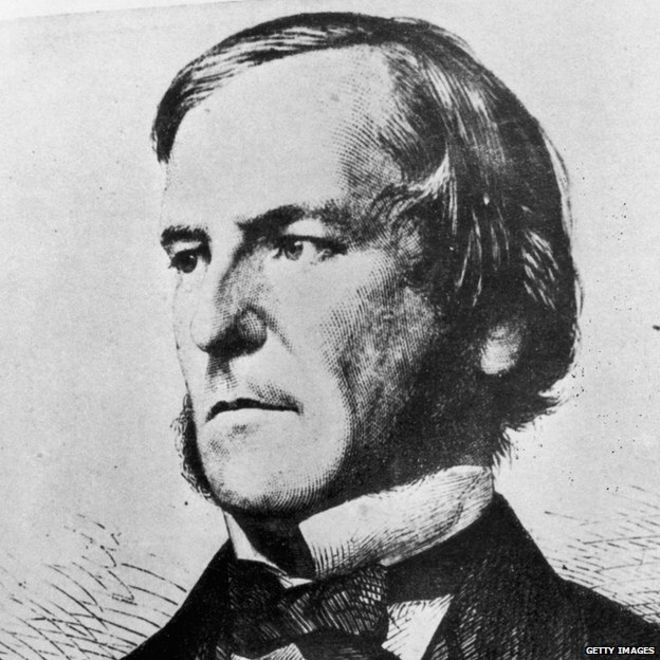
Where would computational complexity be without Boolean algebra? We can use AND, OR, and NOT gates in place of Turing machines to capture computation: A polynomial-sized circuit of these gates can simulate any polynomial-time computable algorithm.
Stephen Cook analyzed the complexity of determining whether a formula φ of Boolean variables connected by AND, OR and NOTs was a tautology, a mathematical law. Cook showed that every nondeterministic polynomial-time computable problem reduced to checking if φ is not a tautology, or equivalently that (NOT φ) is satisfiable. That paper, as you well know, gave us the P v NP problem.
So here's to George Boole, whose desire to give mathematics a firm foundation produced simple tools powerful enough to describe everything.
Thursday, October 29, 2015
S. Barry Cooper (1943-2015)

For the Turing year, Cooper and Jan van Leeuwen co-edited a massive volume Alan Turing: His Work and Impact which includes all of Turing's publications and a number of commentaries on the legacy of that work. I wrote a piece on Turing's Dots for the volume. Alan Turing: His Work and Impact received the R. R. Hawkins Award, the top award for professional and scholarly publishing across all the arts and sciences.
Barry Cooper was also the driving force behind Computability in Europe, an eclectic meeting to discuss all things related to computation.
I hope Barry now gets to meet his hero Turing but we'll miss him greatly down here.
Monday, October 26, 2015
A human-readable proof that every planar graph is 4.5-colorable
About 20 years ago I went to a talk by Jim Propp on the fractional chromatic number of a graph. (Here is a link to a free legal copy of the book on fractional graph theory by Ed Scheinerman and Dan Ullman.)
Let c be a natural number. A graph G=(V,E) is c-colorable if there is a mapping of the vertices of G to the vertices of Kc such that (x,y) ∈ E --> (x,y) is an edge in Kc
Let Kt:k be the Knesser graph: the vertices are all k-element subsets of {1,...,t}, (A,B) is an edge if A∩B=∅. A graph is t/k-colorable if there is a mapping of the vertices of G to the vertices of Kt:k such that (x,y) ∈ E --> (x,y) is an edge in Kt:k. (That is not quite right as that might depend on if you use, say, 15/10 or 3/2 but is close. See page 40-42 in the book linked to above for the formal definition.)
One can also show that this is equivalent to other definitions of fractional chromatic number (one involves a relaxation of an LP problem).
The big open problem in the field and perhaps the motivation for it was this:
Known and the proof is human-readable: Every Planar Graph is 5-colorable.
Known and the current proof is NOT human-readable: Every Planar Graph is 4-colorable.
OPEN: Is there some number 4<c<5 such that every planar graph is c-colorable and the proof is human-readable?
I had not thought about this problem for a long time when I was invited by Dan Cranston to give a talk at a Discrete Math Seminar in Virginia Commonwealth University. Looking over the prior talks in the seminar I noticed a talk on Fractional Chromatic Number of the Plane by Dan Cranston. I inquired:
BILL: Fractional colorings! Has there been progress on finding a number less than 5 so that the proof that every planar graph is c colorable is reasonable?
DAN: Yes. By myself and Landon Rabern. We have shown that every planar graph is 4.5-colorable in this paper! I've given talks on it, here are my slides.
BILL: This is big news! I am surprised I haven't heard about it.
DAN: The paper is on arXiv but not published yet. Also, while you and me think its a great result, since its already known that all planar graphs are 4-colorable, some people are not interested.
BILL: Too bad you didn't prove it in 1975 (the four-color theorem was proven in 1976).
DAN: I was in kindergarten.
BILL: Were you good at math?
DAN: My finger paintings were fractional colorings of the plane and I never used more than 4.5 colors.
DAN: By the way, the paper I spoke about in seminar was about fractional colorings of the plane. The graph is: all points in the plane are vertices, and two points have an edge if they are an inch apart. The ordinary chromatic number is known to be between 4 and 7. Tighter bounds are known for the fractional chromatic number, see the paper linked to above when you first mention that paper.
Some thoughts:
1) I would have thought that they would first get something like 4.997 and then whittle it down. No, it went from 5 right to 4.5. Reducing it any further looks hard and they proved that it cannot be a tweak of their proof.
2) The paper is readable. Its very clever and doesn't really use anything not known in 1975. But the problem wasn't known then and of course the right combination of ideas would have been hard to find back the. In particular, the method of discharging is better understood now.
3) When I told this to Clyde Kruskal he wanted to know if there was a rigorous definition of ``human-readable'' since the open question asked for a human-readable proof. I doubt there is or that there can be, but this paper clearly qualifies. Perhaps a paper is human-readable if 2 humans have actually read it and understood it. Or perhaps you can parameterize is and have n-human-readable for n humans.
4) Why does my spell checker thing colorable and colorings and parameterize are not words?
5) The serendipity: I'm very happy to know the result. I came upon it by complete accident. I'm bothered that there may be other results I want to know about but don't. How does one keep up? One way is to check arXiv's once-a-week or on some regular basis. But is that a good use of your time? I ask non-rhetorical.
Let c be a natural number. A graph G=(V,E) is c-colorable if there is a mapping of the vertices of G to the vertices of Kc such that (x,y) ∈ E --> (x,y) is an edge in Kc
Let Kt:k be the Knesser graph: the vertices are all k-element subsets of {1,...,t}, (A,B) is an edge if A∩B=∅. A graph is t/k-colorable if there is a mapping of the vertices of G to the vertices of Kt:k such that (x,y) ∈ E --> (x,y) is an edge in Kt:k. (That is not quite right as that might depend on if you use, say, 15/10 or 3/2 but is close. See page 40-42 in the book linked to above for the formal definition.)
One can also show that this is equivalent to other definitions of fractional chromatic number (one involves a relaxation of an LP problem).
The big open problem in the field and perhaps the motivation for it was this:
Known and the proof is human-readable: Every Planar Graph is 5-colorable.
Known and the current proof is NOT human-readable: Every Planar Graph is 4-colorable.
OPEN: Is there some number 4<c<5 such that every planar graph is c-colorable and the proof is human-readable?
I had not thought about this problem for a long time when I was invited by Dan Cranston to give a talk at a Discrete Math Seminar in Virginia Commonwealth University. Looking over the prior talks in the seminar I noticed a talk on Fractional Chromatic Number of the Plane by Dan Cranston. I inquired:
BILL: Fractional colorings! Has there been progress on finding a number less than 5 so that the proof that every planar graph is c colorable is reasonable?
DAN: Yes. By myself and Landon Rabern. We have shown that every planar graph is 4.5-colorable in this paper! I've given talks on it, here are my slides.
BILL: This is big news! I am surprised I haven't heard about it.
DAN: The paper is on arXiv but not published yet. Also, while you and me think its a great result, since its already known that all planar graphs are 4-colorable, some people are not interested.
BILL: Too bad you didn't prove it in 1975 (the four-color theorem was proven in 1976).
DAN: I was in kindergarten.
BILL: Were you good at math?
DAN: My finger paintings were fractional colorings of the plane and I never used more than 4.5 colors.
DAN: By the way, the paper I spoke about in seminar was about fractional colorings of the plane. The graph is: all points in the plane are vertices, and two points have an edge if they are an inch apart. The ordinary chromatic number is known to be between 4 and 7. Tighter bounds are known for the fractional chromatic number, see the paper linked to above when you first mention that paper.
Some thoughts:
1) I would have thought that they would first get something like 4.997 and then whittle it down. No, it went from 5 right to 4.5. Reducing it any further looks hard and they proved that it cannot be a tweak of their proof.
2) The paper is readable. Its very clever and doesn't really use anything not known in 1975. But the problem wasn't known then and of course the right combination of ideas would have been hard to find back the. In particular, the method of discharging is better understood now.
3) When I told this to Clyde Kruskal he wanted to know if there was a rigorous definition of ``human-readable'' since the open question asked for a human-readable proof. I doubt there is or that there can be, but this paper clearly qualifies. Perhaps a paper is human-readable if 2 humans have actually read it and understood it. Or perhaps you can parameterize is and have n-human-readable for n humans.
4) Why does my spell checker thing colorable and colorings and parameterize are not words?
5) The serendipity: I'm very happy to know the result. I came upon it by complete accident. I'm bothered that there may be other results I want to know about but don't. How does one keep up? One way is to check arXiv's once-a-week or on some regular basis. But is that a good use of your time? I ask non-rhetorical.
Thursday, October 22, 2015
Complexity Blast from the Past
My friend Marty in grad school mysteriously disappeared in 1985 and showed up yesterday looking exactly the same as I remember him. He said he traveled into my time and asked me how we finally proved P different than NP. I didn't give him the answer he seeked but I let him look around at what complexity has done in the past thirty years. He read through the night and agreed to share his thoughts on this blog.
When I left in '85 Yao and Håstad had just showed that Parity require exponential-size circuits and Razborov showed clique does not have poly-size monotone circuits. Looks like showing some NP problem didn't have poly-size circuits was right around corner so I'm a bit disappointed that didn't happen. I would have thought you would have proven NP is not computable in log space (nope), NP not computable by Boolean formulae (nope) or NP not computable by constant depth circuits with threshold gates (nope). All I see are excuses like "natural proofs". You did show lower bounds for constant depth circuits with modm gates for m prime but that happened back just a year after I left. For m composite you need to go all the way to NEXP and even that took another 25 years.
Back in 1984 we had a 3n lower circuit bound for an explicit function and surely you have much better bounds now, at least quadratic. I almost didn't find any improvement until I saw a paper written last week that improves this lower bound to a whopping 3.011n. You can't make this stuff up.
I shouldn't be that hard on you complexity theorists. All that work on interactive proofs, PCPs, approximations and unique games is pretty cool. Some real impressive stuff on pseudorandom generators and error-correcting codes. Who would have thunk that NL = co-NL or that the entire polynomial-time hierarchy reduces to counting? Nice to see you finally proved that Primes in P and undirected graph connectivity in log-space.
Oh no! Biff stole Lance's copy of Arora-Barak and is taking it back in time. This could change computational complexity forever. I'd better go find Doc Brown and make things right.
[Lance's Note: Thanks to Mostafa Ammar for inspiring this post.]
When I left in '85 Yao and Håstad had just showed that Parity require exponential-size circuits and Razborov showed clique does not have poly-size monotone circuits. Looks like showing some NP problem didn't have poly-size circuits was right around corner so I'm a bit disappointed that didn't happen. I would have thought you would have proven NP is not computable in log space (nope), NP not computable by Boolean formulae (nope) or NP not computable by constant depth circuits with threshold gates (nope). All I see are excuses like "natural proofs". You did show lower bounds for constant depth circuits with modm gates for m prime but that happened back just a year after I left. For m composite you need to go all the way to NEXP and even that took another 25 years.
Back in 1984 we had a 3n lower circuit bound for an explicit function and surely you have much better bounds now, at least quadratic. I almost didn't find any improvement until I saw a paper written last week that improves this lower bound to a whopping 3.011n. You can't make this stuff up.
I shouldn't be that hard on you complexity theorists. All that work on interactive proofs, PCPs, approximations and unique games is pretty cool. Some real impressive stuff on pseudorandom generators and error-correcting codes. Who would have thunk that NL = co-NL or that the entire polynomial-time hierarchy reduces to counting? Nice to see you finally proved that Primes in P and undirected graph connectivity in log-space.
Oh no! Biff stole Lance's copy of Arora-Barak and is taking it back in time. This could change computational complexity forever. I'd better go find Doc Brown and make things right.
[Lance's Note: Thanks to Mostafa Ammar for inspiring this post.]
Sunday, October 18, 2015
Amazon going after fake reviews but mine is still posted
I have always wondered why YELP and Amazon Reviews and other review sites work as well as they do since a company COULD flood one with false reviews (high marks for their company or low marks for their competitors). From what I've seen this does not seem to be a big problem.
Even so, it is A problem, and amazon is taking action on it. See here for details.
A while back I posted a review that is... not sure its false, but I am surprised they allowed it and still allow it. What happened: I bought a copy of my own book Bounded Queries in Recursion Theory (Gasarch and Martin) since my dept wanted a copy to put in one of those glass cases of faculty books. I bought it used for about $10.00. I got email from amazon asking if I wanted to review it, so I thought YES, I'll review my book! I wrote:
This is a great book. I should know, I wrote it.
I am surprised Amazon ASKED me for my opinion.
Seriously- I also have a survey which says whats in the book
better, email me if you want it, gasarch@cs.umd.edu
That was in November of 2014. Its still posted. Is it a false review? Not clear since everything I say in it is true and I am honestly saying who I am.
If Amazon removed it I would be surprised they noticed.
If Amazon does not remove it I'm surprised they allow it.
Is it possible to be surprised both ways?
Even so, it is A problem, and amazon is taking action on it. See here for details.
A while back I posted a review that is... not sure its false, but I am surprised they allowed it and still allow it. What happened: I bought a copy of my own book Bounded Queries in Recursion Theory (Gasarch and Martin) since my dept wanted a copy to put in one of those glass cases of faculty books. I bought it used for about $10.00. I got email from amazon asking if I wanted to review it, so I thought YES, I'll review my book! I wrote:
This is a great book. I should know, I wrote it.
I am surprised Amazon ASKED me for my opinion.
Seriously- I also have a survey which says whats in the book
better, email me if you want it, gasarch@cs.umd.edu
That was in November of 2014. Its still posted. Is it a false review? Not clear since everything I say in it is true and I am honestly saying who I am.
If Amazon removed it I would be surprised they noticed.
If Amazon does not remove it I'm surprised they allow it.
Is it possible to be surprised both ways?
Subscribe to:
Posts (Atom)