Here are the guidelines about submission to STOC 2015 with regard to
submitting a prior published paper. I assume that most of the Theory Conferences have a similar policy.
Prior and Simultaneous Submissions: The conference will follow SIGACT's policy on prior publication and simultaneous submissions. Abstract material which has been previously published in another conference proceedings or journal, or which is scheduled for publication prior to July 2015, will not be considered for acceptance at STOC 2015. The only exception to this policy are prior or simultaneous publications appearing in the Science and Nature journals. SIGACT policy does not allow simultaneous submissions of the same (or essentially the same) abstract material to another conference with published proceedings. The program committee may consult with program chairs of other (past or future) conferences to find out about closely related submissions.
Here is a question that I ask non-rhetorically. What if Alice has a paper in arXiv in 2010 and submits it to STOC in 2012. Technically it has not been published before. However, it certainly is not new.
Should this be allowed? Under the current rules of course YES. Should the rules be changed? A paper can be out there without it being published. Should the rules be changed to reflect this? I think NOT since it might be hard to define carefully and I don't want people to discourage posting on arXiv.
Should the committee be allowed to take its not-newness into account in judging it? Do they already? And the notion of well known or out there are subjective.
BOB: This paper has been known about for years.
EVE: Well, I didn't know about it, so for ME its new!
There might be a newness/quality trade off. If Donna posted her proof that P=NP in 2020 but submitted it to STOC 2030, I think it would still get in. By contrast if Bob posts a proof of a good but not great paper that is STOC-worthy in 2020, and then submits it in 2030,, I think it would not get in.
Then again, by 2030 maybe we will have changed the prestige-conference model we currently use.
Monday, February 22, 2016


Thursday, February 18, 2016
Posting Papers
In the ancient days of the 80's, if someone wanted a paper from you, they would ask and you would mail via post. Sometimes I would get a self-addressed envelope asking for a certain paper. Departments would maintain collections of local technical reports. Someone could request a paper, an admin would make a copy, slap on a cover and send it out.
Sometimes I wonder why I bother and just let people use Google Scholar or DBLP to find my papers. I guess I'm just not ready to give up this record of my research life.
In the 90's, we started distributing papers by email, but then who you sent papers to started to matter. As soon as we had a browser in 1993, for fairness, though more because I got tired of responding to paper requests, I put together a page that had electronic copies of all my papers. Over the years those files have gone from postscript to pdf and the page started as html and later I used bib2html which I kept going on my old Chicago CS account that nobody bothered turning off. Bib2html failed to work for me last week, I asked the twitterverse for an alternative and they answered. I went with bibbase and now can reveal my new paper page. Pretty easy to tell from the page when I started as a department chair. I kept the old page active just in case but it will no longer be updated.
Sometimes I wonder why I bother and just let people use Google Scholar or DBLP to find my papers. I guess I'm just not ready to give up this record of my research life.
Sunday, February 14, 2016
∑{p≤ n} 1/p = ln(ln(n)) + o(1). read it here because....
(Last April fools day I posted four links to stories that seemed absurd and asked which one was false. They all were true. I recently came across five stories that all seem absurd but are all real, but three of them can't wait until April 1 since they are about current political events. Here they are:
Amazon to open many brick-and-mortar stores.
Why John Kasich got second place in New Hampshire (whch was better than expected).
Jim Gilmore's (who?) low expectations,
Why Ben Carson left Iowa.
airpnp- not about P vs NP
Donald Trump defends.... (I added this one on March 14)
And now back to our regularly scheduled blog)
A while back Larry Washington (number theorist at UMCP) showed me a simple proof that
∑p ≤ n 1/p = ln(ln(n)) + o(1)
(p goes through all the primes ≤ n.)
Recently I tried to remember it and could not so I looked on the web and... I could not find it! I found proofs that the sum is at least ln(ln(n)) as part of a proof that the series diverges, but could not find a simple proof of the equality.
I asked Larry Washington to email me the proof, and then (and this happens often) while waiting for the response I came up with it.
Anyway, to try to avoid what Lance pondered, the deterioratation of math over time, I post the proof here.Read it here since you probably can't find this proof elsewhere.
I continue to be amazed at both what IS and IS NOT on the web.
(ADDED LATER- one of the comments pointed to links on the web that DO contain the proofs I could not find.)
Amazon to open many brick-and-mortar stores.
Why John Kasich got second place in New Hampshire (whch was better than expected).
Jim Gilmore's (who?) low expectations,
Why Ben Carson left Iowa.
airpnp- not about P vs NP
Donald Trump defends.... (I added this one on March 14)
And now back to our regularly scheduled blog)
A while back Larry Washington (number theorist at UMCP) showed me a simple proof that
∑p ≤ n 1/p = ln(ln(n)) + o(1)
(p goes through all the primes ≤ n.)
Recently I tried to remember it and could not so I looked on the web and... I could not find it! I found proofs that the sum is at least ln(ln(n)) as part of a proof that the series diverges, but could not find a simple proof of the equality.
I asked Larry Washington to email me the proof, and then (and this happens often) while waiting for the response I came up with it.
Anyway, to try to avoid what Lance pondered, the deterioratation of math over time, I post the proof here.Read it here since you probably can't find this proof elsewhere.
I continue to be amazed at both what IS and IS NOT on the web.
(ADDED LATER- one of the comments pointed to links on the web that DO contain the proofs I could not find.)
Thursday, February 11, 2016
Test of Time Award- a good idea but...
The ESA Conference (European Symposium on Algorithms) has a test-of-time award
which
recognizes outstanding papers in algorithms research that were published in the ESA proceedings 19-21 years ago and which are still influential and stimulating the field today.
This sounds like a great idea- some papers are more influential then people might have thought when they first got into ESA, and some papers are less influential then people might have thought. And I am happy that Samir Khuller (my chair) and Sudipto Guha (a grad student when the paper was written) won it for their paper Approximating Algorithms for Connected Dominating Sets.
But there are two things that are not quite right.
1) 19-21 years. That seems like a very small window. '
2) The paper has to have been published in ESA.
Together this makes the job of the panel that decides the award easier as they only have to look at three years of conferences. But there are many fine papers in algorithms that are not in ESA and there may be an awesome three year period and then a draught, so the window seems short.
But rather than complain let me ask some well defined questions:
Are there any other awards with a lower limit (in this case 19 years) on how long the paper has to be out, so that its influence can be better appreciated? This is a good idea, though 19 seems high. Awards for a lifetime of work are often similar in that the are given after the works influence is known.
Are there any other awards that restrict themselves to ONE conference or journal? Of course best-paper and best-student-paper awards to that, but I don't know of any others.
ADDED LATER: A commenter says that there are LOTS of test-of-time awards associated to conferences:
see here
STOC, FOCS, SODA, CCC don't have them so I foolishly thought that was representative.
That raises another question - why do some conferences have it and some dont'?
which
recognizes outstanding papers in algorithms research that were published in the ESA proceedings 19-21 years ago and which are still influential and stimulating the field today.
This sounds like a great idea- some papers are more influential then people might have thought when they first got into ESA, and some papers are less influential then people might have thought. And I am happy that Samir Khuller (my chair) and Sudipto Guha (a grad student when the paper was written) won it for their paper Approximating Algorithms for Connected Dominating Sets.
But there are two things that are not quite right.
1) 19-21 years. That seems like a very small window. '
2) The paper has to have been published in ESA.
Together this makes the job of the panel that decides the award easier as they only have to look at three years of conferences. But there are many fine papers in algorithms that are not in ESA and there may be an awesome three year period and then a draught, so the window seems short.
But rather than complain let me ask some well defined questions:
Are there any other awards with a lower limit (in this case 19 years) on how long the paper has to be out, so that its influence can be better appreciated? This is a good idea, though 19 seems high. Awards for a lifetime of work are often similar in that the are given after the works influence is known.
Are there any other awards that restrict themselves to ONE conference or journal? Of course best-paper and best-student-paper awards to that, but I don't know of any others.
ADDED LATER: A commenter says that there are LOTS of test-of-time awards associated to conferences:
see here
STOC, FOCS, SODA, CCC don't have them so I foolishly thought that was representative.
That raises another question - why do some conferences have it and some dont'?
Monday, February 08, 2016
The Moral Hazard of Avoiding Complexity Assumptions
Moshe Vardi's CACM editor letter The Moral Hazard of Complexity-Theoretic Assumptions practically begs a response from this blog. I also encourage you to read the discussion between Moshe and Piotr Indyk and a twitter discussion between Moshe and Ryan Williams.
I take issue mostly with the title of Vardi's letter. Unfortunately we don't have the tools to prove strong unconditional lower bounds on solving problems. In computational complexity we rely on hardness assumptions, like P ≠ NP, to show that various problems are difficult to solve. Some of these assumptions, like the strong exponential-time hypothesis, the Unique Games Conjecture, the circuits lower bounds needed for full derandomization, are quite strong and we can't be completely confident that these assumptions are true. Nevertheless computer scientists will not likely disprove these assumptions in the near future so they do point to the extreme hardness of solving problems like getting a better than quadratic upper bound for edit distance or a better than 2-ε approximation for vertex cover.
If you read Vardi's letter, he doesn't disagree with the above paragraph. His piece focuses instead on the press that oversells theory results, claiming the efficiency of Babai's new graph isomorphism algorithm or the impossibility of improving edit distance. A science writer friend once told me that scientists always want an article to be fully and technically correct, but he doesn't write for scientists, he writes for the readers who want to be excited by science. Scientists rarely mislead the press, and we shouldn't, but do we really want to force science writers to downplay the story? These stories might not be completely accurate but if we can get the public interested in theoretical computer science we all win. To paraphrase Oscar Wilde, as I tweeted, the only thing worse than the press talking about theoretical computer science results is the press not talking about theoretical computer science results.
I take issue mostly with the title of Vardi's letter. Unfortunately we don't have the tools to prove strong unconditional lower bounds on solving problems. In computational complexity we rely on hardness assumptions, like P ≠ NP, to show that various problems are difficult to solve. Some of these assumptions, like the strong exponential-time hypothesis, the Unique Games Conjecture, the circuits lower bounds needed for full derandomization, are quite strong and we can't be completely confident that these assumptions are true. Nevertheless computer scientists will not likely disprove these assumptions in the near future so they do point to the extreme hardness of solving problems like getting a better than quadratic upper bound for edit distance or a better than 2-ε approximation for vertex cover.
If you read Vardi's letter, he doesn't disagree with the above paragraph. His piece focuses instead on the press that oversells theory results, claiming the efficiency of Babai's new graph isomorphism algorithm or the impossibility of improving edit distance. A science writer friend once told me that scientists always want an article to be fully and technically correct, but he doesn't write for scientists, he writes for the readers who want to be excited by science. Scientists rarely mislead the press, and we shouldn't, but do we really want to force science writers to downplay the story? These stories might not be completely accurate but if we can get the public interested in theoretical computer science we all win. To paraphrase Oscar Wilde, as I tweeted, the only thing worse than the press talking about theoretical computer science results is the press not talking about theoretical computer science results.
Thursday, February 04, 2016
Go Google Go
In 2009 I posted about a surprising new approach that moved computer Go from programs that lose to beginners to where it could beat good amateurs. That approach, now called Monte Carlo Tree Search, involves evaluating a position using random game play and doing a bounded-depth tree search to maximize the evaluation.
Google last week announced AlphaGo, a program that uses ML techniques to optimize MCTS. This program beat the European Go champion five games to none, a huge advance over beating amateurs. In March AlphaGo will play the world Go champion, Lee Sedol, in a five game match. The world will follow the match closely (on YouTube naturally). For now we should keep our expectations in check, Deep Blue failed to beat Kasparov in its first attempt.
Google researchers describe AlphaGo in detail in a readable Nature article. To oversimplify they train deep neural nets to learn two functions, the probability of a win from a given position, and the probability distribution used to choose the next move in the random game play in MCTS. First they train with supervised learning based on historical game data between expert players and then reinforcement learning by basically having the program play itself. AlphaGo uses these functions to guide the Monte Carlo Tree Search.
AlphaGo differs quite a bit from chess algorithms.
Google last week announced AlphaGo, a program that uses ML techniques to optimize MCTS. This program beat the European Go champion five games to none, a huge advance over beating amateurs. In March AlphaGo will play the world Go champion, Lee Sedol, in a five game match. The world will follow the match closely (on YouTube naturally). For now we should keep our expectations in check, Deep Blue failed to beat Kasparov in its first attempt.
Google researchers describe AlphaGo in detail in a readable Nature article. To oversimplify they train deep neural nets to learn two functions, the probability of a win from a given position, and the probability distribution used to choose the next move in the random game play in MCTS. First they train with supervised learning based on historical game data between expert players and then reinforcement learning by basically having the program play itself. AlphaGo uses these functions to guide the Monte Carlo Tree Search.
AlphaGo differs quite a bit from chess algorithms.
- AlphaGo uses no built-in strategy for Go. The same approach could be used for most other two player games. I guess this approach would fail miserably for Chess but I would love to see it tried.
- Machine learning has the nice property that you can train offline slowly and then apply the resulting neural nets quickly during gameplay. While we can refine the chess algorithms offline but all the computation generally happens during the game.
- If a computer chess program makes a surprising move, good or bad, one can work through the code and figure out why the program made that particular move. If AlphaGo makes a surprising move, we'll have no clue why.
- I wonder if the same applies to human play. A chess player can explain the reasoning behind a particular move. Can Go players do the same or do great Go players rely more on intuition?
Machine learning applications like AlphaGo seemingly tackle difficult computational problems with virtually no built-in domain knowledge. Except for generating the game data for the supervised learning, humans play little role in how AlphaGo decides what to do. ML uses the same techniques to translate languages, to weed out spam, to set the temperature in my house, and in the near future to drive my car. Will they prove our theorems? Time will tell.
Monday, February 01, 2016
Math questions that come out of the Iowa Caucus
Link for info I refer to here
Jim Gilmore, republican, has 0% of the vote. Does that mean that literally NOBODY voted for him?
Hillary beat Bernie , but BOTH get 21 delegates. I hardly call that a win. I call that a tie.
Why do we refer to Hillary and Bernie by their first names, but most of the republicans by their last name. The only exception is Jeb! who we call Jeb to dist from his brother. Also, I think he wants to play down his relation to his brother. Not that it will matter.
Cruz/Trump/Rubio will get 8,7,6 delegates.(This might change but not by a lot). I'd call that a tie. Later states will be winner-take-all which make no sense in a race with this many people (though it may go down soon-- Huckabee has already suspended his campaign which seems like an odd way of saying I quit). But in winner-take-all states there will be real winners. Why are there winner-take-all states? It was a deal made so that those states wouldn't move their primaries up.
This is a terrible way to pick a president. I don't mean democracy which is fine, I mean the confusing combination of Caucus's and Primaries, with some states winner-take-all, some by proportion, and Iowa and NH having... more power than they should. This was NOT a planned system it just evolved that way. But its hard to change.
If you are a registered Republican but want Hillary to win then do you (1) vote for the republican you like the best, or (2) vote for the Republican that Hillary can most easily beat. The problem with (2) is that you could end up with President Trump.
Stat analysis of polls and looking at past trends have their limits for two reasons:
1) The amount of data is small. The modern primary system has only been in place since 1972. Some nominations are incumbents which are very different from a free-for-all. The only times both parties had free-for-alls were 1988, 2000, 2008, and 2016.
2) Whatever trends you do find, even if they are long term (e.g., the tallest candidate wins) might just change. The old Machine Learning warning: Trends hold until they don't.
Most sciences get BETTER over time. Polling is a mixed bag. On the one hand, using modern technology you can poll more people. On the other hand, people have so many diff ways to contact them that its hard to know what to do. For example, its no longer the case that everyone has a landline.
Is this headline a satire?:here
AI project- write a program that tells political satire from political fact. Might be hard.
My wife pointed out that
Hillary WINS since she didn't lose!
Bernie WINS since an insurgent who TIES the favorite is a win
Cruz WINS since... well, he actually DID win
Trump WINS since his support is mostly real and he didn't collapse. And he was surprisingly gracious in his concession speech. (This is the weakest `he WINS' argument on this list)
Rubio might be the BIG WINNER since he did way better than expected. Thats a rather odd criteria and it makes people want to set their expectations low.
SO--- like a little league game where they all tried hard, THE'RE ALL WINNERS!
The American Public--- not so much.
Jim Gilmore, republican, has 0% of the vote. Does that mean that literally NOBODY voted for him?
Hillary beat Bernie , but BOTH get 21 delegates. I hardly call that a win. I call that a tie.
Why do we refer to Hillary and Bernie by their first names, but most of the republicans by their last name. The only exception is Jeb! who we call Jeb to dist from his brother. Also, I think he wants to play down his relation to his brother. Not that it will matter.
Cruz/Trump/Rubio will get 8,7,6 delegates.(This might change but not by a lot). I'd call that a tie. Later states will be winner-take-all which make no sense in a race with this many people (though it may go down soon-- Huckabee has already suspended his campaign which seems like an odd way of saying I quit). But in winner-take-all states there will be real winners. Why are there winner-take-all states? It was a deal made so that those states wouldn't move their primaries up.
This is a terrible way to pick a president. I don't mean democracy which is fine, I mean the confusing combination of Caucus's and Primaries, with some states winner-take-all, some by proportion, and Iowa and NH having... more power than they should. This was NOT a planned system it just evolved that way. But its hard to change.
If you are a registered Republican but want Hillary to win then do you (1) vote for the republican you like the best, or (2) vote for the Republican that Hillary can most easily beat. The problem with (2) is that you could end up with President Trump.
Stat analysis of polls and looking at past trends have their limits for two reasons:
1) The amount of data is small. The modern primary system has only been in place since 1972. Some nominations are incumbents which are very different from a free-for-all. The only times both parties had free-for-alls were 1988, 2000, 2008, and 2016.
2) Whatever trends you do find, even if they are long term (e.g., the tallest candidate wins) might just change. The old Machine Learning warning: Trends hold until they don't.
Most sciences get BETTER over time. Polling is a mixed bag. On the one hand, using modern technology you can poll more people. On the other hand, people have so many diff ways to contact them that its hard to know what to do. For example, its no longer the case that everyone has a landline.
Is this headline a satire?:here
AI project- write a program that tells political satire from political fact. Might be hard.
My wife pointed out that
Hillary WINS since she didn't lose!
Bernie WINS since an insurgent who TIES the favorite is a win
Cruz WINS since... well, he actually DID win
Trump WINS since his support is mostly real and he didn't collapse. And he was surprisingly gracious in his concession speech. (This is the weakest `he WINS' argument on this list)
Rubio might be the BIG WINNER since he did way better than expected. Thats a rather odd criteria and it makes people want to set their expectations low.
SO--- like a little league game where they all tried hard, THE'RE ALL WINNERS!
The American Public--- not so much.
Thursday, January 28, 2016
We Still Can't Beat Relativization
As we celebrate our successes in computational complexity here's a sobering fact: We have had no new non-relativizing techniques in the last 25 years.
A little background: In 1975, a few years after Cook established the P v NP problem, Baker, Gill and Solovay created two sets A and B such that every NP machine that could ask questions about A could be simulated by a P machine that could ask questions to A and there is some language accepted by an NP machine that could ask questions to B that cannot be solved by a P machine that could ask questions to B. In other words PA = NPA but PB ≠ NPB.
All the known proof techniques at the time relativized, i.e., if you proved two classes were the same or different, they would be the same of different relative to any set. BGS implied that these techniques could not settle the P v NP problem.
In the 80's and 90's we got very good at creating these relativized worlds and, with a couple of exceptions, we created relativized worlds that make nearly all the open questions of complexity classes between P and PSPACE both true and false.
There were some results in the that were non-relativizing for technical uninteresting reasons. In the late 80s/early 90s we had some progress, results like NP having zero-knowledge proofs, co-NP (and later PSPACE) having interactive proofs and NEXP having (exponential-sized) probabilistically checkable proofs, despite relativized worlds making those statements false. But then it stopped. We had a few more nonrelativizing results but those just used the results above, not any new techniques.
In 1994 I wrote on survey on what relativization meant post-interactive proofs, still mostly up to date. We have seen new barriers put up such as natural proofs and algebrization, but until we can at least get past traditional relativization we just cannot make much more progress with complexity classes.
A little background: In 1975, a few years after Cook established the P v NP problem, Baker, Gill and Solovay created two sets A and B such that every NP machine that could ask questions about A could be simulated by a P machine that could ask questions to A and there is some language accepted by an NP machine that could ask questions to B that cannot be solved by a P machine that could ask questions to B. In other words PA = NPA but PB ≠ NPB.
All the known proof techniques at the time relativized, i.e., if you proved two classes were the same or different, they would be the same of different relative to any set. BGS implied that these techniques could not settle the P v NP problem.
In the 80's and 90's we got very good at creating these relativized worlds and, with a couple of exceptions, we created relativized worlds that make nearly all the open questions of complexity classes between P and PSPACE both true and false.
There were some results in the that were non-relativizing for technical uninteresting reasons. In the late 80s/early 90s we had some progress, results like NP having zero-knowledge proofs, co-NP (and later PSPACE) having interactive proofs and NEXP having (exponential-sized) probabilistically checkable proofs, despite relativized worlds making those statements false. But then it stopped. We had a few more nonrelativizing results but those just used the results above, not any new techniques.
In 1994 I wrote on survey on what relativization meant post-interactive proofs, still mostly up to date. We have seen new barriers put up such as natural proofs and algebrization, but until we can at least get past traditional relativization we just cannot make much more progress with complexity classes.
Sunday, January 24, 2016
When do we stop giving the original reference?
I was preparing a talk which included my result that there is a sane reduction 4-COL \le 3-COL (the paper is here) when I realized that if I am going to claim the reduction is by Gasarch then I should find out and credit the person who proved 3-COL NP-complete (I assume that the result 3-COL \le 4-COL is too trivial to have an author). I could not find the ref on the web (I am sure that one can find it on the web, but a cursory glance did not yield it). The reference was not in Goldreich's complexity book, nor the CLR Algorithms book. I suspect its not in most recent books.
The reference is Stockmeyer, SIGACT NEWS 1973,
Few modern paper references Cook or Levin's original papers for the Cook-Levin Theorem. I've even heard thats a sign its a crank paper.
Few modern papers reference Ramsey's original paper for Ramsey's Theorem.
But the questions arises--- when is a result such common knowledge that a ref is no longer needed?
A result can also go through a phase where the reference is to a book that contains it, rather than the original paper.
On the one hand, one SHOULD ref the original so that people know who did it and what year it was from. On the other hand there has to be a limit to this or else we would all be refering to Euclid and Pythagoras.
Where does Stockmeyer's result fall? I do not know; however, I've noticed that I didn't reference him, and I will correct that.
Thursday, January 21, 2016
The Growing Academic Divide
So reads the Report on the Modern Language Association Job Information List. The MLA is the main scholarly organization for the humanities in the US. The bright spot--we aren't Japan.The decreases of the past three years bring the number of advertised jobs to a new low, below the level reached after the severe drop between 2007–08 and 2009–10.
Meanwhile in computer science we continue to see large enrollment increases in major, minors and students just wanting to take computer science courses. In the upcoming CRA Snowbird Conference "a major focus of the conference will be booming enrollments, with a short plenary followed by parallel sessions devoted to the topic, its various ramifications, and ideas to help you deal with it, including best practices for managing growth."
The 2015 November CRA News had 83 pages of faculty job ads, up from 75 in 2014 and 34 in 2012. This doesn't even count that fact that many departments are looking to hire two, three, four or more positions in CS. It will be an interesting job market this spring.
All of this is driven by jobs. We can't produce enough strong computer scientists to fill industry demand. And it's becoming increasingly hard for a humanities major to get a good first job.
It's nice to be on the side of growth but it's a shame that faculty hiring seems to be a zero-sum game. We need poets as well as nerds. We've help create a world where we have made ourselves indispensable but is this a world we really want to live in?
Monday, January 18, 2016
Is it okay to praise an article or book in an article or book?
I recently had a paper accepted (YEAH!). The referees had some good corrections and one that puzzled me.
you wrote ``our proof is similar to the one in the wonderful book by Wilf on generationg functions [ref]''. You should not call a book wonderful as that is subjective. You can say it's well known.
I asked a pretension of professors about this. Is it okay to praise an article or book? Is it okay to state an opinon? Would the following be acceptable:
1) In Cook's groundbreaking paper SAT was shown to be NP-complete. It IS grounbreaking, so maybe thats okay.
2) Ramsey's paper, while brilliant, is hard for the modern reader to comprehend. Hence we give an exposition. If I am writing an exposition then I might need to say why the original is not good to read so this is informative.
3) Ryan Williams proved an important lower bound in [ref]. Is this okay to write? For most people yes, but NOT if you are Ryan Williams. (He never wrote such.)
4) William Gasarch proved an unimportant lower bound in [ref]. Is this okay to write ? Only if you ARE William Gasarch (He never wrote such).
The version that will be in a journal will indeed NOT call Wilf's book wonderful. The version on arXiv which will be far more read (not behind a paywall) will call Wilf's book wonderful.
you wrote ``our proof is similar to the one in the wonderful book by Wilf on generationg functions [ref]''. You should not call a book wonderful as that is subjective. You can say it's well known.
I asked a pretension of professors about this. Is it okay to praise an article or book? Is it okay to state an opinon? Would the following be acceptable:
1) In Cook's groundbreaking paper SAT was shown to be NP-complete. It IS grounbreaking, so maybe thats okay.
2) Ramsey's paper, while brilliant, is hard for the modern reader to comprehend. Hence we give an exposition. If I am writing an exposition then I might need to say why the original is not good to read so this is informative.
3) Ryan Williams proved an important lower bound in [ref]. Is this okay to write? For most people yes, but NOT if you are Ryan Williams. (He never wrote such.)
4) William Gasarch proved an unimportant lower bound in [ref]. Is this okay to write ? Only if you ARE William Gasarch (He never wrote such).
The version that will be in a journal will indeed NOT call Wilf's book wonderful. The version on arXiv which will be far more read (not behind a paywall) will call Wilf's book wonderful.
Thursday, January 14, 2016
A limit on the DFA-CFG divide for finite sets
It is easy to see that for Ln = {a,b}*a{a,b}2n
There IS a CFG of size O(n)
ANY DFA is of size double-exp-in-n
I was wondering if we can increase this gap. That is, a statment like: For all but a finite number of n there exists a lang Ln such that
There IS a CFG of size O(n)
ANY DFA is of size triple-exp-in-n.
I also looked at finite sets. For COMPLIMENT of { ww : |w|=2n }
There IS a CFG of size O(n)
ANY DFA (in fact any DPDA) is of size double-exp-in-n.
This is stated in my paper here though the real interesting math needed to get it are in here where they get lower bounds on the size of CFG's, generalizing techniques from here.
SO my question still stands- can we get a triple exp separation? I have shown that this CANNOT be achieved with finite sets:
THEOREM: If L is a finite lang then there exists n such that (1) Any CFG in Chomsky Normal Form for L has to be of size \ge log n, AND (2) there IS a DFA of size 2n.
Proof: Let n be such that the longest string in L if of length n. In order for a Chomsky Normal Form grammar to generate this string it needs \ge log n nonterminals. Since the lang has at most 2n
strings in it, there is a DFA of size 2n for it.
End of proof.
So I have shown that one approach won't work. I am hoping that YOU know an approach to get
a trip-exp-sep and leave a comment about it.
There IS a CFG of size O(n)
ANY DFA is of size double-exp-in-n
I was wondering if we can increase this gap. That is, a statment like: For all but a finite number of n there exists a lang Ln such that
There IS a CFG of size O(n)
ANY DFA is of size triple-exp-in-n.
I also looked at finite sets. For COMPLIMENT of { ww : |w|=2n }
There IS a CFG of size O(n)
ANY DFA (in fact any DPDA) is of size double-exp-in-n.
This is stated in my paper here though the real interesting math needed to get it are in here where they get lower bounds on the size of CFG's, generalizing techniques from here.
SO my question still stands- can we get a triple exp separation? I have shown that this CANNOT be achieved with finite sets:
THEOREM: If L is a finite lang then there exists n such that (1) Any CFG in Chomsky Normal Form for L has to be of size \ge log n, AND (2) there IS a DFA of size 2n.
Proof: Let n be such that the longest string in L if of length n. In order for a Chomsky Normal Form grammar to generate this string it needs \ge log n nonterminals. Since the lang has at most 2n
strings in it, there is a DFA of size 2n for it.
End of proof.
So I have shown that one approach won't work. I am hoping that YOU know an approach to get
a trip-exp-sep and leave a comment about it.
Monday, January 11, 2016
A question in Formal Lang Theory about Size of Desc of Languages.
(This post is inspired by me thinking more about this blog entry and this paper.)
Upper bounds on n are really O(n).
Lower bounds of f(n) are really Omega(f(n))
DPDA = Deterministic Push Down Automata
NDFA = Nondet. Finite Aut.
DFA = Det. Finite Aut.
It is known that FOR ALL n there is a lang Ln such that there is an NDFA of size n, but ANY DFA for Ln is of size at least 2n : Ln = (a,b)*a(a,b)n. for DFA-exactly 2n, NDFA- n+2. One can also get 2n and n.
It is known that FOR ALL n there is a lang Ln such that there is a DPDA of size n, but ANY NDFA for Ln is of size at least roughly 2n size: Ln={a2n }. (ADDED LATER TO CLARIFY- NOTE THAT
Ln is a one-element set, hence regular.)
Can we acheive both at the same time? Is the following true: for all n there exists Ln such that
1) There is a size n DPDA for Ln.
2) Any NDFA for Ln requires size 2n.
3) There IS an NDFA for Ln of size 2n.
4) Any DFA for Ln requires size 22n.
If we replace DPDA with PDA then { (a,b)*a(a,b)2n } works.
Wednesday, January 06, 2016
Rūsiņš Freivalds (1942-2016)

Rūsiņš Freivalds did much of the early work in probabilistic algorithms and automata, and in inductive inference, a computability-theoretic approach to learning. In the 70's he found fast probabilistic algorithms for checking multiplication of integers and matrices. More recently he has looked at quantum finite automata. He supervised several PhD students including Andris Ambainis, one of the leading researchers in quantum algorithms.
Mostly I remember Freivalds as the leader of the Latvian theoretical computer science community and just an extremely nice and friendly colleague. I am glad to have known and worked with him.
Sunday, January 03, 2016
Predictions for 2016
This is the first post of 2016! (that is not a factorial). Hence I will make some predictions and at the end of the year I'll see how I did
1) The USA Prez election will have two main candidates: Hillary Clinton and Ted Cruz. Clinton will win by floating rumors that Cruz was born in a foreign country.
2) There will be a proof that there exists a constant c such that the methods that got a lower bound of (3+1/86)n on an explicit function cannot be extended to cn.
3) P vs NP will not be solved. But see next point.
4) I will be asked to look at at least two resolutions of P vs NP. This year I was asked to look at two
proofs that P=NP. Neither was correct.
5) GI will still not be in known to be in P.
6) There will be a proof that Babai's techniques cannot get GI into P.
7) The fact that 2016=25327 will be useful in a math competition.
8) Posting a video of a talk (as Babai did) will become an acceptable way to claim a result, rather than having a paper on arXiv. Getting a paper in a Journal will become less and less relevant for big results.
(This is a topic for a later blog post.)
9) The Unique Game conjecture... When it was first stated it seemed like maybe it could be proven or disproven. The longer it stays open the harder it seems. Clyde Kruskal tells me that a good method for guessing how long a problem will stay open is how long its been open. So I'll predict it won't be resolved this year. However, by that reasoning, I will always predict it will not be resolved in the following year.
10) There will be a big data breach. The security protocols used were never proven secure, though that won't be what caused the breach. Nor was it caused because of a really fast factoring or DL algorithm.
11) Comp Sci enrollment will continue to rise.
12) Leave your predictions in the comments!
1) The USA Prez election will have two main candidates: Hillary Clinton and Ted Cruz. Clinton will win by floating rumors that Cruz was born in a foreign country.
2) There will be a proof that there exists a constant c such that the methods that got a lower bound of (3+1/86)n on an explicit function cannot be extended to cn.
3) P vs NP will not be solved. But see next point.
4) I will be asked to look at at least two resolutions of P vs NP. This year I was asked to look at two
proofs that P=NP. Neither was correct.
5) GI will still not be in known to be in P.
6) There will be a proof that Babai's techniques cannot get GI into P.
7) The fact that 2016=25327 will be useful in a math competition.
8) Posting a video of a talk (as Babai did) will become an acceptable way to claim a result, rather than having a paper on arXiv. Getting a paper in a Journal will become less and less relevant for big results.
(This is a topic for a later blog post.)
9) The Unique Game conjecture... When it was first stated it seemed like maybe it could be proven or disproven. The longer it stays open the harder it seems. Clyde Kruskal tells me that a good method for guessing how long a problem will stay open is how long its been open. So I'll predict it won't be resolved this year. However, by that reasoning, I will always predict it will not be resolved in the following year.
10) There will be a big data breach. The security protocols used were never proven secure, though that won't be what caused the breach. Nor was it caused because of a really fast factoring or DL algorithm.
11) Comp Sci enrollment will continue to rise.
12) Leave your predictions in the comments!
Monday, December 28, 2015
Complexity Year in Review 2015
We had an incredible year for theorems in 2015, the strongest year in computational complexity in the last decade. Topping the list as the theorem of the year is László Babai's quasipolynomial-time algorithm for graph isomorphism. A little risky because nobody, including Babai himself, has fully verified the proof but given Babai's reputation and the warm reception of his lectures, I have little doubt it will all work out. Again I strongly recommend watching the video of Babai's first lecture. Not only is Babai a great researcher but he's an excellent speaker as well. For the those up to the challenge, the paper is now available as well.
Beyond Babai's result we had a great year including random oracles separating the polynomial-time hierarchy, the (3+1/86)n size lower bound for general circuits, Terry Tao's solution to the Erdős discrepancy problem, explicit constructions of Ramsey Graphs and new bounds on threshold circuits.
We celebrated 50 years of computational complexity and Moore's law, the centenary of Hamming and the bicentenaries of Ada Lovelace and George Boole, the latter giving us the Boolean algebra. In 2016 we will celebrate the centenary of the person who used those bits to describe information.
We thank our guest posters Dylan McKay and Thomas Zeume. Dylan's metric group problem is still open if anyone wants to try and crack it.
In 2015 we continue to see CS departments struggle to meet the demand of students and industry. US universities faced many difficult challenges including dealing with race relations, freedom of speech and safety issues. Too much tragedy in the US and abroad, and a far too divisive political campaign. Here's hoping for reason to prevail in 2016.
We remember Gene Amdahl, Alberto Apostolico, Barry Cooper, George Cox, Jiří Matoušek, John Nash, Leonard Nimoy, Hartley Rogers Jr., Donald Rose, Karsten Schwan and Joe Traub.
Wishing everyone a Happy New Year and a successful 2016.
Beyond Babai's result we had a great year including random oracles separating the polynomial-time hierarchy, the (3+1/86)n size lower bound for general circuits, Terry Tao's solution to the Erdős discrepancy problem, explicit constructions of Ramsey Graphs and new bounds on threshold circuits.
We celebrated 50 years of computational complexity and Moore's law, the centenary of Hamming and the bicentenaries of Ada Lovelace and George Boole, the latter giving us the Boolean algebra. In 2016 we will celebrate the centenary of the person who used those bits to describe information.
We thank our guest posters Dylan McKay and Thomas Zeume. Dylan's metric group problem is still open if anyone wants to try and crack it.
In 2015 we continue to see CS departments struggle to meet the demand of students and industry. US universities faced many difficult challenges including dealing with race relations, freedom of speech and safety issues. Too much tragedy in the US and abroad, and a far too divisive political campaign. Here's hoping for reason to prevail in 2016.
We remember Gene Amdahl, Alberto Apostolico, Barry Cooper, George Cox, Jiří Matoušek, John Nash, Leonard Nimoy, Hartley Rogers Jr., Donald Rose, Karsten Schwan and Joe Traub.
Wishing everyone a Happy New Year and a successful 2016.
Tuesday, December 22, 2015
Guns and Crypto
“We believe it would be wrong to weaken security for hundreds of millions of law-abiding customers so that it will also be weaker for the very few who pose a threat,” said a spokesperson from Smith & Wesson on the recent calls for increased gun control.
The quote was actually from Apple on a proposed British law that would require the company to devise methods to break into iPhone communications.
In the wake of Paris and San Bernardino we've heard calls for controls on both guns and cryptography with eerily similar arguments coming from defenders. If we ban guns/crypto then only bad people will have guns/crypto. Any attempts to limit guns/crypto is a slippery slope that takes away our constitutional rights and our freedoms.
I don't have a gun but I do use encryption, built into the iPhone and the various apps and browsers I use to communicate. Fat lot of good it does me as hackers stole my personal information because I shopped at Home Depot and Target. Because my health insurance runs through Anthem. Because I voted in the State of Georgia.
I am a strong believer in individual rights, a person should be able to use cryptography to protect their communications and a gun, if they wish, to protect their family. But I do see the value in gaining access in communications to stop a terrorist as well as making it harder for them to get the weapons to carry out their acts. Why can't the fingerprint technology that unlocks my iPhone also unlock a gun? The gun/crypto advocates don't trust to government to implement any restrictions reasonably and thus fight any changes.
No laws can completely eliminate or even restrict guns or crypto but they can make it harder to use. The challenges aren't technological, we can create guns or crypto protocols that perform as we want them to perform. The challenges are social, finding the right balance between rights and security and governments we can trust to enforce that balance.
The quote was actually from Apple on a proposed British law that would require the company to devise methods to break into iPhone communications.
In the wake of Paris and San Bernardino we've heard calls for controls on both guns and cryptography with eerily similar arguments coming from defenders. If we ban guns/crypto then only bad people will have guns/crypto. Any attempts to limit guns/crypto is a slippery slope that takes away our constitutional rights and our freedoms.
I don't have a gun but I do use encryption, built into the iPhone and the various apps and browsers I use to communicate. Fat lot of good it does me as hackers stole my personal information because I shopped at Home Depot and Target. Because my health insurance runs through Anthem. Because I voted in the State of Georgia.
I am a strong believer in individual rights, a person should be able to use cryptography to protect their communications and a gun, if they wish, to protect their family. But I do see the value in gaining access in communications to stop a terrorist as well as making it harder for them to get the weapons to carry out their acts. Why can't the fingerprint technology that unlocks my iPhone also unlock a gun? The gun/crypto advocates don't trust to government to implement any restrictions reasonably and thus fight any changes.
No laws can completely eliminate or even restrict guns or crypto but they can make it harder to use. The challenges aren't technological, we can create guns or crypto protocols that perform as we want them to perform. The challenges are social, finding the right balance between rights and security and governments we can trust to enforce that balance.
Monday, December 21, 2015
Blog Followers
If you follow this or any other Blogger-based blog via a non-Google account, you'll need to follow with a Google account instead. Details.
Wednesday, December 16, 2015
Simons and Berkeley
The Simons Institute for the Theory of Computing in Berkeley held two programs this fall, Fine-Grained Complexity and Algorithm Design and Economics and Computation both ending this week. It would have been a great fall for me to spend there as I have strong connections in both groups, but as a department chair and father to a high-school senior it would have been impossible to be away from Atlanta for an extended period of time.
But I did manage some short trips, my first to Simons. In September I went to attend the workshop on Connections Between Algorithm Design and Complexity Theory but had to leave early and to make up for it I visited for a few days last week as well. The Simons Institute has taken over Calvin Lab, a circular building on the UC Berkeley campus. Lecture rooms on the first floor, wide-open working spaces on the second floor where most people congregate and visitor offices on the third floor. It's not just the space but an incredible group of complexity theorists and EC types there this fall.
The year marks thirty years since I spent that not-so-happy year of grad school in Berkeley. The city of Berkeley has mellowed a bit. When I lived there before, many recent graduates didn't leave and instead remained in their cheap rent-controlled apartments. Now you see almost a bimodal distribution centered around college-aged students and late middle-aged residents. Berkeley housing is getting hard to find again, this time because of overflow from limited affordable housing in San Francisco. Still Berkeley seems like a city that has never grown up. I guess people like it that way.
But I did manage some short trips, my first to Simons. In September I went to attend the workshop on Connections Between Algorithm Design and Complexity Theory but had to leave early and to make up for it I visited for a few days last week as well. The Simons Institute has taken over Calvin Lab, a circular building on the UC Berkeley campus. Lecture rooms on the first floor, wide-open working spaces on the second floor where most people congregate and visitor offices on the third floor. It's not just the space but an incredible group of complexity theorists and EC types there this fall.
The year marks thirty years since I spent that not-so-happy year of grad school in Berkeley. The city of Berkeley has mellowed a bit. When I lived there before, many recent graduates didn't leave and instead remained in their cheap rent-controlled apartments. Now you see almost a bimodal distribution centered around college-aged students and late middle-aged residents. Berkeley housing is getting hard to find again, this time because of overflow from limited affordable housing in San Francisco. Still Berkeley seems like a city that has never grown up. I guess people like it that way.
Thursday, December 10, 2015
Ada Lovelace (1815-1852)
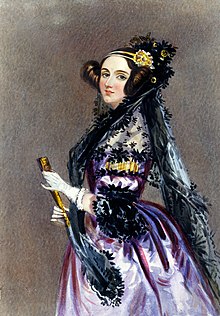
Ada, daughter of the poet Lord Byron, showed an early talent in mathematics. At age 17 she became a friend of Charles Babbage, inventor of the difference engine and proposed a more complex analytic engine. Babbage gave a talk at the University of Turin and Ada had the task of translating an article written by Italian engineer Luigi Menabrea based on the talk. Ada did more than just translate, she added her own thoughts which included a program that could be run on the analytic engine computing a specific sequence of numbers. The analytic engine never got built and Ada never saw her program run but nevertheless she gets credit as the first computer programmer and most notably in 1980 the US Department of Defense named their preferred computer language "Ada" in her honor.
Here's to Lady Ada Lovelace, born way too far ahead of her time.
Monday, December 07, 2015
crank math and crank people
In the same week I got email claming:
1) Babai had shown that GI is in quasipoly time.
2) Opeyemi Enoch, a Nigerian Mathematician, solved the Riemann hypothesis.
I believe Babai's claim since (a) he's worked on the problem a lot and is a known expert, (b) the result is believable, and (c) the math we know now seem up to the task.
I do not believe Enoch's claim. It would be unfair for me to not believe it because I never heard of him. However, my sources in math say that RH is not in a position to be solved. Also, articles I've read on the web including this article seem to say things that cast doubts on it such as this quote:
motivation to solve the problem came from his students, who brought it to him with the hope of making 1 million ``off the internet''
Bobby Jindall (who?) dropped out of the Prez race (why am I bringing this up? Is he working on RH?) Bobby Jindall was a Rhodes Scholar. (why am I bringing this up? Wait and see.)
In 2003 I was in a Taxi (ask your grandparents what Taxi's were before we had Uber) and the driver began telling me lots of conspiracies--- there is no Gold in Fort Knx, the novel Goldfinger was Ian Flemmings attempt to tell us this, Reagan was shot because he knew this, and the American Presidency is controlled by a secret cabal. I pointed out that if that's the case how did George Bush Sr (clearly a member of the Cabal) lose to Bill Clinton. His answer: Bill Clinton was a Rhodes Scholar and the Cabal is controlled by Rhode Scholars.
Its hard to argue with a conspiracy theorist about the past. But you can challenge him to predict the future. So I told him ``if you can predict who will be the Democratic Nominee for Prez in 2004 then I will look at your website and take it seriously. If not, then not'' He smiled and just said ``Wesley Clark was a Rhodes scholar'' If I had asked him who would be the republican nominee in 2016 then he might have said ``Bobby Jindal is a Rhodes Scholar''
The way to expose conspiracy theorists, astrologers, and The National Inquirer is to take their predictions seriously and test them. I wonder why anyone believes these things given their track record.
Judging math things is different- A math paper can be read and should stand on its own.
Thursday, December 03, 2015
Moonshots
In 1961 Kennedy said "this nation should commit itself to achieving the goal, before this decade is out, of landing a man on the Moon and returning him safely to the Earth". In 1969 Neil Armstrong and Buzz Aldrin walked on the moon and returned to earth safely. In the 46 years hence man has gone no further.
Bill Gates founded Microsoft to place "a computer on every desk and in every home". Once he succeeded, Microsoft lost its way. Their current mission takes a different tact "Empower every person and every organization on the planet to achieve more."
In my life I've seen many a moonshot succeed, from a computer chess program that can beat the best humans, the classification of finite simple groups and the proof of Fermat's last theorem. They all seem to end up with a "Now what?". If you have a finite mission, you can only achieve finite things. We often think of moonshots as an amazing challenge but they serve as limits as well.
In computing we have a law that has become a mission, that the power of computing doubles roughly every two years. These improvements have enabled the incredible advances in learning, automation and connectivity that we see today. We keep making better computers because we don't have a limit just a goal of getting better than where we are today.
When I first started writing grant proposals, a senior faculty member chided me for saying "the ultimate goal of computational complexity is prove P ≠ NP". He said that would kill any grant proposals after we did settle the question. While we are in no danger of solving this problem in the near future, eventually we will and I'd hate to see the field whither afterwards.
My favorite mission comes from Star Trek, particularly the TNG version with "Its continuing mission: to explore strange new worlds, to seek out new life and new civilizations, to boldly go where no one has gone before."
Bill Gates founded Microsoft to place "a computer on every desk and in every home". Once he succeeded, Microsoft lost its way. Their current mission takes a different tact "Empower every person and every organization on the planet to achieve more."
In my life I've seen many a moonshot succeed, from a computer chess program that can beat the best humans, the classification of finite simple groups and the proof of Fermat's last theorem. They all seem to end up with a "Now what?". If you have a finite mission, you can only achieve finite things. We often think of moonshots as an amazing challenge but they serve as limits as well.
In computing we have a law that has become a mission, that the power of computing doubles roughly every two years. These improvements have enabled the incredible advances in learning, automation and connectivity that we see today. We keep making better computers because we don't have a limit just a goal of getting better than where we are today.
When I first started writing grant proposals, a senior faculty member chided me for saying "the ultimate goal of computational complexity is prove P ≠ NP". He said that would kill any grant proposals after we did settle the question. While we are in no danger of solving this problem in the near future, eventually we will and I'd hate to see the field whither afterwards.
My favorite mission comes from Star Trek, particularly the TNG version with "Its continuing mission: to explore strange new worlds, to seek out new life and new civilizations, to boldly go where no one has gone before."
Sunday, November 29, 2015
One more sign that a Journal is bogus. Or is it?
I went to an AMS conference with my High School Student Naveen (who presented this paper) and an ugrad from my REU program Nichole (who presented this paper). Note that this is a math conference- low prestige, mostly unrefereed, parallel sessions, but still a good place to pick up some new problems to work on and learn some things, and meet people.
Both Naveen and Nichole later got email from a journal urging them to submit their work! They were also invited to be on the Editorial Board! I can understand inviting a HS student who is a SENIOR to be on an editorial board, but Naveen is a SOPHMORE!
Naveen and Nichole both emailed me asking what this was about and I looked around and found, not to my surprise, that the journal is an author-pays journal of no standards. On the other hand, it was open access, on the other other hand, they had an article claiming that R(4,6)=36 (might be true, but if this was known, I would know it, see this blog post for more on that proof technique).
The pay-to-publish model is not necc. bad, and is standard in some fields, but is unusual for math. Of perhaps more importance is that the journal had no standards. And they prey on the young and naive.
Or do they?
Consider the following scenario: Naveen publishes in this journal and this publication is on his college application, hence he gets into a good college with scholarship. He knows exactly what he is buying. Or Nicole does this to help her Grad school Application. Or I do this for my resume and get a salary increase. Or an untenured prof does this to get tenure ( Deans can count but they can't read). And it gets worse--- the school gives the prof tenure, knowing the papers are bogus, but now they can say they have a prof who publishes X papers a year! At some point I don't know who is scamming who.
This blog post (not mine) gives several criteria for when a journal is bogus. I'll add one: When they ask a 15 years old to be on their editorial board.
Both Naveen and Nichole later got email from a journal urging them to submit their work! They were also invited to be on the Editorial Board! I can understand inviting a HS student who is a SENIOR to be on an editorial board, but Naveen is a SOPHMORE!
Naveen and Nichole both emailed me asking what this was about and I looked around and found, not to my surprise, that the journal is an author-pays journal of no standards. On the other hand, it was open access, on the other other hand, they had an article claiming that R(4,6)=36 (might be true, but if this was known, I would know it, see this blog post for more on that proof technique).
The pay-to-publish model is not necc. bad, and is standard in some fields, but is unusual for math. Of perhaps more importance is that the journal had no standards. And they prey on the young and naive.
Or do they?
Consider the following scenario: Naveen publishes in this journal and this publication is on his college application, hence he gets into a good college with scholarship. He knows exactly what he is buying. Or Nicole does this to help her Grad school Application. Or I do this for my resume and get a salary increase. Or an untenured prof does this to get tenure ( Deans can count but they can't read). And it gets worse--- the school gives the prof tenure, knowing the papers are bogus, but now they can say they have a prof who publishes X papers a year! At some point I don't know who is scamming who.
This blog post (not mine) gives several criteria for when a journal is bogus. I'll add one: When they ask a 15 years old to be on their editorial board.
Monday, November 23, 2015
Star Trek Computing
In the wake of Leonard Nimoy's death last February, I decided to rewatch the entire original Star Trek series, all 79 episodes. I had watched them each many times over in high school in the 70's, though the local station removed a scene or two from each episode to add commercial time and I often missed the opening segment because I didn't get home from school in time. Back in those stone ages we had no DVR or other method to record shows. I hadn't seen many episodes of the original series since high school.
Now I can watch the entire episodes whenever I want in full and in order through the magic of Netflix. I finished this quest a few days ago. Some spoilers below.
I could talk about the heavy sexism, the ability to predict future technologies (the flat screen TV in episode 74), the social issues in the 23rd century as viewed from the 60's, or just the lessons in leadership you can get from Kirk. Given the topic of this blog, let's talk about computing in Star Trek which they often just get so wrong, such as when Spock asks the computer to compute the last digit of π to force Jack-the-Ripper to remove his consciousness from the ship's computers.
Too many episodes end with Kirk convincing a computer or robot to destroy itself. I'd like to see him try that with Siri. In one such episode "The Ultimate Computer", a new computer is installed in the Enterprise that replaces most of the crew. A conversation between Kirk and McCoy sounds familiar to many we have today (source).
MCCOY: Did you see the love light in Spock's eyes? The right computer finally came along. What's the matter, Jim?
KIRK: I think that thing is wrong, and I don't know why.
MCCOY: I think it's wrong, too, replacing men with mindless machines.
KIRK: I don't mean that. I'm getting a Red Alert right here. (the back of his head) That thing is dangerous. I feel. (hesitates) Only a fool would stand in the way of progress, if this is progress. You have my psychological profiles. Am I afraid of losing my job to that computer?
MCCOY: Jim, we've all seen the advances of mechanisation. After all, Daystrom did design the computers that run this ship.
KIRK: Under human control.
MCCOY: We're all sorry for the other guy when he loses his job to a machine. When it comes to your job, that's different. And it always will be different.
KIRK: Am I afraid of losing command to a computer? Daystrom's right. I can do a lot of other things. Am I afraid of losing the prestige and the power that goes with being a starship captain? Is that why I'm fighting it? Am I that petty?
MCCOY: Jim, if you have the awareness to ask yourself that question, you don't need me to answer it for you. Why don't you ask James T. Kirk? He's a pretty honest guy.
Later in the episode the computer starts behaving badly and Kirk has to convince it to shut itself down. But what if the computer just did its job? Is that our real future: Ships that travel to stars controlled only by machine. Or are we already there?
Now I can watch the entire episodes whenever I want in full and in order through the magic of Netflix. I finished this quest a few days ago. Some spoilers below.
I could talk about the heavy sexism, the ability to predict future technologies (the flat screen TV in episode 74), the social issues in the 23rd century as viewed from the 60's, or just the lessons in leadership you can get from Kirk. Given the topic of this blog, let's talk about computing in Star Trek which they often just get so wrong, such as when Spock asks the computer to compute the last digit of π to force Jack-the-Ripper to remove his consciousness from the ship's computers.
Too many episodes end with Kirk convincing a computer or robot to destroy itself. I'd like to see him try that with Siri. In one such episode "The Ultimate Computer", a new computer is installed in the Enterprise that replaces most of the crew. A conversation between Kirk and McCoy sounds familiar to many we have today (source).
MCCOY: Did you see the love light in Spock's eyes? The right computer finally came along. What's the matter, Jim?
KIRK: I think that thing is wrong, and I don't know why.
MCCOY: I think it's wrong, too, replacing men with mindless machines.
KIRK: I don't mean that. I'm getting a Red Alert right here. (the back of his head) That thing is dangerous. I feel. (hesitates) Only a fool would stand in the way of progress, if this is progress. You have my psychological profiles. Am I afraid of losing my job to that computer?
MCCOY: Jim, we've all seen the advances of mechanisation. After all, Daystrom did design the computers that run this ship.
KIRK: Under human control.
MCCOY: We're all sorry for the other guy when he loses his job to a machine. When it comes to your job, that's different. And it always will be different.
KIRK: Am I afraid of losing command to a computer? Daystrom's right. I can do a lot of other things. Am I afraid of losing the prestige and the power that goes with being a starship captain? Is that why I'm fighting it? Am I that petty?
MCCOY: Jim, if you have the awareness to ask yourself that question, you don't need me to answer it for you. Why don't you ask James T. Kirk? He's a pretty honest guy.
Later in the episode the computer starts behaving badly and Kirk has to convince it to shut itself down. But what if the computer just did its job? Is that our real future: Ships that travel to stars controlled only by machine. Or are we already there?
Thursday, November 19, 2015
A Silly String Theorem
First a note on a serious theorem: Babai has posted a video (mp4, 1h 40 m, 653MB) of his first talk on his Graph Isomorphism algorithm.
I was giving a talk on the Kleene star operator (don't ask) and came across this cute little problem. Say a language L commutes if for all u,v in L, uv=vu.
Problem: Show that L commutes if and only if L is a subset of w* for some fixed string w.
Here w* is the set of strings consisting of zero or more concatenations of w with itself. The if case is easy, but I found the other direction pretty tricky and came up with an ugly proof. I found a cleaner proof in Seymour Ginsburg's 1966 textbook The Mathematical Theory of Context Free Languages which I present here.
⇐ If u=wi and v=wj then uv=vu=wi+j.
⇒ Trivial if L contains at most one string. Assume L contains at least two strings.
Proof by induction on the length of the shortest non-empty string v in L.
Base case: |v|=1
Suppose there is an x in L with x not in v*. Then x = vibz for b in Σ-{v}. Then the i+1st character of xv is b and the i+1st character of vx is v, contradicting xv=vx. So we can let w=v.
Inductive case: |v|=k>1.
Lemma 1: Let y=vru be in L (u might be empty). Then uv=vu.
Proof: Since yv=vy we have vruv=vvru=vrvu. So vu=uv.
Let x in L be a string not in v* (if no such x exists we can let w=v). Pick j maximum such that x=vjz with z not the empty string. By Lemma 1 we have zv=vz. Note |z| < |v| otherwise v is a prefix of z, contradicting the maximality of j.
Lemma 2: For all y in L we have yz=zy.
Proof: As before let y = vru. By Lemma 1, uv=vu
Since yx=xy we have vruvjz = vjzvru
vruvjz = vruzvj by swapping v's and z's.
vjzvru = zvruvj by swapping v's and z's, and v's and u's.
So we have vruzvj = zvruvj
or yzvj = zyuj and thus yz=zy.
By Lemma 2, the set L∪{z} commutes. Since 0 < |z| < |v| by induction L∪{z} is a subset of w* for some w so L is a subset of w*.
I was giving a talk on the Kleene star operator (don't ask) and came across this cute little problem. Say a language L commutes if for all u,v in L, uv=vu.
Problem: Show that L commutes if and only if L is a subset of w* for some fixed string w.
Here w* is the set of strings consisting of zero or more concatenations of w with itself. The if case is easy, but I found the other direction pretty tricky and came up with an ugly proof. I found a cleaner proof in Seymour Ginsburg's 1966 textbook The Mathematical Theory of Context Free Languages which I present here.
⇐ If u=wi and v=wj then uv=vu=wi+j.
⇒ Trivial if L contains at most one string. Assume L contains at least two strings.
Proof by induction on the length of the shortest non-empty string v in L.
Base case: |v|=1
Suppose there is an x in L with x not in v*. Then x = vibz for b in Σ-{v}. Then the i+1st character of xv is b and the i+1st character of vx is v, contradicting xv=vx. So we can let w=v.
Inductive case: |v|=k>1.
Lemma 1: Let y=vru be in L (u might be empty). Then uv=vu.
Proof: Since yv=vy we have vruv=vvru=vrvu. So vu=uv.
Let x in L be a string not in v* (if no such x exists we can let w=v). Pick j maximum such that x=vjz with z not the empty string. By Lemma 1 we have zv=vz. Note |z| < |v| otherwise v is a prefix of z, contradicting the maximality of j.
Lemma 2: For all y in L we have yz=zy.
Proof: As before let y = vru. By Lemma 1, uv=vu
Since yx=xy we have vruvjz = vjzvru
vruvjz = vruzvj by swapping v's and z's.
vjzvru = zvruvj by swapping v's and z's, and v's and u's.
So we have vruzvj = zvruvj
or yzvj = zyuj and thus yz=zy.
By Lemma 2, the set L∪{z} commutes. Since 0 < |z| < |v| by induction L∪{z} is a subset of w* for some w so L is a subset of w*.
Monday, November 16, 2015
Is the word Quantum being used properly by civilians? Understood by them? You know the answer.
I've seen the word `civilians' expanded in use from non-military to non-X for some X. Not sure I've ever seen `civilians' mean `people who don't do math stuff' until the title of todays post. Well, there is a first time for everything.
I've blogged in the past about the use of the word Quantum (here) . The phrase Quantum Leap means a BIG leap, where as Quantum stuff is small. Though, to be fair, the discovery (invention?) of Quantum Mechanics was a big leap. So maybe that IS proper use. The James Bond movie Quantum of Solace uses Quantum to mean small, the ONLY time I've seen Quantum used to mean small, so Kudos to the title of an absolutely awful movie. Commenters on my prior blog on the subject pointed out that the original meaning of
quantum was quantity or amount without regard to size of discreteness. I think using it that way now would be very rare.
I came across a theatre called Quantum Theatre. What is Quantum Theatre? The following are actual quotes from their website.
Quantum artists mine all kinds of non-traditional spaces for the sensory possibilities they offer when combined with creative design.
We find it meaningful to place the audience and performer together, the moving parts inside the works.
We want to move people with our experiements.
The shows run the gamut from those you thought you knew but now experience like never before, to shows that didn’t exist until their elements mixed in our laboratory.
I came across this article in a place it didn't belong-- in the middle of an article about Google and NASA trying to build a quantum computer (see here.) This news might be exciting but the article was full of mistakes and bad-signs so I'm not to excited about it. Plus the reference to Quantum Theatre is just odd.
The BEST use of the word quantum that I've heard recently was in the episode The Ricks must be crazy of the excellent TV show Ricky and Morty:
The car is broken
Morty (a 14 year old): W-Whats wrong Rick? Is it the Quantum carburetor or something?
Rick (his grandfather, a brilliant scientist): Quantum carburetor? You can't just add a Sci-fi word to a car word and hope it means something.
W-what's wrong, Rick? Is it the quantum carburetor or something?
Read more at: http://transcripts.foreverdreaming.org/viewtopic.php?f=364&t=20185
Read more at: http://transcripts.foreverdreaming.org/viewtopic.php?f=364&t=20185
W-what's wrong, Rick? Is it the quantum carburetor or something?
Read more at: http://transcripts.foreverdreaming.org/viewtopic.php?f=364&t=20185
Read more at: http://transcripts.foreverdreaming.org/viewtopic.php?f=364&t=20185
Thursday, November 12, 2015
A Primer on Graph Isomorphism

I spent 14 years on the faculty at the University of Chicago. I know László Babai well, we collaborated on some of my best known work. I also know Ryerson 251, a room where I've seen hundreds of talks and given more than a few myself. So I could imagine the excitement in that room on Tuesday as Babai gave the most anticipated talk in the history of theoretical computer science, the first of several talks Babai is giving on his new algorithm for graph isomorphism [Video]. Gabriel Gaster extensively live tweeted the event. Jeremy Kun has some details. Update (12/14): Paper now posted.
For this post instead of doing a bad job trying to overview Babai's proof, I'll explain the graph isomorphism problem and why it is important in the complexity world.
Suppose we have two high schools, say HS North and HS South, each with 1000 students. Consider a diagram (or graph) containing a point for each student at HS North with lines between students who are facebook friends, and a similar diagram for HS South. Is there a 1-1 map from the students at HS North to the students at HS South so that these diagrams look identical? That's the graph isomorphism problem.
To determine whether these two graphs were isomorphic you could look at all the possible mappings between students, but that's 1000! or more than 4x102567 possible maps. There has long been known how to search a smaller number of possibilities, especially if we put some restrictions on the diagrams, but always exponential in n (the number of students) in the worst case. Ideally we'd like a polynomial-time algorithm and Babai gets very close, an algorithm that runs in time nlogkn time for some fixed k.
Graph Isomorphism is one of those few problems, like factoring, known to be in NP but not known to be in P or NP-complete. Graph non-isomorphism is the poster child for the class AM, the problems solved by a randomized verifier asking a single question to a powerful prover. Graph non-isomorphism in AM implies that Graph Isomorphism is not likely NP-complete and that under reasonable derandomization assumptions that Graph non-isomorphism is in NP. Kobler, Schöning and Toran wrote a whole book on the computational complexity issues of graph isomorphism.
Even small progress in graph isomorphism creates waves. At a theory conference in the late 80's a speaker caused a major stir when he casually mentioned he had a proof (he didn't) that Graph non-isomorphism was in NP. Babai's announced caused a huge tsunami and those of us who know him realize he wouldn't make such an announcement without being sure he has a proof. The talk put together a large number of ideas from combinatorics and graph theory. My impression is that those who saw the talk didn't leave convinced of the proof, but did feel Babai had found the pieces to make it work.
With Babai's breakthrough algorithm, the smart money says now that graph isomorphism sits in P. It took decades to get from quasipolynomial time to polynomial time for primality testing and the same time frame may be needed to get polynomial time for graph isomorphism. But it will likely happen and the complexity of graph isomorphism then gets a whole lot simpler.
A couple of thoughts: All the breakthrough results that I can remember were released as papers, ready to devour. This is the first result of this caliber I remember being announced as a talk.
Also we think of theory as a young person's game, most of the big breakthroughs coming from researchers early in their careers. Babai is 65, having just won the Knuth Prize for his lifetime work on interactive proofs, group algorithms and communication complexity. Babai uses his extensive knowledge of combinatorics and group theory to get his algorithm. No young researcher could have had the knowledge base or maturity to be able to put the pieces together the way that Babai did.
More on Babai and graph isomorphism from Scott, Luca, Bill, Tim, Dick and Ken, Reddit, Science News, New Scientist and Science.
Sunday, November 08, 2015
Looking forward to the GI result
As you all know Laszlo Babai will give a talk Tuesday Nov 10 on a result: GI in quasipolynomial time (2 to a polylog). Other theory blogs have already commented on this (GLL,In Theory,Shetl-Opt)
When I was in Graduate School (early 1980's) it looked like GI would get into P. Three key results: graphs of bounded degree, graphs of bounded genus, graphs of bounded eigenvalue multiplicity, were all shown to be in P. These results used group theory and linear algebra in serious ways so the thought was that more advanced group theory, perhaps the classification of all finite simple groups (CFSG) would be used to show GI in P. If CFSG was used in an algorithm for GI in P then the algorithm might have an enormous constant, but that's okay since the quest for GI in P is not for practical reasons (I think that all the people who want to solve it already have fast enough algorithms) . I was looking forward to the debates on if an algorithm with that big a constant would count as poly time (I would say yes). But no algorithm for GI in P, using CFSG or not, was found. Also note that it was possible (and is still possible) that GI is NOT in P. In my 2012 survey of P vs NP I also asked about GI. Of the 20 people who responded 14 thought GI is in P, 6 thought not. Note that GI is not known to be in co-NP or BPP. It IS in IP[2], and if GI was NPC
then PH collapses, so it is unlikely that GI is NP-complete. This tells us NOTHING about whether it is in P.
An analogous thing happened with PRIMES. Lots of results that got it almost in P, lots of hard number theory used, but then the progress stopped. Two differences: Most people thought PRIMES IS in P (likely because it's in coNP and BPP),and this was finally proven in 2002.
Is Babai's proof likely to be correct? There are three parameters to consider when looking at that question: (1) Who is making the claim?, (2) How likely the claim is to be true?, (3) How likely the claim is to be provable with what is known today?.You can give different weights to each one in different combinations..
Laszlo Babai is an expert in GI with a track record in the area. (reading that over again it undersells the case- Babai is, as the kids say, awesome!) That GI is in quasipolynomial time is quite believable. Even those 6 who think that Gi is not in P might believe that. Its harder to know if today's techniques are up to the task; however, there are no results like `group theory won't suffice' or any kind of obstacles, so certainly the claim seems provable with todays technology.
Here's hoping...
When I was in Graduate School (early 1980's) it looked like GI would get into P. Three key results: graphs of bounded degree, graphs of bounded genus, graphs of bounded eigenvalue multiplicity, were all shown to be in P. These results used group theory and linear algebra in serious ways so the thought was that more advanced group theory, perhaps the classification of all finite simple groups (CFSG) would be used to show GI in P. If CFSG was used in an algorithm for GI in P then the algorithm might have an enormous constant, but that's okay since the quest for GI in P is not for practical reasons (I think that all the people who want to solve it already have fast enough algorithms) . I was looking forward to the debates on if an algorithm with that big a constant would count as poly time (I would say yes). But no algorithm for GI in P, using CFSG or not, was found. Also note that it was possible (and is still possible) that GI is NOT in P. In my 2012 survey of P vs NP I also asked about GI. Of the 20 people who responded 14 thought GI is in P, 6 thought not. Note that GI is not known to be in co-NP or BPP. It IS in IP[2], and if GI was NPC
then PH collapses, so it is unlikely that GI is NP-complete. This tells us NOTHING about whether it is in P.
An analogous thing happened with PRIMES. Lots of results that got it almost in P, lots of hard number theory used, but then the progress stopped. Two differences: Most people thought PRIMES IS in P (likely because it's in coNP and BPP),and this was finally proven in 2002.
Is Babai's proof likely to be correct? There are three parameters to consider when looking at that question: (1) Who is making the claim?, (2) How likely the claim is to be true?, (3) How likely the claim is to be provable with what is known today?.You can give different weights to each one in different combinations..
Laszlo Babai is an expert in GI with a track record in the area. (reading that over again it undersells the case- Babai is, as the kids say, awesome!) That GI is in quasipolynomial time is quite believable. Even those 6 who think that Gi is not in P might believe that. Its harder to know if today's techniques are up to the task; however, there are no results like `group theory won't suffice' or any kind of obstacles, so certainly the claim seems provable with todays technology.
Here's hoping...
Thursday, November 05, 2015
Computation and Journalism Part 2
The theory blogosphere is atwitter with an announcement of a talk next Tuesday at Chicago by László Babai Graph Isomorphism in Quasipolynomial Time. Luca will blog from the scene and we will have a full report as details emerge.
More from the Comp and Journalism conference
0) (ADDED WRITE BEFORE POSTING) The conference was about how journalists do or should use technology. Part of this is how news gets to people. Twitter and Blogs are one method, as the above note about Babai's talk shows.
1) There was a panel discussion on context When one reads an article it depends on where one is coming from. Here is a strange thing that technology has allowed journalists to do: An article can have slight differences depending on where its being read. For example if someone from New York is reading it may refer to Broadway, whereas if someone in LA is reading it it might refer to Hollywood. The tech also exists to have the reader (online) have a choice- so you can read it as if you are in place X. This scares me a bit- what if an article is can be tinkered with to appeal to lefthanded latino lesbians who work on the local
Lovasz Lemma. Isn't our country fragmented enough? STILL, the point that context matters came through nicely.
2) There was a panel of three ACTUAL JOURNALISTS (I think that all of the other speakers were academics) who used BIG DATA or MACHINE LEARNING or FILL IN BUZZWORD to write articles. Propublica, a nonprofit newspaper (aren't they all?) did an article about rating doctors (here ) that seems to be very well checked (example- if a patient has to come back again because of a complication, is it the surgeons fault? hard to answer). However, some doctors (those that got low ratings?) complained that there article was not peer reviewed. This brings up a question--- journalists run things by fact checkers and proofreaders, but do not have peer-review. Academics do. Which is the better system? Another journalist did a study of the Supreme court and found that there is a small set of lawyers that are well connected (one used to play darts with Alito) who are involved in over half of the cases the court sees. What interested me is--- what if you have an idea for an article and you do ALL of the number crunching, bring in ML people to help and find out in the end OH, the Supreme court actually is doing a fair job or OH, Doctors are pretty good. No story! They said this happens about 1/3 of the time where either you don't have enough data for a story or the story is not really a story.
3) There was a paper about YELP ratings of doctors. It seems that the actual
doctor-stuff is rarely mentioned, usually it was how long the wait time was,
how boring the magazines in the office were, etc. Also, most doctors got
either 1 star or 5 stars. One thing they didn't mention but I will- Walter Palmer, the Dentist who killed Lion in Africa, got lots of very negative YELP reviews from people who were never patients of his. So YELP ratings can be skewed by things independent of what is supposed to be measured. That is, of course, and extreme case.
4) Key Note by Chris Wiggins who is an academic who, on his Sabbatical, worked for the NYT on issues of How many copies of the paper should we print? and other Operations Research type questions. Print subscriptions still out number online subscriptions, the online is doing pretty well and bringing in money, but they still NEED to find a better business model.I am reminded that when Jeff Bezos bought the Wash Post Stephen Colbert said there are more people buying newspapers than there are people buying newspapers.
(My spellchecker things online is not a word. Everyone else does.)
5) There was a panel on Education. From there point of view very pessimistic---
most schools don't offer courses in how to use Technology in journalism, no real
books, no agreement on what's important. And I suspect they will have a hard time updating courses once they have them. I wonder if the early days of Comp Science were like that.
6) The issue of jobs in journalism going away was not quite ignored but also not
quite confronted either. Some people told me that Journalism schools are not being honest with their students about the dismal job market. Then again, they are journalism students- they should investigate!
7) A journalism student told me of a case going to the supreme court that may be
very important for privacy: Spokeo vs Robins: here
8) UPSHOT- I am glad I went, I learned some things outside of what I usually think about. Unlike the RATLOCC (Ramsey Theory and Logic) I was able to tell my mom what I learned. I didn't bring my laptop nor had TV access I was able to work on some math and had a minor breakthrough. But that,s for a later blog
(My spellcheck thinks blog is not a word. It also thinks spellcheck is not a word.)
More from the Comp and Journalism conference
0) (ADDED WRITE BEFORE POSTING) The conference was about how journalists do or should use technology. Part of this is how news gets to people. Twitter and Blogs are one method, as the above note about Babai's talk shows.
1) There was a panel discussion on context When one reads an article it depends on where one is coming from. Here is a strange thing that technology has allowed journalists to do: An article can have slight differences depending on where its being read. For example if someone from New York is reading it may refer to Broadway, whereas if someone in LA is reading it it might refer to Hollywood. The tech also exists to have the reader (online) have a choice- so you can read it as if you are in place X. This scares me a bit- what if an article is can be tinkered with to appeal to lefthanded latino lesbians who work on the local
Lovasz Lemma. Isn't our country fragmented enough? STILL, the point that context matters came through nicely.
2) There was a panel of three ACTUAL JOURNALISTS (I think that all of the other speakers were academics) who used BIG DATA or MACHINE LEARNING or FILL IN BUZZWORD to write articles. Propublica, a nonprofit newspaper (aren't they all?) did an article about rating doctors (here ) that seems to be very well checked (example- if a patient has to come back again because of a complication, is it the surgeons fault? hard to answer). However, some doctors (those that got low ratings?) complained that there article was not peer reviewed. This brings up a question--- journalists run things by fact checkers and proofreaders, but do not have peer-review. Academics do. Which is the better system? Another journalist did a study of the Supreme court and found that there is a small set of lawyers that are well connected (one used to play darts with Alito) who are involved in over half of the cases the court sees. What interested me is--- what if you have an idea for an article and you do ALL of the number crunching, bring in ML people to help and find out in the end OH, the Supreme court actually is doing a fair job or OH, Doctors are pretty good. No story! They said this happens about 1/3 of the time where either you don't have enough data for a story or the story is not really a story.
3) There was a paper about YELP ratings of doctors. It seems that the actual
doctor-stuff is rarely mentioned, usually it was how long the wait time was,
how boring the magazines in the office were, etc. Also, most doctors got
either 1 star or 5 stars. One thing they didn't mention but I will- Walter Palmer, the Dentist who killed Lion in Africa, got lots of very negative YELP reviews from people who were never patients of his. So YELP ratings can be skewed by things independent of what is supposed to be measured. That is, of course, and extreme case.
4) Key Note by Chris Wiggins who is an academic who, on his Sabbatical, worked for the NYT on issues of How many copies of the paper should we print? and other Operations Research type questions. Print subscriptions still out number online subscriptions, the online is doing pretty well and bringing in money, but they still NEED to find a better business model.I am reminded that when Jeff Bezos bought the Wash Post Stephen Colbert said there are more people buying newspapers than there are people buying newspapers.
(My spellchecker things online is not a word. Everyone else does.)
5) There was a panel on Education. From there point of view very pessimistic---
most schools don't offer courses in how to use Technology in journalism, no real
books, no agreement on what's important. And I suspect they will have a hard time updating courses once they have them. I wonder if the early days of Comp Science were like that.
6) The issue of jobs in journalism going away was not quite ignored but also not
quite confronted either. Some people told me that Journalism schools are not being honest with their students about the dismal job market. Then again, they are journalism students- they should investigate!
7) A journalism student told me of a case going to the supreme court that may be
very important for privacy: Spokeo vs Robins: here
8) UPSHOT- I am glad I went, I learned some things outside of what I usually think about. Unlike the RATLOCC (Ramsey Theory and Logic) I was able to tell my mom what I learned. I didn't bring my laptop nor had TV access I was able to work on some math and had a minor breakthrough. But that,s for a later blog
(My spellcheck thinks blog is not a word. It also thinks spellcheck is not a word.)
Monday, November 02, 2015
Conference on Computation and Journalism (Part I)
(In honor of Boole's Birthday yesterday see this.)
I recently (Oct 2 and 3 2015) went to a conference on Computation and Journalism (see here for their schedule). I went since I co-blog and have a Wikipedia page (here) hence I"ve gotten interested in issues of technology and information (not information-theory, but real world information).
I describe some of what I saw in two posts, today and thursday. Many of the articles I mention can be gotten from the schedule page above.
1) I understood all of the talks. This is very different from STOC, FOCS, CCC, etc; however, old timers tell me that back in STOC 1980 or so one could still understand all of the talks.
2) Lada Adamic gave a keynote on Facebook about whether or not Facebook causes an echo chamber (e.g., liberals only having liberal friends) Her conclusion was NO- about 25% of the friends of an L are a C and vice versa. This makes sense since people friend people who are workers and family, not based on political affiliation (Some of my in-laws are farther to the right than... most of my readers.) She also noted that 10% of the articles passed on by L's are Conservative- though this might not be quite indicative since they may often be `look at this crap that FOX news is saying now' variety. Note that Lada works for Facebook. Talking to people over lunch about that the consensus was that (1) the study was valid, but (2) if the conclusion had been that Facebook is tearing apart our country THEN would they have been allowed to publish it? I leave that as a question.
3) There was a Panel on Comments. The NYT has 14 people whose sole job is the soul-crushing job of reading peoples comments on articles and deciding what to let through. Gee, complexity blog just needs Lance and me. I found out that the best way to ensure intelligent comments and to get rid of trolls is (1) people must register, give their real name, and even have a picture of themselves, and (2) engage with the commenters (like Scott A does, though they did not use him as an example). Lance and I do neither of these things. Oh well.(3)COMPUTERS- can we have a program that can tell if an comment is worth posting? Interesting research question. One basic technique is to not allow comments with curse words in them- NOT out of a prudish impulse, but because curse words are an excellent indicator of articles that will not add to the discourse.
The most interesting question raised was Do Trolls know the are trolls? YES- they just like destroying things for no reason. Picture Bart Simpson using a hammer on Mustard packets just cause.
4) There was two sessions of papers on Bias in the news.
a) Ranking in the Age of Algorithms and Curated News By Suman Deb Rob. How should news articles be ranked? If articles are ranked by popularity then you end up covering Donald Trump too much. If articles are ranked by what the editors think thats too much of THE MAN telling me whats important. Also, there are articles that are important for a longer period of time but never really top-ten important. Nate Silver has written that the most important story of the 2016 election is that the number of serious (defined: Prior Senators of Govs) who are running for the Rep nomination is far larger than ever before. But thats not quite a story.
b) The Gamma: Programming tools for transparent data journalism by Tomas Petricek. So there are data journalists that you can see right through! Wow! Actually he had a tool so that you could, using World Bank Data, get maps that show stuff via colors. His example was the story that China produces more carbon emission than the USA, and a nice color graphic for it, but then the user or the journalist can easily get a nice color graphic of carbon-emms-per-person in which case the USA is still NUMBER ONE! (Yeah!) Later he had a Demo session. I tried to look at % of people who go to college by country, but it didn't have info on some obscure countries like Canada. Canada? The project was Limited by the data we have available.
d) Consumer and supplies: Attention Asymmetries by Abbar, An, Kwak, Messaoui, Borge-Holthofer. They had 2 million comments posted by 90,000 unique readers and analyzed this data to see if there is an asymtery between what readers want and what they are getting. Answer: YES
I recently (Oct 2 and 3 2015) went to a conference on Computation and Journalism (see here for their schedule). I went since I co-blog and have a Wikipedia page (here) hence I"ve gotten interested in issues of technology and information (not information-theory, but real world information).
I describe some of what I saw in two posts, today and thursday. Many of the articles I mention can be gotten from the schedule page above.
1) I understood all of the talks. This is very different from STOC, FOCS, CCC, etc; however, old timers tell me that back in STOC 1980 or so one could still understand all of the talks.
2) Lada Adamic gave a keynote on Facebook about whether or not Facebook causes an echo chamber (e.g., liberals only having liberal friends) Her conclusion was NO- about 25% of the friends of an L are a C and vice versa. This makes sense since people friend people who are workers and family, not based on political affiliation (Some of my in-laws are farther to the right than... most of my readers.) She also noted that 10% of the articles passed on by L's are Conservative- though this might not be quite indicative since they may often be `look at this crap that FOX news is saying now' variety. Note that Lada works for Facebook. Talking to people over lunch about that the consensus was that (1) the study was valid, but (2) if the conclusion had been that Facebook is tearing apart our country THEN would they have been allowed to publish it? I leave that as a question.
3) There was a Panel on Comments. The NYT has 14 people whose sole job is the soul-crushing job of reading peoples comments on articles and deciding what to let through. Gee, complexity blog just needs Lance and me. I found out that the best way to ensure intelligent comments and to get rid of trolls is (1) people must register, give their real name, and even have a picture of themselves, and (2) engage with the commenters (like Scott A does, though they did not use him as an example). Lance and I do neither of these things. Oh well.(3)COMPUTERS- can we have a program that can tell if an comment is worth posting? Interesting research question. One basic technique is to not allow comments with curse words in them- NOT out of a prudish impulse, but because curse words are an excellent indicator of articles that will not add to the discourse.
The most interesting question raised was Do Trolls know the are trolls? YES- they just like destroying things for no reason. Picture Bart Simpson using a hammer on Mustard packets just cause.
4) There was two sessions of papers on Bias in the news.
a) Ranking in the Age of Algorithms and Curated News By Suman Deb Rob. How should news articles be ranked? If articles are ranked by popularity then you end up covering Donald Trump too much. If articles are ranked by what the editors think thats too much of THE MAN telling me whats important. Also, there are articles that are important for a longer period of time but never really top-ten important. Nate Silver has written that the most important story of the 2016 election is that the number of serious (defined: Prior Senators of Govs) who are running for the Rep nomination is far larger than ever before. But thats not quite a story.
b) The Gamma: Programming tools for transparent data journalism by Tomas Petricek. So there are data journalists that you can see right through! Wow! Actually he had a tool so that you could, using World Bank Data, get maps that show stuff via colors. His example was the story that China produces more carbon emission than the USA, and a nice color graphic for it, but then the user or the journalist can easily get a nice color graphic of carbon-emms-per-person in which case the USA is still NUMBER ONE! (Yeah!) Later he had a Demo session. I tried to look at % of people who go to college by country, but it didn't have info on some obscure countries like Canada. Canada? The project was Limited by the data we have available.
c) The quest to automate Fact-Checking by Hassan, Adair, Hamilton, Li, Tremayne, Yang, Yu. We are pretty far from being able to do this, however, they had a program that could identify whether or not something uttered IS checkable . When I am president I will lower taxes is not checkable, whereas Bill Mahr's claim that Donald Trumps father is an Orangutang is checkable.
d) Consumer and supplies: Attention Asymmetries by Abbar, An, Kwak, Messaoui, Borge-Holthofer. They had 2 million comments posted by 90,000 unique readers and analyzed this data to see if there is an asymtery between what readers want and what they are getting. Answer: YES
George Boole (1815-1864)
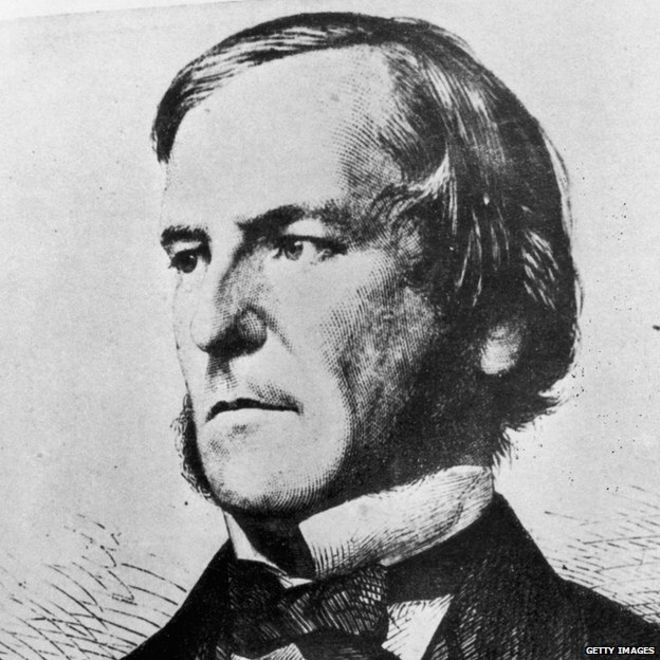
Where would computational complexity be without Boolean algebra? We can use AND, OR, and NOT gates in place of Turing machines to capture computation: A polynomial-sized circuit of these gates can simulate any polynomial-time computable algorithm.
Stephen Cook analyzed the complexity of determining whether a formula φ of Boolean variables connected by AND, OR and NOTs was a tautology, a mathematical law. Cook showed that every nondeterministic polynomial-time computable problem reduced to checking if φ is not a tautology, or equivalently that (NOT φ) is satisfiable. That paper, as you well know, gave us the P v NP problem.
So here's to George Boole, whose desire to give mathematics a firm foundation produced simple tools powerful enough to describe everything.
Thursday, October 29, 2015
S. Barry Cooper (1943-2015)

For the Turing year, Cooper and Jan van Leeuwen co-edited a massive volume Alan Turing: His Work and Impact which includes all of Turing's publications and a number of commentaries on the legacy of that work. I wrote a piece on Turing's Dots for the volume. Alan Turing: His Work and Impact received the R. R. Hawkins Award, the top award for professional and scholarly publishing across all the arts and sciences.
Barry Cooper was also the driving force behind Computability in Europe, an eclectic meeting to discuss all things related to computation.
I hope Barry now gets to meet his hero Turing but we'll miss him greatly down here.
Monday, October 26, 2015
A human-readable proof that every planar graph is 4.5-colorable
About 20 years ago I went to a talk by Jim Propp on the fractional chromatic number of a graph. (Here is a link to a free legal copy of the book on fractional graph theory by Ed Scheinerman and Dan Ullman.)
Let c be a natural number. A graph G=(V,E) is c-colorable if there is a mapping of the vertices of G to the vertices of Kc such that (x,y) ∈ E --> (x,y) is an edge in Kc
Let Kt:k be the Knesser graph: the vertices are all k-element subsets of {1,...,t}, (A,B) is an edge if A∩B=∅. A graph is t/k-colorable if there is a mapping of the vertices of G to the vertices of Kt:k such that (x,y) ∈ E --> (x,y) is an edge in Kt:k. (That is not quite right as that might depend on if you use, say, 15/10 or 3/2 but is close. See page 40-42 in the book linked to above for the formal definition.)
One can also show that this is equivalent to other definitions of fractional chromatic number (one involves a relaxation of an LP problem).
The big open problem in the field and perhaps the motivation for it was this:
Known and the proof is human-readable: Every Planar Graph is 5-colorable.
Known and the current proof is NOT human-readable: Every Planar Graph is 4-colorable.
OPEN: Is there some number 4<c<5 such that every planar graph is c-colorable and the proof is human-readable?
I had not thought about this problem for a long time when I was invited by Dan Cranston to give a talk at a Discrete Math Seminar in Virginia Commonwealth University. Looking over the prior talks in the seminar I noticed a talk on Fractional Chromatic Number of the Plane by Dan Cranston. I inquired:
BILL: Fractional colorings! Has there been progress on finding a number less than 5 so that the proof that every planar graph is c colorable is reasonable?
DAN: Yes. By myself and Landon Rabern. We have shown that every planar graph is 4.5-colorable in this paper! I've given talks on it, here are my slides.
BILL: This is big news! I am surprised I haven't heard about it.
DAN: The paper is on arXiv but not published yet. Also, while you and me think its a great result, since its already known that all planar graphs are 4-colorable, some people are not interested.
BILL: Too bad you didn't prove it in 1975 (the four-color theorem was proven in 1976).
DAN: I was in kindergarten.
BILL: Were you good at math?
DAN: My finger paintings were fractional colorings of the plane and I never used more than 4.5 colors.
DAN: By the way, the paper I spoke about in seminar was about fractional colorings of the plane. The graph is: all points in the plane are vertices, and two points have an edge if they are an inch apart. The ordinary chromatic number is known to be between 4 and 7. Tighter bounds are known for the fractional chromatic number, see the paper linked to above when you first mention that paper.
Some thoughts:
1) I would have thought that they would first get something like 4.997 and then whittle it down. No, it went from 5 right to 4.5. Reducing it any further looks hard and they proved that it cannot be a tweak of their proof.
2) The paper is readable. Its very clever and doesn't really use anything not known in 1975. But the problem wasn't known then and of course the right combination of ideas would have been hard to find back the. In particular, the method of discharging is better understood now.
3) When I told this to Clyde Kruskal he wanted to know if there was a rigorous definition of ``human-readable'' since the open question asked for a human-readable proof. I doubt there is or that there can be, but this paper clearly qualifies. Perhaps a paper is human-readable if 2 humans have actually read it and understood it. Or perhaps you can parameterize is and have n-human-readable for n humans.
4) Why does my spell checker thing colorable and colorings and parameterize are not words?
5) The serendipity: I'm very happy to know the result. I came upon it by complete accident. I'm bothered that there may be other results I want to know about but don't. How does one keep up? One way is to check arXiv's once-a-week or on some regular basis. But is that a good use of your time? I ask non-rhetorical.
Let c be a natural number. A graph G=(V,E) is c-colorable if there is a mapping of the vertices of G to the vertices of Kc such that (x,y) ∈ E --> (x,y) is an edge in Kc
Let Kt:k be the Knesser graph: the vertices are all k-element subsets of {1,...,t}, (A,B) is an edge if A∩B=∅. A graph is t/k-colorable if there is a mapping of the vertices of G to the vertices of Kt:k such that (x,y) ∈ E --> (x,y) is an edge in Kt:k. (That is not quite right as that might depend on if you use, say, 15/10 or 3/2 but is close. See page 40-42 in the book linked to above for the formal definition.)
One can also show that this is equivalent to other definitions of fractional chromatic number (one involves a relaxation of an LP problem).
The big open problem in the field and perhaps the motivation for it was this:
Known and the proof is human-readable: Every Planar Graph is 5-colorable.
Known and the current proof is NOT human-readable: Every Planar Graph is 4-colorable.
OPEN: Is there some number 4<c<5 such that every planar graph is c-colorable and the proof is human-readable?
I had not thought about this problem for a long time when I was invited by Dan Cranston to give a talk at a Discrete Math Seminar in Virginia Commonwealth University. Looking over the prior talks in the seminar I noticed a talk on Fractional Chromatic Number of the Plane by Dan Cranston. I inquired:
BILL: Fractional colorings! Has there been progress on finding a number less than 5 so that the proof that every planar graph is c colorable is reasonable?
DAN: Yes. By myself and Landon Rabern. We have shown that every planar graph is 4.5-colorable in this paper! I've given talks on it, here are my slides.
BILL: This is big news! I am surprised I haven't heard about it.
DAN: The paper is on arXiv but not published yet. Also, while you and me think its a great result, since its already known that all planar graphs are 4-colorable, some people are not interested.
BILL: Too bad you didn't prove it in 1975 (the four-color theorem was proven in 1976).
DAN: I was in kindergarten.
BILL: Were you good at math?
DAN: My finger paintings were fractional colorings of the plane and I never used more than 4.5 colors.
DAN: By the way, the paper I spoke about in seminar was about fractional colorings of the plane. The graph is: all points in the plane are vertices, and two points have an edge if they are an inch apart. The ordinary chromatic number is known to be between 4 and 7. Tighter bounds are known for the fractional chromatic number, see the paper linked to above when you first mention that paper.
Some thoughts:
1) I would have thought that they would first get something like 4.997 and then whittle it down. No, it went from 5 right to 4.5. Reducing it any further looks hard and they proved that it cannot be a tweak of their proof.
2) The paper is readable. Its very clever and doesn't really use anything not known in 1975. But the problem wasn't known then and of course the right combination of ideas would have been hard to find back the. In particular, the method of discharging is better understood now.
3) When I told this to Clyde Kruskal he wanted to know if there was a rigorous definition of ``human-readable'' since the open question asked for a human-readable proof. I doubt there is or that there can be, but this paper clearly qualifies. Perhaps a paper is human-readable if 2 humans have actually read it and understood it. Or perhaps you can parameterize is and have n-human-readable for n humans.
4) Why does my spell checker thing colorable and colorings and parameterize are not words?
5) The serendipity: I'm very happy to know the result. I came upon it by complete accident. I'm bothered that there may be other results I want to know about but don't. How does one keep up? One way is to check arXiv's once-a-week or on some regular basis. But is that a good use of your time? I ask non-rhetorical.
Thursday, October 22, 2015
Complexity Blast from the Past
My friend Marty in grad school mysteriously disappeared in 1985 and showed up yesterday looking exactly the same as I remember him. He said he traveled into my time and asked me how we finally proved P different than NP. I didn't give him the answer he seeked but I let him look around at what complexity has done in the past thirty years. He read through the night and agreed to share his thoughts on this blog.
When I left in '85 Yao and Håstad had just showed that Parity require exponential-size circuits and Razborov showed clique does not have poly-size monotone circuits. Looks like showing some NP problem didn't have poly-size circuits was right around corner so I'm a bit disappointed that didn't happen. I would have thought you would have proven NP is not computable in log space (nope), NP not computable by Boolean formulae (nope) or NP not computable by constant depth circuits with threshold gates (nope). All I see are excuses like "natural proofs". You did show lower bounds for constant depth circuits with modm gates for m prime but that happened back just a year after I left. For m composite you need to go all the way to NEXP and even that took another 25 years.
Back in 1984 we had a 3n lower circuit bound for an explicit function and surely you have much better bounds now, at least quadratic. I almost didn't find any improvement until I saw a paper written last week that improves this lower bound to a whopping 3.011n. You can't make this stuff up.
I shouldn't be that hard on you complexity theorists. All that work on interactive proofs, PCPs, approximations and unique games is pretty cool. Some real impressive stuff on pseudorandom generators and error-correcting codes. Who would have thunk that NL = co-NL or that the entire polynomial-time hierarchy reduces to counting? Nice to see you finally proved that Primes in P and undirected graph connectivity in log-space.
Oh no! Biff stole Lance's copy of Arora-Barak and is taking it back in time. This could change computational complexity forever. I'd better go find Doc Brown and make things right.
[Lance's Note: Thanks to Mostafa Ammar for inspiring this post.]
When I left in '85 Yao and Håstad had just showed that Parity require exponential-size circuits and Razborov showed clique does not have poly-size monotone circuits. Looks like showing some NP problem didn't have poly-size circuits was right around corner so I'm a bit disappointed that didn't happen. I would have thought you would have proven NP is not computable in log space (nope), NP not computable by Boolean formulae (nope) or NP not computable by constant depth circuits with threshold gates (nope). All I see are excuses like "natural proofs". You did show lower bounds for constant depth circuits with modm gates for m prime but that happened back just a year after I left. For m composite you need to go all the way to NEXP and even that took another 25 years.
Back in 1984 we had a 3n lower circuit bound for an explicit function and surely you have much better bounds now, at least quadratic. I almost didn't find any improvement until I saw a paper written last week that improves this lower bound to a whopping 3.011n. You can't make this stuff up.
I shouldn't be that hard on you complexity theorists. All that work on interactive proofs, PCPs, approximations and unique games is pretty cool. Some real impressive stuff on pseudorandom generators and error-correcting codes. Who would have thunk that NL = co-NL or that the entire polynomial-time hierarchy reduces to counting? Nice to see you finally proved that Primes in P and undirected graph connectivity in log-space.
Oh no! Biff stole Lance's copy of Arora-Barak and is taking it back in time. This could change computational complexity forever. I'd better go find Doc Brown and make things right.
[Lance's Note: Thanks to Mostafa Ammar for inspiring this post.]
Sunday, October 18, 2015
Amazon going after fake reviews but mine is still posted
I have always wondered why YELP and Amazon Reviews and other review sites work as well as they do since a company COULD flood one with false reviews (high marks for their company or low marks for their competitors). From what I've seen this does not seem to be a big problem.
Even so, it is A problem, and amazon is taking action on it. See here for details.
A while back I posted a review that is... not sure its false, but I am surprised they allowed it and still allow it. What happened: I bought a copy of my own book Bounded Queries in Recursion Theory (Gasarch and Martin) since my dept wanted a copy to put in one of those glass cases of faculty books. I bought it used for about $10.00. I got email from amazon asking if I wanted to review it, so I thought YES, I'll review my book! I wrote:
This is a great book. I should know, I wrote it.
I am surprised Amazon ASKED me for my opinion.
Seriously- I also have a survey which says whats in the book
better, email me if you want it, gasarch@cs.umd.edu
That was in November of 2014. Its still posted. Is it a false review? Not clear since everything I say in it is true and I am honestly saying who I am.
If Amazon removed it I would be surprised they noticed.
If Amazon does not remove it I'm surprised they allow it.
Is it possible to be surprised both ways?
Even so, it is A problem, and amazon is taking action on it. See here for details.
A while back I posted a review that is... not sure its false, but I am surprised they allowed it and still allow it. What happened: I bought a copy of my own book Bounded Queries in Recursion Theory (Gasarch and Martin) since my dept wanted a copy to put in one of those glass cases of faculty books. I bought it used for about $10.00. I got email from amazon asking if I wanted to review it, so I thought YES, I'll review my book! I wrote:
This is a great book. I should know, I wrote it.
I am surprised Amazon ASKED me for my opinion.
Seriously- I also have a survey which says whats in the book
better, email me if you want it, gasarch@cs.umd.edu
That was in November of 2014. Its still posted. Is it a false review? Not clear since everything I say in it is true and I am honestly saying who I am.
If Amazon removed it I would be surprised they noticed.
If Amazon does not remove it I'm surprised they allow it.
Is it possible to be surprised both ways?
Thursday, October 15, 2015
2015 Fall Jobs Post
When the 2014 fall jobs post is our most popular post, you know it is time for the 2015 jobs post. This year instead of (or in addition to) posting your jobs in the comments, post your theory jobs to Theoretical Computer Science Jobs site coordinated by Boaz Barak.
For job searchers the standard official sites for CS faculty jobs are the the CRA and the ACM. Check out postdocs and other opportunities on the TCS Jobs site mentioned above and Theory Announcements. It never hurts to check out the webpages of departments or to contact people to see if positions are available. Even if theory is not listed as a specific hiring priority you may want to apply anyway since some departments may hire theorists when other opportunities to hire dry up.
Many if not most computer science department should be trying to expand again this year to keep up with ever growing enrollments. Hiring in theoretical computer science is harder to predict, not likely to be a priority in many departments. You can make yourself more valuable by showing a willingness to participate and teach beyond core theory. Machine learning, data science and information security are areas of great need where theorists can play a large role.
Don't ignore postdoc and lecturer positions that will give you some extra training and a stronger CV for future searchers. Think global--there are growing theory groups around the world.
Good luck out there and I look forward to seeing your names on the Spring 2016 jobs post.
For job searchers the standard official sites for CS faculty jobs are the the CRA and the ACM. Check out postdocs and other opportunities on the TCS Jobs site mentioned above and Theory Announcements. It never hurts to check out the webpages of departments or to contact people to see if positions are available. Even if theory is not listed as a specific hiring priority you may want to apply anyway since some departments may hire theorists when other opportunities to hire dry up.
Many if not most computer science department should be trying to expand again this year to keep up with ever growing enrollments. Hiring in theoretical computer science is harder to predict, not likely to be a priority in many departments. You can make yourself more valuable by showing a willingness to participate and teach beyond core theory. Machine learning, data science and information security are areas of great need where theorists can play a large role.
Don't ignore postdoc and lecturer positions that will give you some extra training and a stronger CV for future searchers. Think global--there are growing theory groups around the world.
Good luck out there and I look forward to seeing your names on the Spring 2016 jobs post.
Sunday, October 11, 2015
Moore's Law of Code Optimization
An early version of Moore's law is as follows:
Moore's law is often used to refer to the following:
There are other versions as well. I've heard that some versions of it are no longer working (it couldn't go on forever). But what about the gains made NOT by hardware? Is there a Moore's Law of Code Optimization?
There is! Its called Proebstring's law
The paper pointed to gives evidence for this law.
So is Code Opt worth it? I've heard the following:
1) Some of the Code Opts eventually go into the hardware, so its not quite fair to say that Code Opts improve speed that slowly.
2) Any improvement is worth having.
3) Being forced to think about such issues leads to other benefits.
HARDWARE: The number of transistors on an integrated circuits doubles every 18 MONTHS.
Moore's law is often used to refer to the following:
SPEED: The speed of computers due to hardware doubles every 18 MONTHS.
There are other versions as well. I've heard that some versions of it are no longer working (it couldn't go on forever). But what about the gains made NOT by hardware? Is there a Moore's Law of Code Optimization?
There is! Its called Proebstring's law
SPEED: The speed of computers due to code opt doubles every 18 YEARS.
The paper pointed to gives evidence for this law.
So is Code Opt worth it? I've heard the following:
1) Some of the Code Opts eventually go into the hardware, so its not quite fair to say that Code Opts improve speed that slowly.
2) Any improvement is worth having.
3) Being forced to think about such issues leads to other benefits.
Wednesday, October 07, 2015
Randomness by Complexity
Let n be the following number
135066410865995223349603216278805969938881475605667027524485143851526510604859533833940287150571909441798207282164471551373680419703964191743046496589274256239341020864383202110372958725762358509643110564073501508187510676594629205563685529475213500852879416377328533906109750544334999811150056977236890927563 (RSA 1024)
What is the probability that the fifth least significant bit of the smallest prime factor of n is a one? This bit is fully defined--the probability is either one or zero. But if gave me better than 50/50 odds one way or the other I would take the bet, unless you worked for RSA Labs.
How does this jibe with a Frequentist or Bayesian view of probability? No matter how often you factor the number you will always get the same answer. No matter what randomized process was used to generate the original primes, conditioned on n being the number above, the bit is determined.
Whether we flip a coin, shuffle cards, choose lottery balls or use a PRG, we are not creating truly random bits, just a complex process who unpredictability is,we hope, indistinguishable from true randomness. We know from Impagliazzo-Wigderson, and its many predecessors and successors, that any sufficiently complex process can be converted to a PRG indistinguishable from true randomness. Kolmogorov complexity tells us we can treat a single string with no short description as a "random string".
That's how we ground randomness in complexity: Randomness is not some distribution over something not determined, just something we cannot determine.
135066410865995223349603216278805969938881475605667027524485143851526510604859533833940287150571909441798207282164471551373680419703964191743046496589274256239341020864383202110372958725762358509643110564073501508187510676594629205563685529475213500852879416377328533906109750544334999811150056977236890927563 (RSA 1024)
What is the probability that the fifth least significant bit of the smallest prime factor of n is a one? This bit is fully defined--the probability is either one or zero. But if gave me better than 50/50 odds one way or the other I would take the bet, unless you worked for RSA Labs.
How does this jibe with a Frequentist or Bayesian view of probability? No matter how often you factor the number you will always get the same answer. No matter what randomized process was used to generate the original primes, conditioned on n being the number above, the bit is determined.
Whether we flip a coin, shuffle cards, choose lottery balls or use a PRG, we are not creating truly random bits, just a complex process who unpredictability is,we hope, indistinguishable from true randomness. We know from Impagliazzo-Wigderson, and its many predecessors and successors, that any sufficiently complex process can be converted to a PRG indistinguishable from true randomness. Kolmogorov complexity tells us we can treat a single string with no short description as a "random string".
That's how we ground randomness in complexity: Randomness is not some distribution over something not determined, just something we cannot determine.
Monday, October 05, 2015
Is Kim Davis also against Nonconstrutive proofs?
Recall that Kim Davis is the Kentucky clerk who refused to issue marriage licenses for same-sex couples and was cheered on by Mike Huckabee and other Republican candidates for Prez. Had she refused to issue marriage license for couples that had been previously divorced than Mike Huckabee would not be supporting her, and the Pope wouldn't have a private 15 minute meeting with her telling her to stay strong (NOTE- I wrote this post in that tiny window of time when it was believed she did have such a meeting with the Pope, which is not true. The Pope DID meet with a former student of his who is gay, and that studen'ts partner.) Had she refused to issue marriage licenses to inter-racial couples (this did happen in the years after the Supreme court said that states could not ban interracial marriage, Loving vs Virginia, 1967 ) then ... hmm, I'm curious what would happen. Suffie to say that Mike H and the others would prob not be supporting her.
David Hilbert solved Gordon's problem using methods that were nonconstructive in (I think) the 1890's. This was considered controversial and Gordon famously said this is not math, this is theology. Had someone else solved this problem in 1990 then the fact that the proof is non-constructive might be noted, and the desire for a constructive proof might have been stated, but nobody would think the proof was merely theology.
I don't think the Prob Method was ever controversial; however, it was originally not used much and a paper might highlight its use in the title or abstract. Now its used so often that it would be unusual to point to it as a novel part of a paper. If I maintained a website of Uses of the Prob Method in Computer Science then it would be very hard to maintain since papers use it without commentary.
The same is becoming true of Ramsey Theory. I DO maintain a website of apps of Ramsey Theory to CS (see here) and its geting harder to maintain since using Ramsey Theory is not quite so novel as to be worth a mention.
SO- when does a math technique (e.g., prob method) or a social attuitude (e.g., acceptance of same-sex marriage) cross a threshold where its no longer controversial? Or no longer novel? How can you tell? Is it sudden or gradual? Comment on other examples from Math! CS!
Thursday, October 01, 2015
Cancer Sucks

Just a few months ago, Alberto Apostolico, an algorithms professor at Georgia Tech, also passed away from cancer.
I went back through the obituaries in the blog and we lost quite a few to cancer, often way too young, including Mihai Pătraşcu, Benoît Mandelbrot, Partha Niyogi, Ingo Wegener, Clemens Lautemann and Carl Smith. I just taught Lautemann's proof that BPP is in Σp2∩Πp2 in class yesterday.
With apologies to Einstein, God does play dice with people's lives, taking them at random in this cruel way. Maybe someday we'll find a way to cure or mitigate this terrible disease but for now all I can say is Cancer Sucks.
With apologies to Einstein, God does play dice with people's lives, taking them at random in this cruel way. Maybe someday we'll find a way to cure or mitigate this terrible disease but for now all I can say is Cancer Sucks.
Subscribe to:
Posts (Atom)