Thursday, March 27, 2014

Should We Have a TCS Ethics Board?

We sometimes hear of the (rare) scientist who fakes data or results of experiments. In theoretical computer science one cannot fake a theorem, particularly an important result that will attract close scrutiny before publication in a conference or journal. But that doesn't mean we don't have academic improprieties from outright plagiarism to heated arguments over who should receive credit for a result.

If these issues involve submissions to a particular conference, journal or grant they generally get resolved through the program committee chair, editor-in-chief or program officer. But often these problems go beyond a particular venue.

What if we had a TCS Ethics Board composed of a few of the most trusted members of our community? For example, if two people argue whether or not they proved the same result independently, the board could first try to come to a mutually acceptable resolution and if that fails, make an independent assessment that could be used by PC chairs and EiCs.

For more egregious cases of intentional plagiarism and/or theft of ideas, the board could write a stern letter that would go the perpetrator's supervisor and possibly recommend banning that person from publishing in various TCS journal and conferences for a specified period of time.

The vast majority of TCS researchers are quite honest and to a fault share credit for their ideas, but every now and then some researchers, probably not even realizing they are acting unethically, create an atmosphere of distrust with their actions. An ethics board would show that we care about proper academic behavior and giving a confidential forum where people can address their grievances and hopefully resolve issues before, as had happened, driving people out of our field.  

Sunday, March 23, 2014

The answer is either 0,1, or on the board


I have heard (and later told people) that the in a math course if you don't know the answer you should guess either 0 or 1 or something on the board. This works quite often.

I have heard that in a course on history of theater you should guess either
the theater burned down  or prostitution.  For example, the first musical
was The Black Crook and it happened because of a fire (see the pointer).

In upper level cell biology the guess is If only we could solve the membrane problem.

In a math talk you can always ask is the converse true? or Didn't Gauss prove that?

In computer science when someone asks me about a problem I say  Its probably NP-complete.

In Christian Bible Study a good answer is either Salvation or Jesus. These are referred to as Sunday school answers.

If you know what the usual things to say in other fields is, please comment.

Thursday, March 20, 2014

Spring Breaking at Dagstuhl


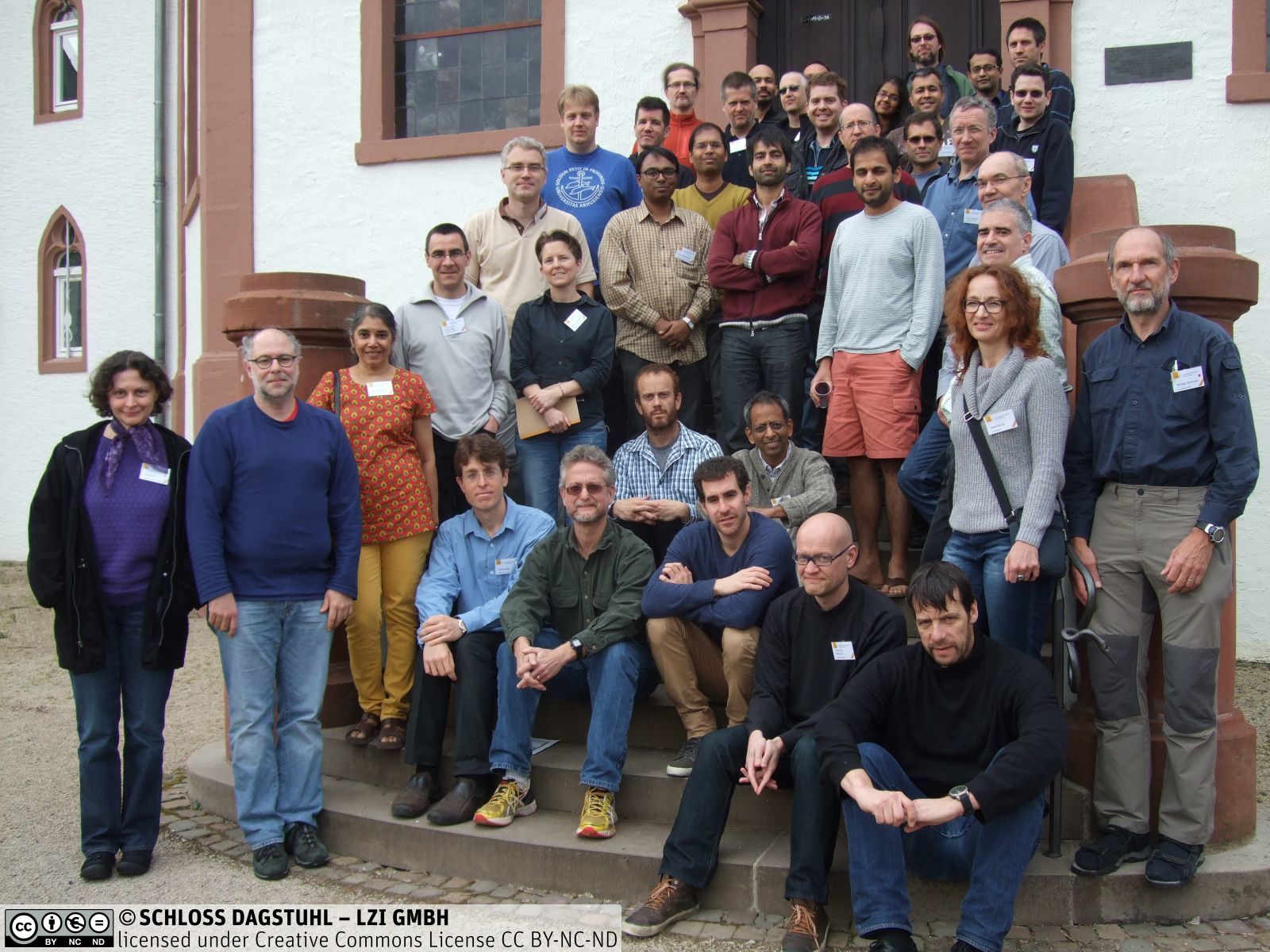
It's spring break at Georgia Tech and time to head to Germany for the Dagstuhl Seminar Computational Complexity of Discrete Problems. Lots of discussion on algebraic circuits, interactive coding, information complexity, pseudorandomness and much more.

This is a break for me, the ability to focus on complexity and research instead of hiring and administration. But even here, in rural Germany, one cannot completely escape the Internet and life back home.

Back in the states I'm hearing of the difficulty for theory students to find postdoc positions. Here I'm hearing of the difficulty of well-funded theory faculty in Europe finding postdocs. Not so bad to spend time on this side of the pond. Some of the positions are listed in the comments of the fall jobs post

Want to organize your own Dagstuhl workshop? Proposals due by April 15. The Dagstuhl staff do an excellent job with most of the organizing, basically you just need to choose participants and talks.

The Dagstuhl library puts out the books authored by conference attendees and ask that authors sign those books. As this is the first Dagstuhl since The Golden Ticket appeared, I carried on the tradition.


Tuesday, March 18, 2014

Leslie Lamport wins Turing Award!

Leslie Lamport wins Turing Award!
See here for more details.

Leslie did work on reliability of systems and security that
(according to the article) is ACTUALLY BEING USED. So Real People
use his stuff.

He also developed LaTeX (building on TeX) which we all know and most
of us use. Academics use LaTeX but I honestly don't know how wide spread
it is outside of academia. However, this could be the first time that a Turing award winner did something that I used DIRECTLY (I am sure I use RSA and other things indirectly).

How well known is The Turing Award? its called `the nobel prize of computer science' but I think its far less well known than the Nobel Prize.

The Fields Medal and he Mill Prize got a big publicity boost when Perelman turned them down. But that only got them 15 minutes of fame, including a Stephen Colbert segment `whose not honoring me now'. So I will not be urging Leslie Lamport to turn  down his Turing Award in order to give it more fame.

CONGRATULATIONS!

Thursday, March 13, 2014

Cosmos from Generation to Generation

During high school, well before the world-wide web with its bloggers and YouTube, out came a series Cosmos that I watched religiously. Back then you had to watch a show when it was aired and no skipping of commercials, though Cosmos was a PBS (public-broadcasting) show so it didn't have any. Cosmos was hosted by the late great Carl Sagan. While I don't remember the contents of the show so much, I do remember being quite inspired by it and the show surely played a role in my future life as a scientist.

I went to Cornell as an undergrad just a year after Cosmos' broadcast. Carl Sagan was a legend on campus, though I saw him just once, in a debate over Ronald Reagan's Star Wars plan. Sagan did have an amazing house looking out over the Ithaca gorge that you could see from the suspension bridge I crossed every day.

Now my younger daughter is in high school and Neil deGrasse Tyson takes on the difficult task of updating Cosmos for this new generation. Molly and I watched the first episode last night. (I'm still blown away we can watch when we want and skip the commercials.) It really brought back memories of the original show and I was really touched when Tyson talked about meeting Sagan as a high school student.

Tyson is giving a talk at Georgia Tech next month. Tickets went on sale yesterday and sold out within hours. Incredible to see the return of the scientific superstar.

Monday, March 10, 2014

Why do we think P NE NP? (inspired by Scott's post)

Recently  Scott Posted an excellent essay on reasons to think that P NE NP.  This inspired me to post on the same topic. Inspired is probably the right word. Some of my post is  copied and some of my post   are my thoughts. A good test: if its intelligent and well thought out then its probably from Scott.

Why do scientists believe any particular theory?  I state three reasons, though there are likely more:
(1) By doing Popperian experiments- experiments that really can fail. Their failure to fail helps to confirm the theory. This is common in Physics, though gets harder when the particles get smaller and string-like. (2) Great Explanatory power. Evolution is the main example here--- it's hard to do real experiments but one can look at the data that is already out there and find a theory that explains it all. (3) (Kuhn-light) It fits into the paradigm that scientists already have. This comes dangerously close to group think; however, if most of the people who have looked at problem X think Y, that should carry some weight.

Can we do Popperian experiments for P vs NP? For that matter can we do Popperian experiments in Mathematics? Goldbach's conjecture and the Riemann Hypothesis seem to have good empirical evidence. Though that kind of reasoning gets me nervous because of the following true story: Let li(x) = int_0^x dt/ln t.
Let pi(x) be the number of primes \le x. It is known that li(x) and pi(x) are VERY CLOSE. Empirical evidence suggested that li(x)  \le  pi(x) and this was conjectured. Skewes proved that there was an x  for which li(x) \ge  pi(x). His bound on x, the the Skewes' number ,was quite large, at one time the largest number to appear in a math paper (that record now belongs to  Graham's Number). Then Littlewood, Skewes's advisor, showed that the sign of li(x)-pi(x) changes infinitely often. So the empirical evidence was not indicative.

There might also be empirical tests you can do for continuous math, especially if its related to physics so you can do physics experiments.

Have there been Popperian experiments to try to verify P NE NP? I am not quite sure what that means, but I do not think there have been (if I'm wrong please comment politely).

So we move on to Great Explanatory Power. Are there many different empirical facts out there for which P NE NP would explain them and give a unifying reason? Does a bear... Well, never mind, the answer is YES! I give one  examples (from Scott's post) and two more. But note that there are MANY MANY MORE.

  1. Set Cover problem: Given S_1,....S_m \subseteq {1,...,n} find the size of the smallest subset of S_1,...,S_m that covers the union of S_1,...,S_m. Chvatal showed in 1979 that one can find, i poly time, a subset of S_1,...,S_m that is (ln n)+OPT. Okay, great, an approximation. EMPIRICAL FACT: people seemed unable to improve on this at all. In 2013 Dana Moshkovitz proved  that, assuming P\ne NP, this bound CANNOT be broken. Note that the algorithm of Chvatal and the lower bound of Moshkovitz have nothing to do with each other.
  2. Vertex cover: given a graph find the smallest set of vertices so that every edge has   one of them as an endpoint. There is an algorthm that gives 2OPT. There is one that does ever so slightly better: (2-(1/sqrt(log V))OPT.  In 2005 Dinur and Safra proved that, assuming P NE NP, there is no 1.36*OPT approximation. This does not match exactly but it still explains the lack of progress somewhat (more on this later when I discuss UQC).
  3. Max 3-SAT: given a 3-CNF formula find an assignment that maximizes the number of clauses satisfied.  Karloff and Zwick proved that there is an algorithm that finds an assignment satisfying (7/8)*OPT. Hastad proved that, assuming P NE NP, (7/8)*OPT is the best you can do.
A bit more prosaic: P NE NP explains why people have had a hard time solving THOUSANDS OF PROBLEMS. I am most impressed with HAM CYCLE since mathematicians had been working on that one for quite some time--- trying to get a similar char to that of EULER circuit.

So in summary, I find that P NE NP has GREAT explanatory power. That makes it a very compelling conjecture. Let us apply this test to other conjectures.

  1. Sigma_2 \ne Pi_2. Does this assumption explain anything? Our inability to find a circuit for SAT. I dont know what else it implies. Same for Sigma_i vs Pi_i. This might qualify as mini-kuhnian: Sigma_2\ne Pi_2 fits into how we view the world.
  2. P=BPP.  Almost every problem in BPP ended up falling into P over time. P=BPP would explain this. Also Nisan-Wigderson and its extensions make P=BPP fit into our world view.
  3. Unique Game Conjecture. This explains many upper and lower bounds that match, though nowhere near that of P NE NP. One of them is the constant 2 for VC. Even so, I find that compelling. (One of Scott's commenters said that all of the lower bounds from UGC are actually unified some how, so its not quite as compelling.)
  4. Factoring not in P. No real explanatory power here except that we seem to have a hard time finding an algorithm for Factoring. 
  5. Graph Isom not in P. Similar to Factoring not in P.
So, what are our reasons to think Sigma_2 \ne Pi_2?

Lastly, mini-Kuhnian. What do people in the field think? The polls on P vs NP that I conducted in 2002  and 2012 (see here)  indicate that believe that P NE NP is growing- roughly 60% in 2002, roughly 80% in 2012. Some of the commentators on Scott's blog took that 20% of P=NP people to be relevant.
And indeed some of the P=NP people are both serious theorists and also not Dick Lipton (who seems to be who  Lubos Motl points to) as a serious theorist who thinks P=NP).(ADDED LATER- SOME COMMENTERS HAVE INFORMED ME THAT LIPTON IS JUST OPEN TO THE POSS THAT P=NP. ) But some of those people emailed me that this was a protest vote, protesting the fields certainty that P=NP. I also note that three of them compared it to their voting or Ralph Nader in 2000, only with less drastic consequences.

I personally don't take `what people think' that seriously, but because of my polls we actually know what people think, so I put it out there.


Thursday, March 06, 2014

Favorite Theorems: Unique Games

Michel Goemans and David Williamson made a splash in the 90's using semidefinite programming to give a new approximation algorithm for the max-cut problem, a ratio of 2θ/(π(1-cos(θ)) minimized over θ between 0 and π, approximately 0.87856. Hard to believe that this ratio is tight, but it is assuming the unique games conjecture.
The first paper showed that the Goemans-Williamson bound was tight assuming the unique games conjecture and a "majority is stablest conjecture", the last says very roughly that the most robust election scheme is a simple majority. The second paper, which followed soon thereafter, proved an invariance property that implies, among other things, that indeed majority is stablest.

Khot and Oded Regev show that under the unique games conjecture that essentially the best algorithm for approximating vertex cover is to take all the vertices involved in a maximal matching.

Prasad Raghavendra gives a simple semidefinite programming approximation algorithm for any constraint satisfaction problem which is optimal under the UGC.

Sanjeev Arora, Boaz Barak and David Steurer describe an algorithm that given a unique game where 1-δ fraction of the edges can be satisfied, you can in time 2npoly(δ) find a coloring that satisfies a constant fraction of edges. This may or may not give evidence against the UGC.

Luca Trevisan has a nice recent survey on the unique games conjecture, covering much of the above and more, including beautiful connections between unique games and semidefinite programming.

Tuesday, March 04, 2014

Why are there so few intemediary problems in Complexity? In Computability?


There are thousands of natural PC problems. Assuming P NE NP how many natural problems are there that are
in NP-P but are NOT NPC? Some candidates are Factoring, Discrete Log, Graph Isom, some in group theory, and any natural sparse set. See
here for some more.

A student asked me WHY there are so few natural intermediary problems. I don't know but here are some
options:

  1. Bill you moron, there are MANY such problems. You didn't mention THESE problems (Followed by a list of problems
    that few people have heard of but seem to be intermediary.)
  2. This is a question of Philosophy and hence not interesting.
  3. This is a question of Philosophy and hence very interesting.
  4. That's just the way it goes.
  5. By Murphy's law there will be many problems that we can't solve quickly.

At least in complexity theory there are SOME candidates for intermediary sets.
In computability theory, where we know Sigma_1 \ne \Sigma_0, there are no
candidates for natural problems that are c.e., not decidable, but not complete. There have been some attempts to show that there can't be any
such sets, but its hard to define ``natural'' rigorously. (There ARE sets that are c.e., not dec, not complete, but they are
constructed for the sole purpose of being there. My darling would call them `dumb ass' sets,
a terminology that my class now uses as well.)

A long time ago an AI student was working on classifying various problems in planning. There was one that was c.e. and not decidable
and he was unable to show it was complete. He asked me to help him prove it was not complete. I told him, without looking at it,
that it was COMPLETE!!!!!!!!! My confidence inspired him to prove it was complete.

So, aside from the answers above, is there a MATH reason why there are so few
intermediary problems in Complexity, and NONE in computability theory?
Is there some other kind of reason?

Thursday, February 27, 2014

Why Become a Professor

Someone took me to task because in November I posted that the CRA News had 50 pages of job ads but didn't note that very few of those ads specifically were searching for CS theory faculty. Yes, it is true that theory is not as high on the search agenda as big data and other applied areas, but many of these schools will hire theorists after they fail to find qualified applicants in the other areas. My advice is to apply widely and it's not too late to do so, as many CS departments are just starting their interview process.

Why is it so hard for universities to hire in applied CS? Because you are not just competing against other universities, you are competing against industrial labs. Besides the usual arguments of typically hire base salary and no required teaching or grants, a place like Facebook or Google can give you access to data that you just can't get a university and your research will have a real-world impact faster than basic academic research.

So why be a professor? Money isn't as big an issue as you expect, professors can consult, own significant portions of their IP (depending on the school) and can start companies. Teaching is time-consuming but extremely rewarding. To me there are two aspects that make being a professor the best job in the world.

  • Freedom to set your own research agenda: Very few labs these days give you the freedom to choose your own research topics and even fewer will reward you for that. In academics we expect you to develop your own research areas and succeed in them. 
  • Working with students: The relationship between advisor and advisee is not unlike a parent and child. And there's no better feeling than watching them succeed. You can often get summer interns and postdocs in industry but it just isn't the same.

Sunday, February 23, 2014

When is a paper public? When is anything public?

A while back I had a paper in an intermediary stage. The version posted to my Ramsey Theory Course Website was not final. Is the paper public? I didn't think about it much but I didn't intend it to be since it was not done yet. But Adam Sheffer's Google Scholar (more on that later) didn't know that. So his Google Scholar program found the paper and he blogged about it here.

This was FINE- my co-author David Conlon posted a comment on the blog that a revised version was coming, and I asked Adam to modify the blog to say so as well. Plus, I am DELIGHTED and SURPRISED when someone noticed my work.
When the final version came out Adam DID report about it here.
But it raises the question- when is a paper public? Some related thoughts
  1. (Kudos to Adam for pointing me to this one). I had heard the ABC conjecture might be solved. What I didn't quite know is that the author posted the papers on HIS OWN website, not on arXiv. Did he intend for it to go public? I do not know- but it is NOW public. If its not correct he can always say well, I didn't tell you it was ready for
    prime time yet
    .
  2. A while back a student pointed me to a website with a paper that claimed to show GI is in P. The author DID NOT post it to arXiv (this may have been before there was an arXiv) nor did he email GI experts across the planet to look at it. So is it public? Is it my job to debunk it? It would be a bit odd to tell someone who didn't ask my opinion that YOUR PROOF IS WRONG! The student was hoping it was TRUE so he wouldn't have to learn the proof that if GI is NPC then PH collapses. I ended up telling the student that its surely wrong else since if GI was in P then I would known it--- not a really rigorous proof, but it sufficed. See here for more on this non-rigorous proof technique.
  3. I have read stories of people who post personal things on FaceBook (a common one is that they are gay) and then are shocked, shocked, when their parents find out.
  4. There's a nice song about a related issue: My Mom's on Facebook.
  5. On the TV show West Wing there was a segment where someone thought a story was just regional and hence would not affect her confirmation hearing. She had to be told NO- there is no such thing as a story that is just regional. Journalists and others can FIND STUFF if it is out there.
  6. Similarly to the last item: I can't post a paper just for my class because Google Scholar will find it (I DO NOT EVER require a password for a course website, I don't want to hassle the students and I am happy if somone else wants to see what I am teaching. Note also that this blog is NOT complaining that Adam found my paper). I (cordially) emailed Adam Sheffer inquiring how Google Scholar found me. For my fellow Luddites I reprint his answer (hmmm, I don't know if he meant his email to be public.)
    Regarding how Google Scholar works: The system constantly scans the web for new papers. It knows the papers which I have coauthored (it finds them while searching the web and asks me to verify that they are indeed mine). Then, in future scans, if it stumbles upon a paper that might be relevant to me - it sends me and update about it. I am not sure what exactly are the criteria that it uses, but it seems to be papers by my coauthors and papers on similar topics (perhaps papers that have common references with my papers?).
    Sound like when TIVO tried to guess what shows you liked- it could be right but it could be far off. I know of liberals who watched FOX news a lot to gain insight into what people they disagree with thought, and then their TIVO thought were Tea Partiers. Then TIVO thought they liked Tea.
  7. I gave Adam kindly blogger-to-blogger advice: DO NOT let this be a cautionary tale. Do not ask permission to post about a PAPER --- just do it. I've done it here when blogging about Galois games and here when blogging about how much trig should a governor know. If you post on something a bit more personal (e.g., here) then maybe you should get permission (one of the people gave permission, the other never responded).

So what to make of all this? We are in a time of transition and some people
may end up revealing more than they intended. The next generation may learn;
however, we seem to always be in a time of transition.
"p.html" 31L, 4785C written

Wednesday, February 19, 2014

Analog Adventures

I was 11 forty years ago when Dungeons and Dragons first appeared and by high school many of my friends spent far too many hours embarking on those fantasy adventures. I didn't play much myself only joining a few campaigns for a short period of time. Nevertheless the game hit its mark, giving escapism to our inner nerdoms.

I just finished a new book on D&D Of Dice and Men by David Ewalt. Ewalt tells three interlocking stories: The history of D&D, Ewalt's personal journey into the game, and some campaigns he's embarked on from the characters' point of view.  Gary Gygax and Dave Arneson originally created the game but Dave soon left the company and was written out of the books. Gary mismanaged the company which has bounced around from various owners every since. I hadn't really kept up with D&D after college and I'm surprised that it has so many incompatible versions (reminds me of LaTeX and Python). A fifth version of D&D to unite them all is due for release this summer.

My daughter's school just put on a production of She Kills Monsters, a play about a woman who discovers her late sister through the sister's D&D adventures. My daughter played an evil cheerleader and her line "We're way too powerful for you" reminded us both of her classic role as NP.

These days we have immersive rich interactive games on our Play Stations and smart phones but still there is still nothing like gathering around a table transformed into a tavern as we meet our fellow adventurers and embark on the next quest.

Monday, February 17, 2014

Maryland looking for a Lecturer/Who teachers your intro courses?

My chairman, Samir Khuller, asked me to post our job posting for a lecturer to my blog, so I and doing it right now. I think he overestimates the power of this blog.

At Univ of MD at College Park lecturers teach most sections of our intro sequence (CS1, CS2, CS3, Discrete Math). They might sometimes do a higher level course if the need arises. They are there to mostly teach and advise students, not do research, though some do and that's certainly fine. Some have PhD's and some don't.  Note that this is a full time job--- these are not adjuncts or rent-a-profs. They are part of the department.

Is having lecturers teach the intro courses  a good idea? Overall YES; however, I would like to have professors teaching those courses once in a while, or be involved once in a while, as they may have a good idea to share with the lecturer (then again, they might  not).  Having said that, you don't see me volunteering for CS1, CS2, or CS3 (My policy: I never teach a course where I would get a B if I took it. One exception- I did once teach Graduate Algorithms and got in a bit over my head.) I do teach Discrete Math once in a while. I also like to proofread the midterm and final of whoever is teaching it. I'm NOT that good a proofreader, but I like to know what they are up to and it gives me an excuse to talk to them about the course and make sure it doesn't drift to much. I would like to think I have a good rapport with the lecturers.

Does having a PhD in CS and being a professor give one some insights on what should be in CS1,2,3 and how to teach it? I honestly don't know. My first semester at Univ of MD (1985) we were teaching program verification in CS1. I knew immediately it was a bad idea and eventually (without any input from me) the dept stopped doing that. This is a case where being a researcher may be a negative with regard to education.

I would like to think that my working in theory helps me teach Discrete Math.  It does as a source of some problems (e.g, if a paper says `by an easy induction...' that can be a problem set) but one should not get to carried away and go over their heads.


Wednesday, February 12, 2014

IEEE and the Conference on Computational Complexity

Dieter van Melkebeek, current conference chair of the IEEE Conference on Computational Complexity has set up a forum to discuss the future affiliation of the conference. Read over the manifesto and update. You can give general comments on the about post. Dieter discusses three options:

  1. Remain with IEEE
  2. Have a joint ACM/IEEE conference in some fashion.
  3. Become an unaffiliated conference.
For most of you this shouldn't matter at all. Most of you readers have never attended the complexity conference (though you ought to give it a try sometime) and those that do would probably continue attending no matter who sponsors the meeting.

There has been a go-it-yourself tendency in this field so as not to pay any organization fees and to publish papers in an open-access format. Just realize this approach has some potential downfalls.
  • Without a sponsor, the conference and in particular the organizing committee, is fully responsible for any deficit. One bad hotel contract can sink a conference. To guard against this, you'll need to budget a surplus far larger than IEEE or ACM would require. Also IEEE and ACM can use their influence to get better deals such as on hotels. 
  • You'll need considerably more volunteer time from faculty to handle the larger administrative load. This time doesn't show up in the financial calculation but it is a real expense.
  • Having a sponsoring organization gives a set of checks and balances to guarantee that the conference retains a consistent mission and be fiscally responsible. If a conference is solo and the organizing committee drops the ball, the conference just disappears. 
I'm not recommendation here, just trying to point out some pitfalls that usually don't get discussed. I'll stay out of the actual debate on the future sponsorship of CCC and leave that to the younger generation.

Sunday, February 09, 2014

Superbowl underdogs and overdogs

(Stephen Colbert tells me that NFL guards their copyright of the name of the game they played on Sunday, which is why stores say they have a `big game sale on beer'. I will get around this the same way he does. I hope he doesn't sue.)

In Superb owl XLVIII (48) (one of the few uses of Roman Numerals left) Denver was the favorite but got beaten. This is not so unusual and they were not a favorite by much-just 2.5 points. But they lost 43-8. That sounds unusual--- for the favorite to get completely whomped (spellcheck thinks that's not a word, but spellcheck doesn't even think spellcheck is a word).

So- how uncommon is it for the favorite to get whomped? We would need a rigorous definition of whomped. I'll say two touchdowns, or 14 points. A list of all of the superb owl games and what the spread was and what happened is here. I summarize:

  1. The underdog WON 15 times. The most surprising was probably when the NY Jets were an 18-point underdog to the Baltimore Colts  in Supeb owl III in 1969 and won 16-7. Good thing they won since Joe Namath (the NY Jets QB) guaranteed  victory.
  2. In 2010, Superb owl 44,  Indianapolis was a 5 points favorite over the New Orleans Saints but the Saints whomped  31-17.
  3. In 2003, Superb owl 37,  Tampa Bay was a 4 point underdog to Oakland. Tampa Bay whomped by winning 48-21.'
  4. In 1988, Supeb owl 22, Washington was a 3 point underdog to Denver, but Washington whomped 42-10.
  5. In 1984, Superb owl 18, LA was a 3-point underdog to Washington, but LA whomped 38-9.
  6. In 1981, Superb owl 15, Oakland was a 3 point underdog to Philadelphia, but Oakland Whomped 27-10.
  7. In 1970, Superb owl 4, Kansas City was a 12 point underdog to Minnesoda, but whomped 23-7.  The reason they were an underdog is that people still though the AFC to be the lesser league and didn't remember that in Superb Owl 3 the AFC won (though didn't whomp).
So the underdog has whomped 5 times. That is FAR MORE than I would have thought. Does this show that underdogs are undervalued? Not sure since if an underdog wins it doesn't matter by how much for the betting, where as if a favorite wins it matters by how much for the point spread.

This may also call into question if point-spread is the best way to express `this teams is that much better than that team'. One issue (though it was NOT an issue in Superb owl 48) is that if a team is behind
then they may use a high-risk high-reward strategy which, if it fails, they lose my a lot. The phrase one may hear is ``the game was closer than the score''.  Note that for baseball they don't do point spreads, they do odds instead. Should Football follow that? What are the PROS and CONS of points spread vs odds?

The cliche is `I watch the game for the commercials' I actually skip the game and watch the `best of superb owl commercials' that come the week before the game.

Thursday, February 06, 2014

Favorite Theorems: Connecting in Log Space

We start the favorite theorems with a result that might surprise many is still less than ten years old.


Intuitively, this result says you can tell if two points are connected in a complex maze by only having to remember the equivalent of a constant number of locations in the maze. Reingold's algorithm builds an expander graph based on the zig-zag construction in a very clever way that uses very little space to construct and to check that two points connect.

In 1979, Aleliunas, Karp, Lipton, Lovász and Rackoff showed that one can solve s-t connectivity in randomized logarithmic space by taking a random walk on the graph. My last favorite theorem from 2004 talked about derandomizing space algorithms and before Reingold the best algorithm for s-t connectivity required log4/3 space. Indepently of Reingold, Vladimir Trifonov gave a O(log n log log n) space algorithm for s-t connectivity, a victim of bad timing.

One neat implication of Reingold's result is a new and simpler characterization of log-space as the set of problems expressible in first-order logic with ordering and symmetric transitive closure.

After Reingold's result we might have expected solutions to a number of related problems but we didn't see much progress.
  • Can every randomized log-space algorithm be derandomized in log space?
  • Do there exist log-space computable universal traversal sequences? 
  • Can we solve directed s-t connectivity better than Savitch
  • Can we modify Reingold's algorithm to bring log space into NC1?

Monday, February 03, 2014

Contribute to the Martin Gardner Centennial

Dana Richards emailed us about a place to write how Martin Gardner influenced you. You can leave such comments here.  I left a comment there, but I expand it for this blog entry.

When I got interested in mathematics in high school I went to the public library looking for math books (this was before Al Gore invented the internet). I found some books by Martin Gardner and began reading them. They were just right for the level of math I was on at the time. My very first proof that I read on my own (outside of a class) was in those books- the proof that (in the terminology I use now) a graph is Eulerian iff every vertex has even degree.

I  learned about SOMA cubes (I bought a set and did every puzzle in the book in about 2 days.This is the only evidence that as a kid I was good at math). I learned the unexpected hanging paradox which confused me then (and still does). I learned the hercules-hydra game and other games that go on for a LOOOOOOOOOONG time. They are related to things in logic. I also learned about NIM games which I have used as a starting point for several student projects.

There have been some conferences in his honors, the Gathering-for-Gardner. I had the pleasure of reviewing some of the books from it. (My review is here.) These articles show that while his work was recreational this is not a well defined term- some if relates to very important and deep mathematics, and some deep math has arisen from such problems. The books also have articles about Gardner the Magician.

In  the 2000's some of his books were reprinted and I was asked to review them for my SIGACT News book review column.  I took this opp to do a joint review of several math recreational books. What a delight to reread his books and contrast them to those of his successors. And I STILL learned some math that I didn't know from them. (My review is here.)

Shortly before a column appears I always email the authors-of-books, authors-of-reviews, and publishers a first draft of my column. His publisher told me that he didn't use email (he was in his 90's!) so I postal mailed him my review. He read it, corrected some typos, but otherwise was quite happy with the review. He died a few months later. I was happy to have some contact, albeit short, with the man who helped keep me interested in math in high school and beyond.

Wednesday, January 29, 2014

Snow Days

An unexpected snowstorm hits the city in the middle of a workday. The roads get hopelessly clogged and I'm lucky to get home--many others just abandoned their cars, or slept in them. I'm talking about Valentine's Day, February 14, 1990 in Chicago. But the same story hit Atlanta yesterday. One big difference--Georgia Tech is closed today and tomorrow because the city can't handle the ice. The University of Chicago was open on February 15th. 

When these events happen, people wonder about the planning. Was it wise for all schools and businesses to shut down about the same time, early yesterday afternoon? Lots of blame to go around (and having CNN based in Atlanta guarantees coverage) but it is not clear that any plan would have done much better--how do you get millions of people safely home with dangerous roads and a limited public transit system? One of these times you wish P = NP and you can just find the right algorithm. One of the issues is that freak mid-day snowstorms don't happen that often, the last major one in Atlanta was 1982.

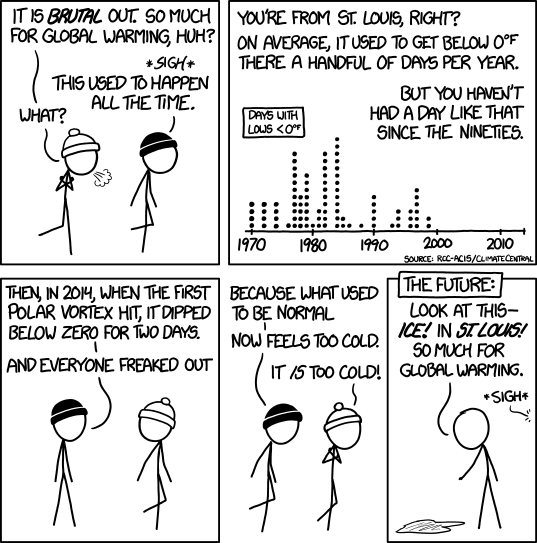
Meanwhile back in Chicago, schools were closed earlier this week, not for snow but for cold. But it was that cold on a regular basis back in the 90's. Global warming has changed expectations, as so brilliantly illustrated in this xkcd


Monday, January 27, 2014

Fermat's Last Theorem and Large Cardinals. Really!


A brilliant math ugrad at UMCP, Doug, is also a creative writer who
wants to work on large cardinals. His creative writing may help him there.
We had the following conversation:

DOUG: The proof of Fermat's last theorem depends on the existence
of certain large cardinals and hence is not in ZFC.

BILL: That is not true.
DOUG: Have you read the proof?
BILL: No, however, if that were true I would know it. See this blog entry.
DOUG: Why would you know it?
BILL: If FLT required LCs then

a) Number theorists would be nervous.
b) Logicians would be ecstatic
c) The math community would not have announced to the world that FLT was solved.
d) Wiles would not have collected his prize money for solving it.
e) Again, I would know it.

DOUG: All compelling arguments. Even so, FLT requires LCs.
BILL: I will bet you five dollars that the current proof of FLT does not depend on LCs.
DOUG: Uh. Your counter arguments are compelling.
BILL: So... no bet?
DOUG: Uh. No.

The next day I got an email from Doug with the subject heading

        I cheated myself out of five dollars.

 Doug found this article, What does it take to prove Fermat's Last Theorem? Grothendieck and the logic of number theory by Colin McLarty, from 2009.The article says that YES the  current proof of FLT DOES depend on LCs. Note that the proof is quite long and uses lots of other stuff that is sort of buried in it. So--- whats the catch?Why aren't number theorists nervous and logicians ecstatic? According to the article anyone who reads the proof of FLT and wanted to could unwind it  and get it down to ZFC (and likely down to PA). But nobody has bothered yet.Hence nobody is nervous or ecstatic.

I will take their word for it, but it does make ME nervous. NOT about FLT which I am sure enough people have looked at (and looked at the background literature) that it really can be made to work in ZFC.I am more worried about papers that are not quite so looked at as having LC assumptions that are hidden from the reader that cannot be easily removed.

However KUDOS to Doug for telling me something in math that I did not know and should have.  I will treat him to a more-than-five-dollar-lunch.

Postscript: AH, the article was right: FLT was proven using ordinary set theory last year. (See here) by Colin McLarty (I assume its the same person). I will still take Doug to lunch- in a stupid, pedantic, technical sense I was right- the current (2014) proof of FLT did not use LC. But for the real issue of there being any problem at all, I was clearly wrong. Only a logician would say I was right. Hmm- Doug is a logician. Its up to him. (Hmm- my spell checker allows `Hmm' but not `Hmmm')

Thursday, January 23, 2014

What will we wrought?

When I went to college in the early 80's, students protested against college endowments invested in companies that had business in apartheid South Africa. My mother worked as a statistician for one of those companies. An interesting dilemma, do I support a policy that hurts the company that is indirectly helping to put me through college?

Now my daughter is in college and worrying that the computing revolution will make it hard to find a job once she graduates and making her consider those job prospects in the major she chooses. And what am I? Chair of a computer science department that helps push that revolution forward.

Computing gets quite a bit of blame these days for the widening income gap between the have and the have nots, and jobs taken over by automation, but without causing a corresponding need for other types of jobs, other than those that serve computation itself. Are those fears real? We can't answer that question yet, positively or negatively. Time will tell.

For now, we just need to do our jobs, making computing better but also understanding and mitigating the negative effects of computing. We need to make sure that computing technology becomes a growing sea that raises all boats, and not just making the world better for the technological elite.

While I stand in awe in how computer science has changed the world, I hope we don't ever end up with CS leaders getting together and saying "What have we wrought?"

Monday, January 20, 2014

We don't care about Ballroom Dancing. Should we?

YOU got into your undergrad school because not only were you good at Math but you were on
the Fencing Team and in the Latin Club (so you could taunt your opponents in Latin: ouyah allcay athay an alestrabay!). Also you had a letter from your principal who never had you for a class but can comment on your leadership since you organized a pep rally for the football team. Why does UNDERGRAD admissions care about these things? Because, while they want good students, they also want to build a community of scholars of different interests and abilities.

YOU apply to grad school in Computer Science. Hey, it worked once maybe it will work again! You write about being in the ballroom dancing club and you have a letter from the Dean, who never had you in a class,
but you worked in his office and he can attest that you are a good leader and a hard worker.

Does the admissions committee care? NO. The only things we care about are CS, MATH, and RESEARCH. A letter from someone not in math or science is worthless. Some exceptions and thoughts:

  1. If you recorded ballroom dancing and made a project out of how to teach it using some interesting new technology this IS good. This is likely an Human-computer-interaction project; however, I would care about this no matter what field you are going into.
  2. If you have an interest in Nat Lang Proc and know Linguistics I would care.  I would think that knowing a foreign language would also be good.
  3. If you are going to go into Human computer Interaction then Psychology helps.
  4. If you are going to do Quantum Computing then Physics is good. However, whatever you do Physics is good as its more evidence of math ability.
  5. For ugrad its been said that if your parents are powerful OR donors you may have an easier time getting into some UGRAD schools. What about Grad school? I've honestly never seen a case of this so I honestly don't know. 

I know a student who is an excellent math major but also a creative writer. I doubt this will help him.
but should it?

I once saw in a students application a letter from his preacher attesting to his fine moral character.
Do we care? should we? How about the other way around- if someone was an EXCELLENT programmer and math person but served 8 years for armed robbery would we care? This might not be fair since perhaps he reformed.

but my real question is- for grad admissions we don't care about Ballroom Dancing or other misc.
Is this a mistake? If someone was NOT as good at math BUT a better writer, should we take them?